Saturday, December 31, 2005 2:20 PM
From an
album cover:

From Feb. 20:
Relativity Blues
and
Hunter Thompson
Commits Suicide


-- Stephen King

-- Hunter S. Thompson
Friday, December 30, 2005 10:10 PM
or:
We are stardust,
We are golden,
continued
1971:
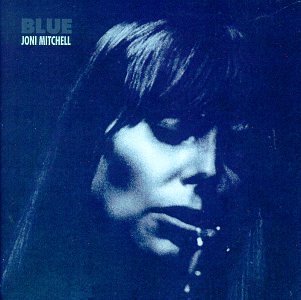
Joni Mitchell, Blue
1994:

Joni Mitchell, Turbulent Indigo
"Some call them
'Emissaries from Heaven,'
others say the 'New Kids'
or even the
'Children of the New Earth.'
They are best known as
the Indigo Children...."
-- Brood Indigo

Children of the Damned (1963)
(Set at
St. Dunstan-in-the-East Church,
London)
Related material:
Shining Through
on
May 19, 2005,
St. Dunstan's Day--

This was the opening date for
the final episode of Star Wars.
Friday, December 30, 2005 1:00 AM
Expression is
an impossible word.
If you want to use it
I think you have to
explain it further...
-- Ad Reinhardt,
Art as Art
"... an equation is a very
abstract expression
of knowledge
about something."
-- The Hidden Side
of Visualization
Well, yes.
For example:

Abstract Expression,
pixels on screen, 12/30/05
The Scope and Limits of Quotation (pdf), in The Philosophy of Donald Davidson, ed. L. E. Hahn, Open Court Publishers, 1999, pp. 691-714, by Dr. Ernest Lepore, Rutgers University: "... an assumption I wish to reject, namely, that in quotation an abstract expression (shape) is denoted.... Since Davidson, however, only says 'we may take [an expression] to be an abstract shape' [1979, p.85, my emphasis], his theory is compatible with expressions being something else. We need only find something that can be instantiated by radically differently shaped objects. Whatever it is must be such that written tokens, spoken tokens, signed tokens, Braille tokens, Semaphore tokens, finger language tokens, and any other way in which words can be produced, can be instantiated by it.... Such entities might  exist; if they do, they might ultimately play some role in the metaphysics of language." My emphasis. exist; if they do, they might ultimately play some role in the metaphysics of language." My emphasis.Reference: Davidson, D., 1979, "Quotation," in Inquiries into Truth and Interpretation, Oxford, Oxford University Press, 1984, pp.79-92. |
For more on zero and other entities,
see Is Nothing Sacred?
For more on Davidson,
see Shema.
Thursday, December 29, 2005 6:29 PM
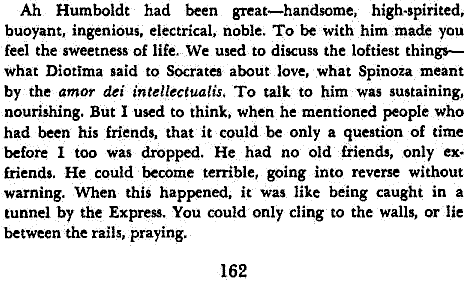
Express
You've got to make him
Express himself
Hey, hey, hey, hey
-- Madonna
Related material on trains:
Davenport's Express
and End of Days.
Related material on 162:
Dogma Part II: Amores Perros,
The Matthias Defense,
The Still Point and the Wheel,
Mark, and Confession.
Related material on
self-expression:
Wishmaster 3:
Beyond the
Gates of Hell,
SciFi channel,
7 PM tonight

"This world is not conclusion;
a sequel stands beyond."
-- Emily Dickinson
Thursday, December 29, 2005 3:31 PM
Parallel Lines
Meet at Infinity
| From Log24, Dec. 16, 2005:  | From today's New York Times, a man who died (like Charlie Chaplin and W. C. Fields) on Christmas Day: 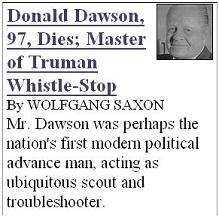 |
From Log24, Dec. 6, 2002,
Santa Versus the Volcano:
Well if you want to ride
you gotta ride it like you find it.
Get your ticket at the station
of the Rock Island Line.
-- Lonnie Donegan
(d. Nov. 3, 2002)
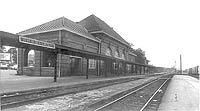
The Rock Island Line's namesake depot
in Rock Island, Illinois
Tuesday, December 27, 2005 12:11 PM
(continued)
The Pennsylvania lottery
on St. Stephen's Day--
Midday: 105
Evening: 064
From a new
branch of theology,
lottery hermeneutics:
See Log24, 1/05,
Death and the Spirit,
and the 64 hexagrams of
the box-style I Ching.
From the Wikipedia
article on hermeneutics:
Monday, December 26, 2005 7:00 PM
Boxing Day
In the box-style I Ching
Hexagram 34,
The Power of the Great,
is represented by
 .
.Art is represented
by a box
(Hexagram 20,
Contemplation, View)
 .
.And of course
great art
is represented by
an X in a box.
(Hexagram 2,
The Receptive)
 .
."... as a Chinese jar still
Moves perpetually
in its stillness"
"... at the still point,
there the dance is."
-- T. S. Eliot
 "They are the same six lines that exist in the I Ching.... Now observe the square more closely: four of the lines are of equal length, the other two are longer.... For this reason symmetry cannot be statically produced and a dance results." -- Marie-Louise von Franz, Number and Time |
For those who prefer
technology to poetry,
there is the Xbox 360.
(Today is day 360 of 2005.)
Monday, December 26, 2005 3:00 PM
Wren Day
"St. Stephen's Day [Dec. 26] is a national holiday in Ireland, but the celebrations have little connection to the Saint."
This day in Ireland is instead devoted to a barbaric ritual, "the hunting of the wren."
Let us therefore recall a more civilized figure-- St. Christopher Wren-- whose feast day is Feb. 25.
From Log24 on that date in 2005:
... Only by the form,
the pattern,
Can words or music reach
The stillness, as
a Chinese jar still
Moves perpetually in its stillness.
Not the stillness of the violin,
while the note lasts,
Not that only, but
the co-existence,
Or say that the end
precedes the beginning,
And the end
and the beginning
were always there
Before the beginning
and after the end.
And all is always now.
Sunday, December 25, 2005 8:00 PM
(continued)
Compare and contrast:


Click on pictures for details.
"... die Schönheit... [ist] die
richtige Übereinstimmung
der Teile miteinander
und mit dem Ganzen."
"Beauty is the proper conformity
of the parts to one another
and to the whole."
-- Werner Heisenberg,
"Die Bedeutung des Schönen
in der exakten Naturwissenschaft,"
address delivered to the
Bavarian Academy of Fine Arts,
Munich, 9 Oct. 1970, reprinted in
Heisenberg's Across the Frontiers,
translated by Peter Heath,
Harper & Row, 1974
Saturday, December 24, 2005 9:00 PM
(continued)

The figures are:
A symbol of Apollo from
Balanchine's Birthday and
A Minature Rosetta Stone,
a symbol of pure reason from
Visible Mathematics and
Analogical Train of Thought,
a symbol of Venus from
Why Me? and
To Graves at the Winter Solstice,
and, finally, a more
down-to-earth symbol,
adapted from a snowflake in

an online Christmas card.
Those who prefer their
theological art on the scary side
may enjoy the
Christian Snowflake
link in the comments on
the "Logos" entry of
Orthodox Easter (May 1), 2005.
Saturday, December 24, 2005 12:00 PM
"Concept (scholastics' verbum mentis)--
theological analogy of Son's procession
as Verbum Patris, 111-12"
-- index to Joyce and Aquinas,
by William T. Noon,
Society of Jesus,
Yale University Press 1957,
second printing 1963, page 162
Then there is
the Daughter's procession:

For the String Theory
Appreciation Club, see
Raoul Bott, 1923-2005.
For another
imaginary club, see
The Club Dumas (below).
For a non-imaginary club,
see the organization
that included Noon (above).
Saturday, December 24, 2005 12:08 AM
-- Foucault's Pendulum
by Umberto Eco,
Professor of Semiotics
The Club Dumasby Arturo Perez-Reverte |
"Only gradually did I discover
what the mandala really is:
'Formation, Transformation,
Eternal Mind's eternal recreation'"
(Faust, Part Two)
-- Carl Gustav Jung
Wednesday, December 21, 2005 4:07 PM
From Fitzgerald's The Diamond as Big as the Ritz:
"Now," said John eagerly, "turn out your pocket and let's see what jewels you brought along. If you made a good selection we three ought to live comfortably all the rest of our lives."
Obediently Kismine put her hand in her pocket and tossed two handfuls of glittering stones before him.
"Not so bad," cried John, enthusiastically. "They aren't very big, but-- Hello!" His expression changed as he held one of them up to the declining sun. "Why, these aren't diamonds! There's something the matter!"
"By golly!" exclaimed Kismine, with a startled look. "What an idiot I am!"
"Why, these are rhinestones!" cried John.
From The Hawkline Monster, by Richard Brautigan:
"What are we going to do now?" Susan Hawkline said, surveying the lake that had once been their house.
Cameron counted the diamonds in his hand. There were thirty-five diamonds and they were all that was left of the Hawkline Monster.
"We'll think of something," Cameron said.
"A disciple of Ezra Pound, he adapts to the short story the
ideogrammatic method of The Cantos, where a grammar of images, emblems,
and symbols replaces that of logical sequence. This grammar allows for
the grafting of particulars into a congeries of implied relation
without subordination. In contrast to postmodernists, Davenport does
not omit causal connection and linear narrative continuity for the sake
of an aleatory play of signification but in order to intimate by
combinational logic kinships and correspondences among eras, ideas and
forces."
-- When Novelists Become Cubists:
The Prose Ideograms of Guy Davenport,
by Andre Furlani
"T.S. Eliot's experiments in ideogrammatic method are equally germane to Davenport, who shares with the poet an avant-garde aesthetic and a conservative temperament. Davenport's text reverberates with echoes of Four Quartets."
"At the still point,
there the dance is."
-- T. S. Eliot, Four Quartets,
quoted in the epigraph to
the chapter on automorphism groups
in Parallelisms of Complete Designs,
by Peter J. Cameron,
published when Cameron was at
Merton College, Oxford.
"As Gatsby closed the door of
'the Merton College Library'
I could have sworn I heard
the owl-eyed man
break into ghostly laughter."
Wednesday, December 21, 2005 1:35 PM
| To Graves at the Winter Solstice "There is one story and one story only That will prove worth your telling.... Dwell on her graciousness, dwell on her smiling, Do not forget what flowers The great boar trampled down in ivy time. Her brow was creamy as the crested wave, Her sea-blue eyes were wild But nothing promised that is not performed. " -- Robert Graves, To Juan at the Winter Solstice   |
Tuesday, December 20, 2005 12:00 AM
"Heaven-- Where Is It?
How Do We Get There?"
To air on ABC
Tuesday, Dec. 20
(John Spencer's birthday)

"And we may see
the meadow in December,
icy white and crystalline."
Monday, December 19, 2005 11:00 PM

"There's a place for us...."
Monday, December 19, 2005 2:00 PM
continued
From last night:
"There is an
underlying timelessness
in the basic conversation
that is mathematics."
-- Barry Mazur (pdf)
"The authors of the etiquette book The Art of Civilized Conversation say that conversation's versatility makes it 'the Swiss Army knife of social skills.'"
the broken beer bottle
school of etiquette:
Monday, December 19, 2005 2:45 AM
underlying timelessness
in the basic conversation
that is mathematics."
-- Barry Mazur (pdf)
It's Quarter to Three
(continued):
but you gotta be
true to your code."
-- Sinatra
Today is the birthday of Helmut Wielandt (Dec. 19,
From MacTutor:
"In his speech accepting membership of the Heidelberg Academy in 1960 he said:-
Permutation groups are still not without interest. See today's updates (Notes [01] and [02]) to Pattern Groups.It is to one of Schur's seminars that I owe the stimulus to work with permutation groups, my first research area. At that time the theory had nearly died out. It had developed last century, but at about the turn of the century had been so completely superseded by the more generally applicable theory of abstract groups that by 1930 even important results were practically forgotten - to my mind unjustly."
Sunday, December 18, 2005 6:00 PM
Steven Spielberg,
director of "1941"--
Sunset for Sydney Leff,
who died at 104
on December 10,
and is said to have drawn
the illustration below.

The sun also rises,
and the sun goes down,
and hurries to its place
where it rises.
-- Ecclesiastes 1:5
From Log24 Sunday a week ago:
a link to Satori at Pearl Harbor
and to

Sunday, December 18, 2005 8:11 AM
The Meadow
"Heaven-- Where Is It?
How Do We Get There?"
To air on ABC
Tuesday, Dec. 20
(John Spencer's birthday)
By Trevanian, who died on
Wednesday, Dec. 14, 2005:
| "Well... the flow of the play was just right, and it began to bring me to the meadow. It always begins with some kind of flowing motion... a stream or river, maybe the wind making waves in a field of ripe rice, the glitter of leaves moving in a breeze, clouds flowing by. And for me, if the structure of the Go stones is flowing classically, that too can bring me to the meadow." "The meadow?" "Yes. That's the place I expand into. It's how I recognize that I am resting." "Is it a real meadow?" "Yes, of course." "A meadow you visited at one time? A place in your memory?" "It's not in my memory. I've never been there when I was diminished." "Diminished?" "You know... when I'm in my body and not resting." "You consider normal life to be a diminished state, then?" "I consider time spent at rest to be normal. Time like this... temporary, and... yes, diminished." "Tell me about the meadow, Nikko." "It is triangular. And it slopes uphill, away from me. The grass is tall. There are no animals. Nothing has ever walked on the grass or eaten it. There are flowers, a breeze... warm. Pale sky. I'm always glad to be the grass again." "You are the grass?" "We are one another. Like the breeze, and the yellow sunlight. We're all... mixed in together." "I see. I see. Your description of the mystic experience resembles others I have read. And this meadow is what the writers call your 'gateway' or 'path.' Do you ever think of it in those terms?" "No." "So. What happens then?" "Nothing. I am at rest. I am everywhere at once. And everything is unimportant and delightful. And then... I begin to diminish. I separate from the sunlight and the meadow, and I contract again back into my bodyself. And the rest is over." Nicholai smiled uncertainly. "I suppose I am not describing it very well, Teacher. It's not... the kind of thing one describes." "No, you describe it very well, Nikko. You have evoked a memory in me that I had almost lost. Once or twice when I was a child... in summer, I think... I experienced brief transports such as you describe. I read once that most people have occasional mystic experiences when they are children, but soon outgrow them. And forget them...." |
"And we may see
the meadow in December,
icy white and crystalline."
Saturday, December 17, 2005 6:02 PM
the Absolute
-- Emily Dickinson
From John Spencer's birthday,
December 20, in 2003:
Riddled:
The Absolutist Faith
of The New York Times
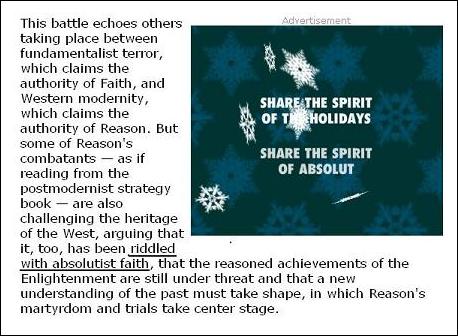
White and Geometric, but not Eternal.
(See previous entry.)
The title of this entry
comes from within
an entry of June 2, 2005,
Saturday, December 17, 2005 3:17 PM
For John Spencer,
who died on December 16:
"He was a kind, sweet, funny man...
a man who made your words come to life
in ways you would never expect."
-- James Mangold, quoted in
today's Los Angeles Times

Related material:
Entries from the date
of Spencer's death
and
White, Geometric, and Eternal
(from Dec. 20, 2003--
Spencer's birthday).
Saturday, December 17, 2005 1:01 PM
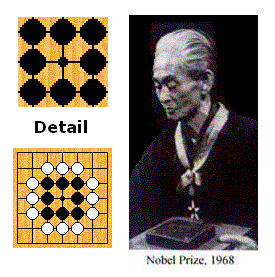
"...that ineffable constellation of talents that makes the player of rank: a gift for conceiving abstract schematic possibilities; a sense of mathematical poetry in the light of which the infinite chaos of probability and permutation is crystallized under the pressure of intense concentration into geometric blossoms; the ruthless focus of force on the subtlest weakness of an opponent."
-- Trevanian,
Shibumi
'Even black has various subtle shades,' Sosuke nodded."
-- Yasunari Kawabata,
The Old Capital
"The Zen disciple sits for long hours silent and motionless, with his eyes closed. Presently he enters a state of impassivity, free from all ideas and all thoughts. He departs from the self and enters the realm of nothingness. This is not the nothingness or the emptiness of the West. It is rather the reverse, a universe of the spirit in which everything communicates freely with everything, transcending bounds, limitless."
-- Yasunari Kawabata,
Nobel lecture, 1968
Friday, December 16, 2005 5:00 PM
A Wintry Friday AfternoonThree years ago today in the New York Times:
"The book was Will Durant's Story of Philosophy, and I was 12 or 13 when I carried it home from the library one wintry Friday afternoon.
I cannot even remember the novel that accompanied it. But I remember that I was curled up on our beat-up old couch, the one with the huge embarrassing rip where my older sister would position me to sit demurely, my dress fanned out over the damage, when her dates arrived. I was reading Durant's section on Plato, struggling to understand his theory of the ideal Forms that lay in inviolable perfection out beyond the phantasmagoria. (That was the first, and I think the last, time that I encountered that word.)
The
Forms are abstract but real, I read, graspable only through the eyes of
the mind, pure reason. And it seemed to me, that dark winter afternoon
as I read, that I was grasping them; that I, a yiddishe maidel of
questionable worth, was seeing with the eyes of my mind exactly what
that ancient Greek philosopher had seen; that just like him I was out
beyond the phantasmagoria, suspended in formal perfection; that I was
out beyond myself, had almost lost all touch with who I even was, and
it was . . . bliss."
-- Rebecca Goldstein
Related material:
Davenport's Express.Update of 6:14 PM EST:
Whistle Stop
For the late John Spencer,
actor on NBC's "West Wing"
-- "When was the last time
you went to a meeting?"
-- "AA?.... What meeting
could I possibly go to?"
-- "Mine."

Friday, December 16, 2005 2:00 PM
A Brief Chronology
In 1946, Robert Graves published "King Jesus, an historical novel based on the theory and Graves' own historical conjecture that Jesus was, in fact, the rightful heir to the Israelite throne... written while he was researching and developing his ideas for The White Goddess."
In 1948, C. S. Lewis finished the first draft of The Lion, The Witch, and The Wardrobe, a novel in which one of the main characters is "the White Witch."
In 1948, Robert Graves published The White Goddess.
In 1949, Robert Graves published Seven Days in New Crete [also titled Watch the North Wind Rise], "a novel about a social distopia in which Goddess worship is (once again?) the dominant religion."
Lewis died on November 22, 1963, the day John F. Kennedy was killed.
Related material:
Log24, December 10, 2005
Graves died on December 7 (Pearl Harbor Day), 1985.
Related material:
Log24, December 7, 2005, and
Log24, December 11, 2005
Jesus died, some say, on April 7 in the year 30 A.D.
Related material:
Art Wars, April 7, 2003:
Geometry and Conceptual Art,
Eight is a Gate, and
Plato's Diamond
-- Motto of
Plato's Academy

bless me, what do they
teach them at these schools?"
the Narnia Chronicles
"How much story do you want?"
-- George Balanchine
Thursday, December 15, 2005 10:00 PM
The Cinematic
Imagination,
or
"Frida" meets
"Under the Volcano"

A scene from "Frida"
and a scene from the
Day of the Dead festival,
Cuernavaca, 10/30/04
Related material:
For the Man in Black
(Log 24, 9/13/03)
and
For a Man in Black
(Log 24, 11/17/05).
Thursday, December 15, 2005 3:48 PM
"Mahlburg likens his approach to an analogous one for deciding whether a dance party has an even or odd number of attendees. Instead of counting all the participants, a quicker method is to see whether everyone has a partner—in effect making groups that are divisible by 2.
In Mahlburg's work, the partition numbers play the role of the dance participants, and the crank splits them not into couples but into groups of a size divisible by the prime number in question. The total number of partitions is, therefore, also divisible by that prime.
Mahlburg's work 'has effectively written the final chapter on Ramanujan congruences,' Ono says.
'Each
step in the story is a work of art,' Dyson says, 'and the story as a
whole is a sequence of episodes of rare beauty, a drama built out of
nothing but numbers and imagination.'"
-- Erica Klarreich in Science News Online, week of June 18, 2005
This
would seem to meet the criteria set by Fritz Leiber for "a story that
works." (See previous entry.) Whether the muse of dance (played in
"Xanadu" by a granddaughter of physicist Max Born-- see recent entries) has a role in the Dyson story is debatable.
| Born Dec. 11, 1882, Breslau, Germany. Died Jan. 5, 1970, Göttingen, |  Max Born |
Those who prefer less abstract stories may enjoy a mythic tale by Robert Graves, Watch the North Wind Rise, or a Christian tale by George MacDonald, At the Back of the North Wind.
Related material:
-- Tao Te Ching
For an image of a particular
incarnation of the mystic woman
(whether as muse, as goddess,
or as the White Witch of Narnia,
I do not know) see Julie Taymor.
"Down in the valley,
valley so low,
hang your head over,
hear the wind blow."
-- Folk song
"Which is the sound of the land
Full of the same wind
That is blowing in
the same bare place
For the listener,
who listens in the snow,
And, nothing himself, beholds
Nothing that is not there
and the nothing that is."
-- Wallace Stevens