From the journal of Steven H. Cullinane...
2005 August 1-15
Saturday, August 13, 2005
2:00 PM
Kaleidoscope, continued:
Austere Geometry
From Noel Gray, The Kaleidoscope: Shake, Rattle, and Roll:
"... what we will be considering is how the ongoing production of
meaning can generate a tremor in the stability of the initial
theoretical frame of this instrument; a frame informed by geometry's
long tradition of privileging the conceptual ground over and above its
visual manifestation. And to consider also how the possibility of a
seemingly unproblematic correspondence between the ground and its
extrapolation, between geometric theory and its applied images, is
intimately dependent upon the control of the truth status ascribed to
the image by the generative theory. This status in traditional
geometry has been consistently understood as that of the graphic
ancilla-- a maieutic force, in the Socratic sense of that term-- an
ancilla to lawful principles; principles that have, traditionally
speaking, their primary expression in the purity of geometric
idealities.* It follows that the possibility of installing a tremor in
this tradition by understanding the kaleidoscope's images as announcing
more than the mere subordination to geometry's theory-- yet an
announcement that is still in a sense able to leave in place this
self-same tradition-- such a possibility must duly excite our attention
and interest.
* I refer here to Plato's utilisation in the
Meno of graphic austerity as the tool to bring to the surface,
literally and figuratively, the inherent presence of geometry in the
mind of the slave."
See also
Noel Gray, Ph.D. thesis, U. of Sydney, Dept. of Art History and Theory, 1994:
"The Image of Geometry: Persistence qua Austerity-- Cacography and The Truth to Space."
Saturday, August 13, 2005
12:04 PM
Kaleidoscope, continued:
In Derrida's Defense
The previous entry quoted an attack on Jacques Derrida for ignoring the
"kaleidoscope" metaphor of Claude Levi-Strauss. Here is a quote by
Derrida himself:
"The time for
reflection is also the chance for turning back on the very conditions
of reflection, in all the senses of that word, as if with the help of
an optical device one could finally see sight, could not only view the
natural landscape, the city, the bridge and the abyss, but could view
viewing. (1983:19)
-- Derrida, J. (1983) ‘The Principle of Reason: The University in the Eyes of its Pupils’, Diacritics 13.3: 3-20."
The above quotation comes from Simon Wortham, who thinks the "optical device" of Derrida is a mirror. The same quotation appears in Desiring Dualisms at thispublicaddress.com, where the "optical device" is interpreted as a kaleidoscope.
Derrida's "optical device" may (for university pupils desperately seeking an essay topic) be compared with Joyce's "collideorscape." For a different connection with Derrida, see The 'Collideorscape' as Différance.
Thursday, August 11, 2005
8:16 AM
Kaleidoscope, continued
From Clifford Geertz, The Cerebral Savage:
"Savage
logic works like a kaleidoscope whose chips can fall into a variety of
patterns while remaining unchanged in quantity, form, or color. The
number of patterns producible in this way may be large if the chips are
numerous and varied enough, but it is not infinite. The patterns
consist in the disposition of the chips vis-a-vis one another (that is,
they are a function of the relationships among the chips rather than
their individual properties considered separately). And their range of
possible transformations is strictly determined by the construction of
the kaleidoscope, the inner law which governs its operation. And so it
is too with savage thought. Both anecdotal and geometric, it builds
coherent structures out of 'the odds and ends left over from
psychological or historical process.'
These
odds and ends, the chips of the kaleidoscope, are images drawn from
myth, ritual, magic, and empirical lore.... as in a kaleidoscope, one
always sees the chips distributed in some pattern, however
ill-formed or irregular. But, as in a kaleidoscope, they are
detachable from these structures and arrangeable into different ones of
a similar sort.... Levi-Strauss generalizes this permutational view of
thinking to savage thought in general. It is all a matter of shuffling
discrete (and concrete) images--totem animals, sacred colors, wind
directions, sun deities, or whatever--so as to produce symbolic
structures capable of formulating and communicating objective (which is
not to say accurate) analyses of the social and physical worlds.
.... And the point is general. The relationship between a symbolic structure and its referent, the basis of its meaning,
is fundamentally 'logical,' a coincidence of form-- not affective, not
historical, not functional. Savage thought is frozen reason and
anthropology is, like music and mathematics, 'one of the few true
vocations.'
Or like linguistics."
Edward Sapir on Linguistics, Mathematics, and Music:
"...
linguistics has also that profoundly serene and satisfying quality
which inheres in mathematics and in music and which may be described as
the creation out of simple elements of a self-contained universe of
forms. Linguistics has neither the sweep nor the instrumental power of
mathematics, nor has it the universal aesthetic appeal of music. But
under its crabbed, technical, appearance there lies hidden the same
classical spirit, the same freedom in restraint, which animates
mathematics and music at their purest."
-Edward Sapir, "The Grammarian and his Language,"
American Mercury 1:149-155,1924
From Robert de Marrais, Canonical Collage-oscopes:
"...underwriting
the form languages of ever more domains of mathematics is a set of deep
patterns which not only offer access to a kind of ideality that Plato
claimed to see the universe as created with in the Timaeus;
more than this, the realm of Platonic forms is itself subsumed in this
new set of design elements-- and their most general instances are not
the regular solids, but crystallographic reflection groups. You know,
those things the non-professionals call . . . kaleidoscopes! * (In the next exciting episode, we'll see how Derrida claims mathematics is the key to freeing us from 'logocentrism' **-- then ask him why, then, he jettisoned the deepest structures of mathematical patterning just to make his name...)
* H. S. M. Coxeter, Regular Polytopes (New York: Dover, 1973) is the great classic text by a great creative force in this beautiful area of geometry (A polytope is an n-dimensional analog of a polygon or polyhedron. Chapter V of this book is entitled 'The Kaleidoscope'....)
**
... contemporary with the Johns Hopkins hatchet job that won him
American marketshare, Derrida was also being subjected to a series of
probing interviews in Paris by the hometown crowd. He first gained
academic notoriety in France for his book-length reading of Husserl's
two-dozen-page essay on 'The Origin of Geometry.' The interviews were
collected under the rubric of Positions (Chicago: U. of Chicago
Press, 1981...). On pp. 34-5 he says the following: 'the resistance to
logico-mathematical notation has always been the signature of
logocentrism and phonologism in the event to which they have dominated
metaphysics and the classical semiological and linguistic projects....
A grammatology that would break with this system of presuppositions,
then, must in effect liberate the mathematization of language.... The
effective progress of mathematical notation thus goes along with the
deconstruction of metaphysics, with the profound renewal of mathematics
itself, and the concept of science for which mathematics has always
been the model.' Nice campaign speech, Jacques; but as we'll see, you
reneged on your promise not just with the kaleidoscope (and we'll
investigate, in depth, the many layers of contradiction and
cluelessness you put on display in that disingenuous 'playing to the
house'); no, we'll see how, at numerous other critical junctures, you
instinctively took the wrong fork in the road whenever mathematical
issues arose... henceforth, monsieur, as Joe Louis once said, 'You can
run, but you just can't hide.'...."
Tuesday, August 9, 2005
5:01 PM
Kaleidoscope
A new web page simplifies the Diamond 16 Puzzle and relates the resulting "kaleidoscope" to Hesse's Bead Game.
Sunday, August 7, 2005
12:12 PM
Religious Symbolism
at Harvard
Sunday, August 7, 2005
7:20 AM
Presbyterian Justice
News from today's New York Times:
The Rev. Dr. Theodore Alexander Gill Sr., a Presbyterian theologian, a
philosophy teacher, and an influential provost emeritus of John Jay
College of Criminal Justice in Manhattan, died at 85 on June 10 in
Princeton. In retirement from John Jay, The Rev. Dr. Gill was
theologian in residence at Nassau Presbyterian Church in Princeton.
In memory of The Rev. Dr. Gill:
Religious Symbolism at Princeton
(on Nassau Presbyterian Church),
Pro-Semitism
(on number theory at Princeton),
For the Mad Musicians of Princeton,
(on Schroeder and Bernstein),
Movie Date and its preceding entries
(on Princeton's St. John von Neumann),
Why Me?
(for Princeton theologian Elaine Pagels),
Notes on Literary and Philosophical Puzzles
(Princeton's John Nash as Ya Ya Fontana), and
Go Tigers!
(for the Princeton Evangelical Fellowship).
For a more conventional memorial, see

the obituary from
San Francisco Theological Seminary.
Saturday, August 6, 2005
1:25 PM
The Fugue
"True joy is a profound remembering, and true grief is the same.
Thus it was, when the dust storm that had snatched Cal up finally
died, and he opened his eyes to see the Fugue spread out before him, he
felt as though the few fragile moments of epiphany he'd tasted in his
twenty-six years-- tasted but always lost-- were here redeemed and wed.
He'd grasped fragments of this delight before. Heard rumour of it in
the womb-dream and the dream of love; known it in lullabies. But never,
until now, the whole, the thing entire.
It would be, he idly thought, a fine time to die.
And a finer time still to live, with so much laid out before him."
From Monday:
Weaveworld,
Book Three:
Out of the
Empty Quarter
"The wheels of its body rolled,
the visible mathematics
of its essence turning on itself...."
Saturday, August 6, 2005
9:00 AM
For André Weil on
the seventh anniversary
of his death:
A Miniature
Rosetta Stone

In a 1940 letter to his sister Simone, André Weil discussed a sort of "Rosetta stone," or trilingual text of three analogous parts: classical analysis on the complex field, algebraic geometry over finite fields, and the theory of number fields.
John Baez discussed (Sept. 6, 2003) the analogies of Weil, and he himself furnished another such Rosetta stone on a much smaller scale:
"... a 24-element group called the 'binary tetrahedral group,' a
24-element group called 'SL(2,Z/3),' and the vertices of a regular
polytope in 4 dimensions called the '24-cell.' The most important fact
is that these are all the same thing!"
For further details, see Wikipedia on the 24-cell, on special linear groups, and on Hurwitz quaternions,
The group SL(2,Z/3), also known as "SL(2,3)," is of course derived from
the general linear group GL(2,3). For the relationship of this group
to the quaternions, see the Log24 entry for August 4 (the birthdate of the discoverer of quaternions, Sir William Rowan Hamilton).
The 3x3 square shown above may, as my August 4 entry indicates, be used to picture the quaternions and, more generally, the 48-element group GL(2,3). It may therefore be regarded as the structure underlying the miniature Rosetta stone described by Baez.
"The typical example of a finite group is GL(n,q), the general linear
group of n dimensions over the field with q elements. The student who
is introduced to the subject with other examples is being completely misled."
-- J. L. Alperin, book review,
Bulletin (New Series) of the American
Mathematical Society 10 (1984), 121
Saturday, August 6, 2005
8:15 AM
Friday, August 5, 2005
4:23 PM
For Sir Alec
From Elegance:
"Philosophers ponder the idea of identity: what it is to give something
a name on Monday and have it respond to that name on Friday...."
-- Bernard Holland, page C12,
The New York Times,
Monday, May 20, 1996.
Holland was pondering the identity of the Juilliard String Quartet,
which had just given a series of concerts celebrating its fiftieth
anniversary.
"Elegant"
-- Page one,
The New York Times,
Monday, August 7, 2000.
The Times was describing the work of Sir Alec Guinness, who died on 8/5/00.
An example of the Holland name problem:
Monday, August 1, 2005 -- Visible Mathematics:
"Earlier, there had been mapping projects in Saudi Arabia's Rub'
al-Khali, the Empty Quarter in the south and west of the country....
'"Empty" is a misnomer... the Rub' al-Khali contains many hidden riches.'"
Friday, August 5, 2005 --
Friday, August 5, 2005
1:16 PM
Thursday, August 4, 2005
1:00 PM
Visible Mathematics, continued
Today's mathematical birthdays:
Saunders Mac Lane, John Venn,
and Sir William Rowan Hamilton.
It is well known that the quaternion group is a subgroup of GL(2,3), the general linear group on the 2-space over GF(3), the 3-element Galois field.
The figures below illustrate this fact.

Related material: Visualizing GL(2,p)
"The
typical example of a finite group is GL(n,q), the general linear group
of n dimensions over the field with q elements. The student who is
introduced to the subject with other examples is being completely
misled."
-- J. L. Alperin, book review,
Bulletin (New Series) of the American
Mathematical Society 10 (1984), 121
Wednesday, August 3, 2005
2:02 PM
Epiphany Term
"In
Epiphany Term, 1942, C.S. Lewis delivered the Riddell Memorial
Lectures... in.... the University of Durham.... He delivered three
lectures entitled 'Men without Chests,' 'The Way,' and 'The Abolition
of Man.' In them he set out to attack and confute what he saw as the
errors of his age. He started by quoting some fashionable lunacy from
an educationalists' textbook, from which he developed a general attack
on moral subjectivism. In his second lecture he argued against various
contemporary isms, which purported to replace traditional objective
morality. His final lecture, 'The Abolition of Man,' which also
provided the title of the book published the following year, was a
sustained attack on hard-line scientific anti-humanism. The intervening
fifty years have largely vindicated Lewis."
-- J. R. Lucas, The Restoration of Man
Tuesday, August 2, 2005
10:18 AM
|
By SALAH NASRAWI
The Associated Press
Tuesday, August 2, 2005 9:50 AM EDT
RIYADH,
Saudi Arabia -- Muslim leaders and Saudi princes bade farewell to King
Fahd on Tuesday, saying prayers in a packed Riyadh mosque and then
burying him in an unmarked desert grave in keeping with the kingdom's
austere version of Islam. |
Tuesday, August 2, 2005
7:00 AM
Today's birthday:
Peter O'Toole
"What is it, Major Lawrence,
that attracts you personally
to the desert?"
"It's clean."
Visible Mathematics,
continued --
From May 18:
Lindbergh's Eden
"The Garden of Eden is behind us
and there is no road
back to innocence;
we can only go forward."
-- Anne Morrow Lindbergh,
Earth Shine, p. xii
"Beauty is the proper conformity
of the parts to one another
and to the whole."
-- Werner Heisenberg,
"Die Bedeutung des Schönen
in der exakten Naturwissenschaft,"
address delivered to the
Bavarian Academy of Fine Arts,
Munich, 9 Oct. 1970, reprinted in
Heisenberg's Across the Frontiers,
translated by Peter Heath,
Harper & Row, 1974
Related material:

The Eightfold Cube
(in Arabic, ka'b)
and

Tuesday, August 2, 2005
5:24 AM
Final Arrangements, continued
Kismet
From yesterday's Log24 --
Clive Barker's Weaveworld:
Another
of the angel's attributes rose from memory now, and with it a sudden
shock of comprehension. Uriel had been the angel left to stand guard
at the gates of Eden.
Eden.
At the word, the creature blazed. Though the ages had driven it to
grief and forgetfulness, it was still an angel: its fires
unquenchable. The wheels of its body rolled, the visible mathematics
of its essence turning on itself and preparing for new terrors.
There were others here, the Seraph said, that called this place Eden. But I never knew it by that name.
"What, then?" Shadwell asked.
Paradise, said the Angel, and at the word a new picture appeared in Shadwell's mind. It was the garden, in another age....
This was a place of making, the Angel said. Forever and ever. Where things came to be.
"To be?"
To find a form, and enter the world.
If I stand starry-eyed
That's a danger in paradise
For mortals who stand beside
An angel like you.
-- Robert Wright and George Forrest

Tuesday, August 2, 2005
12:00 AM
Monday, August 1, 2005
11:00 PM
Final Arrangements, continued
Ready for Her Closeup
From today's New York Times:
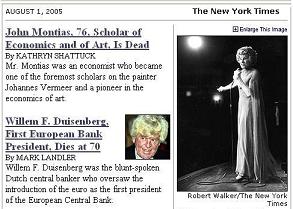
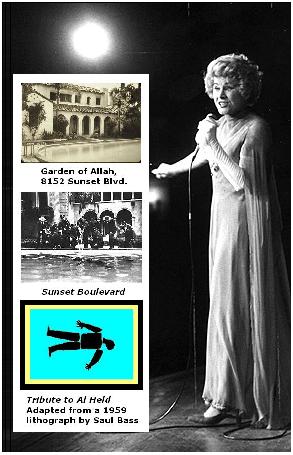
"BERLIN, July 31 - Willem F. Duisenberg, the blunt-spoken Dutch central
banker who oversaw the introduction of the euro as the first president
of the European Central Bank, was found dead on Sunday in a swimming
pool at his villa in the south of France...."
Monday, August 1, 2005
12:00 PM
Visible Mathematics
"Earlier, there had been mapping projects in Saudi Arabia's Rub'
al-Khali, the Empty Quarter in the south and west of the country....
'"Empty" is a misnomer... the Rub' al-Khali contains many hidden riches.'"
-- Maps from the Sky,
Saudi Aramco World, March/April 1995
... As a child he'd learned the names of all the angels and archangels
by heart: and among the mighty, Uriel was of the mightiest. The
archangel of salvation: called by some the flame of God.... What had he
done, stepping into the presence of such power? This was Uriel, of the
principalities....
Another of the angel's attributes rose from
memory now, and with it a sudden shock of comprehension. Uriel had
been the angel left to stand guard at the gates of Eden.
Eden.
At the word, the creature blazed. Though the ages had driven it to
grief and forgetfulness, it was still an angel: its fires
unquenchable. The wheels of its body rolled, the visible mathematics
of its essence turning on itself and preparing for new terrors.
There were others here, the Seraph said, that called this place Eden. But I never knew it by that name.
"What, then?" Shadwell asked.
Paradise, said the Angel, and at the word a new picture appeared in Shadwell's mind. It was the garden, in another age....
This was a place of making, the Angel said. Forever and ever. Where things came to be.
"To be?"
To find a form, and enter the world.
|
Monday, August 1, 2005
9:05 AM
In memory of filmmaker
Kayo Hatta
From Google News,
8:15 AM EDT today:

A brief film: