The Da Vinci
Code
and Symbology at
Harvard
Notes by Steven H. Cullinane, February 18-24, 2004
The protagonist of the recent bestseller The Da Vinci Code is Robert Langdon, "a professor of Religious Symbology at Harvard University." A prominent part in the novel is played by the well-known Catholic organization Opus Dei. Less well known (indeed, like Langdon, nonexistent) is the academic discipline of "symbology." (For related disciplines that do exist, click here.) What might a course in this subject at Harvard be like?
From log24.net, the web journal of Steven H. Cullinane:
Friday, February 20, 2004 12:00 AM
Symbology at Harvard
|
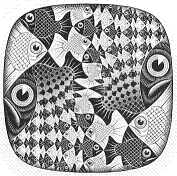
Harvard Crimson, April 10, 2003: While Opus Dei members said that they do not refer to their practices of recruitment as "fishing," the Work’s founder does describe the process of what he calls "winning new apostles" with an aquatic metaphor. Point #978 of The Way invokes a passage in the New Testament in which Jesus tells Peter that he will make him a "fisher of men." The point reads:
|

Exercise for Symbology 101:
Describe the symmetry
in each of the pictures above.
Show that the second picture
retains its underlying structural
symmetry under a group of
322,560 transformations.
Having reviewed yesterday's notes
on Gombrich, Gadamer, and Panofsky,
discuss the astrological meaning of
the above symbols in light of
today's date, February 20.
Extra credit:
Relate the above astrological
symbolism to the four-diamond
symbol in Jung's Aion.
Happy metaphors!
Thursday, February 19, 2004 9:22 PM
What is Poetry, Part II --
Gombrich vs.
Gadamer
Excerpts from
Tetsuhiro Kato on
Gombrich and the
Hermeneutics of Art
Kato on Gombrich
"... according to Gombrich, an image is susceptible to become a target for 'symbol detectives'.... But the hidden authorial intention... ([for example]... astrology, recalling the famous warning of Panofsky [1955: 32]) almost always tends to become a reproduction of the interpreter's own ideological prejudice. Not to give into the irrationalism such psychological overinterpretation might invite.... we have to look for the origin of meaning... in... the social context.... The event of image making is not the faithful transcription of the outside world by an innocent eye, but it is the result of the artist's act of selecting the 'nearest equivalence'... based on social convention...."
Kato on Gadamer
"For [Gadamer], picture reading is a process where a beholder encounters a picture as addressing him or her with a kind of personal question, and the understanding develops in the form of its answer (Gadamer 1981: 23-24; Gadamer 1985: 97,102-103). But, it must be noted that by this Gadamer does not mean to identify the understanding of an image with some sort of 'subsumption' of the image into its meaning (Gadamer 1985: 100). He insists rather that we can understand an image only by actualizing what is implied in the work, and engage in a dialogue with it. This process is ideally repeated again and again, and implies different relations than the original conditions that gave birth to the work in the beginning (Gadamer 1985: 100).
What matters here for Gadamer is to let the aesthetic aspect of image take its own 'Zeitgestalt' (Gadamer 1985: 101)."
Example (?) -- the Zeitgestalt
of
today's previous entry:

See, too,
The Quality of
Diamond.
Kato's References:
Gadamer, Hans-Georg. 1981. "Philosophie und Literatur: Was ist die Literatur?," Phänomenologische Forschungen 11 (1981): 18-45.
Gadamer, Hans-Georg. 1985. "Über das Lesen von Bauten und Bildern." Modernität und Tradition: Festschrift für Max Imdahl zum 60. Geburtstag. Ed. Gottfried Boehm, Karlheinz Stierle, Gundorf Winter. Munchen: Wilhelm Fink. 97-103.
Panofsky, Erwin. 1955. Meaning in the Visual Arts: Papers in and on Art History. New York: Anchor.
Thursday, February 19, 2004 12:00 PM
Five Easy
Pieces
for Lee Marvin's
Birthday
| 1. |
"EVERYTHING'S a story. |
|
| 2. |
"You see that sign, sir?" |
|
| 3. |
|
|
| 4. |
|
|
| 5. |
Wednesday, February 18, 2004 7:20 PM
Diamonds and Whirls
New applets have rotating 3D versions of the diamond and whirl cubes in Block Designs.
Wednesday, February 18, 2004 12:25 PM
Story
"Oh, Sara!" she whispered joyfully. "It is like a story!"
"It IS a story," said Sara. "EVERYTHING'S a story. You are a story-- I am a story."
-- Frances Hodgson Burnett,
A Little Princess
For further details, see Why Narrative?
"What modern painters are
trying to do,
if they only knew it, is paint invariants."
-- James J. Gibson in Leonardo
(Vol. 11, pp. 227-235. Pergamon Press Ltd., 1978)
Page created Feb. 20, 2004
