Saturday, May 14, 2005 9:00 PM
"Nine is a very powerful Nordic number."
-- Katherine Neville, author of The Eight,

"To live is to defend a form."
("Leben, das heisst eine Form verteidigen")
-- attributed to Hölderlin
In defense of the nine-square grid:

For details on the above picture, see
Translation Plane.
Saturday, May 14, 2005 4:00 PM

Mondrian, Malevich, Kandinsky,
Pollock, Newman, Rothko, and Still
by John Golding
Cloth | 2000 | $65.00 | ISBN: 0-691-04896-7
240 pp. | 7 x 10 | 63 color plates 109 halftones
This may illuminate Krauss's remarks on
Mondrian and Malevich at the
conclusion of the previous entry.
Saturday, May 14, 2005 1:00 PM
Today's New York Times:
"Horton Marlais Davies, Putnam professor emeritus of religion at Princeton
and an author of many books about church history, died on Wednesday at
his home in Princeton, N.J. He was 89.... Dr. Davies specialized in the impact of Christianity on the arts."

apparently first published by Eerdmans
at Grand Rapids, Michigan, in 1990
The Catholic Encyclopedia (1908) on the communion of saints:
"One cannot read the parables of the kingdom (Matt., xiii) without perceiving its corporate nature and the continuity which links together the kingdom in our midst and the kingdom to come. The nature of that communion, called by St. John a fellowship with one another ('a fellowship with
Related material:
Religious art in the entry Art History of 11 AM Wednesday, May 11, the date of Davies's death. See also the following direct and indirect links from that entry:
To a cruciform artifact from the current film Kingdom of Heaven, to an entry quoting John xv, Nine is a Vine, and to Art Theory for Yom Kippur.
For less-religious material on the number nine, see the entries and links in the Log24 archive for June 17-30, 2004.

"If we open any tract--
Plastic Art and Pure Plastic Art
or The Non-Objective World,
for instance-- we will find that
Mondrian and Malevich are not
discussing canvas or pigment or
graphite or any other form of
matter. They are talking about
Being or Mind or Spirit."
Amen.
Friday, May 13, 2005 4:00 PM
PowersFrom today's New York Times --
Francesco Marchisano, made a cardinal
on October 21, 2003:
"All the saints have powers."
Tonight at 8 PM ET on Fox: X-Men.
Wednesday, May 11, 2005 7:11 PM
"Si me de veras quieres,
deja me en paz."
(See Shining Forth.)
Natasha Richardson,
Martha Quinn,
Frances Fisher --
remind me of
The Sprite and the Synergist Three
drinks later he was suddenly inspired. "What I need right now is a
girl to lose myself in. That's the only way to wait for a pattern to
show." One of his reciprocal Rogues (he had a dozen alternate selves) answered, "Feel free, but you left your big red book in the workshop." "Why, for jigjeeze sake, can't I have the little black book, famed in song and story?" "Why can't you remember a phone number? Never mind. Shall we join the ladies?" He made three calls, all negative. He had three more drinks, all positive. He stripped, went to his Japanese bed in the monk's cell, thrashed, swore, and slept at last, dreaming crazed p a t t e r n s a t t e r n s t t e r n s t e r n s e r n s r n s n s s |
Wednesday, May 11, 2005 3:00 PM
y es un caminarte en círculo
dar a tus hechos dimensión de arco
y a solas con tu impulso decirte la palabra.
-- Homero Aridjis

 Established in 1916, Established in 1916,Montreat College is a private, Christian college located in a beautiful valley in the Blue Ridge Mountains of North Carolina. |

Wednesday, May 11, 2005 11:00 AM
Reuters - "Joe Grant, a legendary Disney artist who designed the Queen/Witch in 'Snow White and the Seven Dwarfs,' died of a heart attack while doing what he loved most, drawing, the Walt Disney Co. said Monday.
shown to connect with anything else:
existence is infinitely cross-referenced."
-- Opening sentence of
Martha Cooley's The Archivist
From Log24 last Friday,
a Greek cross:

Click on picture for details.
And from Sunday, May 1
(Orthodox Easter):
Columbia University's
Meyer Schapiro Professor
of Modern Art and Theory:
"There is no painter in the West
who can be unaware of
the symbolic power of
the cruciform shape1
and the Pandora's box

Click on pictures for details.
Related material:
Nine is a Vine3.
1 Natasha Richardson, born 11 May 1963,
Jedi wife and costar of Nell
2 Martha Quinn, born 11 May 1959,
MTV wit
3 Frances Fisher, born 11 May 1952,
dazzling redhead
Monday, May 9, 2005 12:12 PM
-- Boston Globe on events of
Sunday, May 8, 2005
"After all, tomorrow is another day."
-- Gone with the Wind
| Adolf Holl, Jg. 1930, war Kaplan und Dozent an der Katholisch- Theologischen Fakultät der Universität Wien; 1973 wurde ihm die kirchliche Lehrerlaubnis entzogen, 1976 das Priesteramt; er lebt und arbeitet als freier Schriftsteller in Wien. Das Büchlein "Falls ich Papst werden sollte. Ein Szenario" (1998, List-Verlag), dem die hier abgedruckten Passagen - mit Ausnahme des Post Skriptums - entnommen sind, ist leider schon vergriffen; Abdruck mit freundlicher Genehmigung des Autors. | Falls ich Papst werden sollte... Kaum zu glauben: Adolf Holl wirft alle Papabile-Charts über den Haufen und empfiehlt sich dem am Montag beginnenden Konklave als Pontifex Sixtus VI. - kursorische Notizen eines Außenseiters "Ich bin der Präfekt der Kongregation für die Glaubenslehre, Eure Heiligkeit. Aber natürlich. Entschuldigen Sie meine Vergesslichkeit. Möchten Sie einen Espresso? Mit oder ohne Milch? Den Espresso mache ich lieber selber, auf einer Pavoni- Maschine. Zum Präfekten der Glaubenskongregation werde ich sagen: Besorgen Sie mir die besten Übersetzungen der Werke Ephräm, des Syrers (Kirchenschriftsteller, gest. 373) ins Deutsche. Und eine kommentierte Liste aller Fachleute, die über ihn gearbeitet haben. Das wird den Präfekten eine Weile beschäftigen." |
St. Ephrem the Syrian
(about 306 AD - 373 AD)
"He... acquired honor as
a Christian musician and poet.
He was so accomplished in both arts
that he was called the
'lyre of the Holy Spirit.'"
-- Pope Benedict XV
Sunday, May 8, 2005 10:31 AM
Today's Sermon:"Holl, Adolf" pneumatology.
Sunday, May 8, 2005 12:00 AM
Geometry and TheologySee
- C. S. Lewis on this topic (pdf) and
Mark Olson's article is at the website of the New England Science Fiction Association, publisher of Ingathering: The Complete People Stories of Zenna Henderson. This book, by one of my favorite science-fiction authors, was apparently edited by the same Mark Olson.
The following remarks seem relevant to the recurring telepathy theme in Henderson:
From the first article cited above,
David L. Neuhouser,
Higher Dimensions in the Writings of C. S. Lewis (pdf):
"If we are three-dimensional cross-sections of four-dimensional reality, perhaps we are parts of the same body. In fact, we know we are parts of the same body in some way, this four-dimensional idea just may help us to see it more clearly. Remember the preceding comments are mine, not Lewis's. He puts it this way, 'That we can die "in" Adam and live "in" Christ seems to me to imply that man as he really is differs a good deal from man as our categories of thought and our three-dimensional imaginations represent him; that the separateness... which we discern between individuals, is balanced, in absolute reality, by some kind of inter-inanimation of which we have no conception at all. It may be that the acts and sufferings of great archetypal individuals such as Adam and Christ are ours, not by legal fiction, metaphor, or causality, but in some much deeper fashion. There is no question, of course, of individuals melting down into a kind of spiritual continuum such as Pantheistic systems believe in; that is excluded by the whole tenor of our faith.'"
From Webster's Unabridged, 1913 edition:
inanimate,
[Pref. in- in (or intensively) + animate.]
inanimation, n.
animation; inspiration.
The inanimation of Christ
living and breathing within us.
-- Bp. Hall.
Related words...
Also from the 1913 Webster's:
circumincession, n.
of the three persons of the Trinity.
From an online essay:
perichoresis
"The term means mutual indwelling or, better, mutual interpenetration and refers to the understanding of both the Trinity and Christology. In the divine perichoresis, each person has 'being in each other without coalescence' (John of Damascus ca. 650). The roots of this doctrine are long and deep."
-- Bert Waggoner
coinherence, n.
-- Timothy Ware, Bishop Kallistos of Diokleia,
The Human Person as an Icon of the Trinity
Friday, May 6, 2005 7:28 PM
"To improvise an eight-part fugue
is really beyond human capability."
-- Douglas R. Hofstadter,
Gödel, Escher, Bach

Order of a projective
automorphism group:
168
"There are possibilities of
contrapuntal arrangement
of subject-matter."
-- T. S. Eliot, quoted in
Origins of Form in Four Quartets.
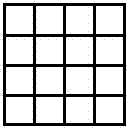
Order of a projective
automorphism group:
20,160
Friday, May 6, 2005 2:56 PM


-- Roget's II: The New Thesaurus, Third Edition
Friday, May 6, 2005 1:01 PM
"It's ... extremely weird how the previously-
-- The Flick Filosopher
Friday, May 6, 2005 10:18 AM
"In Francis Ford Coppola's film, Col. Kurtz tells how after his medics inoculated a small village, the Reds chopped off every child's left arm. 'My God, the genius of that. The genius,' Kurtz said. 'The will to do that. Perfect, genuine, complete, crystalline, pure! And then I realized they were stronger than me because they could stand it.'"
-- Col. David Hackworth
on Tuesday, April 9, 2002.
Col. Hackworth died at 74
on Wednesday, May 4, 2005.
 |  |
Click on pictures for details.
Wednesday, May 4, 2005 1:00 PM
Revisualized:
or, The Eightfold Cube
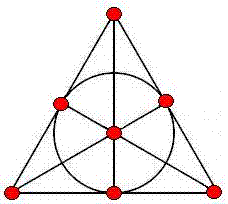
The above model indicates with great clarity six symmetries of the plane-- those it shares with the equilateral triangle. It does not, however, indicate where the other 162 symmetries come from.
Shown below is a new model of this same projective plane, using partitions of cubes to represent points:
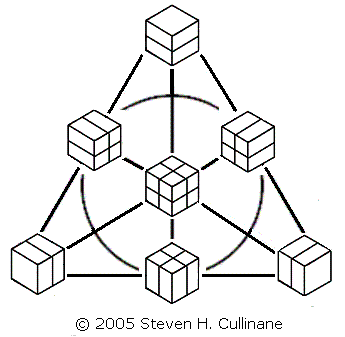
The second model is useful because it lets us generate naturally all 168 symmetries of the Fano plane by splitting a cube into a set of four parallel 1x1x2 slices in the three ways possible, then arbitrarily permuting the slices in each of the three sets of four. See examples below.
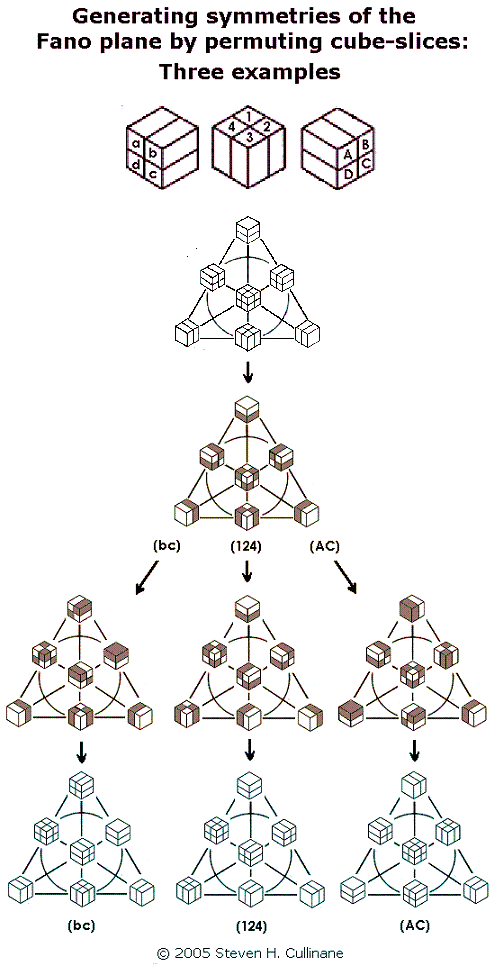
(Note that this procedure, if regarded as acting on the set of eight individual subcubes of each cube in the diagram, actually generates a group of 168*8 = 1,344 permutations. But the group's action on the diagram's seven partitions of the subcubes yields only 168 distinct results. This illustrates the difference between affine and projective spaces over the binary field GF(2). In a related 2x2x2 cubic model of the affine 3-space over GF(2) whose "points" are individual subcubes, the group of eight translations is generated by interchanges of parallel 2x2x1 cube-slices. This is clearly a subgroup of the group generated by permuting 1x1x2 cube-slices. Such translations in the affine 3-space have no effect on the projective plane, since they leave each of the plane model's seven partitions-- the "points" of the plane-- invariant.)
For another application of the points-as-partitions technique, see Latin-Square Geometry: Orthogonal Latin Squares as Skew Lines.
For more on the plane's symmetry group in another guise, see John Baez on Klein's Quartic Curve and the online book The Eightfold Way. For more on the mathematics of cubic models, see Solomon's Cube.
Tuesday, May 3, 2005 9:29 AM
Monday, May 2, 2005 11:00 AM
"Professor Krauss even uses many of the same decorations with which she festooned earlier volumes. Bataille’s photograph of a big toe, for example, which I like to think of as her mascot, reappears. As does her favorite doodle, a little graph known as a 'Klein Group' or 'L Schema' whose sides and diagonals sport arrows pointing to corners labeled with various opposing pairs: e.g., 'ground' and 'not ground,' 'figure' and 'not figure.' Professor Krauss seems to believe that this device, lifted from the pages of structuralist theory, illuminates any number of deep mysteries: the nature of modernism, to begin with, but also the essence of gender relations, self-consciousness, perception, vision, castration anxiety, and other pressing conundrums that, as it happens, she has trouble distinguishing from the nature of modernism. Altogether, the doodle is a handy thing to have around. One is not surprised that Professor Krauss reproduces it many times in her new book."
The Semiotics of Human Action,
Ritual, and Dance:

Beckett's "Quad" figure
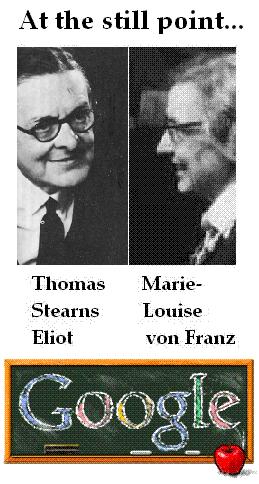
 "They are the same six lines that exist in the I Ching.... Now observe the square more closely: four of the lines are of equal length, the other two are longer.... For this reason symmetry cannot be statically produced and a dance results." -- Marie-Louise von Franz, Number and Time (1970) |
"People have believed in the fundamental character of binary oppositions since at least classical times. For instance, in his Metaphysics Aristotle advanced as primary oppositions: form/matter, natural/unnatural, active/passive, whole/part, unity/variety, before/after and being/not-being.* But it is not in isolation that the rhetorical power of such oppositions resides, but in their articulation in relation to other oppositions. In Aristotle's Physics the four elements of earth, air, fire and water were said to be opposed in pairs. For more than two thousand years oppositional patterns based on these four elements were widely accepted as the fundamental structure underlying surface reality....
 The structuralist semiotician Algirdas Greimas introduced the semiotic square (which he adapted from the 'logical square' of scholastic philosophy) as a means of analysing paired concepts more fully...."
* Compare Chandler's list of Aristotle's primary oppositions with Aristotle's list (also in the Metaphysics) of Pythagorean oppositions (see Midrash Jazz Quartet).
Sunday, May 1, 2005 1:11 PM
Harvard's Barry Mazur on
one mathematical style:
"It’s the barest, most Beckett-like vocabulary
that incorporates the theory and nothing else."
Samuel Beckett, Quad (1981):
A Jungian on this six-line logo:
"They are the same six lines
that exist in the I Ching....
Now observe the square more closely:
four of the lines are of equal length,
the other two are longer....
For this reason symmetry
cannot be statically produced
and a dance results."
-- Marie-Louise von Franz,
Number and Time (1970),
Northwestern U. Press
paperback, 1979, p. 108
A related logo from
Columbia University's
Department of Art History
and Archaeology:

Also from that department:
Rosalind Krauss,
Meyer Schapiro Professor
of Modern Art and Theory:
"There is no painter in the West
who can be unaware of
the symbolic power
of the cruciform shape
and the Pandora's box
of spiritual reference
that is opened
once one uses it."
"In the garden of Adding
live Even and Odd..."
-- The Midrash Jazz Quartet in
City of God, by E. L. Doctorow
THE GREEK CROSS
are the same length.
Here, for reference, is a Greek cross
within a nine-square grid:

Related religious meditation for
Doctorow's "Garden of Adding"...
illustrated in Wikipedia
under "cross":

From designboom.com:
THE BAPTISMAL CROSS

a Greek cross, which is superimposed
on a Greek 'chi,' the first letter
of the Greek word for 'Christ.'
Since the number eight is symbolic
of rebirth or regeneration,
this cross is often used
as a baptismal cross.
Related material:

or "double cross" logo.
See Why Me? and
A Shot at Redemption.
Happy Orthodox Easter.
Sunday, May 1, 2005 12:00 AM
Hooray, Hooray...