for St. Peter's Day
Compare and contrast:
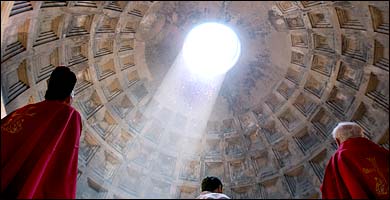
Pigi Cipelli for The New York Times
Tuesday, June 29, 2004 11:22 PM
ART WARS
for St. Peter's Day
Compare and contrast:
Pigi Cipelli for The New York Times
 |
Tuesday, June 29, 2004 2:22 PM
| When? Going to dark bed there was a square round Sinbad the Sailor roc's auk's egg in the night of the bed of all the auks of the rocs of Darkinbad the Brightdayler. Where?  -- Ulysses, conclusion of Ch. 17 |

For further details on this structure, see
Magic Squares, Finite Planes,
and Points of Inflection
on Elliptic Curves,
by Ezra Brown, and
Visualizing GL(2, p)
by Steven H. Cullinane.
For a more literary approach
to this structure, see
Balanchine's Birthday (Jan. 9, 2003),
Art Theory for Yom Kippur (Oct. 5, 2003),
A Form (May 22, 2004),
Ineluctable (May 27, 2004),
A Form, continued (June 5, 2004),
Parallelisms (June 6, 2004),
Deep Game (June 26, 2004), and
Gameplayers of Zen (June 27, 2004).

To appreciate fully this last entry
on Gameplayers,
one must understand
the concept of "suicide"
in the game of Go
and be reminded
by the fatuous phrase of the
Institute of Contemporary Art
quoted in Gameplayers --
"encompassed by 'nothing' " --
of John 1:5.

Sunday, June 27, 2004 7:11 PM
"The void, the ineffable, the sublime,
nonsense, nihilism, zero—
all are encompassed by
-- Institute of Contemporary Art,
Philadelphia
"The Zen disciple sits for long hours silent and motionless, with his eyes closed. Presently he enters a state of impassivity, free from all ideas and all thoughts. He departs from the self and enters the realm of nothingness. This is not the nothingness or the emptiness of the West. It is rather the reverse, a universe of the spirit in which everything communicates freely with everything, transcending bounds, limitless."
-- Yasunari Kawabata, Nobel lecture, 1968

Saturday, June 26, 2004 12:00 PM


Saturday, June 26, 2004 3:03 AM
 : 39, 237f)." Wildgen, W. 1998. Das kosmische Gedächtnis. Kosmologie, Semiotik und Gedächtniskunst im Werke von Giordano Bruno. Frankfurt/Bern: Lang.

Friday, June 25, 2004 2:00 PM


Tuesday, June 22, 2004 9:00 AM
Dirty Trick
Some quotations in memory of philosopher Stuart Hampshire, who died on June 13, 2004.
From the Hampshire obituary in The Guardian:
I He frequently told the story of how, towards the end of the war, he had to interrogate a French traitor (imprisoned by the Free French), who refused to cooperate unless he was allowed to live. Should Hampshire, knowing the man was condemned to die, promise him a reprieve, which he was in no position to give, or truthfully refuse it, thereby jeopardising the lives of Resistance fighters? "If you're in a war," said Hampshire, "you can't start thinking, 'Well I can't lie to a man who's going to be shot tomorrow and tell him that he isn't.' " But what the whole anecdote, and its incessant retelling, revealed was that Hampshire had, in fact, thought precisely what he said was unthinkable, and that whichever of the two decisions he finally took lay heavy on his conscience ever afterwards. Indicatively, too, it was especially loathsome to him because, although he did not say this in so many words, the traitor was almost a mirror image of himself - a cultivated young intellectual, looking like a film star, much influenced by elegant literary stylists - except that, in the traitor's case, his literary mentors were fascist. II It is hard to know how Hampshire's academic career was vitiated by the scandal over his affair with Ayer's wife Renee, whom he married in 1961 after a divorce in which he was named as co-respondent. Even if less a matter of the dons' moral conviction than their concern over how All Souls would appear, the affair caused a massive furore.... |
From a log24 entry on the day before Hampshire's death:
I "Hemingway called it a dirty trick. It might even be an ancient Ordeal laid down on us by an evil Inquisitor in Space.... the dirty Ordeal by -- Jack Kerouac in Desolation Angels II The New Yorker of June 14 & 21, 2004: ...in 'The Devil's Eye,' Bergman's little-known comedy of 1960. Pablo seduces the wife of a minister, and then, sorrowful and sated, falling to his knees, he addresses her thus: |
Whether Hampshire is now in Hell, the reader may surmise. Some evidence in Hampshire's favor:
His review of On Beauty and Being Just, by Elaine Scarry, in The New York Review of Books of November 18, 1999. Note particularly his remarks on Fred Astaire, and the links to Astaire and the Four Last Things in an earlier entry of June 12, which was, as noted above, the day before Hampshire's death.
As for the day of death itself, consider the following remark with which Hampshire concludes his review of Scarry's book:
"But one must occasionally fly the flag, and the flag, incorrigibly, is beauty."
In this connection, see the entry of the Sunday Hampshire died, Spider Web, as well as entries on the harrowing of hell -- Holy Saturday,
Thursday, June 17, 2004 11:00 PM
Ishtar WannabeFrom Robert A. Heinlein's Glory Road: Her face turned thoughtful. "Would you like to call me 'Ettarre'?" "Is that one of your names?" "It is much like one of them, allowing for different spelling and accent. Or it could be 'Esther' just as closely. Or 'Aster.' Or even 'Estrellita.' " " 'Aster,' " I repeated. "Star. Lucky Star!" |