From the journal of Steven H. Cullinane...
2008 November 01-30
Sunday, November 30, 2008 10:31 AM
ART WARS for St. Andrew's Day:
Abstraction and Faith
From Sol
LeWitt: A Retrospective, edited by Gary Garrels, Yale
University Press, 2000, p. 376:
THE SQUARE AND THE CUBE
by Sol LeWitt
The best that can be said for either the square or the cube is that
they are relatively uninteresting in themselves. Being basic
representations of two- and three-dimensional form, they lack the
expressive force of other more interesting forms and shapes. They are
standard and universally recognized, no initiation being required of
the viewer; it is immediately evident that a square is a square and a
cube a cube. Released from the necessity of being significant in
themselves, they can be better used as grammatical devices from which
the work may proceed.
Reprinted from Lucy R. Lippard et al., "Homage to the Square," Art
in America 55, No. 4 (July-August 1967): 54. (LeWitt's
contribution was originally untitled.)
|
A vulgarized version
of LeWitt's remarks
appears on
a
webpage of
the National Gallery of Art.
|
Today's Sermon
"Closing
the Circle on Abstract Art"
On Kirk Varnedoe's National Gallery lectures in 2003 (Philip Kennicott,
Washington Post, Sunday, May 18, 2003):
"Varnedoe's lectures were ultimately about
faith, about his faith in the power of abstraction, and abstraction as
a kind of anti-religious faith in itself."
|
Saturday, November 29, 2008 1:06 PM
A Third Birthday Wish:
Virginia Heffernan on
the film version of A Wrinkle in Time:
"... the film is also sad, and soaring. It recalls the hippie days when
a perverse, hubristic originality was a quality to be cultivated, not
medicated. Told not from an aloof remove-- through the eyes of a wise
Yoda or Peter Jackson-- the movie glitters irregularly, woven through
with the sparkling fibers of a righteous child's tormented imagination.
Steven Spielberg also attempted, with the same ambiguous but moving
results, this messier brand of science fiction in 'A.I.'"
Saturday, November 29, 2008 11:29 AM
In Memoriam:
Saturday, November 29, 2008 2:06 AM
Annals of Literature:
A Story
for Madeleine
Part One: Frame
Tale
Part Two: A Little
Princess
Part Three: Happy Birthday
Wednesday, November 26, 2008 1:00 PM
Mathematics and Narrative, continued:
Meanwhile...
Recent abstracts of interest:
Kuwait
Foundation Lectures --
Jan. 29, 2008: J. P. Wintenberger, "On
the Proof of Serre's Conjecture"
Oct. 28, 2008: Chandrashekhar Khare, "Modular
Forms and Galois Representations"
Background:
The
Last Theorem, a novel by Arthur C. Clarke and Frederik Pohl
published Aug.
5, 2008
"Going
Beyond Fermat's Last Theorem," a news article in The Hindu
published April
25, 2005
Wikipedia: Serre
Conjecture (Number Theory)
Henri Darmon, "Serre's
Conjectures"
Monday, November 24, 2008 8:16 PM
Another Dharwadker Fan:
"Wow
wow wow. Who the heck is this guy?"
Monday, November 24, 2008 12:00 PM
Annals of Symmetry:
Frame Tale

Click on image for details.
Sunday, November 23, 2008 12:00 PM
Requiem for a Critic:
At the Still Point
This
morning's entry quoted Ezra Pound:
"The first credential we should demand of a critic is
his ideograph of the good."
Dance critic
Clive
Barnes died
Wednesday.
Pound may have whispered his advice in St. Peter's ear when Barnes
stood before the
Janitor
Coeli at heaven's gate. If so, another angel may have whispered
in the other ear,
"Vide
Forever Fonteyn."
Sunday, November 23, 2008 9:00 AM
Today's Sermon:
The Idea of Identity
"The first credential
we should demand of a critic
is his ideograph of the good."
-- Ezra Pound,
How
to Read
Music critic Bernard Holland in The New York Times on Monday,
May 20, 1996:
The
Juilliard's
Half-Century
Ripening
Philosophers ponder the idea of identity: what it is to give something
a name on Monday and have it respond to that name on Friday regardless
of what might have changed in the interim. Medical science tells us
that the body's cells replace themselves wholesale within every seven
years, yet we tell ourselves that we are what we were....
Schubert at the end of his life had already passed on to another level
of spirit. Beethoven went back and forth between the temporal world and
the world beyond right up to his dying day.
Exercise
Part I:
Apply Holland's Monday-to-Friday "idea of identity" to the lives and
deaths during the week of Monday, Nov. 10 ("Frame
Tales"), through Friday,
Nov. 14, of a musician and a maker of music documentaries-- Mitch
Mitchell (d. Nov. 12) and Baird
Bryant (d. Nov. 13).
Part II:
Apply Holland's "idea of identity" to last week (Monday,
Nov. 17, through Friday, Nov. 21), combining it with Wigner's
remarks on invariance (discussed here on Monday)
and with the "red dragon" (Log24,
Nov. 15) concept of flight over "the Hump"-- the Himalayas-- and
the 1991 documentary filmed by Bryant, "Heart
of Tibet."
Part III:
Discuss Parts I and II in the context of Eliot's Four Quartets.
(See Time Fold,
The
Field of Reason, and Balance.)
Friday, November 21, 2008 5:01 PM
Mathematics and Literature --
Gatsby
Starts Over:
Cleaning Up the
St. Olaf Mess
St. Olaf College,
Northfield, Minnesota --
From The MSCS Mess
(Dept. of Mathematics, Statistics,
and Computer Science)
November 14, 2008
Volume
37, Number 9--
Math Film Festival 2008
The MSCS Department is sponsoring the second of two film-discussion
evenings this Wednesday, November 19. Come to RNS 390 at 7:00 PM to see
watch [sic]
two short [sic]--
Whatchu Know 'bout Math and Just a Finite Simple
Group of Order Two-- and our feature film, Good Will Hunting.
Will Hunting is a mathematical genius who's living a rough life in
South Boston, while being employed at a prestigious college in Boston,
he's [sic]
discovered by a Fields Medal winning mathematics Professor [sic] who
eventually tries to get Will to turn his life around but becomes
haunted by his own professional inadequacies when compared with Will.
Professor Garrett will explain the “impossible problem” and its
solution after the film.
Background:
Log24 entries of Wednesday, November 19, the day "Good Will Hunting"
was shown:
Damnation
Morning revisited and
Mathematics
and Narrative continued
From
a story in
the November 21
Chronicle of Higher Education
on a recent St. Olaf College
reading of
Paradise Lost:
|
"Of man's first disobedience,
and the fruit
Of that forbidden tree,
whose mortal taste
Brought death into the World,
and all our woe....
A red apple made the rounds,
each reader tempting the next."
|
Wednesday, November 19, 2008 5:01 PM
Mathematics and Narrative, continued:
"It's still the same old story...."
-- Song lyric
The Great Gatsby, Chapter
6:
"An instinct toward his future glory had led him, some months before,
to the small Lutheran college of St. Olaf in southern Minnesota. He
stayed there two weeks, dismayed at its ferocious indifference to the
drums of his destiny, to destiny itself, and despising the janitor’s
work with which he was to pay his way through."
There is a link to an article on St. Olaf College in Arts & Letters Daily today:
"John Milton, boring? Paradise Lost has a little bit of
something for everybody. Hot sex! Hellfire! Some damned good poetry,
too..." more»
The "more" link is to The Chronicle of Higher Education.
For related material on Paradise Lost and higher education, see
Mathematics and
Narrative.
Wednesday, November 19, 2008 2:56 AM
Damnation Morning revisited:
Sympathy for Baird Bryant
"Pleased to meet you
Hope you guess my name
But what's puzzling you
Is the nature of my game"
-- The
Rolling Stones
"'Don't you want to
hear him call your name
when you're standing
at the pearly gates?'
I told the Preacher 'Yes, I do,
but I hope he don't call today.'"
-- Kenny Chesney, song
at the CMA Awards on Wednesday, November 12, quoted here at
9:00 AM on Thursday, Novermber 13
Related material:
LA
Times obituary for the experienced
bohemian writer and filmmaker Baird Bryant, who died at 80 on Thursday,
November 13. Bryant filmed parts of "Easy Rider" in 1968
and of the Altamont
concert in 1969. He was apparently a member of the Harvard College
Class of 1950.
A more
complete account of Bryant's life
Thirty
references to the Devil in a book by Bryant
Solace
With Interruptions
(Log24 entries for November 12, 13, and 14 -- the day before Bryant's
death, the day of his death, and the day after)
Monday, November 17, 2008 9:00 AM
ART WARS and...
Limits
From
the
previous entry:
"If it’s a seamless whole you want,
pray to Apollo, who sets the limits
within which such a work can exist."
-- Margaret Atwood,
author of Cat's
Eye
 Happy
birthday
Happy
birthday
to the late
Eugene
Wigner
... and a belated
Merry Christmas
to Paul Newman:

"The laws of nature permit us to foresee events on
the basis of the knowledge of other events; the principles of
invariance
should permit us to establish new correlations between events, on the
basis of the knowledge of established correlations between events. This
is exactly what they do."
-- Eugene Wigner,
Nobel
Prize Lecture, December 12, 1963
Sunday, November 16, 2008 8:00 PM
Annals of Philosophy:
Art and Lies
Observations suggested by an article on author Lewis Hyde-- "What
is Art For?"-- in today's New York Times Magazine:
Margaret Atwood (pdf)
on Lewis Hyde's
Trickster
Makes This World: Mischief, Myth, and Art --
"Trickster," says Hyde, "feels no anxiety when he
deceives.... He... can tell his lies with creative abandon, charm,
playfulness, and by that affirm the pleasures of fabulation." (71) As
Hyde says, "... almost everything that can be said about
psychopaths can also be said about tricksters," (158), although the
reverse is not the case. "Trickster is among other things the
gatekeeper who opens the door into the next world; those who mistake
him for a psychopath never even know such a door exists." (159)
What is "the next world"? It might be the Underworld....
The pleasures of fabulation, the charming and playful lie-- this line
of thought leads Hyde to the last link in his subtitle, the connection
of the trickster to art. Hyde reminds us that the wall between the
artist and that American favourite son, the con-artist, can be a thin
one indeed; that craft and crafty rub shoulders; and that the words
artifice, artifact, articulation and art all come from the same ancient
root, a word meaning to join, to fit, and to make. (254) If it’s a
seamless whole you want, pray to Apollo, who sets the limits within
which such a work can exist. Tricksters, however, stand where the door
swings open on its hinges and the horizon expands: they operate where
things are joined together, and thus can also come apart.
"What happened to that... cube?"
Apollinax
laughed until his eyes teared. "I'll give you a hint, my dear. Perhaps
it slid off into a higher dimension."
"Are you pulling my leg?"
"I wish I were," he sighed. "The fourth dimension, as you know, is an
extension along a fourth coordinate perpendicular to the three
coordinates of three-dimensional space. Now consider a cube. It has
four main diagonals, each running from one corner through the cube's
center to the opposite corner. Because of the cube's symmetry, each
diagonal is clearly at right angles to the other three. So why
shouldn't a cube, if it feels like it, slide along a fourth coordinate?"
-- "Mr. Apollinax Visits New York," by Martin Gardner, Scientific
American, May 1961, reprinted in The Night is
Large
|
Sunday, November 16, 2008 10:30 AM
Today's Sermon:
From Koestler's Darkness at Noon, a fictional Communist on
propaganda:
"It is necessary to hammer every sentence into the masses
by repetition and simplification. What is presented as right must shine
like gold; what is presented as wrong must be black as pitch."
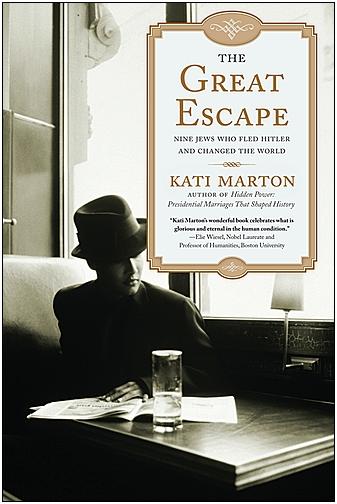
Thanks for this quotation to Kati Marton, author of The Great
Escape: Nine Jews Who Fled Hitler and Changed the World (Simon
& Schuster, paperback edition Nov.
6, 2007). One of Marton's nine was Koestler.
From another book related to this exodus:
"Riesz was one of the most elegant mathematical writers in
the world, known for his precise, concise, and clear expositions. He
was one of the originators of the theory of function spaces-- an
analysis which is geometrical in nature."
-- Stanislaw Ulam, Adventures of a
Mathematician
And from
Gian-Carlo Rota, a friend of Ulam:
"Riesz's example is well worth following today."
Related material: Misunderstanding
in the Theory of Design and Geometry for Jews.
For a different approach to ethnicity and the number nine that is also
"geometrical in nature," see The
Pope in Plato's Cave and the four entries preceding it, as well as A
Study in Art Education.
Saturday, November 15, 2008 8:48 AM
Poetry at War:
Middle Kingdom
Space Machine Family
From "
The Chung,"
by
W. C. McDonald, Jr.--

"CHUNG is a Chinese character which means 'in the
middle of' or 'the center,' or, as applied to our CNAC aircraft,
'MIDDLE KINGDOM SPACE MACHINE FAMILY.'"
(Here CNAC stands for "China National
Aviation Corporation," an organization that in World War II, as
part of the Army Air Transport Command, made high-altitude flights over
the Himalayas.)
Related material on poetry:
Related material on space machines:
Friday, November 14, 2008 5:24 PM
Quantum of Solace, continued:
Ballistics and Faith
From a
review of José
Saramago's new novel, Death With Interruptions:
"The church has never been asked to explain anything," the
cardinal assures the prime minister. "Our specialty, along with
ballistics, has always been the neutralization of the overly curious
mind through faith."
Related material:
Sept. 7, 2006- Birthday
of Elizabeth I
Sept. 7, 2007- Madeleine
L'Engle is Dead
Sept. 7, 2008- From
the Finland Station
For some mythology relevant to the first two of these three dates, see "Damnation
Morning" and The
Big Time. For some non-mythology related to ballistics, faith,
and the third of these dates, see Rudy
Ratzinger vs. Joseph
Ratzinger.
As for the main character
of Saramago's novel...
“V.
is whatever lights you to
the end of the street:
she is also the dark annihilation
waiting at the end of the street.”
-- Tony Tanner, page 36,
"V. and V-2," in
Pynchon: A Collection
of Critical Essays.
Ed. Edward Mendelson.
Englewood Cliffs, N. J.:
Prentice-Hall, 1978. 16-55.
|
Friday, November 14, 2008 8:00 AM
Frame Tales (cont. from Mon.):
Riverrun
(The first word in Finnegans Wake.
See also the
Log24 entries following
the death of Pope John Paul II.)
At Inside
Higher Ed, Margaret Soltan ("UD") discusses...
"moments of clarity [cf. related
essay (pdf)]
that seem, when you look at all of them together late in the day, to
disclose our life’s otherwise hidden pattern, meaning, and flow.
'Not far downstream was a dry channel where the river had run
once, and part of the way to come to know a thing is through its death.
But years ago I had known the river when it flowed through this now dry
channel, so I could enliven its stony remains with the waters of
memory. In death it had its pattern, and we can only hope for as much.'"
-- A
River Runs Through It, by Norman Maclean, a story about trout
fishing and grace
Related material:
Maclean's fellow author Kilgore Trout
and the story he is said to be most proud of, about Bunker Bingo.
See also yesterday's
entry, Bob's
Country Bunker, and On
Linguistic Creation.
Thursday, November 13, 2008 9:00 AM
Experienced, Part II:
Wednesday, November 12, 2008 8:35 AM
Casino Royale, continued:
Quantum of Solace
Lottery Numbers
for November 11, 2008:
PA midday 007, evening 628
NY midday 153, evening 069
Experienced readers of this
journal will have little difficulty interpreting these results,
except for 153. For that enigmatic number, see Object
Lesson.
Tuesday, November 11, 2008 7:59 AM
Ovoidal Insight:
Monday, November 10, 2008 10:31 AM
Annals of Aesthetics:
Frame Tales
From June
30 --
("Will this be on the test?")
Frame Tale One:
Frame Tale Two:
Barry Sharples
on his
version of the
Kaleidoscope
Puzzle --
Background:
"A possible origin of this puzzle
is found in a dialogue
between Socrates
and Meno
written by the Greek philosopher,
Plato, where a square is drawn
inside a square such that
the blue square is twice the area
of the yellow square.

Colouring the triangles
produces a starting pattern
which is a one-diamond figure
made up of four tiles and there are
24 different possible arrangements."

"The king asked, in compensation for his toils during this strangest of
all the nights he had ever known, that the twenty-four riddle tales
told him by the specter, together with the story of the night itself,
should be made known over the whole earth and remain eternally famous
among men."
Frame Tale Three:
Finnegans Wake
--
"The quad gospellers may own the targum but any of
the Zingari shoolerim may pick a peck of kindlings yet from the sack of
auld hensyne."
Sunday, November 9, 2008 9:00 AM
Rhyme and Reason
"Beauty is a riddle."
-- Dostoevsky
"Seven is Heaven
Eight is a Gate
Nine is a Vine"
-- Folk rhyme
Saturday, November 8, 2008 10:30 AM
ART WARS, Aesthetics Division:
Roman Religion

ET SUPER HANC PETRAM
AEDIFICABO ECCLESIAM
MEAM ET PORTAE INFERI
NON PRAEVALEBUNT
ADVERSUS EAM
Benedict XVI, before he became Pope:
"... a purely harmonious concept of beauty is not enough.... Apollo,
who for Plato's Socrates was 'the God' and the guarantor of unruffled
beauty as 'the truly divine' is absolutely no longer sufficient."
Tom
O'Bedlam:
"I
know more than Apollo...."
Wikipedia:
"The lapis manalis (Latin: 'stone of the Manes')
was a name given to two sacred stones used in the Roman religion. One
covered a gate to Hades, abode of the dead....
One such stone covered the mundus Cereris, a pit thought to
contain an entrance to the underworld....
The... mundus was located in the Comitium,
on the Palatine Hill. This stone was ceremonially opened three times a
year, during which spirits of the blessed dead (the Manes) were
able to commune with the living. The three days upon which the mundus
was opened were August
24, October 5, and November 8. Fruits of the harvest were offered
to the dead at this time."
Saturday, November 8, 2008 8:28 AM
Annals of Theology...
From a
Cartoon
Graveyard
"That corpse you planted
last year in your garden,
Has it begun to sprout?
Will it bloom
this year?
Or has the sudden frost
disturbed its bed?"
-- T. S. Eliot, "The Waste Land"
Wikipedia:
"In the Roman Catholic tradition, the term 'Body of Christ' refers not
only to the body of Christ in the spiritual realm, but also to two
distinct though related things: the Church and the reality of the
transubstantiated bread of the Eucharist....
According to the Catechism of the Catholic Church, 'the comparison of
the Church with the body casts light on the intimate bond between
Christ and his Church. Not only is she gathered around him; she is
united in him, in his body....'
....To distinguish the Body of Christ in this sense from his physical
body, the term 'Mystical Body of Christ' is often used. This term was
used as the first words, and so as the title, of the encyclical Mystici
Corporis Christi of Pope Pius XII."
Pope Pius XII:
"83. The Sacrament of the Eucharist is itself a
striking and wonderful figure of the unity of the Church, if we
consider how in the bread to be consecrated many grains go to form one
whole, and that in it the very Author of supernatural grace is given to
us, so that through Him we may receive the spirit of charity in which
we are bidden to live now no longer our own life but the life of
Christ, and to love the Redeemer Himself in all the members of His
social Body."
Friday, November 7, 2008 2:22 PM
ART WARS continued:
The Sincerest Form
of Flattery
At a
British puzzle website today I found this, titled "Tiles Puzzle by
Steven H. Cullinane"--

The version there states that
"there are 322,560 patterns made by swapping rows, swapping
columns and swapping the four 2x2 quadrants!"
Friday, November 7, 2008 10:31 AM
Happy Birthday:
Billy Graham is 90.
Joni Mitchell is 65.
Buen fin de semana a todos.
-- Desconvencida
Friday, November 7, 2008 7:11 AM
For St. Steve McQueen's Day:
Thursday, November 6, 2008 5:24 PM
ART WARS continued:
Thursday, November 6, 2008 10:07 AM
Final Arrangements, continued:
Death of a Classmate
Michael Crichton,
Harvard College, 1964
 Authors Michael Crichton and
David Foster Wallace in today's
New York Times obituaries
The Times's remarks above
on the prose styles of
Crichton and Wallace--
"compelling formula" vs.
"intricate complexity"--
suggest the following works
of
visual
art in memory
of Crichton.
"Crystal"--

"Dragon"
(from Crichton's
Jurassic Park)--

For the mathematics
(dyadic harmonic analysis)
relating these two figures,
see
Crystal
and Dragon.
Some philosophical
remarks related to
the Harvard background
that Crichton and I share--
Hitler's Still Point
and
The Crimson Passion.
Wednesday, November 5, 2008 10:23 AM
Fashion Statement: