Wednesday, February 28, 2007 7:59 AM
Parts of a Whole:
of Geometry
From Lectures on the Science of Language, by Max Muller, fellow of All Souls College, Oxford. New York: Charles Scribner's Sons, 1890, pp. 88-90 --
Stoicheia
"The question is, why were the elements, or the component primary parts of things, called stoicheia by the Greeks? It is a word which has had a long history, and has passed from Greece to almost every part of the civilized world, and deserves, therefore, some attention at the hand of the etymological genealogist.
Stoichos, from which stoicheion, means a row or file, like stix and stiches in Homer. The suffix eios is the same as the Latin eius, and expresses what belongs to or has the quality of something. Therefore, as stoichos means a row, stoicheion would be what belongs to or constitutes a row....
Hence stoichos presupposes a root stich, and this root would account in Greek for the following derivations:--
- stix, gen. stichos, a row, a line of soldiers
- stichos, a row, a line; distich, a couplet
- steicho, estichon, to march in order, step by step; to mount
- stoichos, a row, a file; stoichein, to march in a line
In German, the same root yields steigen, to step, to mount, and in Sanskrit we find stigh, to mount....
Stoicheia are the degrees or steps from one end to the other, the constituent parts of a whole, forming a complete series, whether as hours, or letters, or numbers, or parts of speech, or physical elements, provided always that such elements are held together by a systematic order."

The Miracle Octad Generator of R. T. Curtis
For the geometry of these stoicheia, see
The Smallest Perfect Universe and
Finite Geometry of the Square and Cube.
Tuesday, February 27, 2007 9:25 PM
Harvard Design, continued
New York Times story
on a Harvard student's
research on pattern in
Islamic art --
and in memory of
George Sadek --
From Log24 in July 2005:
Intersections A Trinity Sunday sermon "... to apprehend See also The Diamond Project. |
"... an alphabet
By which to spell out holy doom and end,
A bee for the remembering of happiness."
-- Wallace Stevens,
"The Owl in the Sarcophagus"
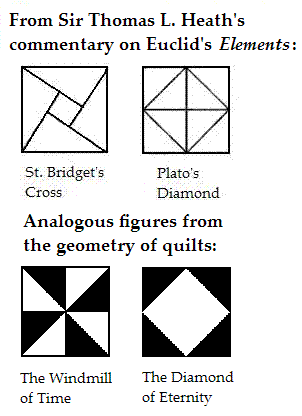
Some context for these figures:
The Diamond Theory of Truth
Tuesday, February 27, 2007 7:59 AM
ART WARS: Time and Chance
The Poetics of Space
Log24 yesterday:
"Imprimatur.
+John Cardinal Farley,
Archbishop of New York"
New York State Lottery
yesterday, Feb. 26, 2007:
Mid-day 206
Evening 888
For more on the artistic
significance of 206,
see 2/06.
For more on the artistic
significance of 888, see
St. Bonaventure on the
Trinity at math16.com.
A trinity:
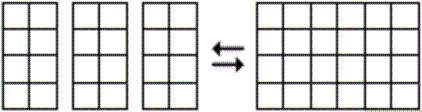
Click on picture for further details.
Monday, February 26, 2007 9:29 AM
From the Academy:

Monica Almeida/The New York Times
Martin Scorsese won the best-director
Oscar last night for "The Departed."
From left, Francis Ford Coppola, Scorsese,
George Lucas and Steven Spielberg.
-- The Catholic Encyclopedia, Volume XIV. Published 1912. New York: Robert Appleton Company. Nihil Obstat, July 1, 1912. Remy Lafort, S.T.D., Censor. Imprimatur. +John Cardinal Farley, Archbishop of New York
Sunday, February 25, 2007 10:31 AM
For Oscar Night

walk in both worlds.
I'm T. S. Eliot."
| I caught the sudden look of some dead master Whom I had known, forgotten, half recalled Both one and many; in the brown baked features The eyes of a familiar compound ghost Both intimate and unidentifiable. So I assumed a double part, and cried And heard another's voice cry: 'What! are you here?' Although we were not. I was still the same, Knowing myself yet being someone other— And he a face still forming; yet the words sufficed To compel the recognition they preceded. And so, compliant to the common wind, Too strange to each other for misunderstanding, In concord at this intersection time Of meeting nowhere, no before and after, We trod the pavement in a dead patrol. I said: 'The wonder that I feel is easy, Yet ease is cause of wonder. Therefore speak: I may not comprehend, may not remember.' And he: 'I am not eager to rehearse My thoughts and theory which you have forgotten. These things have served their purpose: let them be. So with your own, and pray they be forgiven By others, as I pray you to forgive Both bad and good. Last season's fruit is eaten And the fullfed beast shall kick the empty pail. For last year's words belong to last year's language And next year's words await another voice. But, as the passage now presents no hindrance To the spirit unappeased and peregrine Between two worlds become much like each other, So I find words I never thought to speak In streets I never thought I should revisit When I left my body on a distant shore. Since our concern was speech, and speech impelled us To purify the dialect of the tribe And urge the mind to aftersight and foresight, Let me disclose the gifts reserved for age To set a crown upon your lifetime's effort. First, the cold friction of expiring sense Without enchantment, offering no promise But bitter tastelessness of shadow fruit As body and soul begin to fall asunder. Second, the conscious impotence of rage At human folly, and the laceration Of laughter at what ceases to amuse. And last, the rending pain of re-enactment Of all that you have done, and been; the shame Of motives late revealed, and the awareness Of things ill done and done to others' harm Which once you took for exercise of virtue. Then fools' approval stings, and honour stains. From wrong to wrong the exasperated spirit Proceeds, unless restored by that refining fire Where you must move in measure, like a dancer.' |
Sunday, February 25, 2007 10:30 AM
Hollywood Sermon
On the night of October 30-31, 1993, also known as Devil's Night, there was a full Hunter's Moon and the Pennsylvania Lottery number was 666.
-- Steven H. Cullinane, 03/20/01
"Mystery surrounds the death of young actor River Phoenix.... The
actor... was declared dead at 1:51 a.m. PT Sunday [Oct. 31, 1993].
Phoenix died about 50 minutes after collapsing in front of the Viper
Room, a new club on the Sunset Strip...."
-- Karen Thomas, USA Today, Monday, November 1, 1993
Related material:
The five Log24 entries
ending on Yom Kippur, 2006.
Tuesday, February 20, 2007 10:15 AM
For Mardi Gras:
On this, the second anniversary of Hunter Thompson's death, two Xanga footprints from Texas furnish appropriate links:
Texas /514659186/item.html 2/20/2007 7:47 AM
Texas /534740724/item.html 2/20/2007 9:39 AM.
The first link is to Highway 1 Revisited (8/1/06).
The second link is to Serious (10/3/06).
(See also today's previous entry.)
Related material:
The Crimson Passion: A Drama at Mardi Gras.
Tuesday, February 20, 2007 7:09 AM
Philosophy and...
Today is the 21st birthday of my note "The Relativity Problem in Finite Geometry."
Some relevant quotations:
"This is the relativity problem: to fix objectively a class of equivalent coordinatizations and to ascertain the group of transformations S mediating between them."
-- Hermann Weyl, The Classical Groups, Princeton University Press, 1946, p. 16
Describing the branch of mathematics known as Galois theory, Weyl says that it
"... is nothing else but the relativity theory for the set Sigma, a set which, by its discrete and finite character, is conceptually so much simpler than the infinite set of points in space or space-time dealt with by ordinary relativity theory."
-- Weyl, Symmetry, Princeton University Press, 1952, p. 138
Weyl's set Sigma is a finite set of complex numbers. Some other sets with "discrete and finite character" are those of 4, 8, 16, or 64 points, arranged in squares and cubes. For illustrations, see Finite Geometry of the Square and Cube. What Weyl calls "the relativity problem" for these sets involves fixing "objectively" a class of equivalent coordinatizations. For what Weyl's "objectively" means, see the article "Symmetry and Symmetry Breaking," by Katherine Brading and Elena Castellani, in the Stanford Encyclopedia of Philosophy:
"The old and natural idea that what is objective should not depend upon the particular perspective under which it is taken into consideration is thus reformulated in the following group-theoretical terms: what is objective is what is invariant with respect to the transformation group of reference frames, or, quoting Hermann Weyl (1952, p. 132), 'objectivity means invariance with respect to the group of automorphisms [of space-time].'[22]
22. The significance of the notion of invariance and its group-theoretic treatment for the issue of objectivity is explored in Born (1953), for example. For more recent discussions see Kosso (2003) and Earman (2002, Sections 6 and 7).
References:
Born, M., 1953, "Physical Reality," Philosophical Quarterly, 3, 139-149. Reprinted in E. Castellani (ed.), Interpreting Bodies: Classical and Quantum Objects in Modern Physics, Princeton, NJ: Princeton University Press, 1998, pp. 155-167.
Earman, J., 2002, "Laws, Symmetry, and Symmetry Breaking; Invariance, Conservation Principles, and Objectivity,' PSA 2002, Proceedings of the Biennial Meeting of the Philosophy of Science Association 2002, forthcoming [Abstract/Preprint available online]
Kosso, P., 2003, "Symmetry, objectivity, and design," in K. Brading and E. Castellani (eds.), Symmetries in Physics: Philosophical Reflections, Cambridge: Cambridge University Press, pp. 410-421.
Weyl, H., 1952, Symmetry, Princeton, NJ: Princeton University Press.
See also
Archives Henri Poincaré (research unit UMR 7117, at Université Nancy 2, of the CNRS)--
"Minkowski, Mathematicians, and the Mathematical Theory of Relativity," by Scott Walter, in The Expanding Worlds of General Relativity (Einstein Studies, volume 7), H. Goenner, J. Renn, J. Ritter and T. Sauer, editors, Boston/Basel: Birkhäuser, 1999, pp. 45-86--
"Developing his ideas before Göttingen mathematicians in April 1909, Klein pointed out that the new theory based on the Lorentz group (which he preferred to call 'Invariantentheorie') could have come from pure mathematics (1910: 19). He felt that the new theory was anticipated by the ideas on geometry and groups that he had introduced in 1872, otherwise known as the Erlangen program (see Gray 1989: 229)."
References:
Gray, Jeremy J. (1989). Ideas of Space. 2d ed. Oxford: Oxford University Press.
Klein, Felix. (1910). "Über die geometrischen Grundlagen der Lorentzgruppe." Jahresbericht der deutschen Mathematiker-Vereinigung 19: 281-300. [Reprinted: Physikalische Zeitschrift 12 (1911): 17-27].
Related material: A pathetically garbled version of
the above concepts was published in 2001 by Harvard University
Press. See Invariances: The Structure of the Objective World, by Robert Nozick.
Sunday, February 18, 2007 10:30 AM
The Practical Cat, or...
in Harvard Iconology
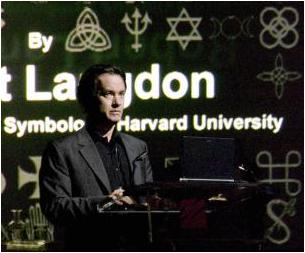
Robert Langdon, Harvard author
of "the renowned collegiate
texbook Religious Iconology"
is said to be titled
The Solomon Key.
Related material--
The Harvard Crimson online:
| Fishburne To Receive Honors at Cultural Rhythms Acclaimed actor and humanitarian chosen as the Harvard Foundation's Artist of the Year By DORIS A. HERNANDEZ Friday, February 16, 2007 9:37 PM Tony and Emmy Award-winning actor Laurence Fishburne will take the stage later this month as the 2007 Artist of the Year during the 22nd annual Cultural Rhythms festival, the Harvard Foundation for Intercultural and Race Relations announced Friday afternoon. |

Fishburne
as Morpheus

"Metaphor for Morphean morphosis,
Dreams that wake, transform, and die,
Calm and lucid this psychosis,
Joyce's nightmare in Escher's eye....
Ripples spread from castle rock. The metaphor
For metamorphosis no keys unlock."
-- Steven H. Cullinane,
November 7, 1986,
"Endgame"
More on metamorphosis--
(Log24, June 20, 2006):
"The end is where
we start from."
-- T. S. Eliot


and
Garfield 2003-06-24
See also:
Zen Koan
and
Blue Dream.
Update of 5:24 PM
Feb. 18, 2007:
A Xanga footprint from France
this afternoon (3:47 PM EST)
indicates that someone there
may be interested in the above
poem's "claves regni caelorum."
The visitor from France viewed
"Windmills" (Nov. 15, 2005).
Material related to that entry
may be found in various places
at Log24.com. See particularly
"Shine On, Hermann Weyl," and
entries for Women's History
Month last year that include
"Christ at the Lapin Agile."
Sunday, February 18, 2007 2:00 AM
O O O O that Shakespeherian Rag...
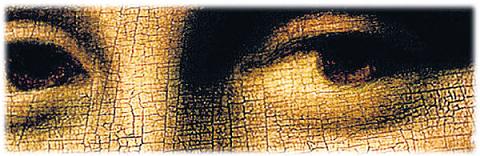
| "Many dreams have been brought to your doorstep They just lie there and they die there Are you warm, are you real, Mona Lisa? Or just a cold and lonely lovely work of art?" -- Ray Evans, who died at 92 on Thursday, Feb. 15, 2007 |
-- T. S. Eliot, Four Quartets
Saturday, February 17, 2007 9:00 AM
The Stuff That Dreams Are Made Of:
Zen Mind, Empty MindIntroduction:
A mathematician hopes for more exciting vulgarizations of his subject--
"I would hope that clever writers might point out how mathematics is altering our lifestyles and do it in a manner that would not lead Garfield the Cat to say 'ho hum.'"
-- Philip J. Davis, "The Media and Mathematics Look at Each Other" (pdf), Notices of the American Mathematical Society, March 2006
Part I:
"Our mathematical skills are assumed to derive from a special 'mental vacuum state,' whose origin is explained on the basis of anthropic and biological arguments, taking into account the need for the informational processes associated with such a state to be of a life-supporting character. ESP is then explained in terms of shared 'thought bubbles' generated by the participants out of the mental vacuum state."
-- Nobel laureate Brian D. Josephson, Department of Physics, University of Cambridge, "String Theory, Universal Mind, and the Paranormal" (Dec. 2003)
Part II:

Friday, February 16, 2007 6:16 AM
Proposed book title:
"The much-borrowed Brown formula involves some very specific things. The name of a great artist, artifact or historical figure must be in the book’s story, not to mention on its cover. The narrative must start in the present day with a bizarre killing, then use that killing as a reason to investigate the past. And the past must yield a secret so big, so stunning, so saber-rattling that all of civilization may be changed by it. Probably not for the better.
for
The Judas Seat:
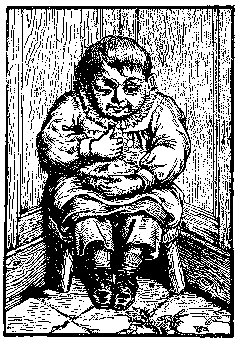
Norton Anthology of
Children's Literature
The Narrative:
Princeton Scholar
and Bible Translator
Dies at 93
The Secret:
"Little 'Jack' Horner was actually Thomas Horner, steward to the Abbot of Glastonbury during the reign of King Henry VIII.... Always keen to raise fresh funds, Henry had shown a interest in Glastonbury (and other abbeys). Hoping to appease the royal appetite, the nervous Abbot, Richard Whiting, allegedly sent Thomas Horner to the King with a special gift. This was a pie containing the title deeds to twelve manor houses in the hope that these would deflect the King from acquiring Glastonbury Abbey. On his way to London, the not so loyal courier Horner apparently stuck his thumb into the pie and extracted the deeds for Mells Manor, a plum piece of real estate. The attempted bribe failed and the dissolution of the monasteries (including Glastonbury) went ahead from 1536 to 1540. Richard Whiting was subsequently executed, but the Horner family kept the house, so the moral of this one is: treachery and greed pay off, but bribery is a bad idea." --Chris Roberts, Heavy Words Lightly Thrown: The Reason Behind the Rhyme
"The Grail Table has thirteen seats, one of which is kept vacant in memory of Judas Iscariot who betrayed Christ." --Symbolism of King Arthur's Round Table
The Log24 entry for the date--
February 13, 2007--
of the above Bible scholar's death,
and the three entries preceding it:
-- T. S. Eliot, Four Quartets