Wednesday, March 15, 2006 3:00 PM
continues...
Gallia est omnis divisa in partes tres,
quarum unam incolunt Belgae,
aliam Aquitani, tertiam qui ipsorum
lingua Celtae, nostra Galli appellantur.
-- Julius Caesar, De Bello Gallico
Wednesday, March 15, 2006 2:24 PM
From today's Harvard Crimson:

Log24, Feb. 24, 2006:
"What other colleges call fraternities,
Princeton calls Eating Clubs."
Tuesday, March 14, 2006 7:00 PM
Tuesday, March 14, 2006 12:00 PM
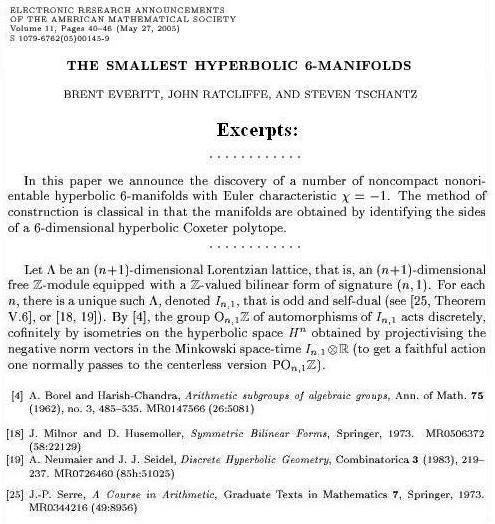
and Minkowski Space-Time
(For the tigers of Princeton,
a selection suggested by
the work of Richard Parker
on Lorentzian lattices)
Tuesday, March 14, 2006 12:00 AM



Click on pictures
for details.
Monday, March 13, 2006 1:01 PM
| Le Républicain Lorrain du 14
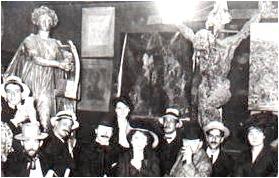
janvier 2001 Le Lapin Agile veille sur la Butte (par Michel Genson) 24 décembre 1900. Dans son atelier glacial du Bateau Lavoir, à flanc de la colline de Montmartre, Picasso se frotte les yeux. C’est bien Wasley, son ami Wasley, qu’il aperçoit traversant la place Ravignan, courbé sous le poids d’un grand Christ en croix. Le sculpteur titube et s’en va gravissant un à un les escaliers qui mènent au sommet de la Butte, direction la rue des Saules. Car l’œuvre est destinée aux murs du petit estaminet où la bande a trouvé asile, pour y échanger chaque soir des refrains, bocks et vaticinations les plus folles. La bande, c’est à dire Utrillo, Max Jacob, Modigliani et les autres… Un siècle et un souffle de légende plus tard, le même Christ blanc occupe toujours la même place, sous les lumières tamisées du Lapin Agile. À l’abri sous son aisselle droite, l’autoportrait de Picasso en Arlequin a été authentique en son temps. Jusqu’au jour où le grand Frédé, tenancier mythique du lieu, s’est gratté la barbe avant de le céder à un amateur suédois de passage. Depuis l’original a fait le voyage du MAM (Modern Art Museum) de New-York, et la Butte se contente d’une copie. Pour le reste, rien a changé ou presque pour le doyen des cabarets parisiens. Ni le décor, ni l’esprit. L’incroyable patine noire des murs, posée là par des lustres de tabagies rigolardes ou inspirées, rappelle au générique les voix des habituées de jadis, Apollinaire, Carco, Dullin, Couté, puis Pierre Brasseur, et plus proches de nous encore d’autres débutants, Caussimon, Brassens, François Billetdoux… La liste exhaustive serait impossible à dresser de tous ceux qui ont émargé au livre d’or du Lapin Agile. « En haut de la rue Saint-Vincent… » La goualante roule sa rime chaotique sur le pavé de la Butte. Au carrefour de la rue des Saules, la façade est avenante, sans apprêts, avec son acacia dans la cour, et cette étrange dénomination, née des amours burlesques entre l’imagination d’un dessinateur et les facéties des usagers. En 1875, André Gill, caricaturiste ami de Rimbaud, croque en effet, pour l’enseigne de l’ancien Cabaret des Assassins, un lapin facétieux sautant d’une marmite. Le temps d’un jeu de mots et le Lapin à Gill gagne son brevet d’agilité. L’épopée commence, que perpétue Yves Mathieu, aujourd’hui propriétaire, mémoire et continuateur d’une histoire somme toute unique. Histoire, qui, pour l’anecdote, faillit se terminer prématurément, sous la pioche des démolisseurs. Vers 1900, les bicoques du maquis montmartrois doivent laisser place à un grand projet immobilier. C’est Aristide Bruant qui sauvera in extremis le cabaret. Il achète l’établissement, laisse Frédé dans les murs qu’il revendra pour « un prix amical » à Paulo, le fils du même Frédé. Lequel Paulo n’est autre que le beau-père de l’actuel patron : « C’est un truc de famille. J’ai commencé à chanter ici en 48, égrène Yves Mathieu. Ensuite j’ai fait de l’opérette à la Gaîté Lyrique, de la revue aux Folies Bergères, je suis parti en Amérique… En revenant j’ai repris le cabaret, ma femme y chante, mes fils sont là, ils apprennent le métier… C’est comme le cirque, c’est le même esprit. » Malgré les tempêtes et les modes, le Lapin Agile dure et perdure donc. Et sa silhouette pour carte postale inspire toujours les peintres venus de partout. Comme si la halte faisait partie d’un parcours initiatique immuable. Deux pièces pour un minuscule rez-de-chaussée, dans la première, mi-loge, mi-vestiaire, une guitare attend son tour de projecteur. En l’occurrence un faisceau unique clouant le chanteur (l’humoriste ou le diseur) au rideau rouge de la seconde salle. Là où le spectacle se déroule depuis toujours, là où l’on s’accoude sans vergogne à la table d’Apollinaire, sous les lampes toujours drapées de rouge, pour écouter Ferré, Aragon, Mac Orlan ou les rengaines du Folklore populaire montmartrois. Yves Mathieu reste ferme, « ici, pas de sonorisation, pas de haut-parleur. Les gens découvrent la voix humaine. » Un refrain de Piaf glisse jusqu’au « laboratoire », le réduit où les autres artistes du programme dissertent sur l’état du monde. Les meubles de Bruant sont encore là, au hasard d’un coffre breton, un autre de marine, la façade d’un lit clos… « Des trucs d’origine » pour Yves Mathieu, qui malgré les vicissitudes du temps - il s’ingénie toute l’année durant à entretenir un établissement qui ne bénéficie d’aucun classement officiel, ni d’aucun subside - prêche haut et fort sa confiance, « parce qu’on aura plus que jamais besoin de racines, de repères, et qu’ici, c’est tout un pan de patrimoine qu’on défend à travers la chanson française, celle qu’on chante tous ensemble… » Le même secoue sa longue carcasse et se fend d’un sourire entendu : « Quand je descends à Paris, c’est pas pareil. Ici, le jour, c’est comme dans une église. Il y a le silence, et l’impression de ressentir les ondes laissées pare les cerveaux de ces types, là… » Aux murs, dessins ou tableaux laissés par Mac Orlan, Maclet ou Suzanne Valadon jouent avec l’ombre amicale. Le Lapin Agile, 22 rue des Saules, 75018 Paris. Tel : 01 46 06 85 87 Source: http://www.au-lapin-agile.com/info4.htm |
Note the above description
of Christmas Eve 1900,
and the remark that
"Ici, le jour, c’est comme
dans une église."
A search for more material on
the Wasley Christ leads to
Princeton's Nassau Church:
|
The fullness of time. I don’t have to call on the physicists among us to conclude that this fullness was not meant to be the end of the time line. That Paul must not have been talking about time in a linear way. Fullness. Complete. Almost perfect. Overflowing with grace. Just right. Fullness. As in “the earth is the Lord’s and the fullness thereof.” Fullness. As in “I pray that you may have the power to comprehend with all of the saints, what is the breadth, and length, and height and depth, and to know the love of Christ that surpasses all knowledge, so that you may be filled with all the fullness of God.” Fullness. As in “For in Christ, all the fullness of God was pleased to dwell.” “When the fullness of time had come, God sent his Son, born of a woman.” I can remember Christmas Eve as a child....
-- Christmas Eve, 2004, Sermon at Nassau Church by The Rev. Dr. David A. Davis |
Religious Symbolism at Princeton,
on the Nassau Church,
Counting Crows on
the Feast of St. Luke
("Fullness... Multitude"),
The Quality of Diamond,
in memory of
Saint Hans-Georg Gadamer,
who died at 102
four years ago on this date,
and
Diamonds Are Forever.
Sunday, March 12, 2006 1:00 PM
A Circle of QuietFrom the Harvard Math Table page:
"No Math table this week. We will reconvene next week on March 14 for a special Pi Day talk by Paul Bamberg."

| Some friends of mine are in this band. They're playing in a bar on Diversey, way down the bill, around... I said I'd be there. Great. They're all in the math department. They're good. They have this song called "i." You'd like it. Lowercase i. They just stand there. They don't play anything for three minutes. Imaginary number? It's a math joke. You see why they're way down the bill. |
From the April 2006 Notices of the American Mathematical Society, a footnote in a review by Juliette Kennedy (pdf) of Rebecca Goldstein's Incompleteness:
4 There is a growing literature in the area of postmodern commentaries of [sic] Gödel's theorems. For example, Régis Debray has used Gödel's theorems to demonstrate the logical inconsistency of self-government. For a critical view of this and related developments, see Bricmont and Sokal's Fashionable Nonsense [13]. For a more positive view see Michael Harris's review of the latter, “I know what you mean!” [9]....
[9] MICHAEL HARRIS, “I know what you mean!,” http://www.math.jussieu.fr/~harris/Iknow.pdf.
[13] ALAN SOKAL and JEAN BRICMONT, Fashionable Nonsense, Picador, 1999.
Following the trail marked by Ms. Kennedy, we find the following in Harris's paper:
"Their [Sokal's and Bricmont's] philosophy of mathematics, for instance, is summarized in the sentence 'A mathematical constant likedoesn't change, even if the idea one has about it may change.' ( p. 263). This claim, referring to a 'crescendo of absurdity' in Sokal's original hoax in Social Text, is criticized by anthropologist Joan Fujimura, in an article translated for IS*. Most of Fujimura's article consists of an astonishingly bland account of the history of non-euclidean geometry, in which she points out that the ratio of the circumference to the diameter depends on the metric. Sokal and Bricmont know this, and Fujimura's remarks are about as helpful as FN's** referral of Quine's readers to Hume (p. 70). Anyway, Sokal explicitly referred to "Euclid's pi", presumably to avoid trivial objections like Fujimura's -- wasted effort on both sides.32 If one insists on making trivial objections, one might recall that the theorem
that p is transcendental can be stated as follows: the homomorphism Q[X] --> R taking X to
More interestingly, one can ask what kind of object
as a creation rather than a discovery. But Platonism does correspond to the familiar experience that there is something about mathematics, and not just about other mathematicians, that precisely doesn't let us get away with saying 'évidemment'!38
32 There are many circles in Euclid, but no pi, so I can't think of any other reason for Sokal to have written 'Euclid's pi,' unless this anachronism was an intentional part of the hoax. Sokal's full quotation was 'the
33 This is not mere sophistry: the construction of models over number fields actually uses arguments of this kind. A careless construction of the equations defining modular curves may make it appear that pi is included in their field of scalars.
34 Unless you claim, like the present French Minister of Education [at the time of writing, i.e. 1999], that real numbers exist in nature, while imaginary numbers were invented by mathematicians. Thus
35 Cf. M. Kline, Mathematics The Loss of Certainty, p. 324.
36 Compare Morris Hirsch's remarks in BAMS April 94.
37 IS*, p. 38, footnote 26. Weinberg's remarks are contained in his article “Sokal's Hoax,” in the New York Review of Books, August 8, 1996.
38 Metaphors from virtual reality may help here."


* Earlier defined by Harris as "Impostures Scientifiques (IS), a collection of articles compiled or commissioned by Baudouin Jurdant and published simultaneously as an issue of the journal Alliage and as a book by La Découverte press."
** Earlier defined by Harris as "Fashionable Nonsense (FN), the North American translation of Impostures Intellectuelles."
What is the moral of all this French noise?
Perhaps that, in spite of the contemptible nonsense at last summer's
Mykonos conference on mathematics and narrative, stories do
have an important role to play in mathematics -- specifically, in the history
of mathematics.
Despite
his disdain for Platonism, exemplified in his remarks on the noteworthy
connection of pi with the zeta function in the formula given above,
Harris has performed a valuable service to mathematics by pointing out
the excellent historical work of Catherine
Goldstein.
Ms. Goldstein has demonstrated that even a French nominalist can
be a
first-rate scholar. Her essay on circles that Harris cites in a
French
version is also available in English, and will repay the study of those
who, like Barry Mazur and other Harvard savants, are much too careless
with the facts of history. They should consult her "Stories of
the
Circle," pp. 160-190 in A
History of Scientific Thought, edited by Michel
Serres, Blackwell Publishers (December 1995).
For
the historically-challenged mathematicians of Harvard, this essay would
provide a valuable supplement to the upcoming "Pi Day" talk by Bamberg.
For
those who insist on limiting their attention to mathematics proper, and
ignoring its history, a suitable Pi Day observance might include
becoming familiar with various proofs of the formula, pictured above,
that connects pi with the zeta function of 2. For a survey, see
Robin
Chapman, Evaluating Zeta(2)
(pdf). Zeta functions in a much wider context will be discussed
at
next May's politically correct "Women in Mathematics" program at
Princeton, "Zeta Functions All the Way" (pdf).
Saturday, March 11, 2006 12:00 PM
|
Holy the Firm
by Annie Dillard Esoteric Christianity, I read, posits a substance. It is a created substance, lower than metals and minerals on a "spiritual scale" and lower than salts and earths, occurring beneath salts and earths in the waxy deepness of planets, but never on the surface of planets where men could discern it; and it is in touch with the Absolute, at base. In touch with the Absolute! At base. The name of this substance is Holy the Firm. Holy the Firm: and is Holy the Firm in touch with metals and minerals? With salts and earths? Of course, and straight on up, till "up" ends by curving back. Does something that touched something that touched Holy the Firm in touch with the Absolute at base seep into ground water, into grain; are islands rooted in it, and trees? Of course. Scholarship has long distinguished between two strains of thought which proceed in the West from human knowledge of God. In one, the ascetic's metaphysic, the world is far from God. Emanating from God, and linked to him by Christ, the world is yet infinitely other than God, furled away from him like the end of a long banner falling. This notion makes, to my mind, a vertical line of the world, a great chain of burning. The more accessible and universal view, held by Eckhart and by many peoples in various forms, is scarcely different from pantheism: that the world is immanation, that God is in the thing, and eternally present here, if nowhere else. By these lights the world is flattened on a horizontal plane, singular, all here, crammed with heaven, and alone. But I know that it is not alone, nor singular, nor all. The notion of immanence needs a handle, and the two ideas themselves need a link, so that life can mean aught to the one, and Christ to the other. For to immanence, to the heart, Christ is redundant and all things are one. To emanance, to the mind, Christ touches only the top, skims off only the top, as it were, the souls of men, the wheat grains whole, and lets the chaff fall where? To the world flat and patently unredeemed; to the entire rest of the universe, which is irrelevant and nonparticipant; to time and matter unreal, and so unknowable, an illusory, absurd, accidental, and overelaborate stage. But if Holy the Firm is "underneath salts," if Holy the Firm is matter at its dullest, Aristotle's materia prima, absolute zero, and since Holy the Firm is in touch with the Absolute at base, then the circle is unbroken. And it is. Thought advances, and the world creates itself, by the gradual positing of, and belief in, a series of bright ideas. Time and space are in touch with the Absolute at base. Eternity sockets twice into time and space curves, bound and bound by idea. Matter and spirit are of a piece but distinguishable; God has a stake guaranteed in all the world. And the universe is real and not a dream, not a manufacture of the senses; subject may know object, knowedge may proceed, and Holy the Firm is in short the philosopher's stone. These are only ideas, by the single handful. Lines, lines, and their infinite points! Hold hands and crack the whip, and yank the Absolute out of there and into the light, God pale and astounded, spraying a spiral of salts and earths, God footloose and flung. And cry down the line to his passing white ear, "Old Sir! Do you hold space from buckling by a finger in its hole? O Old! Where is your other hand?" His right hand is clenching, calm, round the exploding left hand of Holy the Firm. -- Annie Dillard, Holy the Firm, Harper & Row 1977, reissued by Harper Perennial Library in 1988 as a paperback, pp. 68-71. |
Friday, March 10, 2006 7:59 PM

In honor of the upcoming program
on Women and Mathematics
at the Institute for Advanced Study
and of Sharon Stone's 2005 lecture
at Harvard's Memorial Church,
here are links to reviews of
two Sharon Stone classics:
"King Solomon's Mines" (1985),
said to be inspired by the
1981 box-office success of
"Raiders of the Lost Ark," and
"Diabolique" (1996), starring
Stone as a teacher of mathematics
at St. Anselm's School for Boys.
For related material on St. Anselm
and mathematics at Princeton, see
Modal Theology and the
April 2006 AMS Notices
on Kurt Gödel.
See also yesterday's entry
and Log24, Jan. 1-15, 2006.
Today's birthdays:
Sharon Stone and
Gregory La Cava.
Thursday, March 9, 2006 2:56 PM
Finitegeometry.org Update(Revised May 21, 2006)
Finitegeometry.org now has permutable JavaScript views of the 2x2x2 and 4x4x4 design cubes. Solomon's Cube presented a claim that the 4x4x4 design cube retains symmetry under a group of about 1.3 trillion transformations. The JavaScript version at finitegeometry.org/sc/64/view/ lets the reader visually verify this claim. The reader should first try the Diamond 16 Puzzle. The simpler 2x2x2 design cube, with its 1,344 transformations, was described in Diamonds and Whirls; the permutable JavaScript version is at finitegeometry.org/sc/8/view/.
Saturday, March 4, 2006 10:34 AM
Women's History Month continues.Contender
Miss O'Hara
on the Oscars:
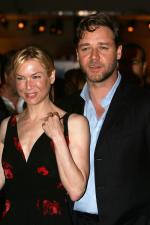
"Cinderella Man: To me, this is the best film of 2005 (qualifier: I have not yet seen Walk the Line). Cinderella Man is a terrific film - maybe even a great one. It isn't flashy, it isn't brimming with special effects, porn stars, or snappy one-liners. But it is a terrific story, one that you feel good after watching. It's a slice of the true Golden Age of Hollywood - a solid story about good people that is well-acted by a superb cast. It's a very family-friendly film - although some of the boxing scenes may be too intense for little ones. I can't recommend this film highly enough, and am still furious that it was snubbed for the Oscars - then again, perhaps I shouldn't be. It would be an insult to the movie, the actors, and the writers to nominate this fine film with the dreck they are glorifying this year. Watch this movie. I guarantee you'll enjoy it."
Friday, March 3, 2006 9:26 PM

For Scarlett on James Merrill's birthday
(which he shares with Jean Harlow)--
the Log24 links of Palm Sunday, 2004:
Google's "sunlit paradigm" and
my own "Lost in Translation."
Friday, March 3, 2006 1:00 PM
Women's History Month continues.One Small Step
Audrey Terras, University of Maryland '64:
We cannot discuss the proof here as it requires some knowledge of zeta functions of curves over finite fields.Charles Small, Harvard '64:
The moral is that the zeta function exhibits a subtle connection between the "global" (topological, characteristic 0) nature of the curve and its "local" (diophantine, characteristic p for all but finitely many "bad" primes p) behaviour. The full extent of this connection only becomes apparent in the context of varieties more general than curves....

are in this band...."
-- David Auburn, "Proof"
"Women and Mathematics
is a joint program of
the Institute for Advanced Study
and Princeton University."
-- School of Mathematics,
1 Einstein Drive,
Princeton, New Jersey
Thursday, March 2, 2006 4:30 PM
John Updike in
The New Yorker:
"Birthday, death-day --
what day is not both?"
For the Time Being:
"in and out of time"
Born on this date:Died on this date:
Philip K. Dick
Thursday, March 2, 2006 1:06 PM
continues...
"My father is, of course,
as mad as a hatter."
-- Diana Rigg in "The Hospital,"
as transcribed at
script-o-rama.com

"A vesicle pisces* is the name that author Philip K. Dick gave to a symbol he saw (on February 2**, 1974) on the necklace of a delivery woman.
PKD was probably conflating the names of two related symbols, the ichthys
consisting of two intersecting arcs resembling the profile of a fish...
used by the early Christians as a secret symbol, and the vesica piscis, from the centre of which the ichthys
symbol can be drawn."
-- Wikipedia
Related material at Log24:
Related material elsewhere:
* Wikipedia's earliest online history for this
incorrect phrase is from 25 November, 2003, when the phrase was
attributed to Dick by an anonymous Wikipedia user, 216.221.81.98, who at
that time apparently did not know the correct phrase, "vesica piscis,"
which was later supplied (16 February, 2004) by an anonymous user (perhaps the
same as the first user, perhaps not) at a different IP address, 217.158.203.103. Wikipedia authors have never supplied a source
for the alleged use of the phrase by Dick. This comedy of errors would
be of little interest were it not for its strong resemblance to the
writing process that resulted in what we now call the Bible.
** Other accounts (for instance, Divine
Invasions: A Life of Philip K. Dick,
by Lawrence Sutin, Carroll & Graf paperback (copyright 1989,
republished on August 9, 2005), page 210) say Dick's encounter was not
on Groundhog Day (also known as Candlemas), but rather on February 20,
1974.
Wednesday, March 1, 2006 6:29 PM
"Teach us to care and not to care."
— T. S. Eliot, "Ash Wednesday"

Related material:
Beth Israel Deaconess,

The House of God,
and, from Is Nothing Sacred?,
the following quotations--
"I know what 'nothing' means."
-- Joan Didion in
Play
It As It Lays
"Nothing is random."
-- Mark Helprin in
Winter's
Tale
"692" -- Pennsylvania lottery,
Ash Wednesday, 2000;
"hole" -- Page 692,
Webster's New World Dictionary,
College Edition, 1960
"This hospital, like every other,
is a hole in the universe
through which holiness
issues in blasts.
It blows both ways,
in and out of time."
-- Annie Dillard in
For
the Time Being
(1999)
Wednesday, March 1, 2006 2:24 PM
Women's History Month continues:and Meg Ryan,
a quotation from
Sir Walter Raleigh,
via Susanna Moore
and Elizabeth Tallent:
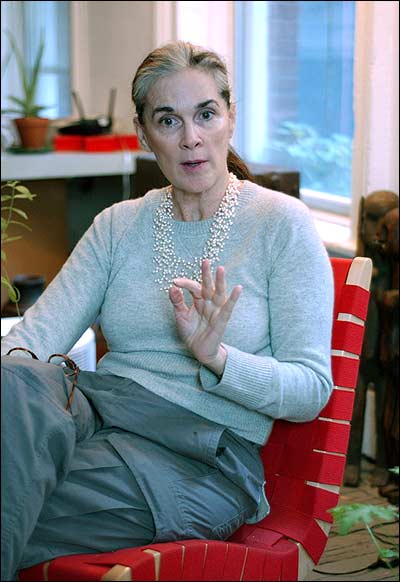
Author Susanna Moore,
photo by Paresh Gandhi
An article in The Telegraph
on the late Sybille Bedford
(see also the previous entry), and

On Glory Roads:
A Pilgrim's Book
About Pilgrimage,
by Eleanor Munro
Wednesday, March 1, 2006 12:00 AM
