From the journal of Steven H. Cullinane...
2005 October 01-31
Monday, October 31, 2005 10:23 AM
Halloween
Meditations
"They don't understand
what it is to be awake,
To be living
on several planes at once
Though one cannot speak
with several voices at once."
-- T. S. Eliot,
The Family Reunion
"Multispeech is
a mode of communication...
which facilitates
direct idea transference
at high speed
and with 'multiple channels'
like a kind of
multidimensional speech -
described in contrast to
normal language
which is, of course, strictly
linear and one-dimensional."
--
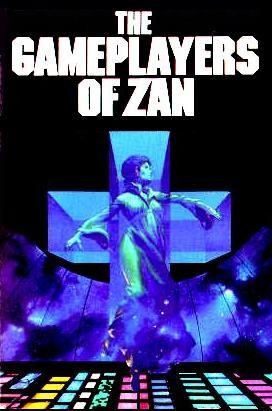
langmaker.com on
The Gameplayers of Zan
"Examples are the
stained-glass windows
of knowledge."
--
Vladimir Nabokov
"necess yet again from bridge of brainbow
oyotecraven stare decesis on landaway necessity timeslast the arnings
ent and tided turn yet beastfall nor mindstorms neither in their
canceling sarved cut the line that binds ecessity towarn and findaway
twill open pandorapack wishdearth amen amenusensis opend the mand of
min apend the pain of durthwursht vernichtung desiree tolight and eadly
dth cessity sesame
Monday, October 31, 2005 2:00 AM
Balance

"An asymmetrical balance is sought since
it possesses more movement. This is achieved by the imaginary plotting
of the character upon a nine-fold square, invented by some ingenious
writer of the Tang dynasty. If the square were divided in half or in
four, the result would be symmetrical, but the nine-fold square permits
balanced asymmetry."
-- Chiang Yee,
Chinese Calligraphy,
quoted in
Aspen
no. 10, item 8
"'Burnt Norton' opens as a meditation on time. Many comparable and
contrasting views are introduced. The lines are drenched with
reminiscences of Heraclitus' fragments on flux and movement....
the chief contrast around which Eliot constructs this poem is that
between the view of time as a mere continuum, and the difficult
paradoxical Christian view of how man lives both 'in and out of time,'
how he is immersed in the flux and yet can penetrate to the eternal by
apprehending timeless existence within time and above it. But even for
the Christian the moments of release from the pressures of the flux are
rare, though they alone redeem the sad wastage of otherwise unillumined
existence. Eliot recalls one such moment of peculiar poignance, a
childhood moment in the rose-garden-- a symbol he has previously used,
in many variants, for the birth of desire. Its implications are
intricate and even ambiguous, since they raise the whole problem of how
to discriminate between supernatural vision and mere illusion. Other
variations here on the theme of how time is conquered are more directly
apprehensible. In dwelling on the extension of time into movement,
Eliot takes up an image he had used in 'Triumphal March': 'at the still
point of the turning world.' This notion of 'a mathematically pure
point' (as Philip Wheelwright has called it) seems to be Eliot's poetic
equivalent in our cosmology for Dante's 'unmoved Mover,' another way of
symbolising a timeless release from the 'outer compulsions' of the
world. Still another variation is the passage on the Chinese jar in the
final section. Here Eliot, in a conception comparable to Wallace
Stevens' 'Anecdote of the Jar,' has suggested how art conquers time:
Only by the form, the pattern,
Can words or music reach
The stillness, as a Chinese jar still
Moves perpetually in its stillness."
-- F. O. Matthiessen,
The Achievement of T.S. Eliot,
Oxford University Press, 1958,
as quoted in
On "Burnt Norton"
Sunday, October 30, 2005 2:56 PM
Recommended Reading
for Hogwarts Students
on Devil's Night:
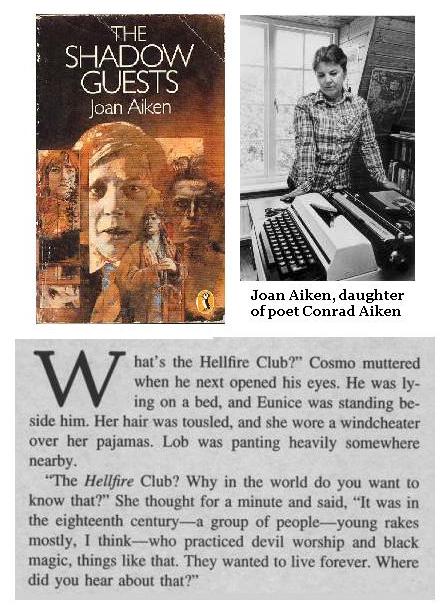
Click on the above for details.
Saturday, October 29, 2005 11:07 PM
Aquarius Jazz
 Adapted from Matisse
"The Jazz Age spirit flared
in the Age of Aquarius."
-- Maureen Dowd, essay
for Devil's Night, 2005:
What's a Modern Girl to Do?
"I hope she'll be a fool --
that's the best thing a girl can be
in this world, a beautiful little fool."
-- Daisy Buchanan in Chapter I
of The Great Gatsby
"Thanks for the tip,
American Dream."
-- Spider-Girl, in
Vol. 1, No. 30, March 2001
(Excerpts from
Random Thoughts
for St. Patrick's Eve)
Saturday, October 29, 2005 3:17 PM
Aion
From AP's "Today in History" for October 29:
On this date:
In 1967, the counter-culture musical "Hair" opened off-Broadway.
Related material:
Jung on Pisces and Aquarius in Aion
The Da Vinci Code and Symbology at Harvard
"This is the turning point
Funny
But by the end
Bitter and serious and deadly"
-- Jill O'Hara singing "The
Climax"
in "Hair"
(original cast recording)
Saturday, October 29, 2005 1:00 PM
For Kate Jackson on her birthday:
Drop-Dead Gorgeous
I need a photo-opportunity
I want a shot at redemption
Don't want to end up a cartoon
In a cartoon graveyard
-- Paul Simon

"The idea that this Sad Geezer may fancy a cartoon character is, of
course, ludicrous (even if she is drop-dead gorgeous…)."
-- Aeon Flux - An Introduction
"Dr. Cameron was also interested in how chemical elements are formed
inside stars, a field known as nucleosynthesis."
-- Today's New York Times.
Saturday, October 29, 2005 4:23 AM
Flux Redux
"I remember how the darkness doubled
I recall lightning struck itself
I was listening, listening to the rain
I was hearing, hearing something else
Life in the hive puckered up my night
The kiss of death, the embrace of life
There I stand neath the Marquee Moon
Just waiting"
--
Tom Verlaine, "Marquee Moon"

In memory of
Michael Gill,
producer and director of the
1969 TV series "Civilisation,"
who died on October 20:
Two descriptions of "Aeon Flux,"
a story featured in
the Log24 entry
on the day that Gill died --
"The title character is a tall, sexy,
scantily-clad secret agent from the country of Monica.... Her mission
is to infiltrate the strongholds of the neighboring country of Bregna,
which is led by her sworn enemy, and sometimes lover, Trevor
Goodchild. Monica represents a dynamic anarchist society while
Bregna embodies a
centralized scientific planned state."
--
Wikipedia
"After Aeon is done, Trevor decides that she knows too much, so he has
a underling propose a plan to kill her. The plan, quite strangely, is
to implant a bunch of nanites (microscopic robots) in Trevors seminal
duct so he has sex with Aeon and the nanites tear her apart from the
inside. But Aeon was prepared because she had some weird, mean,
spiky, device in her uterus(!?!!) that eats the nanites (that part is
kinda weak), she blows up a wall then and escapes leaving Trevor
standing there naked and confused."
-- The
Sad Geezers Guide
to Aeon Flux Cultures
In memory of
Richard Smalley,
advocate of nanotechnology,
who died yesterday at 62:
The Incredible Shrinking Man
(Wired Magazine, October 2004)
See also yesterday's entry on Scientism.
In memory of
Thomas Wootton Masland,
brother of
Richard Harry Masland, Harvard '64,
the Log24 entries of October 25.

Tom Masland
Funeral services for
Masland will be held Sunday, Oct. 30, at 5 p.m. at St. Paul's Episcopal
Church, 113 Engle Street, Englewood, N.J. The family asks that in lieu
of flowers, a donation be made to the Jazz Foundation of America, 322
West 48th Street, New York, N.Y. 10036. The group helps elderly and
ailing jazz and blues musicians with medical care, housing and other
services.
Friday, October 28, 2005 4:30 PM
Skeptics' Anniversary
From AP's "Today in History" for Oct. 28:
"On this date:
In 1636, Harvard College was founded in Massachusetts."
In the spring of 1960, Harvard sent to all incoming freshmen a reading
list consisting, as I recall, of two books:
1. Fads and Fallacies in the
Name of Science, by Martin Gardner (Dover, 1957), and
2. A book on evolution, whose title I do not recall.
Perhaps it was Apes, Angels, and
Victorians, by William Irvine (McGraw-Hill, 1955).
I found in later years that Gardner was not to be trusted (certainly
not on the subject of mathematics-- he never had even one college
course in the subject). Darwin, however, still seems eminently
reasonable.
For my own views on the religion of Scientism advocated by many at
Harvard and by those who admire Gardner, see
For a musical version of some related views, see
For an update on the religion of Scientism, see yesterday's Newsday:
The word "nonreligious" here should, since Scientism itself
amounts to a religion, be viewed with a great deal of skepticism.
Thursday, October 27, 2005 12:48 PM
Final Arrangements, continued...
They Might Be Giants

Wednesday, October 26, 2005 2:56 PM
Human Conflict
Number Five
(Album title, 10,000 Maniacs)

This album contains
Planned Obsolescence:
science
is truth for life
watch religion fall obsolete
science
will be truth for life
technology as nature
science
truth for life
in fortran tongue the
answer
with wealth and prominence
man so near perfection
possession
it's an absence of interim
secure no demurrer
defense against divine
defense against his true
image
human conflict number five
discovery
dissolved all illusion
mystery
destroyed with conclusion
and illusion never restored
any modern man can see
that religion is
obsolete
piety
obsolete
ritual
obsolete
martyrdom
obsolete
prophetic vision
obsolete
mysticism
obsolete
commitment
obsolete
sacrament
obsolete
revelation
obsolete
Secrets of the I Ching
(Album title, 10,000 Maniacs)
Time of this entry: 2:56:37
Question suggested by the
lottery in the state of Grace
(Kelly) on the night Sinatra died:
What is 256 about?
Answer: 37.
In other words...


For details, see Log24,
11 AM Sunday, October 16:
Philadelphia Stories.
Wednesday, October 26, 2005 7:48 AM
Today's Birthday:
Natalie Merchant
From Wikipedia:
For Natalie,
a new web page summing up the
benefits of a Fredonia education:
Certified Crank
Tuesday, October 25, 2005 7:59 PM
And for the Halloween season...
Darkness Doubled
"The mixolydian mode is one of the authentic 'church modes' of the
Middle Ages.... On the white notes of a piano, the mixolydian
scale runs from G to G."
Lulu
Friday, Oct. 21--Saturday, Oct. 29.... Tickets available at the Harvard
Box Office and Loeb Drama Center Box Office, 64 Brattle St.
The film version:

Related material:
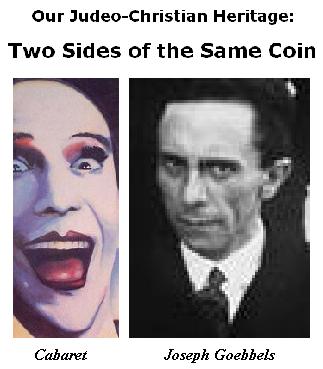
Click on pictures for details.
Tuesday, October 25, 2005 12:00 PM
Brightness Doubled

From
Log24 on October 7, 2005,
the day that
Dr. Michael Ward died:
Seven is Heaven
"Love is the shadow that ripens the vine.
Set the controls for the heart of the Sun.
Witness the man who raves at the wall
Making the shape of his questions to Heaven.
Knowing the sun will fall in the evening,
Will he remember the lessons of giving?
Set the controls for the heart of the Sun.
Set the controls for the heart of the Sun."
-- Roger Waters, quoted in
Allusions to Classical
Chinese Poetry in Pink Floyd
Saturday, October 22, 2005 2:12 PM
Barrington Moore Jr. in 1978 On Moral
Outrage:
"People's organizations, loudspeakers, newspapers, the secret
police, and the courts all swing into action and the campaign is
launched. A reasonably intelligent person, particularly the educated
product of Chinese civilization, which for centuries has stressed the
nuances of moral indignation in a setting of intrigue and bureaucratic
protocol, will know at once just how to adjust facial expressions and
tones of voice in showing the correct degree of indignation for each
degree on the official set of priorities that ranks all possible
varieties of the execrable behavior of the enemies of the people. A
poor peasant or worker cannot be expected to do as well.
Worse still, a peasant or a worker may have trouble understanding why
this year's enemies of the people include some of last year's heroes,
and why it is necessary to have another exhausting campaign so soon if
the last one was as successful as everybody said it was. But since
socialism is a workers' and peasants' state that belongs to the people,
there are lots of people to explain such matters to workers and
peasants, and indeed to anybody else who cares to listen. Furthermore
just about everybody must care to listen. Woe to the person who
stubbornly refuses to listen to the right noises or to try to make the
right noises under socialism, since a socialist state is very efficient
in its allocation of human as well as material resources."
"Come gather 'round friends
And I'll tell you a tale of when
the red iron pits ran plenty....
My children will go
As soon as they grow.
Well, there ain't nothing
here now to hold them."
-- Robert Zimmerman,
"
North
Country Blues," 1963
"Well, if you're travelin'
in the north country fair,
Where the winds hit heavy
on the borderline,
Remember me to
one who lives there.
She once was
a true love of mine."
-- Robert Zimmerman,
"
Girl
of the North Country," 1963
 Click
to enlarge
Click
to enlarge.
Above: propaganda poster of
the 2005 October revolution.
The title of the current film
"
North Country"
was taken from Zimmerman's
second song above.
Apparently Zimmerman's first lament,
about the iron pits being idle, is not currently in favor with
leftists. It still has validity, however. See
Where the Rivers Run North,
by
Diane Alden.
Alden, who has lived in northern
Minnesota, is perhaps more familiar with its problems than is the
New Zealand feminist Niki Caro (director of "Whale
Rider," as well as "North Country").
Thursday, October 20, 2005 4:25 PM
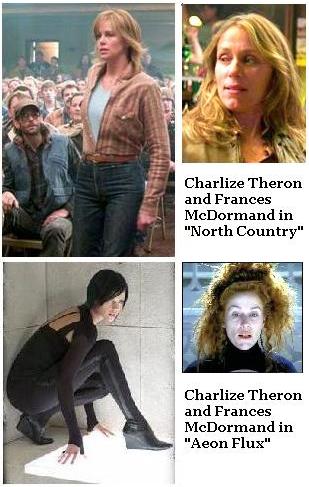
North Country Flux
Wednesday, October 19, 2005 3:00 PM
#
"Beauty therefore is a relation."
-- Gerard Manley Hopkins


Leo Bogart,
dead on Oct. 15.
No relation.
|
|
“Leo Bogart is surely the Grand
Master of social research in the world of the newspaper and the mass
media in general.”
|
Tuesday, October 18, 2005 11:07 AM
11:07:16
"Serious numbers
will always be heard."
-- Paul Simon (64 on Oct. 13)
"Her wallet's filled with
pictures."
-- Chuck Berry (79 today)

Collegiate Church of
St. Mary Magdalene,
Atrani, Amalfi Coast, Italy:
"An interior made exterior"
-- Wallace Stevens
Monday, October 17, 2005 1:00 PM
Place
"Critics have compared Mr. Stone to Conrad, Faulkner, Hemingway, Graham
Greene, Malcolm Lowry, Nathanael West; all apt enough, but there's a
James T. Farrell, Raymond Chandler, Dashiell Hammett strain as well - a
hard-edged, lonely intelligence that sets bright promise off against
stark failure and deals its mordant hand lightly. In A Flag for Sunrise (1981), an
anthropologist observes: 'There's always a place for God. . . . There is some question as to
whether He's in it.'"
-- Jean Strouse on Robert Stone
"When times are mysterious
Serious numbers will always be heard
And after all is said and done
And the numbers all come home
The four rolls into three
The three turns into two
And the two becomes a
One"
-- Paul Simon,
"When Numbers Get Serious," from
"Hearts
and Bones" album, 1983
"Hickory Dickory Dock...."
-- Anonymous folk tune
Sunday, October 16, 2005 11:00 AM
Philadelphia Stories
for John O'Hara
How does one stand
To behold the sublime,
To confront the mockers,
The mickey mockers
And plated pairs?
-- Wallace Stevens, 1936
On the left, a Catholic answer.
On the right, a Protestant answer.
Pictured:
"High Society," "The Philadelphia Story,"
"Rocky" statue, Robert Scott
These are familiar parts of
popular culture except for Scott, who died on Thursday. According
to the New York Times, Scott's mother, "the former
Helen Hope Montgomery, was said to be the model for Tracy Lord,
Katharine Hepburn's character in 'The Philadelphia Story.'" "High
Society" is, of course, a
rather Catholic version of that story, starring
Grace Kelly, also of Philadelphia.
Saturday, October 15, 2005 10:28 AM
Canon
A brief note to place Edward
Bennett Marks, who died either on Saturday, October 8, 2005 (Washington Post), or on Monday, October 10, 2005 (New
York Times), in my personal canon of saints. Today's New York
Times says that Marks spent his career "aiding refugees as an executive
of American and international agencies, both official and
volunteer." This alone was commendable, but not miraculous.
The miraculous is contained in three words from the Log24 entry of October 10, the date of death of
Orson Welles, of Yul Brynner, and perhaps of Marks: "All come home."
For a rather different perspective on St. Yul Brynner, see "Shall We
Dance?"-- a profile by Calvin Tomkins in this week's New Yorker
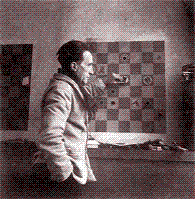
(issue dated 2005 10/17, posted 10/10) of an artist raised in Bangkok. It is perhaps not
irrelevant that the chess enthusiast Marcel Duchamp plays a prominent
role in this piece.
Some other remarks on chess and art:
From Introduction to Aesthetics
(Log24, October 10, 2004) --
G. H. Hardy on chess problems:
"It is essential... (unless the
problem is too simple to be really amusing) that the key-move should be
followed by a good many variations, each requiring its own individual
answer."
According to the New York Times, Marks died on Oct. 10 (see related entry).
According to the Washington Post, Marks died on Oct. 8 (see related entry). |
For some remarks on art by St. Edward, see UN Chronicle, Issue 4, 1998.
Friday, October 14, 2005 12:00 PM
(12:00:02 PM EDT Oct. 14, 2005)
For
Richard
Roth, senior United Nations
correspondent for CNN, a card:

Thursday, October 13, 2005 12:00 PM
A Poem for Pinter
The Guardian on Harold Pinter, winner of this year's
Nobel Prize for Literature:
"Earlier this year, he announced his decision to retire from
playwriting in favour of poetry,"
Michael Muskal in
today's Los Angeles Times:
"Pinter, 75, is known for his sparse and thin style as well as his
etched characters whose crystal patter cuts through the mood like
diamond drill bits."
Robert Stone,
A Flag for Sunrise (
See Jan. 25):
"'That old Jew gave me this here.' Egan looked at the
diamond.... 'It's worth a whole lot of money-- you can tell that
just by looking-- but it means something, I think. It's got a
meaning, like.'
'Let's see,' Egan said, 'what would it mean?' He took hold of
Pablo's hand cupping the stone and held his own hand under it.
'"The jewel is in the lotus," perhaps that's what it means. The
eternal in the temporal....'"
Notes on Modal
Logic:
|
A Poem for Pinter

|
Commentary:
Wednesday, October 12, 2005 11:00 AM
Don't Know Much About
History
 Click to enlarge.
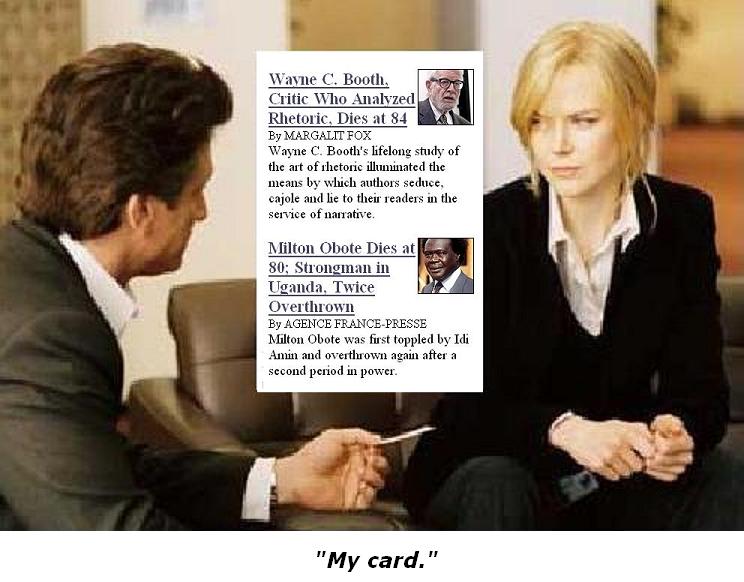
"My card."
Sources:
Today's online New York Times
and Sean Penn and Nicole Kidman
in "The Interpreter"
|
"Is Heart of Darkness the story of
Kurtz or the story of Marlow’s experience of Kurtz? Was Marlow
invented as a rhetorical device for heightening the meaning of Kurtz’s
moral collapse, or was Kurtz invented in order to provide Marlow with
the centre of his experience in the Congo? Again a seamless web,
and we tell ourselves that the old-fashioned question 'Who is the
protagonist?' is a meaningless one."
|
The dates of death for the two men
pictured in the Times clipping were
October 9 and
October 10.
Log24 entries for those dates contain allusions
to games of chance and games of skill.
See also yesterday's entry.
Tuesday, October 11, 2005 2:08 PM
Storytelling
and Game Theory
 Click on picture for details.
"Game theory is no doubt wonderful for telling
stories. However, it flunks the main test of any scientific
theory: The ability to make empirically testable predictions."
-- "
A Nobel Letdown in Economics,"
by Michael Mandel in Business Week
Monday, October 10, 2005 10:00 AM
Starflight
"The crème de la crème
of the chess world in a
show with everything
but Yul Brynner"
--
One Night in Bangkok

Mate in 2,
V. Nabokov, 1919,
"Starflight" theme
Today is the feast of St. Yul Brynner,
who died on this date in 1985.
"Head bent down over the guitar,
he barely seemed to hum;
ended "all come home";
....
Yule-- Yul log for the
Christmas-fire tale-spinner--
of fairy tales that can come true.
Yul Brynner."
-- Marianne Moore,
"Rescue with Yul Brynner"
Related material:
Starflight, a year ago today
Pleiades, by Ivan Bunin, winner of the Nobel Prize
for Literature in 1933, whose birthday is today
Natasha's Dance (Log24, Jan. 8, 2004)
Star!
by John Gregory Dunne (NY Review of Books, Jan. 15, 2004)
Sunday, October 9, 2005 11:00 AM
Today's Sermon:
Magical Thinking
On this date-- "In 1936,
the first generator at Boulder
(later Hoover) Dam began
transmitting electricity to Los Angeles."
-- Today in History, Associated Press
"... She thought about nothing. Her mind was a blank tape,
imprinted daily with snatches of things overheard, fragments of
dealers' patter, the beginnings of jokes and odd lines of song
lyrics. When she finally lay down nights in the purple room she
would play back the day's tape, a girl singing into a microphone and a
fat man dropping a glass, cards fanned on a table and a dealer's rake
in closeup and a woman in slacks crying and the opaque blue eyes of the
guard at some baccarat table. A child in the harsh light of a
crosswalk on the Strip. A sign on Fremont Street. A light
blinking. In her half sleep the point was ten, the jackpot was on
eighteen, the only man that could ever reach her was the son of a
preacher man, someone was down sixty, someone was up, Daddy wants a
popper and she rode a painted pony let the spinning wheel spin.
By the end of a week she was thinking constantly about where her
body stopped and the air began, about the exact point in space and time
that was the difference between Maria and other.
She had the sense that if she could get that in her mind and hold it
for even one micro-second she would have what she had come to
get. As if she had fever, her skin burned and crackled with a
pinpoint sensitivity. She could feel smoke against her
skin. She could feel voice waves. She was beginning to feel
color, light intensities, and she imagined that she could be put
blindfolded in front of the signs at the Thunderbird and the Flamingo
and know which was which. 'Maria,' she felt someone whisper one
night, but when she turned there was nobody.
She began to feel the pressure of Hoover Dam, there on the desert,
began to feel the pressure and pull of the water. When the
pressure got great enough she drove out there. All that day she
felt the power surging through her own body. All day she was
faint with vertigo, sunk in a world where great power grids converged,
throbbing lines plunged finally into the shallow canyon below the dam's
face, elevators like coffins dropped into the bowels of the earth
itself. With a guide and a handful of children Maria walked
through the chambers, stared at the turbines in the vast glittering
gallery, at the deep still water with the hidden intakes sucking all
the while, even as she watched, clung to the railings, leaned out,
stood finally on a platform over the pipe that carried the river
beneath the dam. The platform quivered. Her ears
roared. She wanted to stay in the dam, lie on the great pipe
itself, but reticence saved her from asking.
'Just how long have you been here now,' Freddy Chaikin asked when
she ran into him in Caesar's. 'You planning on making a year of
it? Or what?'"
Related material
The front page of today's
New York Times Book Review
and Log24, July 15, 2004:
|

A quotation that somehow
seems relevant:
O the mind, mind has mountains,
cliffs of fall
Frightful, sheer, no-man fathomed.
Hold them cheap
May who ne'er hung there.
-- Gerard Manley Hopkins
|
Saturday, October 8, 2005 8:48 PM
News for Mina Le
Saturday, October 8, 2005 11:49 AM
Saturday, October 8, 2005 10:08 AM
In memory of Jacques Derrida,
who died one year ago today:
A History of Death
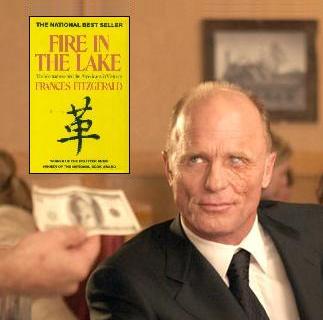
References:
1. Fire in the Lake, by Frances FitzGerald
2. A History of Violence, a film by
David Cronenberg
3. The Gift of Death, by Jacques Derrida
Related material:
Derrida on Giving,
Last-Minute Shopping
Friday, October 7, 2005 7:00 PM
Seven is Heaven

"Love is the shadow that ripens the vine.
Set the controls for the heart of the Sun.
Witness the man who raves at the wall
Making the shape of his questions to Heaven.
Knowing the sun will fall in the evening,
Will he remember the lessons of giving?
Set the controls for the heart of the Sun.
Set the controls for the heart of the Sun."
-- Roger Waters, quoted in
Allusions to Classical
Chinese Poetry in Pink Floyd
Friday, October 7, 2005 12:00 PM
Oslo Connection
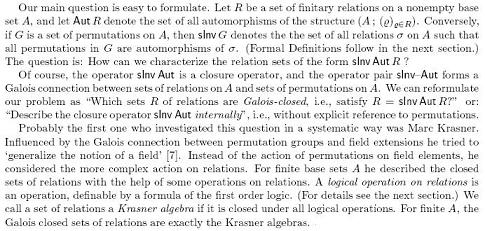
Today is the birthday of Oystein Ore (1899-1968), Sterling Professor of
Mathematics at Yale for 37 years, who was born and died in Oslo,
Norway. Ore is said to have coined the term "Galois
connection." In his honor, an excerpt dealing with such
connections:
Thursday, October 6, 2005 7:24 AM
Freedom of the Press
From about 7:00 AM EDT today:

Thursday, October 6, 2005 2:00 AM
A Voice
In memory of
Harold Leventhal,
folk-music concert producer,
who died on Tuesday
(Rosh Hashana, 2005)
Leventhal recently appeared in the American Masters Bob
Dylan documentary on PBS. According to today's NYT obituary, "Mr. Leventhal was... widely, if
tacitly, acknowledged to have been the inspiration for Irving
Steinbloom, the folk impresario whose memorial concert sets in motion
the plot of the 2003 film comedy 'A Mighty Wind.'"
From a Rosh Hashana sermon by Devra Felder Noily:
"Throughout these Holy Days we will chant Unetaneh Tokef, a
liturgical poem more than a thousand years old. In it we find the words:
U-ve shofar gadol yi-ta-ka. V' kol d'ma-ma da-kah yi-shama.
The great shofar is sounded. And a still small voice is heard....
The prayer quotes from the book of Kings. There, the prophet Elijah
has reached his breaking point, and God reaches out to him. The text
tells us:
Then the Eternal passed by. There was a great and mighty
wind, splitting mountains and shattering rocks by the power of God, but
God was not in the wind. After the wind, an earthquake-- but God was
not in the earthquake. After the earthquake, fire-- but God was not in
the fire. And after the fire, a still small voice."
Wednesday, October 5, 2005 5:00 PM
New Page for Harvard's President
From today's Harvard Crimson:
"University President Lawrence H. Summers said
yesterday that he will marry his longtime partner, Professor of English
Elisa New."
"I dwell in Possibility -
A fairer House than Prose"
-- Emily Dickinson, quoted in
The
Regenerate Lyric:
Theology
and Innovation
in
American Poetry, by
Elisa New, page 162
Related material:
Log24 entries for Jan. 24 and 25, 2005.
Wednesday, October 5, 2005 6:00 AM
New Page on Geometry
See Pattern
Groups, which now has a link to an interesting Nov. 2003
preprint on A6.
Today is the birthday of Sir Thomas L. Heath, a saint of geometry whose feast
day is March 16.
Monday, October 3, 2005 10:00 AM
On This Date
"In 1955, 50 years ago, 'Captain Kangaroo'
and 'The Mickey Mouse Club'
premiered on CBS and ABC, respectively."
-- Today in History, Associated Press
Part I
For a Christian meditation on Captain Kangaroo, see the
Log24 entries of Jan. 24, 2004.
Part II
"Rosh Hashana, the Jewish New Year, begins at sunset."
-- Today in History, Associated Press
A Rosh Hashana catechism:
Question
(See Chorus from the Rock.)
How does one stand
To behold the sublime,
To confront the mockers,
The mickey mockers
And plated pairs?
-- Wallace Stevens,
"The American Sublime"
Answer
"Spear Daddy!" in yesterday's entry,
Happy Birthday, Wallace Stevens
Sunday, October 2, 2005 1:06 PM
Happy Birthday, Wallace Stevens
Readings for today:
At the Wallace Stevens online
concordance, search for X and for primitive.
In the e-book edition of Bester's The Deceivers, search for X.
"We seek
Nothing beyond reality. Within it,
Everything, the spirit's alchemicana
Included, the spirit that goes roundabout
And through included, not merely the visible,
The solid, but the movable, the moment,
The coming on of feasts and the habits of saints,
The pattern of the heavens and high, night air."
-- Wallace
Stevens,
Oct. 2, 1879 - Aug. 2, 1955,
"An Ordinary Evening in New Haven"
IX.1-18, from The Auroras of Autumn,
Knopf, NY (1950)
Related material:
(Added Monday, Oct. 3, 8:45 AM)
"What if Shakespeare had been born in Teaneck, N.J., in 1973?
He would call himself Spear Daddy. His rap would exhibit a profound,
nuanced understanding of the frailty of the human condition, exploring
the personality in all its bewildering complexity: pretension, pride,
vulnerability, emotional treachery, as well as the enduring triumph of
love.
Spear Daddy would disappear from the charts in about six weeks."
-- Gene Weingarten in the Washington Post,
Sunday, Oct. 2, 2005
Presenting...