From http://www.xs4all.nl/~timkr/chess2/diary_1.htm.....
Open Chess Diary entries 1-20, 1999, by Tim Krabbé, Amsterdam
9. 1 July: Starflight.
Nabokov yet again—what can I do against chance, and this being his centennial
year.
A friend who visited the 'Nabokov under glass' exhibition
in the New York Public Library (5th Ave. & 42nd St.; opened till August
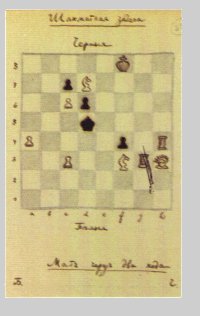
21) brought me its little program book. It has the facsimile of a page
from a 1919 notebook, with a diagram drawn by the 20- or 19-year old Vladimir
of a chess problem—one that has never been published before.
It is not a great problem (coming from an anonymous
it would hardly be published today), but for a beginner, in 1919, it is
really good. The solution of this two-mover is not difficult (but that
is not the point of a good problem) and in a way, even obvious.
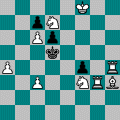 Mate in 2
V. Nabokov, 1919
Mate in 2
V. Nabokov, 1919
|
The black king has three white flight squares, without mates being provided
for these flights, which suggests giving him a fourth. 1.Bg2 therefore
presents itself, especially when you notice that it prepares mates for
all the flights, and for the king remaining on its original square.
1.Bg2
Kxc6 2.Nfe5 mate
Ke6 2.Nd4 mate
Kc4 2.Nd2 mate
Ke4 2.Nd4 mate
fxg3 2.Ng5 mate
The five variations together are the theme; 'starflight'. (With orthogonal
squares it is called plus- or cross-flight.) Starflight is one of the oldest
themes in problem history; the first one was constructed in 1852. It has
later been used for very ingenious and complicated problems, where for
instance White has mates ready for the entire star, but no key with which
he can keep these mates. There is a key however which still allows the
star, which is now met by new mating moves - which are sometimes related
to the original ones in some amazing way.
Nabokov's problem, in its simple prettiness and
purity, suggests he has just invented starflight himself.