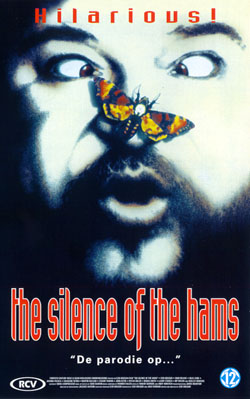
Are the hams silent now, Clarice? See also my Xanga entry of August 3, 2002.

|
Tuesday, October 15, 2002 |
Are the hams silent now, Clarice? See also my Xanga entry of August 3, 2002. |
|
Tuesday, October 15, 2002 |
From the Archives: On this date in 1971, "Rick Nelson was booed off the stage when he didn’t stick to all oldies at the seventh Annual Rock ’n’ Roll Revival show at Madison Square Garden, New York. He tried to slip in some of his new material and the crowd did not approve. The negative reaction to his performance inspired Nelson to write his last top-40 hit, 'Garden Party,' which hit the top-ten about a year after the Madison Square Garden debacle. 'Garden Party,' ironically, was Nelson’s biggest hit in years." "With a little effort, anything can be shown to connect with anything else: existence is infinitely cross-referenced." -- Opening sentence of Martha Cooley's The Archivist Woe unto Isaiah 5:20 As she spoke The world Cole Porter Actor Pat O'Brien died on this date in 1983. "A man in Ireland, who came in contact with a Bible colporteur, at first repulsed him. Finally he was persuaded to take a Bible and later he said: 'I read a wee bit out of the New Testament every day, and I pray to God every night and morning.' When asked if it helped him to read God's Word and to pray, he answered: 'Indade it does. When I go to do anything wrong, I just say to myself, "Pat, you'll be talking to God tonight." That keeps me from doing it!'" colporteur |
|
Monday, October 14, 2002 |
Going His Way October 14 in history: 1888 Katherine Mansfield, author, is born. 1977 Bing Crosby, singer/actor (Going My Way), dies. "He was given up to his dream. What did garden-parties and baskets and lace frocks matter to him? He was far from all those things. He was wonderful, beautiful.... Happy ... happy ... All is well, said that sleeping face. This is just as it should be. I am content." -- Katherine Mansfield, "The Garden Party" In honor of Mansfield, Crosby, and other authors and singers, this site's music is now a midi rendition of Rick Nelson's classic.
|
|
Sunday, October 13, 2002 |
Two Literary Classics On this date in 1962, Edward Albee's classic play, "Who's Afraid of Virginia Woolf?" opened on Broadway.
As I was preparing this entry, based on the October 13 date of the Albee play's opening, after I looked for a picture of Marshall's book I thought I'd better check dates related to Marshall, too. This is what I was surprised to find: Marshall (b. Oct. 10, 1942) died in 1992 on today's date, October 13. This may be verified at The James Edward Marshall memorial page, A James Edward Marshall biography, and Author Anniversaries for October 13. The titles of the three acts of Albee's play suffice to indicate its dark spiritual undercurrents: "Fun and Games" (Act One), A theological writer pondered Albee in 1963: "If, as Tillich has said of Picasso's Guernica, a 'Protestant' picture means not covering up anything but looking at 'the human situation in its depths of estrangement and despair,' then we could call Edward Albee's Who's Afraid of Virginia Woolf? a 'Protestant' play. On any other definition it might be difficult to justify its religious significance except as sheer nihilism." It is a great relief to have another George and Martha (who first appeared in 1972) to turn to on this dark anniversary, and a doubly great relief to know that Albee's darkness is balanced by the light of Saint James Edward Marshall, whose feast day is today. For more on the carousel theme of the Marshall book's cover, click the link for "Spinning Wheel" in the entry below. 10:55 pm Comments on this post:
|
|
Saturday, October 12, 2002 |
She's a...
In honor of this dance, of Columbus, and of Joan Didion, this site's music for the weekend is "Spinning Wheel." For the relevance of this music, see Chapter 65 (set in Las Vegas) of Didion's 1970 novel Play It As It Lays, which, taken by itself, is one of the greatest short stories of the twentieth century. The photograph of Didion on the back cover of Play It (taken when she was about 36) is one of the most striking combinations of beauty and intelligence that I have ever seen. She's the queen of cool Play It As It Lays is of philosophical as well as socio-literary interest; it tells of a young actress's struggles with Hollywood nihilism. For related material, see The Studio by Didion's husband, John Gregory Dunne. A review of Dunne's book: "Not since F. Scott Fitzgerald and Nathanael West has anyone done Hollywood better." High praise indeed. |
|
Friday, October 11, 2002 |
The Fourth Man:
Arthur Koestler's somewhat more respectable mystical thoughts about infinity may be found here. Related material: my September 5 entry, Arrow in the Blue. Added ca. 10 to 11:40 p.m. October 11, 2002: A review of Castaneda seems in order... the bad Carlos, not the good Carlos. (The bad Carlos being, of course, the bullshit artist who apparently died in 1998, and the good Carlos the publisher who died yesterday.) From the LiveJournal site of fermina -- Today's Public Service Message:
My comment: From a review of Carlos Castaneda's last book, The Active Side of Infinity: "We wind up learning something more of Castaneda but not much at all about the active side of infinity, which is mystically translated as 'intent.' It appears that we ought to live with intent, never forgetting that we will die, regardless. Death (and the knowledge of it) should thus inform all of our actions and relationships, providing a perspective and enforcing our humility. This is hardly an original idea, and it can't justify wading through Castaneda's welter of self-indulgence, which might translate better to a bumper-sticker adage." Hmm... What adage might that be? As for the good Carlos, see "In Lieu of Rosebud, Part II," below... As was said of Saint Francis Borgia, whose feast is celebrated on the day good Carlos died, he 5:10 pm Comments on this post:
|
|
Friday, October 11, 2002 |
In Lieu of Rosebud, Part II* Bernard Ridder dies at 85 BY MARTIN MERZER Bernard H. Ridder Jr., once one of the nation's most influential publishers and the inheritor and protector of a family tradition of newspapering, died Thursday night. He was 85.... ''If there is one thing he instilled in me,'' [his son] Peter Ridder said, "it was to be honest. If you don't know the answer, say so.'' His father had been publisher of the St. Paul newspapers; his grandfather, Herman Ridder, launched the family business in 1875 as publisher of The Catholic News in New York. Though six-foot-five and with a commanding presence, he also was known as an honest, compassionate man and boss. A private memorial service will be held at a date to be determined, the family said. In lieu of flowers, relatives suggested a contribution to a charity of the donor's choice. Karl J. Karlson of The St. Paul Pioneer Press contributed to this report.
* For "In Lieu of Rosebud, Part I," see my entry of October 10, 9:44 a.m., below. My contributions: Harry Lime -- "In Italy for 30 years under the Borgias they had warfare, terror, murder, and bloodshed, but they produced Michelangelo, Leonardo da Vinci, and the Renaissance. In Switzerland they had brotherly love - they had 500 years of democracy and peace, and what did that produce? The cuckoo clock ..." It is with good reason that Spain and the Church venerate in St. Francis Borgia a great man and a great saint. The highest nobles of Spain are proud of their descent from, or their connexion with him. By his penitent and apostolic life he repaired the sins of his family and rendered glorious a name, which but for him, would have remained a source of humiliation for the Church. His feast is celebrated 10 October. The New York Times of October 11, 2002 -- This year's winner of the Nobel Prize for literature is Imre Kertész, a writer on Auschwitz. http://auschwitz.dk/Orson.htm -- In honor of Orson Welles and Bernard Ridder (who both died on October 10), of Imre Kertész (who won a Nobel Prize on October 10), and of the parent site of the Third Man site, this site's music is now the Third Man Theme. |
|
Thursday, October 10, 2002 |
Happy National Depression Day! Welcome to Hilbert's Hotel... Moray Eel Desk Clerk by Ralph Steadman "Although it's always crowded, "Some of our patrons have
Song by U2, (These lyrics differ from the official From where I stand Stay, we're on the dark side of love (Rest of song continues as above) (I'm back. And I'm gonna make it A primitive love See also the official U2 site. |
|
Thursday, October 10, 2002 |
In Lieu of Rosebud... On this date in 1985, Orson Welles died ...sitting at his typewriter, working on the next day's script changes for his movie,"The Other Side of the Wind." From a review of "Leaving Las Vegas" -- a film starring Nicolas Cage that includes a tribute to Welles: At least Cage dies without saying "Rosebud." To me, the musical equivalent of "Rosebud" in this film is a song that Sting sings on the soundtrack, "Angel Eyes," which of course was rendered to perfection in Vegas by Sinatra long before Cage and Sting. One visual equivalent, in turn, of "Angel Eyes," is to me a sketch for a painting I did in 1976. This has been likened to the many eyes of an angelic creature named Proginoskes in a novel for children and adolescents by Madeleine L'Engle. Perhaps the dark cynicism of Leaving Las Vegas (the book) might be somewhat counterbalanced by the looney religiosity of A Wind in the Door, L'Engle's novel. At any rate, here are links to the "Angel Eyes" © 1976 Steven H. Cullinane Also, "Angel Eyes" is now the background music for this site; one night of the Bach midi was enough.
|
|
Wednesday, October 09, 2002 |
Annie's Song In honor of Apollo (see entries below) and of the Red Mass celebrated tonight on the TV drama "The West Wing," this site's music is, for the time being, Bach's Mass in B minor (BWV.232) from the Classical Guitar Midi Archives. |
|
Wednesday, October 09, 2002 |
ART WARS: Apollo and Dionysus From the New York Times of October 9, 2002: Daniel Deverell Perry, a Long Island architect who created the marble temple of art housing the Sterling and Francine Clark Art Institute in Williamstown, Mass., died Oct. 2 in Woodstock, N.Y.... He was 97. From The Birth of Tragedy, by Friedrich Nietzsche (tr. by Shaun Whiteside): Chapter 1.... To the two gods of art, Apollo and Dionysus, we owe our recognition that in the Greek world there is a tremendous opposition, as regards both origins and aims, between the Apolline art of the sculptor and the non-visual, Dionysiac art of music. Chapter 25.... From the foundation of all existence, the Dionysiac substratum of the world, no more can enter the consciousness of the human individual than can be overcome once more by that Apolline power of transfiguration, so that both of these artistic impulses are forced to unfold in strict proportion to one another, according to the law of eternal justice. Where the Dionysiac powers have risen as impetuously as we now experience them, Apollo, enveloped in a cloud, must also have descended to us; some future generation will behold his most luxuriant effects of beauty. Notes: "When it opened in 1955, overlooking 140 acres of fields and ponds, Arts News celebrated its elegant galleries as the 'best organized and most highly functional museum erected anywhere.'"
|
|
Wednesday, October 09, 2002 |
On this date in 28 B.C. the Temple of Apollo Frui paratis et valido mihi, O grant me, Phoebus, calm content, -- The Odes and Carmen Saeculare of Horace, Representations of Apollo:
See also "Everything is found |
|
Tuesday, October 08, 2002 |
On Graham Greene's novel "Greene, always the master of economy, never wrote a tighter or more beautifully focused novel." "The main character is Maurice Castle, the head of the Africa station for a branch of British intelligence.... [the] writing is sparse and neat rather than languid or flowery...." From Chapter I: "Castle could see that telling the truth this time had been an error of judgement, yet, except on really important occasions, he always preferred the truth. The truth can be double-checked." On fiction and truth: Here is a short story that is The story is also true.
This problem embodies the "starflight" theme; As the example of Nabokov shows, a taste for truth (as in chess or geometry) may accompany a taste for fiction. This applies also to Krabbé, as shown by the following reviews of his novel The Cave: New York Times Library Journal |
|
Monday, October 07, 2002 |
Comment to Wakariyasui, translated I do not understand your phrase "the angel and the stone" (though I like it). Yes, many feel something is missing, and that their life is not complete. But also they are wise if they are suspicious of "vision." Many visions are, of course, false. --A fellow wanderer. |
|
Monday, October 07, 2002 |
Music for R.D. Laing In honor of the birth in Scotland on this date in 1927 of R. D. Laing, author of The Facts of Life, this site's music is today taken from the classic film "The Piano."
From the 1991 4th draft of Jane Campion's screenplay for
|
|
Sunday, October 06, 2002 |
Twenty-first Century Fox On Sunday, October 6, 1889, the Moulin Rouge music hall opened in Paris, an event that to some extent foreshadowed the opening of Fox Studios Australia in Sydney on November 7, 1999. The Fox ceremonies included, notably, Kylie Minogue singing "Diamonds are a Girl's Best Friend." Red Windmill Kylie Minogue For the mathematical properties of the red windmill (moulin rouge) figure at left, see Diamond Theory.
|
|
Saturday, October 05, 2002 |
The Message from Vega
"Mercilessly tasteful" 11:30 pm |
|
Saturday, October 05, 2002 |
Zen holy day: Bodhidharma Day Epigraph to Chapter 23 of Contact, by Carl Sagan: We have not followed cunningly devised fables.... Song lyric: It's still the same old story.... From Chapter 23 of Contact, by Carl Sagan: "You mean you could decode a picture hiding in pi and it would be a mess of Hebrew letters?" Moonlight and love songs, See also my journal note |
|
Friday, October 04, 2002 |
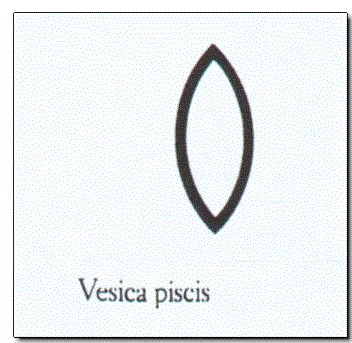
ART WARS: Today's birthdays: To honor the birth of these three noted spiritual leaders, I make the following suggestion: Use the mandorla as the New Orleans Mardi Gras symbol. Rice lives in New Orleans and LaBelle's classic "Lady Marmalade" deals with life in that colorful city. What, you may well ask, is the mandorla? This striking visual symbol was most recently displayed prominently at a meeting of U.S. cardinals in the Pope's private library on Shakespeare's birthday. The symbol appears in the upper half of a painting above the Pope. From Church Anatomy: The illustration below shows how Barbara G. Walker in her excellent book "The Woman’s Encyclopedia of Myths and Secrets" describes the mandorla.
For further details on the mandorla (also known as the "ya-ya") see my June 12, 2002, note The Ya-Ya Monologues.
A somewhat less lurid use of the mandorla in religious art -- the emblem of the Episcopal Diocese of South Carolina, taken from the website of St. Michael's Church in Charleston -- is shown below.

|
|
Thursday, October 03, 2002 |
Style A memorial to jazz pianist Ellis Larkins, |
|
Thursday, October 03, 2002 |
Literary Landmarks From Dr. Mac's Cultural Calendar for Oct. 3: "On this day in 1610, Ben Jonson's funniest comedy The Alchemist was entered into the Stationer's Register. It involves a servant who when the masters are away sets up a necromantic shop, tricking all and everyone." From Literary Calendar for tomorrow, Oct. 4: "1892 -- Robert Lawson, the only author/illustrator to win both the Caldecott Award and the Newbery Award—both coveted awards in the United States for children's literature, is born." As a child I was greatly influenced by Robert Lawson's illustrations for the Godolphin abridgement of Pilgrim's Progress. Later I was to grow up partly in Cuernavaca, Mexico, an appropriate setting for The Valley of the Shadow of Death and other Bunyan/Lawson themes. Still later, I encountered Malcolm Lowry's great novel Under the Volcano, set in Cuernavaca. Lowry's novel begins with an epigraph from Bunyan. For the connection with Ben Jonson, see Pete Hamill's article "The Alchemist of Cuernavaca" in Art News magazine, April 2001, pages 134-137. See also my journal note of April 4, 2001, The Black Queen. |
|
Wednesday, October 02, 2002 |
A Crackpot with Power The following is an greatly abbreviated version of a sci.math group thread on an attempted proof of the four-color theorem. There is a nicely presented approach to proving the Four Color Theorem... at the following... site: Where in the proof is the hypothesis of "requiring N colors" (not colorable with N-1 colors) used? (Following some banter) Go play elsewhere if you buy into 4CT crackpot proofs. The proposed 4CT proof is hardly crackpot, and may contain some new ideas (or reformulations of old ones). That's what all crackpots say. Join the club. My first-glance reaction is that it's an amazing collection of undigested chunks of heavy equipment. It seems more designed to confuse any expert (by making sure it contains something the expert doesn't understand) than to convince anyone of the truth of the 4CT. Skimming the proof I did not see any place where the minimality of the chromatic number N was used, nor any explanation of why a 12-fold covering is introduced (other than it fits the numerology needed to rule out a Steiner system). This makes me skeptical about the proof, but it's hardly crackpot. The author of this attempted proof, Ashay Dharwadker, is now an editor of the following Open Directory Project categories: Science: Math: Combinatorics and I agree with "Default," Eppstein, and Varney. As "Default" notes, the proof is invalid, since it does not even use the hypotheses of the theorem. I pointed this out in November 2000 in a sub-page of a website in the Open Directory combinatorics category, I also agree with Eppstein that Dharwadker's writing seems "designed to confuse." Finally, I strongly agree with Varney that Dharwadker is a crackpot. I reluctantly arrived at this conclusion only last night, after learning that |
|
Tuesday, October 01, 2002 |
Comment to Wakariyasui:
You are a philosopher after my own heart. |
|
Tuesday, October 01, 2002 |
Who's on First? To Lucero on October First, 2002: ES TU NOMBRE Y ES TAMBIÉN OCTUBRE... Es tu nombre y es también octubrees el diván y tus ungüentos es ella tú la joven de las turbaciones y son las palomas en vuelos secretos y el último escalón de la torre y es la amada acechando el amor en antemuros y es lo dable en cada movimiento y los objetos y son los pabellones y el no estar del todo en una acción y es el Cantar de los Cantares y es el amor que te ama y es un resumen de vigilia de vigilancia sola al borde de la noche al borde del soñador y los insomnios y también es abril y noviembre y los disturbios interiores de agosto y es tu desnudez que absorbe la luz de los espejos y es tu capacidad de trigo de hacerte mirar en las cosas y eres tú y soy yo y es un caminarte en círculo dar a tus hechos dimensión de arco y a solas con tu impulso decirte la palabra. 12:25 am Comments on this post:
|