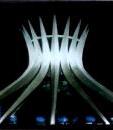
"Crown of Thorns"
Cathedral, Brasilia
From the journal of Steven H. Cullinane
Saturday, August 16, 2003 6:00 AM
Varnedoe's Crown
Kirk Varnedoe, 57, art historian and former curator of the Museum of Modern Art, died Thursday, August 14, 2003.
From his New York Times obituary:
" 'He loved life in its most tangible forms, and so for him art was as physical and pleasurable as being knocked down by a wave,' said Adam Gopnik, the writer and a former student of his who collaborated on Mr. Varnedoe's first big show at the Modern, 'High & Low.' 'Art was always material first — it was never, ever bound by a thorny crown of ideas.' "
For a mini-exhibit of ideas in honor of Varnedoe, see
(Scroll down to see it below.)
Verlyn Klinkenborg on Varnedoe:
"I was always struck by the tangibility of the words he used.... It was as if he were laying words down on the table one by one as he used them, like brushes in an artist's studio. That was why students crowded into his classes and why the National Gallery of Art had overflow audiences for his Mellon Lectures earlier this year. Something synaptic happened when you listened to Kirk Varnedoe, and, remarkably, something synaptic happened when he listened to you. You never knew what you might discover together."
Perhaps even a "thorny crown of ideas"?
"Crown of Thorns"
Cathedral, Brasilia
Varnedoe's death coincided with
the Great Blackout of 2003.
"To what extent does this idea of a civic life produced by sense of adversity correspond to actual life in Brasília? I wonder if it is something which the city actually cultivates. Consider, for example the cathedral, on the monumental axis, a circular, concrete framed building whose sixteen ribs are both structural and symbolic, making a structure that reads unambiguously as a crown of thorns; other symbolic elements include the subterranean entrance, the visitor passing through a subterranean passage before emerging in the light of the body of the cathedral. And it is light, shockingly so...."
-- Modernist Civic Space: The Case of Brasilia, by Richard J. Williams, Department of History of Art, University of Edinburgh, Scotland
|
ART WARS August 15, 2003: The following journal entries were written For related material, see Friday, August 15, 2003 3:30 PM ART WARS: The Boys from Brazil It turns out that the elementary half-square designs used in Diamond Theory
also appear in the work of artist Nicole Sigaud. Sigaud's website The ANACOM Project has a page that leads to the artist Athos Bulcão, famous for his work in Brasilia. From the document Conceptual
Art in an by Angélica Madeira: "Athos created unique visual plans, tiles of high poetic significance, icons inseparable from the city." As Sigaud notes, two-color diagonally-divided squares play a large part in the art of Bulcão. The title of Madeira's article, and the remarks of Anna Chave on the relationship of conceptual/minimalist art to fascist rhetoric (see my May 9, 2003, entries* ), suggest possible illustrations for a more politicized version of Diamond Theory:
Is it safe? These illustrations were suggested in part by the fact that today is the anniversary of the death of Macbeth, King of Scotland, and in part by the following illustrations from my journal entries of July 13, 2003 comparing a MOMA curator to Lady Macbeth:
* May 9 entries are reproduced below.
Thursday, August 14, 2003 3:45 AM Famous Last Words The ending of an Aug. 14 Salon.com article on Mel Gibson's new film, "The Passion": " 'The Passion' will most likely offer up the familiar puerile, stereotypical view of the evil Jew calling for Jesus' blood and the clueless Pilate begging him to reconsider. It is a view guaranteed to stir anew the passions of the rabid Christian, and one that will send the Jews scurrying back to the dark corners of history." -- Christopher Orlet "Scurrying"?! The ghost of Joseph Goebbels, who famously portrayed Jews as sewer rats doing just that, must be laughing -- perhaps along with the ghost of Lady Diana Mosley (née Mitford), who died Monday. This goes well with a story that Orlet tells at his website: "... to me, the most genuine last words are those that arise naturally from the moment, such as
Voltaire's response to a request that he foreswear Satan: 'This is no time to make new enemies.' " For a view of Satan as an old, familiar, acquaintance, see the link to Prince Ombra in my entry last October 29 for Goebbels's birthday. Wednesday, August 13, 2003 3:00 PM Best Picture For some reflections inspired in part by
| ||||||||||||||||||||
Update of Sunday, August 17, 2003:
Claude Martel, 34, a senior art director for The New York Times Magazine, also died Thursday, August 14, 2003. His obituary is in today's Times. For a memorial, see