Philosophy and Poetry:
The Origin of ChangeA note on the figure
from this morning's sermon:
"Two things of opposite natures seem to depend
On one another, as a man depends
On a woman, day on night, the imagined

On the real. This is the origin of change.
Winter and spring, cold copulars, embrace
And forth the particulars of rapture come."

-- Wallace Stevens,
  "Notes Toward a Supreme Fiction,"
   Canto IV of "It Must Change"
Sunday, March 15, 2009 11:00 AM
Ides of March Sermon:
"Symbology"
'... a verse by Ovid, the great Latin poet, springs to mind. In one of his elegies he encouraged the Romans of his time with these words:
"Perfer et obdura: multo graviora tulisti."
"Hold out and persist:
you have got through
far more difficult situations."
(Tristia, Liber V, Elegia XI, verse 7).'"

Note the color-interchange
symmetry of each symbol
under 180-degree rotation.
Related material:
The Illuminati Diamond:


Tom Hanks as Robert Langdon
A possible source for Brown's term "symbology" is a 1995 web page, "The Rotation of the Elements," by one "John Opsopaus." (Cf. Art History Club.)
"The four qualities are the key to understanding the rotation of the elements and many other applications of the symbology of the four elements." --John Opsopaus* "...ambigrams were common in symbology...." --Angels & Demons
Saturday, March 14, 2009 2:02 PM
Annals of Scholarship:

|
On Time
(in Mathematics and Literature) "... I want to spend these twenty minutes savoring, and working up, the real complexity of the metaphorical relationship of time and distance-- to defamiliarize it for us. And then I will give a few examples of how imaginative literature makes use of the inherent strangeness in this relationship: Time ↔ Distance.
And finally I will offer my opinion (which I think must be everyone’s
opinion) about why we derive significant-- but not total-- comfort from
this equation."-- Barry Mazur, March 8, 2009, draft (pdf) of talk for conference on comparative literature* |
Another version of
Mazur's metaphor
Time ↔ Distance:
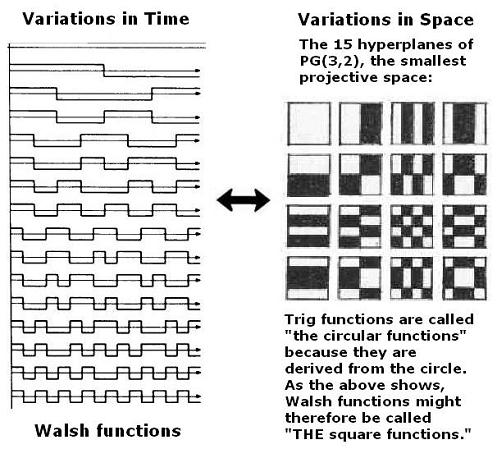
-- Steven H. Cullinane,
October 8, 2003
For some context in
comparative literature,
see Time Fold
(Oct. 10, 2003)
and A Hanukkah Tale
(Dec. 22, 2008).
Related material:
Rat Psychology
yesterday.
Saturday, March 14, 2009 11:07 AM
Notes on Literature:
for Our Times
"This could be Heaven
or this could be Hell."
-- "Hotel California"
Heaven --

or --

Hell --

"Fear + hate = power was Mike Freesmith's formula for success. He first tested it in high school when he seduced his English teacher and drove a harmless drunk to suicide. He used it on the woman who paid his way through college. He used it to put his candidate in the governor's chair, and to make himself the most ruthless, powerful kingmaker in American politics."
Don't forget greed. See yesterday's Friday the 13th entries.
Friday, March 13, 2009 11:30 PM
ART WARS continued:
Lawrence Summers, former president of Harvard, home of the rat psychology of Skinner and Quine, today offered a lesson in behavioral economics.
From a transcript of Summers's remarks (for a video, see the previous entry)--
"An abundance of greed and an absence of fear on Wall Street led some to make purchases - not based on the real value of assets, but on the faith that there would be another who would pay more for those assets. At the same time, the government turned a blind eye to these practices and their potential consequences for the economy as a whole. This is how a bubble is born. And in these moments, greed begets greed. The bubble grows.
Eventually, however, this process stops - and reverses. Prices fall. People sell. Instead of an expectation of new buyers, there is an expectation of new sellers. Greed gives way to fear. And this fear begets fear.
This is the paradox at the heart of the financial crisis. In the past few years, we've seen too much greed and too little fear; too much spending and not enough saving; too much borrowing and not enough worrying. Today, however, our problem is exactly the opposite.
It is this transition from an excess of greed to an excess of fear that President Roosevelt had in mind when he famously observed that the only thing we had to fear was fear itself. It is this transition that has happened in the United States today."
Related material

Spatial Practice,
Paris-Style:

"Voids,
a Retrospective,"
an exhibit of empty rooms
that runs through March 23
at the Centre Pompidou
See also "Art
Humor"
and "Conceptual
Art."
Friday, March 13, 2009 7:20 PM
Annals of Finance:
continued from
March 26, 2006
"When did Wharton School take over?"
-- Chris Matthews tonight on "Hardball"
Good question.
Related material
from the
Harvard school:

Friday, March 13, 2009 12:15 PM
Philosophy News:
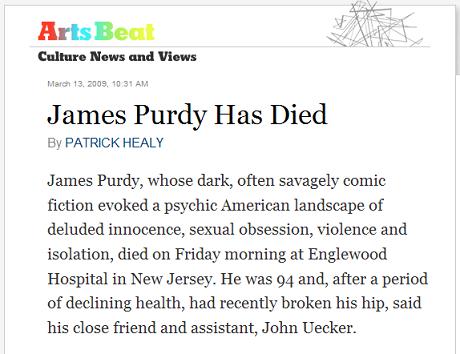
Tom Conoboy on James Purdy's novel Malcolm:
"Life, Purdy is telling us, is meaningless. Existence is absurd. It consists of events and happenings, all unavoidable, all simultaneously significant and meaningless. They touch you, wound even, ultimately kill, yet somehow existence appears to obtain in a bubble outside of the self. As Thomas M. Lorch describes it, 'the novel portays humanity revolving about an abyss.'[1] What is real is not real, and what is not real becomes real. Malcolm describes himself as a 'cypher' and, in the end, his death affects no-one, least of all him.
Yet, through this, Purdy presents us with the final, and greatest, paradox. In presenting us with nothingness, and in deliberately describing the action in such bland and emotionless language, Purdy actually creates a sense of loss: there is nothing to lose, he is telling us, and yet we feel the loss greatly. What he does is to create a world of genuine nihilism, where nobody communicates, nobody connects, so that we can, in negative, imagine what a world in harmony might be like."
[1] Thomas M. Lorch, "Purdy's Malcolm: A Unique Vision of Radical Emptiness." Wisconsin Studies in Contemporary Literature, Vol. 6, No. 2 (Summer, 1965), p. 212.
funny papers, Purdy.

Friday, March 13, 2009 12:00 AM
Friday the 13th, continued:
From 12:00 AM on last month's
Friday the 13th:

From the soundtrack CD of
"Midnight in the Garden
of Good and Evil"--
"Accentuate the positive."
-- Clint Eastwood
MODE online:
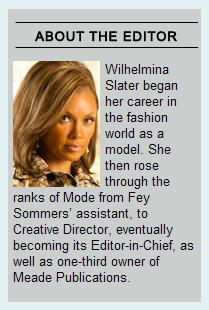 |
My advice for this month is to learn the lesson
from the young and innocent. Embrace optimism and go forward with life,
hoping only for the best.... Accentuate your positives and don’t worry
about your negatives.... Because when you smile, others smile back. Wilhelmina Slater |
Thursday, March 12, 2009 8:30 PM
Conceptual Art:
of Matter,
continued

International
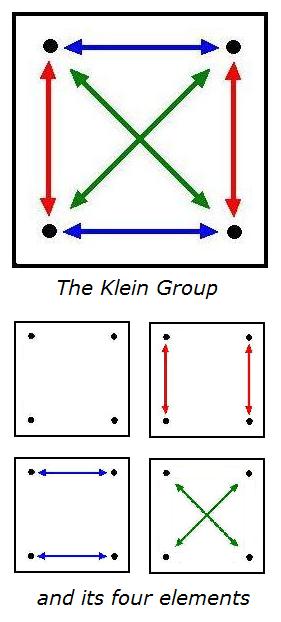
Klein
Blue
Related material:
Aspects of Symmetry,
from the day that
Scarlett Johansson
turned 23, and...
|
"...A foyer of the spirit in a landscape In which we read the critique of paradise -- "Crude Foyer," by Wallace Stevens |
Wednesday, March 11, 2009 7:00 PM
Politics, Religion, Scarlett:
in translation
The Associated Press, "Today in History" March 11-- On this date...
"In 1959, the Lorraine Hansberry drama 'A Raisin in the Sun' opened at New York's Ethel Barrymore Theater."
| Miles to Go... With a wink to Lois Wyse and a nod to Woody Allen -- "Listen, I tell you a mystery...." |


Wednesday, March 11, 2009 9:00 AM
Art Humor:
in Translation
(continued from
May 15, 1998)
The New York Times March 10--
"Paris | A Show About Nothing"--

The Times describes one of the empty rooms on exhibit as...
"... Yves Klein’s 'La spécialisation de la sensibilité à l’état matière première en sensibilité picturale stabilisée, Le Vide' ('The Specialization of Sensibility in the Raw Material State Into Stabilized Pictorial Sensibility, the Void')"
This is a mistranslation. See "An Aesthetics of Matter" (pdf), by Kiyohiko Kitamura and Tomoyuki Kitamura, pp. 85-101 in International Yearbook of Aesthetics, Volume 6, 2002--
"The exhibition «La spécialisation de la sensibilité à l’état matière-première en sensibilité picturale stabilisée», better known as «Le Vide» (The Void) was held at the Gallery Iris Clert in Paris from April 28th till May 5th, 1955." --p. 94
"... «Sensibility in the state of prime matter»... filled the emptiness." --p. 95
Kitamura and Kitamura translate matière première correctly as "prime matter" (the prima materia of the scholastic philosophers) rather than "raw material." (The phrase in French can mean either.)
The Diamond Archetype and
The Illuminati Diamond.
The link above to
prima materia
is to an 1876 review
by Cardinal Manning of
a work on philosophy
by T. P. Kirkman, whose
"schoolgirls problem" is
closely related to the
finite space of the
diamond theorem.
Tuesday, March 10, 2009 7:11 PM
Poetry and Religion--
Immortal Diamondcontinued:
"That flower unseen, that gem of purest ray,
Bright thoughts uncut by men:
Strange that you need but speak them, Thomas Gray,
And the mind skips and dives beyond its ken,
Finding at once the wild supposed bloom,
Or in the imagined cave
Some pulse of crystal staving off the gloom
As covertly as phosphorus in a grave."
-- From "In a Churchyard," by Richard Wilbur
"A metaphysical assertion of this kind is the idea of the 'diamond body,' the indestructible breath-body which develops in the Golden Flower, or in the square inch space."
-- The Secret of the Golden Flower, by Richard Wilhelm, Carl Gustav Jung, and Hua-Yang Liu, second rev. ed., publ. by Routledge, 1999, pp. 130-131
For more about these concepts, see the work cited.
Tuesday, March 10, 2009 9:26 AM
ART WARS, continued:
"... in some autistic enchantment, pure as one of Bach's inverted canons or Euler's formula for polyhedra."
-- George Steiner, "A Death of Kings," in The New Yorker, issue dated Sept. 7, 1968
"Classrooms are filled with discussions not of the Bible and Jesus but of 10 'core values'-- perseverance and curiosity, for instance-- that are woven into the curriculum."
-- "Secular Education, Catholic Values," by Javier C. Hernandez, The New York Times, Sunday, March 8, 2009
-- Raymond Chandler, The Big Sleep
The Chandler quotation appears in "Language Game," an entry in this journal on April 7, 2008.
Some say the "Language Game" date, April 7, is the true date (fixed, permanent) of the Crucifixion-- by analogy, Eliot's "still point" and Jung's "centre." (See yesterday, noon.)
Monday, March 9, 2009 5:24 PM
Mathematics and Narrative, continued:
Next Sunday's New York Times Book Review arrived in today's mail. On the inside of the first page is a full-page ad for a course of 24 lectures on DVD's called "Games People Play: Game Theory in Life, Business, and Beyond." On the inside of the last page is "Our Steiner Problem-- and Mine," a full-page essay by Lee Siegel on polymath George Steiner.
Related material:
- The five Log24 entries ending Jan. 19, 2008
- "The End of Endings," by Richard John Neuhaus
And tell sad stories of the death of kings"
-- Richard II, Act III, Scene ii
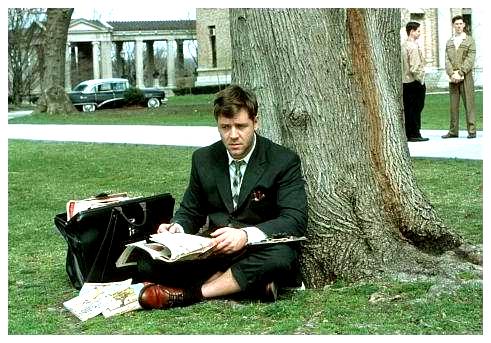
Russell Crowe as game theorist
John Nash in "A Beautiful Mind"
Monday, March 9, 2009 12:00 PM
Annals of Psychology:

"Always with a
little humor."
-- Dr. Yen Lo

From Temperament: A Brief Survey
For other interpretations
of the above shape, see
The Illuminati Diamond.
More psychological background,
from Jung's Aion:
As for rotation, see the ambigrams in Dan Brown's Angels & Demons (to appear as a film May 15) and the following figures:
Click on image
for a related puzzle.
For a solution, see
The Diamond Theorem.
A related note on
"Angels & Demons"
director Ron Howard:

Click image for details.
Sunday, March 8, 2009 4:07 PM
Annals of Philosophy:
In memory of
Stanley Kubrick
(overlooked in
yesterday's memorial)
| "For believers the day of death, and even more the day of
martyrdom, is not the end of all; rather, it is the 'transit' towards
immortal life. It is the day of definitive birth, in Latin, dies
natalis." |

"'Wherever you come near
the human race, there's layers
and layers of nonsense,'
says the Stage Manager in
Thornton Wilder's 'Our Town.'"
-- Today's sermon
from Frank Rich


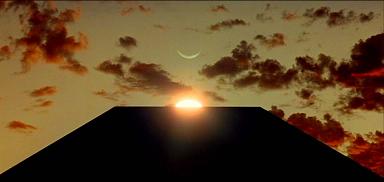
For more layers, see
James A. Michener's
The Source.
Saturday, March 7, 2009 12:00 PM
ART WARS, continued:
| From James Joyce's A
Portrait of the Artist as a Young Man: The dean returned to the hearth and began to stroke his chin. --When may we expect to have something from you on the esthetic question? he asked. --From me! said Stephen in astonishment. I stumble on an idea once a fortnight if I am lucky. --These questions are very profound, Mr Dedalus, said the dean. It is like looking down from the cliffs of Moher into the depths. Many go down into the depths and never come up. Only the trained diver can go down into those depths and explore them and come to the surface again. --If you mean speculation, sir, said Stephen, I also am sure that there is no such thing as free thinking inasmuch as all thinking must be bound by its own laws. --Ha! --For my purpose I can work on at present by the light of one or two ideas of Aristotle and Aquinas. --I see. I quite see your point. |
Besides being Mondrian's birthday, today is also the dies natalis (in the birth-into-heaven sense) of St. Thomas Aquinas and, for those who believe worthy pre-Christians also enter heaven, possibly of Aristotle.
Pope Benedict XVI explained the dies natalis concept on Dec. 26, 2006:
"For believers the day of death, and even more the day of martyrdom, is not the end of all; rather, it is the 'transit' towards immortal life. It is the day of definitive birth, in Latin, dies natalis."
were in St. Peter's Square.

Pictorial
version
of Hexagram 20,
Contemplation (View)
symbolizing art itself.
(See Nov.30 - Dec.1, 2008.)
In honor of
Aristotle and Aquinas,
here is a new web site,
illuminati-diamond.com,
with versions of the diamond shape
made famous by Mondrian --

possibility within modal logic
as well as the potentiality of
Aristotle's prima materia.
Friday, March 6, 2009 7:30 PM
Where Entertainment is God, continued:
TV listing for this evening --
Family Channel, 7:30 PM:
"Harry Potter and
the Sorcerer's Stone"
In other entertainment news --
Scheduled to open May 15:
"Only gradually did I discover
what the mandala really is:
'Formation, Transformation,
Eternal Mind's eternal recreation'"
(Faust, Part Two)
-- Carl Gustav Jung
Related material:
| "For just about half a century, E.J. Holmyard's
concisely-titled Alchemy has served as a literate,
well-informed, and charming introduction to the history and literature
of Western alchemy." --Ian
Myles Slater |

For more about this
"prime matter" (prima materia)
see The Diamond Archetype

and Holy the Firm.
Holmyard --

-- and Aristotle's
On Generation and Corruption.
Thursday, March 5, 2009 9:20 PM
Annals of Finance:
Here's hoping this president knows how to read the newspaper.Thursday, March 5, 2009 7:20 PM
Annals of Storytelling:
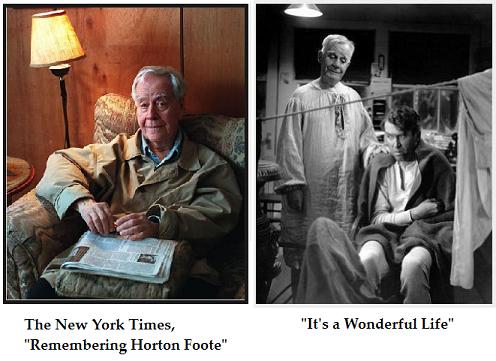
Wednesday, March 4, 2009 10:07 PM
Annals of Religion:

As religious fictions go,
I prefer...
|
De Angelis
"Richardson leaned forward and picked up from the table a very old bound book and a very fat exercise book. He again settled himself in his chair, and said, looking firmly at Anthony-- 'This is the De Angelis of Marcellus Victorinus of Bologna, published in the year 1514 at Paris, and dedicated to Leo X.' 'Is it?' Anthony said uncertainly." -- Charles Williams, The Place of the Lion, 1931 |
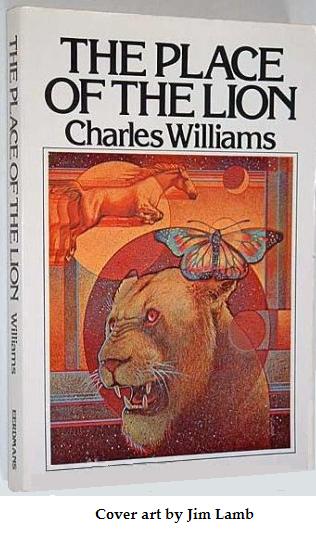
For more about the artist,
see an entry at the weblog
"Through the Wardrobe"
on Aug. 18, 2008.
Related material:
previous entry.
Wednesday, March 4, 2009 5:24 PM
Annals of Philosophy:
Stanley Fish in
Sunday's New York Times
on "Redemption,"
by George Herbert:
-- Dr. Hunter S. Thompson
"I'm a rolling stone from Texas"
-- Theme song in
"Secondhand Lions"
(starring Robert Duvall, 2003)
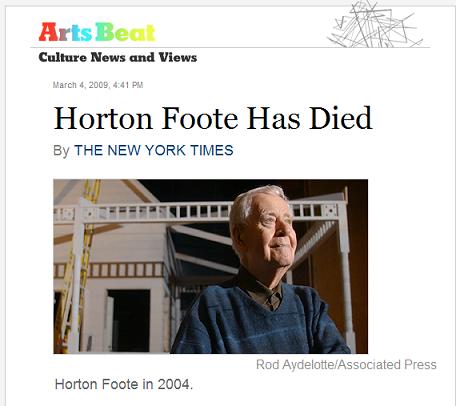
Foote was not associated with
"Secondhand Lions" (which I
saw for the first time last night)
but has worked many times
with Duvall.
Wednesday, March 4, 2009 9:00 AM
Time and Chance, continued:
-- New York Times obituary of Jacob T. Schwartz dated Tuesday, March 3, 2009
March 3, 2009:

"Autistic schizophrenic children present challenging and baffling problems in treatment.... Many of the children have been followed subsequently into later childhood, adolescence, and adulthood.... Meanwhile, a new group of young autistic children are always available for new treatment endeavors as the new modes become available."*

Related material: The previous five entries.
* by Lauretta Bender, M.D., Lothar Goldschmidt, M.D., and D.V. Siva Sankar, Ph.D., in Recent Advances in Biological Psychiatry, 1962, 4, 170-177.
Tuesday, March 3, 2009 11:32 AM
Playing it...
"For every kind of vampire,
there is a kind of cross."
-- Thomas Pynchon in
Gravity's Rainbow
This entry is continued
from yesterday evening,
from midnight last night,
and from an entry of
February 20 (the date
four years ago of
Hunter Thompson's death)--
"Emblematizing the Modern"--
|
Emblematizing the Modern
Note that in applications, the vertical axis of the Cross of Descartes often symbolizes the timeless (money, temperature, etc.) while the horizontal axis often symbolizes time. T.S. Eliot:
"Men’s curiosity searches past and future And clings to that dimension. But to apprehend The point of intersection of the timeless With time, is an occupation for the saint...." |

The best villains are the ones who are
both protagonist and antagonist."
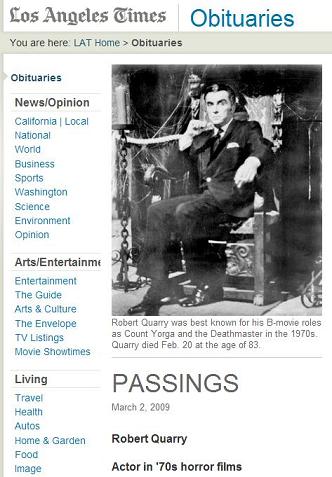
-- The late Robert Quarry
"Selah."
-- The late Hunter Thompson

Yesterday afternoon's online
New York Times:

Today's online New York Times:
Footnote

Tuesday, March 3, 2009 12:00 AM
Where Entertainment is God:
in the Garden
continues

Click poster for details.
Click image for details.
Related material:
The three entries here on
the date of Quarry's death:
Emblematizing the Modern,
A Kind of Cross, and
The Cross of Constantine.
Monday, March 2, 2009 7:00 PM
Fish Story, continued:
From this journal's Sunday sermon:
"Flowers's thoughts stray to Brown,
with affectionate pity, as he
drinks port and eats walnuts
for the first time in
Senior Combination Room."
-- G. H. Hardy recounting the plot
of A Fellow of Trinity
| A
Glossary of Cambridge: Combination Room Attached to the High Table end of the largely unheated medieval college halls, this was a warm place for Fellows to gather before and after meals. Now known as the Senior Combination Room to distinguish it from the Junior and Middle combination rooms. |
|
George Herbert's "Redemption" --
"'I resolved to be bold,/And make a suit unto him, to afford/A new small-rented lease and cancel th'old.' But first he has to find him.... Either he's just left or he hasn't been seen, but then, unexpectedly and in the most unlikely circumstances, he turns up: Before he or his reader can ask 'what on earth are you doing here?,' the final line provides an answer with a compact swiftness that is literally breathtaking: 'Who straight, "Your suit is granted," said, and died.'" |
For Senior Combination Room as
a den of thieves and murderers,
see That Hideous Strength.
Related material:
"The Painted Word"
G. H. Hardy died at 70
on December 1, 1947.
That date is now observed as
"Day Without Art."

Click on image
for further details.
Monday, March 2, 2009 11:30 AM
ART WARS:
Today in History - March 2Today is Monday, March 2, the 61st day of 2009. There are 304 days left in the year. Today's Highlight in History: On March 2, 1939, Roman Catholic Cardinal Eugenio Pacelli was elected Pope on his 63rd birthday; he took the name Pius XII. |
|
Log24
on June 9, 2008--
From Gravity's Rainbow (Penguin Classics, 1995), page 563: "He brings out the mandala he
found.
'What's it mean?' [....] Slothrop gives him the mandala. He hopes it
will work like the mantra that Enzian told him once, mba-kayere (I am
passed over), mba-kayere... a spell [...]. A mezuzah. Safe passage
through a bad night...."
 Christ and the Four Elements
This 1495 image is found in The Janus Faces of Genius: The Role of Alchemy in Newton's Thought, by B. J. T. Dobbs, Cambridge University Press, 2002, p. 85 Related mandalas:
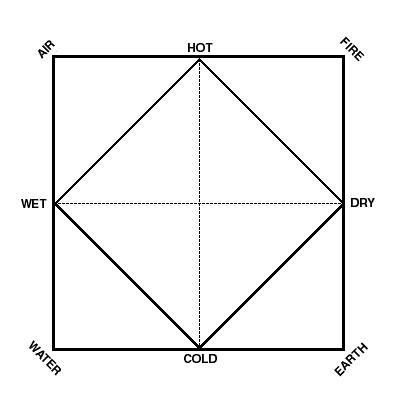 and  For further details,
click on any of the three mandalas above. |


Sunday, March 1, 2009 11:00 AM
Today's Sermon:
continued
-- G. H. Hardy, A Mathematician's Apology
"The Solomon Key is the working title of an unreleased novel in progress by American author Dan Brown. The Solomon Key will be the third book involving the character of the Harvard professor Robert Langdon, of which the first two were Angels & Demons (2000) and The Da Vinci Code (2003)." --Wikipedia
"One has O+(6) ≅ S8, the symmetric group of order 8! ...."
-- "Siegel Modular Forms and Finite Symplectic Groups," by Francesco Dalla Piazza and Bert van Geemen, May 5, 2008, preprint.
"The complete projective group of collineations and dualities of the [projective] 3-space is shown to be of order [in modern notation] 8! .... To every transformation of the 3-space there corresponds a transformation of the [projective] 5-space. In the 5-space, there are determined 8 sets of 7 points each, 'heptads' ...."
-- George M. Conwell, "The 3-space PG(3, 2) and Its Group," The Annals of Mathematics, Second Series, Vol. 11, No. 2 (Jan., 1910), pp. 60-76
"It must be remarked that these 8 heptads are the key to an elegant proof...."
-- Philippe Cara, "RWPRI Geometries for the Alternating Group A8," in Finite Geometries: Proceedings of the Fourth Isle of Thorns Conference (July 16-21, 2000), Kluwer Academic Publishers, 2001, ed. Aart Blokhuis, James W. P. Hirschfeld, Dieter Jungnickel, and Joseph A. Thas, pp. 61-97