From the journal of Steven H. Cullinane...
2009 January 16-31
Saturday, January 31, 2009 11:07 AM
Annals of Education:
Catholic Schools Week
Today is the conclusion of
Catholic Schools Week.
From one such school,
Cullinane College:

Cullinane students
display school spirit
Related material:
James Joyce, A
Portrait of the Artist as a Young Man:
He turned to the flyleaf of the geography and read what he had
written there: himself, his name and where he was.
Stephen Dedalus
Class of Elements
Clongowes Wood College
Sallins
County Kildare
Ireland
Europe
The World
The Universe
That was in his writing: and Fleming one night for a cod had
written on the opposite page:
Stephen Dedalus is my name,
Ireland is my nation.
Clongowes is my dwellingplace
And heaven my expectation.
He read the verses backwards but then they were not poetry.
Then he read the flyleaf from the bottom to the top till he came to his
own name. That was he: and he read down the page again. What was after
the universe?
Nothing. But was there anything round the universe to show
where it stopped before the nothing place began?
|
Alfred Bester, Tiger!
Tiger!:
- Gully Foyle is my name
- And Terra is my nation
- Deep space is my dwelling place
- The stars my destination
|
"Guilty! Read the Charge!"
-- Quoted here on
January 29, 2003
The
Prisoner,
Episode One, 1967:
"I...
I meant a larger map."
-- Quoted here on
January
27, 2009
Friday, January 30, 2009 11:07 AM
Annals of Aesthetics:
Two-Part Invention
This journal on
October
8, 2008,
at
noon:
"There is a pleasantly discursive treatment of Pontius Pilate's
unanswered question 'What is truth?'"
-- H. S. M. Coxeter, introduction to Richard J.
Trudeau's remarks on the "story theory" of truth as opposed to the
"diamond theory" of truth in The
Non-Euclidean Revolution
Trudeau's 1987 book uses the phrase "diamond theory" to denote the
philosophical theory, common since Plato and Euclid, that there exist
truths (which Trudeau calls "diamonds") that are certain and eternal--
for instance, the truth in Euclidean geometry that the sum of a
triangle's angles is 180 degrees.
Insidehighered.com
on
the same day, October 8, 2008,
at 12:45 PM EDT
"Future readers may consider Updike our era’s Mozart; Mozart was once
written off as a too-prolific composer of 'charming nothings,' and some
speak of Updike that way."
-- Comment by BPJ
|
"Birthday, death-day--
what day is not both?"
--
John
Updike
Updike
died on January 27.
On the same date,
Mozart was
born.
Requiem
Mr. Best entered,
tall, young, mild, light.
He bore in his hand
with grace a notebook,
new, large, clean, bright.
-- James Joyce, Ulysses,
Shakespeare and Company,
Paris, 1922, page 178
|
Related material:
Thursday, January 29, 2009 10:23 AM
Annals of Philosophy:
Dagger Definitions

Midrash by a post-bac:
By Amy Peterson
Jacques Derrida once asked
the surly and self-revealing question, "Why is it the philosopher who
is expected to be easier and not some scientist who is even more
inaccessible?" As with philosophers generally, literary critics come
with their own inaccessible argot, some terms of which are useful, but
most of which are not and only add more loops to literary criticism's
spiraling abstraction. Take for example, James
Wood's neologism thisness (h/t: 3
Quarks Daily) :
The project of modernity in Wood's eyes is largely in
revealing the contour and shape, the specific 'feel' of that
essential mystery. He even borrows a concept from the medieval
philosopher Duns Scotus, haecceitas or 'thisness,' to explain what he
means: 'By thisness, I mean any detail that draws abstraction toward
itself and seems to kill that abstraction with a puff of palpability,
any detail that centers our attention with its concretion.' (my
emphasis)
Wood is clearly taking his cue here from the new trend in literary
criticism of referring to realism by its etymological meaning, thingism.
Where thingism is meant to capture the materialism of late
nineteenth and early 20th century Realist literature, thisness, it
seems, is meant to capture the basic immaterialism of Modern realist
literature. In this, it succeeds. Realism is no longer grounded in the
thingism , or material aspect, of reality as it was during the
Victorian era. In contemporary literature, it is a "puff of
palpability" that hints at reality's contours but does not disturb our
essential understanding of existence as an impalpable mystery. So now
we have this term that seems to encompass the Modern approach to
reality, but is it useful as an accurate conception of reality (i.e.
truth, human existence, and the like), and how are we to judge its
accuracy?
I think that, as far as literature is concerned, the test of the term's
accuracy lies in the interpretation of the Modernist texts that Wood
champions as truthful but largely abstract depictions of human
experience:
'Kafka's '"Metamorphosis" and Hamsun's "Hunger" and
Beckett's "Endgame" are not representations of likely or typical human
activity but are nevertheless harrowingly truthful texts.'
For brevity's sake, I'll pick a passage from a different Modernist text
that I think exemplifies the issues involved in the question of
thingism and thisness' reality. In James Joyce's Ulysses, a pub discussion of art's purpose
arises in which the writer Geoffrey Russell† asserts that "Art has to
reveal to us ideas, formless spiritual essences"; in his thoughts,
Stephen Dedalus prepares to counter this:
Unsheathe your dagger definitions.
Horseness is the whatness of allhorse. Streams of tendency and eons
they worship. God: noise in the street: very peripatetic. Space: what
you damn well have to see. Through spaces smaller than red globules of
man's blood they creepy crawl after [William] Blake's buttocks into
eternity of which this vegetable world is but a shadow. Hold to the
now, the here, through which all future plunges to the past.
To give my best translation of Stephen-think: The physical being of the
horse ("horseness") grounds the over-arching, abstract idea of the
horse ("allhorse") in reality ("whatness"). God---the ultimate
abstraction---is elusive and rarely manifests himself as a material
reality (when listening to children playing earlier in the book,
Stephen asserts that God is a "shout in the street"). Space---the
material world---must be observed to make sense of abstract ideas (like
God). Stephen's opponents who believe that art must depict the abstract
and the essential make claims about existence that have very little
basis in material reality so that they can grasp at the divine through
the work of such famously fantastic artists as William Blake, whose
unrealistic poetry and paintings Stephen evidently holds in little
esteem here, though he's kinder to Blake elsewhere. Finally, the
present makes concrete the abstract possibilities of the future by
turning them into the realities of the past.
Ulysses elucidates the distinction between abstractly
based and materially based realism because, while abstract to be sure,
Joyce's writing is deeply rooted in material existence, and it is this
material existence which has given it its lasting meaning and
influence. The larger point that I'm trying to make here is that
material reality gives meaning to the abstract. (As a corollary, the
abstract helps us to make sense of material reality.) There can be no
truth without meaning, and there can be no meaning without a material
form of existence against which to judge abstract ideas. To argue, as
Wood does, that the abstract can produce concrete truths with little
reference to material reality is to ignore the mutual nature of the
relationship between material reality and truth. The more carefully we
observe material reality, the more truth we gain from our abstractions
of its phenomena, or, to state it in the vocabulary---though not the
style---of literary criticism: thisness is a diluted form of thingism,
which means that thisness is productive of fewer (and lesser) truths.
|
"Space:
what you
damn well
have to see."
Amy Peterson
has failed to see
that the unsheathing
of dagger definitions
takes place not in
a pub, but in
The
National Library
of Ireland.
† The
Russell here is not
Geoffrey but rather
George
William Russell,
also known as AE.
Related material:
Yesterday's Log24 entry
for the Feast of
St. Thomas Aquinas,
"
Actual
Being,"
and the four entries
that preceded it.
Wednesday, January 28, 2009 7:59 AM
Annals of Philosophy:
ACTUAL BEING
continued from
October
25, 2008

"These people have discovered how to turn dreams into
reality. They know how to enter their dream realities. They can stay
there, live there, perhaps forever."
-- Alfred Bester on the inmates of Ward T in his 1953 short story,
"Disappearing Act"
|
|
When?
Going to dark bed there was a square round Sinbad the Sailor
roc's auk's egg in the night of the bed of all the auks of the rocs of
Darkinbad the Brightdayler.
Where?

-- Ulysses,
conclusion of Episode 17 |
Tuesday, January 27, 2009 3:00 PM
Aesthetics continued:
Tuesday, January 27, 2009 12:00 PM
Annals of Aesthetics:
A Kind of Cross
"For every kind of vampire,
there is a kind of cross."
--
Gravity's Rainbow

The above text on Joyce's theory of epiphanies:
"It emphasizes the radiance, the effulgence, of the thing itself
revealed in a special moment, an unmoving moment, of time. The moment,
as in the macrocosmic lyric of Finnegans Wake, may involve all
other moments, but it still remains essentially static, and though it
may have all time for its subject matter it is essentially timeless."
-- Page 17 of Stephen Hero, by James Joyce, Theodore Spencer,
John J. Slocum, and Herbert Cahoon, Edition: 16, New Directions
Publishing, 1963
Related epiphanies --
Detail from
the above text:

Cover of
a paperback novel
well worth reading:

Related material:
"Joyce knew no Greek."
-- Statement by the prototype
of Buck Mulligan in
Ulysses,
Oliver
St. John Gogarty,
quoted in the above
New Directions
Stephen Hero
"
Chrysostomos."
-- Statement in
Ulysses
by the prototype
of Stephen Dedalus,
James Augustine Aloysius Joyce
See also the link to
Mardi
Gras, 2008,
in
yesterday's
entry,
with its text from
the opening of
Ulysses:
"He faced about and
blessed gravely thrice
the tower,
the surrounding country
and the awaking mountains."
Some context:
(Click on images for details.)

and

"In the process of absorbing
the rules of the institutions
we inhabit, we become
who we are."
-- David
Brooks, Jewish columnist,
in today's
New York Times
The
Prisoner,
Episode One, 1967:
"I...
I meant a larger map."
Monday, January 26, 2009 4:23 PM
Annals of Hogwarts:
Harvard, Magic,
and The New York Times,
continued from
Jan. 15:
The New York Times Jan. 15:
Google News, 4:19 PM ET today:

"My shavin' razor's cold
and it stings."
-- Song quoted here on
Mardi
Gras, 2008
Monday, January 26, 2009 6:00 AM
Happy Birthday, Paul Newman:
Episode One
For the
Hole
in the Wall Gang:
Shopkeeper: Good morning, sir. And what can I do for you then?
Prisoner: I'd like a map of this area.
Shopkeeper: Map? Colour or black and white?
Prisoner: Just a map.
Shopkeeper: Map...
He pauses to remember where he keeps such a thing.
Shopkeeper: Ah. Black and white...
He produces a map from a cupboard.
Shopkeeper: There we are, sir. I think you'll find that shows
everything.
The map is labelled "map of your village." The Prisoner opens it; it
shows the village bordered by "the mountains": there are no external
geographical names.
Prisoner: I... I meant a larger map.
Shopkeeper: Only in colour, sir. Much more expensive.
Prisoner: That's fine.
The shopkeeper fetches him a colour map as inadequate as the last.
It folds out as a larger sheet of paper, but still mentions only "the
mountains," "the sea," and "the beach," together with the title "your
village."
Prisoner: Er, that's not what I meant. I meant a... a larger area.
Shopkeeper: No, we only have local maps, sir. There's no demand for any
others. You're new here, aren't you?
-- Comment at
The
Word magazine,
January
16, 2009
|
"In the pictures of the old masters, Max Picard wrote in The
World of Silence, people seem as though they had just come out of
the opening in a wall... "
-- Annie Dillard in
For the Time Being
|
"Shopkeeper:
Only in colour, sir.
Much
more expensive.
Prisoner:
That's fine."
Sunday, January 25, 2009 11:00 AM
Today's Sermon --
Review:
The Maker's Gift

Click on image for details.
Saturday, January 24, 2009 11:32 AM
To the Academy:
Saturday, January 24, 2009 4:12 AM
Annals of Philosophy:
Gift
(Click on image for details.)
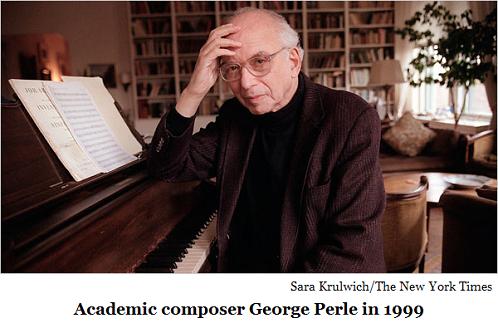
"George Perle, a composer, author, theorist and teacher who won the
Pulitzer Prize for music in 1986 and was widely considered the poetic
voice of atonal composition, died on Friday [Jan. 23, 2009] at his home
in Manhattan. He was 93."
-- The
New York Times this morning
From this journal on
June 15, 2004:

Kierkegaard on death:
"I have thought too much about death not to know that he
cannot speak earnestly about death who does not know how to employ (for
awakening, please note) the subtlety and all the profound waggery which
lies in death. Death is not earnest in the same way the eternal
is. To the earnestness of death belongs precisely that capacity
for awakening, that resonance of a profound mockery which, detached
from the thought of the eternal, is an empty and often brash jest, but
together with the thought of the eternal is just what it should be,
utterly different from the insipid solemness which least of all
captures and holds a thought with tension like that of death."
-- Works of Love,
Harper Torchbooks,
1964, p. 324
For more on "the thought of the eternal," see the discussion of
the number 373 in Directions Out and Outside the World, both of 4/26/04. |
Friday, January 23, 2009 12:12 PM
Mathematics and Narrative, continued:
Hilbert vs. Pascal
Mathematics:
Happy
Hilbert's
Birthday.
Today is the birthday
of mathematician
David
Hilbert (1862-1943).
Narrative:
See a different Hilbert-- namely Jules, a fictional professor of
literary theory
at
the University of Illinois at Chicago played by Dustin Hoffman in
"Stranger than Fiction" (cf.
yesterday's
entry). See also, in
today's
previous entry, Stanley Fish-- a non-fictional
literary theorist and
former dean at the same institution.
Related material:
"
The Gift
in 'Stranger than Fiction'," by Eric Austin Lee (June 1, 2007).
Lee's essay might please another mathematician whose name appears in
the film. The clever but heartless Professor Hilbert is opposed,
indirectly, in "
Stranger
than Fiction" by a Harvard Law dropout, Ana, who dispenses
eucharistic blessings, in the form of cookies, at her Chicago
bakery/café-- filmed at a real Chicago location,
Catedral Café. Her last name
is
Pascal.
Friday, January 23, 2009 9:07 AM
Fish Story:
"Numb were the Beadsman's fingers,
while he told |
|
His rosary, and while
his frosted breath, |
|
Like pious incense
from a censer old, |
|
Seem'd taking flight for heaven,
without a death...."
-- John Keats
|
"The word not only brings the things out of silence; it also produces
the silence in which they can disappear again."
-- Max Picard, The World
of Silence,
quoted here on
January 15
"Let the word go forth...."
-- John Fitzgerald Kennedy, quoted here
on
January 20 -- The
Eve of St. Agnes
Related material:
Fish contrasts President Obama's prose style with one that "asks the
reader or hearer to hold in suspension the components of an argument
that will not fully emerge until the final word."
See also the final word of this journal's entry on
January 21, which was "Keats."
Thursday, January 22, 2009 7:00 AM
Philosophy and Narrative:
Wednesday, January 21, 2009 12:00 PM
By the Numbers:
Scripture

"... while some are elected,
others not elect are
passed by...."
--
A
commentary on the
Calvinist doctrine of preterition
Gravity's Rainbow, Penguin Classics,
1995, page 742:
"... knowing his Tarot, we would expect to look among the Humility,
among the gray
and preterite souls, to look for him adrift in the hostile light of
the sky, the darkness of the sea....
Now there's only a long cat's-eye of bleak sunset left over the plain
tonight, bright gray against a purple ceiling of clouds, with an iris of
742"
|
"God is the original
conspiracy theory."
--
Pynchon's
Paranoid History
"We remain a young nation, but in the words of Scripture, the time has
come to set aside childish things."
-- President Obama yesterday
It is not entirely clear what these "childish things" are. Perhaps the
young nation's "childish things" that the new President refers to are
part of what Robert Stone memorably called "our secret culture."
Stone was referring to Puritanism, which some advocates of the new
religion of Scientism might call "childish." I do not. Lunatic,
perhaps, but not childish.
Related meditations:
A year ago yesterday, on Sunday, Jan. 20, 2008, the mid-day lottery for
New York State was 605.
A midrash in the Judeo-Christian tradition of paranoia a
year ago today suggested that 605 might be a veiled reference to "God,
the Devil, and a Bridge," a weblog entry on mathematician
André Weil.
Continuing in this vein a year later, we are confronted with the mid-day
New York lottery for yesterday:
742.
Taking a hint from another
entry
on Weil, this may be
regarded as a reference to
The Oxford Book of
English Verse (1919 edition):
Selection 742 in that book
comports well with this
jounal's recent meditations
on
death and Brooklyn:
742: The Imprisoned Soul
--
|
| "Let me glide noiselessly forth; |
|
With the key of softness
unlock the locks...."
-- Walt Whitman
|
Applying this method of
exegesis to last year's
lottery, we have
605: Hymn of Pan --
"And all that did then
attend and follow, |
|
Were silent with love,
as you now, Apollo, |
|
With envy of
my sweet pipings." |
"In time, his carefree lifestyle began to upset the
early Christians, who saw his earthy temptations as a manifestation of
the Devil. Who would've thought that the horny old goat would become
the blueprint for popular conceptions of Satan-- cloven hooves, horns
and all?"
--
Pan:
God of Shepherds, Flocks, and Fornication
Hymn 605 thus
supplies a reference to the devil mentioned by Weil in the
entry
of 6/05.
It, together with Hymn 742 of a year later, may be
regarded as a divine response to
a
weblog entry yesterday from the Greater Wasilla Area on listening
to the inauguration:
"... thus far, I have not heard any priests of Apollo, nor of any other
God, issuing any auguries."
Neither have I, but hearing is only one of the senses.
"Heard melodies are sweet,
but those unheard
Are sweeter."
-- John Keats
Tuesday, January 20, 2009 8:00 AM
Short Story:
Monday, January 19, 2009 8:48 AM
Signifyin' Johnson and...
The Return of
The Purloined Letter
"The letter acts like a signifier precisely to the extent that its
function in the story does not require that its meaning be revealed."
-- Barbara Johnson, "The
Frame of Reference," an essay on a story by Poe
Sunday, January 18, 2009 8:00 AM
Today's Sermon:
Birthdays
Part I: The Pagan View
From The
Fire, Katherine Neville's sequel
to her novel The
Eight:
"'Cat.... realized that we all need some kind of a chariot driver to
pull our forces together, like those horses of Socrates, one pulling
toward heaven, one toward the earth....'
... I asked, 'Is that why you said my mother's and my birthdays are
important? Because April 4 and October 4 are opposite in the calendar?'
Rodo beamed a smile.... He said, 'That's how the process takes
place....'"
Part II: The Christian View
"The Calendar
of saints is a traditional Christian method of organizing a liturgical year by associating each day
with one or more saints and referring to the day as that saint's feast
day. The system arose from the very early Christian custom of
annual commemoration of martyrs on the dates of their deaths, or birth
into heaven, and is thus referred to in Latin as dies
natalis ('day of birth')." --Wikipedia
The October 4 date above, the birthday of Cat's daughter, Xie, in The
Fire, is also the liturgical Feast
of St. Francis of Assisi (said by
some to be also the date of his death).
The April 4 date above is Neville's birthday and that of her alter
ego Cat in The Eight and The Fire. Neville states
that this is also the birth date of Charlemagne. It is, as well, the dies
natalis (in the "birth into heaven" sense), of Dr. Martin Luther
King.
For more about April 4, see Art
Wars and 4/4/07.
For more about October 4, see "Revelation
Game Continued: Short Story."
Friday, January 16, 2009 1:00 PM
ART WARS continued:
Behind
the Picture
"Oftentimes people will like a picture I paint because it’s maybe the
sun hitting on the side of a window and they can enjoy it purely for
itself," Wyeth once said. "It reminds them of some afternoon. But for
me, behind that picture could be a night of moonlight when I’ve been in
some house in Maine, a night of some terrible tension, or I had this
strange mood. Maybe it was Halloween. It’s
all there, hiding behind the realistic side."
-- Andrew
Wyeth, who died today
Related material:
"In the pictures of the old masters, Max
Picard wrote in The World of Silence, people seem as though
they had just come out of the opening in a wall... "
-- Annie Dillard in For the Time Being
"And the wall is made of light-- that
entirely credible yet unreal Vermeer light. Light like this does not
exist, but we wish it did."
-- Susanna Kaysen in Girl, Interrupted
Friday, January 16, 2009 10:31 AM
Annals of Philosophy:
Academy Award
"Philosophers ponder the idea of identity: what it is to give something
a name on Monday and have it respond to that name on Friday."
— Bernard
Holland
"I feel very happy to be a part of Mind Champions Academy."
-- A winner at a chess
awards ceremony in India on Monday
John Mortimer, who wrote the TV version of Brideshead
Revisited, died
today. In his memory: