From the journal of Steven H. Cullinane...
2008 December 16-31
Monday, December 29, 2008 12:21 PM
Return of...
The Gift
"'That old Jew gave me this here.' Egan
looked at the diamond. 'I ain't giving this to you, understand? The old
man gave it to me for my boy. It's worth a whole lot of money-- you can
tell that just by looking-- but it means something, I think. It's got a
meaning, like.'
'Let's see,' Egan said, 'what would it mean?' He took hold of Pablo's
hand cupping the stone and held his own hand under it. '"The jewel is
in the lotus," perhaps that's what it means. The eternal in the
temporal. The Boddhisattva declining nirvana out of compassion.
Contemplating the ignorance of you and me, eh? That's a metaphor of our
Buddhist friends.'
Pablo's eyes glazed over. 'Holy shit,' he said. 'Santa Maria.' He
stared at the diamond in his palm with passion."
For further details, click on the diamond. |
Today's online Times on
the Saturday, Dec. 27,
death of an artist:
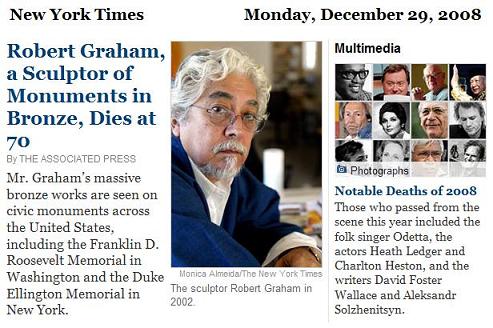
"Dale Wasserman... the playwright responsible for two
Broadway hits of the 1960s, 'One Flew Over the Cuckoo’s Nest' and 'Man
of La Mancha,' died on Sunday [December 21, 2008] at his home in
Paradise Valley, Ariz., near Phoenix....
Mr. Wasserman wrote more than 75 scripts for
television, the stage and the movies, including screenplays for 'The
Vikings' (1958), a seafaring epic with Tony Curtis and Kirk Douglas,
and 'A Walk With Love and Death' (1969), a John Huston film set in
14th-century Europe....
He feuded with... John Huston, who gave the lead female role in 'Walk'
to his teenage daughter, Anjelica, against Mr. Wasserman's wishes. And
he never attended ceremonies to receive the awards he won."
Accepting for Mr. Wasserman:
Mr. Graham's widow,
Anjelica Huston --
 "Well..."
Monday, December 29, 2008 2:45 AM
Religion and Narrative:
Her
Scalloped Shore --
A meditation for Becket's
Day on James Joyce, Santiago de Compostela, and the death of Pope
John Paul II
Friday, December 26, 2008 4:07 PM
ART WARS and...
Narrative
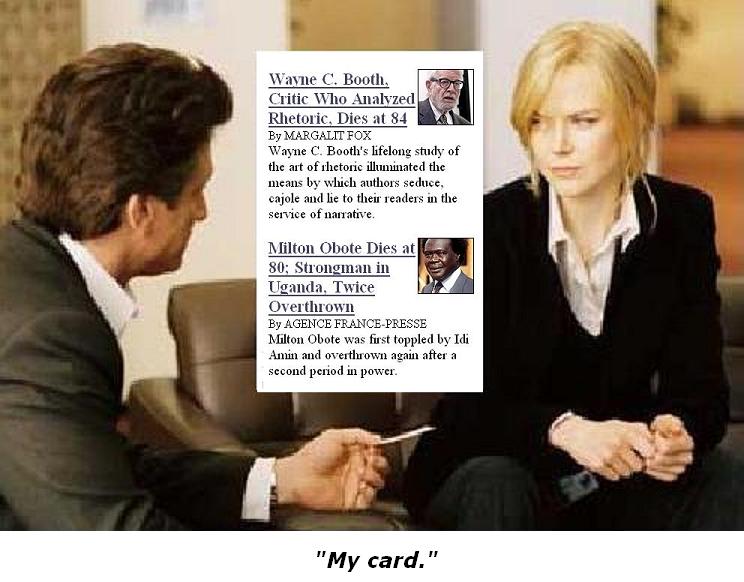
"Wayne C. Booth's lifelong
study of the art of rhetoric
illuminated the means
by which authors seduce,
cajole and lie to their readers
in the service of narrative."
--
New
York Times, Oct. 11, 2005
Roberta Smith in a
New York Times Christmas
Day review of an exhibit at the Museum of Modern Art:
"He ends the show with Ed Ruscha's painting 'The End.' But if you
consult the brochure, you'll see that it also lists one final object up
above, near the ceiling. This is the green LED exit sign that directs
you out of the gallery. The sign, designed by Mark Wamble, Dawn Finley
and Ben Thorne of Interloop Architecture, is, like everything else
here, in the Modern's collection. Here, of course, it is also just
doing its job."
Other Christmas Day endings --
Those of W.C. Fields-- see
Cafe
Society (April 14, 2007)-- and,
this
year, of Eartha Kitt:

From April 12 last year:
 This Way to
the Egress
Thursday, December 25, 2008 12:00 PM
Annals of Religion:
Tuesday, December 23, 2008 12:00 PM
Mathematics and Narrative:
"There is one story
and one story only
That will prove
worth your telling....
...of
the undying snake
from chaos hatched,
Whose coils contain the ocean,
Into whose chops
with naked sword he springs,
Then in black water,
tangled by the reeds,
Battles three days and nights,
To be spewed up
beside her scalloped shore...."
-- Robert Graves,
"To Juan at the Winter Solstice"
Tuesday, December 23, 2008 12:20 AM
A Quest for Sontag:
Kindred Spirit
On the late film director Robert
Mulligan, who died early
Saturday [Dec. 20, 2008] at 83:
Mulligan received a best
director Oscar nomination in 1963 for "[To Kill a] Mockingbird"....
While some debated whether he had a discernible personal vision in his
films, Mulligan was known for his casting and direction of children,
including "[Up
the Down] Staircase," where he personally interviewed more than 500
New York high school students.
Sensing a kindred spirit, Francois Truffaut was a vocal champion,
particularly cognizant of what he perceived as undue criticism of
Mulligan's work for lacking a particular "style." Mulligan himself was
dismissive of critics/cineaste talk: "I don't know anything about 'the
Mulligan style,' " he told the Village Voice in 1978. "If you can find
it, well, that's your job."
-- Duane
Byrge, The Hollywood Reporter
Thanks to desconvencida
for a trailer of "The Man in the Moon" (1991), Reese Witherspoon's
first film and Mulligan's last.
Mulligan also directed Natalie
Wood in a personal favorite of mine, "Love with the Proper
Stranger."
Monday, December 22, 2008 9:00 PM
A Hanukkah Tale:
The Folding
Hamlet,
Act 1, Scene 5
--
Ghost:
"I could a tale unfold
whose lightest word
Would harrow up thy soul,
freeze thy young blood,
Make thy two eyes, like stars,
start from their spheres,
Thy knotted and combined
locks to part
And each particular hair
to stand on end,
Like quills upon
the fretful porpentine:
But this eternal blazon
must not be
To ears of flesh and blood.
List, list, O, list!"
This recalls the title of a piece in this week's New Yorker:
"The
Book of Lists:
Susan Sontag’s early journals"
(See Log24
on
Thursday, Dec. 18.)
In the rather grim holiday spirit of that piece, here are some journal
notes for Sontag, whom we may imagine as the ghost of Hanukkah past.
There are at least two ways of folding a list (or tale) to fit a
rectangular frame.
The normal way, used in typesetting English prose and poetry, starts at
the top, runs from left to right, jumps down a line, then again runs
left to right, and so on until the passage is done or the bottom right
corner of the frame is reached.
The
boustrophedonic
way again goes from top to bottom, with the first line running from
left to right, the next from right to left, the next from left to
right, and so on, with the lines' directions alternating.
The word "boustrophedon" is from the Greek words describing the
turning, at the end of each row, of an ox plowing (or "harrowing") a
field.
The Tale of
the Eternal Blazon
by Washington Irving
"
Blazon meant originally a
shield, and then the
heraldic
bearings on a shield. Later it was applied to the art of describing
or depicting heraldic bearings in the proper manner; and finally the
term came to signify
ostentatious display and also
description
or record by words or other means. In
Hamlet, Act I. Sc. 5,
the Ghost, while talking with Prince Hamlet, says:
'But this eternal blazon
must not be
To ears of flesh and blood.'
Eternal blazon signifies
revelation or description of things
pertaining to eternity."
--
Irving's
Sketch Book, p. 461
By Washington Irving and
Mary Elizabeth Litchfield,
Ginn & Company, 1901
Related material:
Folding (and harrowing up)
some eternal blazons --

These are the foldings
described above.
They are two of the 322,560
natural ways to fit
the list (or tale)
"1, 2, 3, ... 15, 16"
into a 4x4 frame.
For further details, see
The Diamond 16 Puzzle.
Moral of the tale:
Cynthia
Zarin in The New Yorker, issue dated April 12, 2004--
"Time, for
L'Engle,
is accordion-pleated. She elaborated, 'When you bring a sheet off the
line, you can't handle it until it's folded, and in a sense, I think,
the universe can't exist until it's folded-- or it's a story without a
book.'"
Monday, December 22, 2008 11:07 AM
Snows of Yesteryear:
Fides et Ratio
Part I:
Ratio
Continued from...
|
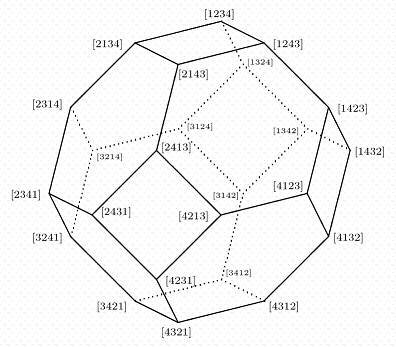
Makin' the Changes
(From "Flag
Matroids," by
Borovik, Gelfand, and White)
Edward Rothstein,
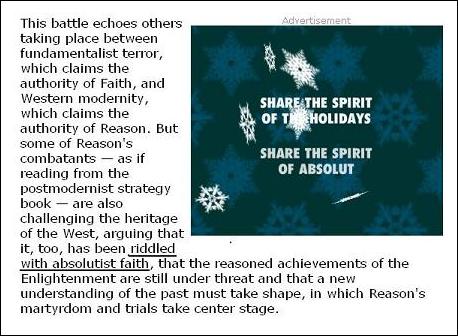
White and Geometric,
but not Eternal.
|
Part II:
Fides

For more information,
click on the cocktail.
Sunday, December 21, 2008 4:23 PM
Mathematics and Narrative:
Le PLI
An excerpt from Simon Blackburn's
1999 review
of Eco's
Kant and the Platypus:
Prominent literary intellectuals often like to make
familiar reference to the technical terminology of mathematical logic
or philosophy of language. A friend of mine overheard the following
conversation in Cambridge during l'affaire Derrida, when the
proposal to grant an honorary degree to that gentleman met serious
academic opposition in the university. A journalist covering the fracas
asked a Prominent Literary Intellectual what he took to be Derrida's
importance in the scheme of things. 'Well,' the PLI confided
graciously, unblushingly, 'Gödel showed that every theory is
inconsistent unless it is supported from outside. Derrida showed that
there is no outside.'
Now, there are at least three remarkable things about
this. First, the thing that Gödel was supposed to show could not
possibly be shown, since there are many demonstrably consistent
theories. Second, therefore, Gödel indeed did not show it, and
neither did he purport to do so. Third, it makes no sense to say that
an inconsistent theory could become consistent by being 'supported from
outside', whatever that might mean (inconsistency sticks; you cannot
get rid of it by addition, only by subtraction). So what Derrida is
said to have done is just as impossible as what Gödel was said to
have done.
These mistakes should fail you in an undergraduate
logic or math or philosophy course. But they are minor considerations
in the world of the PLI. The point is that the mere mention of
Gödel (like the common invocation of 'hierarchies' and
'metalanguages') gives a specious impression of something thrillingly
deep and thrillingly mathematical and scientific (theory!
dazzling! Einstein!) And, not coincidentally, it gives the PLI a
flattering image of being something of a hand at these things, an
impresario of the thrills. I expect the journalist swooned.
An excerpt from Barry Mazur's "
Visions,
Dreams, and Mathematics" (apparently a talk presented
at
Delphi), dated Aug. 1, 2008, but
posted on Dec. 19:
"The word explicit is from the Latin explicitus
related to the verb explicare meaning to 'unfold, unravel,
explain, explicate' (plicare means 'to fold'; think of the
English noun 'ply')."
Related material: Mark Taylor's Derridean use of "
le pli" (
The Picture in
Question, pp. 58-60, esp. note 13, p. 60). See also the
discussion of Taylor in this journal
posted
on Dec. 19.
Sunday, December 21, 2008 1:06 PM
ART WARS continued:
Interpretive Grids

The 15 grids in the picture at right above may be
regarded as
interpreting
the structure of the space at left above.
This pair of pictures was suggested by yesterday's
entry
at Ars Mathematica containing the phrase "a dramatic
extension of the notion of points."
For other uses of the phrase "interpretive grid," see today's
previous
entry.
Sunday, December 21, 2008 11:00 AM
Philosophy and Law:
A Sontag Sermon
I: "Against
Interpretation,"
by Susan Sontag
II: An
interpretation
of Sontag that introduces
the concept of
the interpretive grid
III: An
Interpretive Grid
Related commentary:
Texas Law
Review and
Michigan
Law Review.
Saturday, December 20, 2008 11:11 AM
Annals of Religion:
Cheap*
Epiphanies
for the Church of
the Forbidden Planet
Mid-day lotteries Dec. 19:
* NY 198 PA 918
From
9/18:
O the mind, mind has mountains,
cliffs of fall
Frightful, sheer, no-man fathomed.
Hold them cheap
May who ne'er hung there.
Evening lotteries Dec. 19:
* NY 198 PA 414
From
4/14:
"minds
blazing, to the barricades"
-- The
New York Times
on
the Wheeler effect
See also
Bloomsday for Nash:
The Revelation Game --

For details,
click on the
black hole.
Friday, December 19, 2008 1:06 PM
Art and Religion:
Inside the
White Cube
Part I: The White Cube
 Part II: Inside
 Part III: Outside

Click to enlarge.
Mark
Tansey, The Key (1984)
For remarks on religion
related to the above, see
Log24
on the Garden of Eden
and also Mark C. Taylor,
"
What
Derrida Really Meant"
(
New York Times, Oct. 14, 2004).
For some background on Taylor,
see Wikipedia.
Taylor,
Chairman
of the Department of Religion at
Columbia University, has a
1973 doctorate in religion from
Harvard
University. His opinion
of Derrida indicates that his
sympathies lie more with
the
serpent than with the angel
in the Tansey picture above.
For some remarks by Taylor on
the art of Tansey
relevant to the
structure of the white cube
(Part I above), see Taylor's
The Picture
in Question:
Mark Tansey and the
Ends of Representation
(U. of Chicago Press, 1999):
From Chapter 3,
"Sutures* of Structures," p. 58:
"What, then, is a frame, and what is frame work?
This question is deceptive in its simplicity. A frame is, of course, ' a basic skeletal
structure designed to give shape or support' ( American Heritage
Dictionary).... when the frame is in question, it is difficult to
determine what is inside and what is outside. Rather than being on one
side or the other, the frame is neither inside nor outside. Where,
then, Derrida queries, 'does the frame take place....'"
* P. 61:
"... the frame forms the suture of
structure. A suture is 'a seamless [sic**] joint or line of
articulation,' which, while joining two surfaces, leaves the trace of
their separation."
** A dictionary says
"a seamlike joint or line of articulation," with no mention of
"trace," a term from Derrida's
jargon.
|
Thursday, December 18, 2008 1:00 PM
A Mamet Yule:
Polar Opposites
Susan Sontag in
this week's
New Yorker:
"
The
mind is a whore."
Embedded in the Sontag
article is the following:


Act One
South Pole:

 Shi Ho
Act Two
North Pole:

 Kun
Kun
"If baby I'm the bottom,
you're the top."
--
Cole Porter
Happy birthday,
Steven Spielberg.
Wednesday, December 17, 2008 12:00 AM
At the still point...
The Dance
(
continued)
"... physicists are doing more
than 'discovering the endless
diversity of nature.' They are
dancing with
Kali...."
Gary Zukav,
Harvard
'64
Tuesday, December 16, 2008 8:00 PM
A Problematic Phenomenon:
The Square Wheel
(continued)
From The
n-Category Cafe today:
David Corfield at 2:33
PM UTC quoting a
chapter from a
projected second volume of a biography:
"Grothendieck’s spontaneous reaction to whatever appeared to be causing
a difficulty... was to adopt and embrace the very phenomenon that was
problematic, weaving it in as an integral feature of the structure he
was studying, and thus transforming it from a difficulty into a
clarifying feature of the situation."
John Baez at 7:14
PM UTC on research:
"I just don’t want to reinvent a wheel, or waste my time inventing a
square one."
For the adoption and embracing of such a problematic phenomenon, see The
Square Wheel (this journal, Sept. 14, 2004).
For a connection of the square wheel with yesterday's
entry for Julie Taymor's birthday, see a note from 2002: