From the journal of Steven H. Cullinane...
2007 January 01-15
Tuesday, January 9, 2007
12:00 PM
Old Style
For Balanchine's Birthday
(continued from
January 9, 2003)
George BalanchineEncyclopædia Britannica Article
born January 22
[January 9, Old Style], 1904,
St. Petersburg, Russia
died April 30, 1983, New York,
New York, U.S.

George Balanchine.
©1983 Martha Swope
original name
Georgy Melitonovich Balanchivadze
most
influential choreographer of classical ballet in the United States in
the 20th century. His works, characterized by a cool neoclassicism,
include The Nutcracker (1954) and Don Quixote (1965),
both pieces choreographed for the New York City Ballet, of which he was
a founder (1948), the artistic director, and the…
Balanchine, George... (75 of 1212 words) |
"What on earth is
a concrete universal?"
-- Robert M. Pirsig
Review:
From Wikipedia's
"Upper Ontology"
and
Epiphany 2007:
"There is no neutral ground
that can serve as
a means of translating between
specialized (lower) ontologies."
There is, however,
"the field of reason"--
the 3x3 grid:

Click on grid
for details.
As Rosalind Krauss
has noted, some artists
regard the grid as
"a staircase to
the Universal."
Other artists regard
Epiphany itself as an
approach to
the Universal:
"Epiphany signals the traversal
of the finite by the infinite,
of the particular by the universal,
of the mundane by the mystical,
of time by eternity."
-- Richard Kearney, 2005,
in The New Arcadia Review

Kearney (right) with
Martin Scorsese (left)
and Gregory Peck
in 1997.
"...
one of the things that worried me about traditional metaphysics, at
least as I imbibed it in a very Scholastic manner at University College
Dublin in the seventies, is that philosophy was realism and realism was
truth. What disturbed me about that was that everything was already
acquired; truth was always a systematic given and it was there to be
learned from Creation onwards; it was spoken by Jesus Christ and then
published by St. Thomas Aquinas: the system as perfect synthesis.
Hence, my philosophy grew out of a hunger for the 'possible'
and it was definitely a reaction to my own philosophical formation. Yet
that wasn't my only reaction. I was also reacting to what I considered
to be the deep pessimism, and even at times 'nihilism' of the
postmodern turn."
-- Richard Kearney, interview (pdf) in The Leuven Philosophy Newsletter, Vol. 14, 2005-2006
For more on "the possible," see Kearney's The God Who May Be, Diamonds Are Forever, and the conclusion of Mathematics and Narrative:
"We symbolize logical necessity with the box ( ) )and logical possibility with the diamond ( )." )."-- Keith Allen Korcz 
"The possibilia that exist, and out of which the Universe arose, are located in a necessary being...." -- Michael Sudduth, Notes on
God, Chance, and Necessity
by Keith Ward, Regius Professor of Divinity, Christ Church College, Oxford (the home of Lewis Carroll) |
Sunday, January 7, 2007
12:00 PM
Happy 007, continued:
Thursday, April 7, 2005 7:26 PM
In the Details
Wallace Stevens,
An Ordinary Evening in New Haven:
XXII
Professor Eucalyptus said, "The search
For reality is as momentous as
The search for God." It is the philosopher's search
For an interior made exterior
And the poet's search for the same exterior made
Interior....
... Likewise to say of the evening star,
The most ancient light in the most ancient sky,
That it is wholly an inner light, that it shines
From the sleepy bosom of the real, re-creates,
Searches a possible for its possibleness.
Julie Taymor, "Skewed Mirrors" interview:
"...
they were performing for God. Now God can mean whatever you want it to
mean. But for me, I understood it so totally. The detail....
They
did it from the inside to the outside. And from the outside to the in.
And that profoundly moved me then. It was...it was the most important
thing that I ever experienced."
"Skewed Mirrors"
illustrated:
Click on the above to enlarge.
Details:

The above may be of interest to students
of iconology -- what Dan Brown in
The Da Vinci Code calls "symbology" --
and of redheads.
The artist of Details,
"Brenda Starr" creator
Dale Messick, died on Tuesday,
April 5, 2005, at 98.

AP Photo
Dale Messick in 1982
For further details on
April 5, see
Art History:
The Pope of Hope

Sunday, January 7, 2007
11:00 AM
Happy Birthday, Nicolas Cage, Part II:
Birthday Greetings
to Nicolas Cage
from Marxists.org
Fredric Jameson, Postmodernism, or, The Cultural Logic of Late Capitalism--
Various forms of "the modern movement" that include "... the modernist
school of poetry (as institutionalised and canonised in the works of Wallace Stevens) all are now seen as the final, extraordinary flowering of a high-modernist impulse which is spent and exhausted..." --marxists.org:
"One of the primary critiques of modernism that Learning from Las Vegas was engaged in, as Frederic [sic] Jameson clearly noted, was the dialectic between inside and outside
and the assumption that the outside expressed the interior.* Let's call
this the modernist drive for 'expressive transparency.'"
-- Aron Vinegar of Ohio State U., "Skepticism and the Ordinary: From Burnt Norton to Las Vegas"
* Jameson, Frederic [sic]. 1988. "Architecture and the Critique of Ideology." The Ideologies of Theory: Essays, 1971-1986. Volume 2. Minneapolis: University of Minnesota Press, 59.
Steven Helmling, The Success and Failure of Fredric Jameson, SUNY Press, 2001, p. 54--
Jameson "figures the inside/outside problem in the metaphor of the 'prison-house of language'...."
"Welcome to The Rock."
-- Sean Connery

"... just as God defeats the devil:
this bridge exists...."
-- Andre Weil

The bridge illustration
is thanks to Magneto.
Sunday, January 7, 2007
10:00 AM
Happy Birthday, Nicolas Cage, Part I:
Saturday, January 6, 2007
9:00 PM
ART WARS: Epiphany
"Varnedoe's lectures were ultimately
about faith, about his faith in
the power of abstraction,
and abstraction as a kind of
anti-religious faith in itself...."
-- The Washington Post
Related material:
The more industrious scholars
will derive considerable pleasure
from describing how the art-history
professors and journalists of the period
1945-75, along with so many students,
intellectuals, and art tourists of every
sort, actually struggled to see the
paintings directly, in the old
pre-World War II way,
like Plato's cave dwellers
watching the shadows, without
knowing what had projected them,
which was the Word."
-- Tom Wolfe, The Painted Word
Log24, Aug. 23, 2005:
"Concept (scholastics' verbum mentis)--
theological analogy of Son's procession
as Verbum Patris, 111-12"
-- Index to Joyce and Aquinas,
by William T. Noon, S.J.,
Yale University Press 1957,
second printing 1963, page 162
"So did God cause the big bang?
Overcome by metaphysical lassitude,
I finally reach over to my bookshelf
for The Devil's Bible.
Turning to Genesis I read:
'In the beginning
there was nothing.
And God said,
'Let there be light!'
And there was still nothing,
but now you could see it.'"
-- Jim Holt, Big-Bang Theology,
Slate's "High Concept" department

"Bang."
"...Mondrian and Malevich
are not discussing canvas
or pigment or graphite or
any other form of matter.
They are talking about
Being or Mind or Spirit.
From their point of view,
the grid is a staircase
to the Universal...."
-- Rosalind Krauss, "Grids"
Saturday, January 6, 2007
10:31 AM
Damnation Morning Revisited
An Epiphany
for the Birthday
of E. L. Doctorow,
Author of
City of God
(Doctorow wrote about
New York. A city more
closely associated with
God is Jerusalem.)
On the morning of January 2 this year, inspired by Sambin's "basic picture," I considered an entry dealing with Galois lattices (pdf). This train of thought was halted by news of the death earlier that morning of Teddy Kollek, 95, a founder of the Israeli intelligence service and six-term mayor of Jerusalem. (This led later to the entry "Damnation Morning"-- a reference to the Fritz Leiber short story.)
This morning's entry reboards the Galois train of thought.
Here are some relevant links:
Galois Connections (a French weblog entry providing an brief overview of Galois theory and an introduction to the use of Galois lattices in "formal concept analysis")
Ontology (an introduction to formal concept analysis linked to on 3/31/06)
One motive for resuming consideration of Galois lattices today is to honor the late A. Richard Newton, a pioneer in engineering design who died at 55-- also on Tuesday, Jan. 2, the date of Kollek's death. Today's New York Times obituary for Newton says that "most recently, Professor Newton championed the study of synthetic biology."
A check of syntheticbiology.org leads to a web page on-- again-- ontology.
For the relationship between ontology (in the semantic-web sense) and Galois lattices, see (for instance)
"Knowledge Organisation and Information Retrieval Using Galois Lattices" (ps) and its references.
An epiphany within all this that Doctorow might appreciate is the following from Wikipedia, found by following a link to "upper ontology" in the syntheticbiology.org ontology page:
- There is no self-evident way of dividing the world up into concepts.
- There is no neutral ground that can serve as a means of translating between specialized (lower) ontologies.
- Human language itself is already an arbitrary approximation of just one among many possible conceptual maps. To draw any necessary correlation
between English words and any number of intellectual concepts we might
like to represent in our ontologies is just asking for trouble.
Related material:
The intellectual concepts
mentioned by Richard Powers
at the end of tomorrow's
New York Times Book Review.
(See the links on these concepts
in yesterday's "Goldberg Variation.")
See also Old School Tie.
Friday, January 5, 2007
7:59 PM
Happy birthday, Boo Radley
In Twelfth Night, the character Feste
"..
seems to be the wisest person within all the characters in the comedy.
Viola remarks this by saying 'This fellow's wise enough to play the
fool'.... Since Feste is a licensed fool, his main role in Twelfth Night is to speak the truth. This is where the humor lies...."
-- Field-of-Themes.com
Friday, January 5, 2007
12:00 PM
Interface
A Goldberg Variation
Final page of The New York Times Book Review, issue dated January 7, 2007:
On using speech-recognition software to dictate a book:
"Writing is the act of accepting the huge shortfall between the story
in the mind and what hits the page. 'From your lips to God's ears,'
goes the old Yiddish wish. The writer, by contrast, tries to read God's
lips and pass along the words.... And for that, an interface will never
be clean or invisible enough for us to get the passage right....
Everthing we write-- through any medium-- is lost in translation. But something new is always found again, in their eager years. In Derrida's fears. Make that: in the reader's ears."
-- Richard Powers (author of The Gold Bug Variations)
Found in translation:

Click on picture
for details.
Friday, January 5, 2007
9:26 AM
For Diane Keaton's birthday:
Time and the River
Front page of The New York Times Book Review, issue dated January 7, 2007:
"Time passes, and what it passes through is people-- though people
believe that they are passing through time, and even, at certain
euphoric moments, directing time. It's a delusion, but it's where
memoirs come from, or at least the very best ones. They tell how
destiny presses on desire and how desire pushes back, sometimes
heroically, always poignantly, but never quite victoriously. Life is
an upstream, not an uphill, battle, and it results in just one story:
how, and alongside whom, one used his paddle."
-- Walter Kirn, "Stone's Diaries"
"So we beat on, boats against the current, borne back ceaselessly into the past."
-- F. Scott Fitzgerald, The Great Gatsby
Thursday, January 4, 2007
12:00 PM
On Style and Order
Readings for wise men
on the date of
T. S. Eliot's death:
"A cold coming we had of it...."
"... a Church is to be judged by its intellectual fruits, by its
influence on the sensibility of the most sensitive and on the intellect
of the most intelligent, and it must be made real to the eye by
monuments of artistic merit."
-- T. S. Eliot, For Lancelot Andrewes: Essays on Style and Order, published by Faber & Gwyer, London, in 1928.
The visual "monuments of artistic merit" I prefer are not those of a Church-- except, perhaps, the Church of Modernism. Literary monuments are another matter. I recommend:
The Death of Adam,
The Novels of Charles Williams, and
Let Sleeping Beauties Lie.
Related material
on style and order:
Eliot's essay on Andrewes begins,
"The Right Reverend Father in God,
Lancelot Bishop of Winchester,
died on September 25, 1626."
For evidence of Andrewes's
saintliness (hence, that
of Eliot) we may examine
various events of the
25th of September.
("On September 25th most of
the Anglican Communion
commemorates the day on which
Lancelot Andrewes died.")
In Log24,
these events are...
Sept. 25, 2002 --
"Las Mañanitas"
Sept. 25, 2003 --

Aloha.
Sept. 25, 2004 --

Sept. 25, 2005 --

Sept. 25, 2006 --

(Yau and Perelman)
It seems that I am
somewhat out of step with
the Anglican Communion...
though perhaps, in a sense,
in step with Eliot.
Note his words in
"Journey of the Magi":
Birth or Death?
There was a Birth, certainly,
We had evidence and no doubt.
I had seen birth and death,
But had thought they were different;
this Birth was
Hard and bitter agony for us,
like Death, our death.
See also entries for
Dec. 27, 2006 (the day of
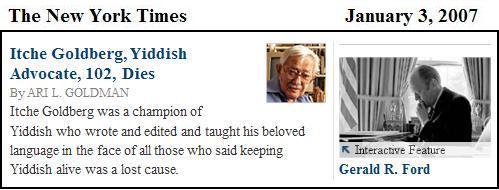
Itche Goldberg's death) --
-- "Least Popular
Christmas Present
Revisited" --
and for the same date
three years earlier --
"If you don't play
some people's game, they say
that you have 'lost your marbles,'
not recognizing that,

while Chinese checkers
is indeed a fine pastime,
a person may also play dominoes,
chess, strip poker, tiddlywinks,
drop-the-soap or Russian roulette
with his brain.
One brain game that is widely,
if poorly, played is a gimmick
called 'rational thought.'"
-- Tom Robbins
Wednesday, January 3, 2007
11:32 AM
The Wanderer:
11:32:56
"What on earth is
a concrete universal?"
-- Robert M. Pirsig

"James Joyce meant Finnegans Wake to become a universal book. His universe was primarily Dublin, but Joyce believed that the universal
can be found in the particular. 'I always write about Dublin,' he said
to Arthur Power, 'because if I can get to the heart of Dublin I can get
to the heart of all the cities of the world' (Ellmann 505). He achieved that goal in Ulysses by making Bloom a universal wanderer, the everyman trying to find his way in the labyrinth of the world." --The Joyce of Science
The Past as Prologue:
Grand Rapids Revisited
Tuesday, January 2, 2007
7:00 AM
Damnation Morning
Introduction to

the Double Cross
This time slot, 7:00 AM EST,
Tuesday, Jan. 2, 2007,
was reserved earlier.
It now (mid-day Jan. 3)
seems an appropriate place
for the following
illustration --
Monday, January 1, 2007
3:00 PM
On the numbers 3 and 7:


For further details, click on the pictures.
Happy 007.