From the journal of Steven H. Cullinane...
2008 October 01-31
Thursday, October 30, 2008 12:25 PM
Annals of Theology:
Readings for
Devil's Night

Thursday, October 30, 2008 5:01 AM
ART WARS, continued:
From the Mountaintop
Katherine Neville, author of perhaps the greatest bad novel of the
twentieth century, The Eight, has now graced a new century with
her sequel, titled The Fire. An
excerpt:
"Our family lodge had been built at about this same period
in the prior century, by neighboring tribes, for my
great-great-grandmother, a pioneering mountain lass. Constructed of
hand-hewn rock and massive tree trunks chinked together, it was a huge
log cabin that was shaped like an octagon-- patterned after a hogan or
sweat lodge-- with many-paned windows facing in each cardinal
direction, like a vast, architectural compass rose.
........
From here on the mountaintop, fourteen thousand feet atop the Colorado
Plateau, I could see the vast, billowing sea of three-mile-high
mountain peaks, licked by the rosy morning light. On a clear day like
this, I could see all the way to Mount Hesperus-- which the Diné
call Dibé Nitsaa: Black Mountain. One of the four sacred
mountains created by First Man and First Woman.
Together with Sisnaajinii, white mountain (Mt. Blanca) in the east;
Tsoodzil, blue mountain (Mt. Taylor) in the south, and Dook’o’osliid,
yellow mountain (San Francisco Peaks) in the west, these four marked
out the four corners of Dinétah-- 'Home of the Diné,' as
the Navajo call themselves.
And they pointed as well to the high plateau I was standing on: Four
Corners, the only place in the U.S. where four states-- Colorado, Utah,
New Mexico, and Arizona-- come together at right angles to form a
cross."
Monday, October 27, 2008 5:07 AM
Annals of Religion, continued:
Halloween
Meditation
for...

5:07:33 AM ET

 33 Retreat
THE IMAGE
Mountain under heaven:
the image of RETREAT.
Thus the superior man
keeps the inferior man
at a distance,
not angrily
but with reserve.
"The mountain rises up under heaven, but owing to its
nature it finally comes to a stop. Heaven on the other hand retreats
upward before it into the distance and remains out of reach. This
symbolizes the behavior of the superior man toward a climbing inferior;
he retreats into his own thoughts as the inferior man comes forward. He
does not hate him, for hatred is a form of subjective involvement by
which we are bound to the hated object. The superior man shows strength
(heaven) in that he brings the inferior man to a standstill (mountain)
by his dignified reserve." --
Richard Wilhelm
Saturday, October 25, 2008 11:01 AM
Annals of Religion:
Actual Being
The New York Times Book Review online today has a review by Sam
Tanenhaus of a new John Updike book.
The title of the review (not the book) is "Mr.
Wizard."
"John Updike is the great genial sorcerer of American
letters. His output alone (60 books, almost 40 of them novels or story
collections) has been supernatural. More wizardly still is the
ingenuity of his prose. He has now written tens of thousands of
sentences, many of them tiny miracles of transubstantiation whereby
some hitherto overlooked datum of the human or natural world-- from the
anatomical to the zoological, the socio-economic to the spiritual--
emerges, as if for the first time, in the completeness of its
actual being."
Rolling Stone interview with
Sting, February 7, 1991:
"'I was brought up in a very strong Catholic community,'
Sting says. 'My parents were Catholic, and in the Fifties and Sixties,
Catholicism was very strong. You know, they say, "Once a Catholic,
always a Catholic." In a way I'm grateful for that background. There's
a very rich imagery in Catholicism: blood, guilt, death, all that
stuff.' He laughs."
Saturday, October 25, 2008 12:00 AM
Happy Picasso's Birthday:
Friday, October 24, 2008 8:08 AM
Cube Space, 1984-2003:
"
The Cube Space"
is a name given to
the
eightfold cube in a vulgarized mathematics text,
Discrete
Mathematics: Elementary and Beyond, by
Laszlo
Lovasz et al., published by Springer in 2003. The
identification in a natural way of the eight points of the linear
3-space over the 2-element field GF(2) with the eight vertices of a
cube is an elementary and rather obvious construction, doubtless found
in a number of discussions of discrete mathematics. But the
less-obvious generation of
the affine
group AGL(3,2) of order 1344 by permutations of parallel edges in
such a cube may (or may not) have originated with me. For descriptions
of this process I wrote in 1984, see
Diamonds and
Whirls and Binary Coordinate
Systems. For a vulgarized description of this process by Lovasz,
without any acknowledgement of his sources, see an excerpt
from his book.
Thursday, October 23, 2008 2:29 AM
Terminator Prequel:
Wednesday, October 22, 2008 6:23 PM
Reading the Paper:
Wednesday, October 22, 2008 9:26 AM
Concepts of Space:
Euclid vs. Galois
On
May 4, 2005, I wrote a note about how to visualize the 7-point Fano
plane within a cube.
Last month, John Baez showed slides that touched on the same topic.
This note is to clear up possible confusion between our two approaches.
From Baez's Rankin
Lectures at the University of Glasgow:

Note that Baez's statement (
pdf) "Lines in
the Fano plane correspond to planes through the origin [the vertex
labeled '1'] in this cube" is, if taken (wrongly) as a statement about
a cube in Euclidean 3-space, false.
The statement is, however, true of the
eightfold cube,
whose eight subcubes correspond to points of the linear 3-space over
the two-element field, if "planes through the origin" is interpreted as
planes within that linear 3-space, as in
Galois geometry,
rather than within the Euclidean cube that Baez's slides seem to
picture.
This Galois-geometry interpretation is, as
an article of his
from 2001 shows, actually what Baez was driving at. His remarks,
however, both in 2001 and 2008, on the plane-cube relationship are both
somewhat trivial-- since "planes through the origin" is a standard
definition of lines in projective geometry-- and also unrelated-- apart
from the possibility of confusion-- to my own efforts in this area. For
further details, see
The Eightfold Cube.
Monday, October 20, 2008 1:06 AM
A Riff for Dave:
Me and My Shadow
Thoughts suggested by Saturday's entry--
"... with primitives the beginnings of art, science, and
religion coalesce in the undifferentiated chaos of the magical
mentality...."
-- Carl G. Jung, "On the Relation of Analytical Psychology to Poetry," Collected
Works, Vol. 15, The Spirit in Man, Art, and Literature,
Princeton University Press, 1966, excerpted in Twentieth
Century Theories of Art, edited by James M. Thompson.
For a video of such undifferentiated chaos, see the Four Tops' "Loco in Acapulco."
"Yes, you'll be goin' loco
down in Acapulco,
the magic down there
is so strong."
This song is from the 1988 film "Buster."
(For a related religious use of that name-- "Look, Buster, do you want
to live?"-- see Fritz Leiber's "Damnation
Morning," quoted here on Sept.
28.)
Art, science, and religion are not apparent within the undifferentiated
chaos of the Four Tops' Acapulco video, which appears to incorporate
time travel in its cross-cutting of scenes that seem to be from the
Mexican revolution with contemporary pool-party scenes. Art, science,
and religion do, however, appear within my own memories of Acapulco.
While staying at a small thatched-roof hostel on a beach at Acapulco in
the early 1960's, I read a paperback edition of Three
Philosophical Poets, a book by George Santayana on Lucretius,
Dante, and Goethe. Here we may regard art as represented by Goethe,
science by Lucretius, and religion by Dante. For a more recent and
personal combination of these topics, see Juneteenth
through Midsummer Night, 2007, which also has references to the
"primitives" and "magical mentality" discussed by Jung.
"The major structures of the psyche for Jung include the
ego, which is comprised of the persona and the shadow. The persona is
the 'mask' which the person presents [to] the world, while the shadow
holds the parts of the self which the person feels ashamed and guilty
about."
-- Brent Dean Robbins, Jung page at Mythos & Logos
As for shame and guilt, see Malcolm Lowry's classic Under the
Volcano, a novel dealing not with Acapulco but with a part of
Mexico where in my youth I spent much more time-- Cuernavaca.
Lest Lowry's reflections prove too depressing, I recommend as
background music the jazz piano of the late Dave
McKenna... in particular, "Me and My Shadow."
McKenna died on Saturday, the date of the
entry that included "Loco in Acapulco." Saturday was also the Feast
of Saint Luke.
Saturday, October 18, 2008 7:07 AM
Death on a Friday and...
Allure
(continued from
July 3, 2006)
This morning's
New York Times
has an obituary for the father
of the paper's executive editor,
Bill Keller:

For more on George Keller and on
the more colorful Levi Stubbs,
who also died on Friday,
see
the
Times's AP obituaries.
Keller's son Bill has emphasized
what he calls the "
allure"
of the
Times's lifestyles coverage.
An example of such coverage--
a 2006 story on visual art in Mexico
that included a reference to...
"
Damien Hirst's
gory new series
'The Death of God--
Towards a Better Understanding
of Life Without God
Aboard the Ship of Fools.'"
For descriptions of such life,
I prefer the literary art of
Robert Stone-- in particular,
Stone's novel
A Flag for Sunrise.
Credit must be given to
the
Times for an excellent
1981
review
of that novel.
(This was well before
the younger Keller
joined the
Times in 1984.)
My own views on life are
less like those of either Keller
than like those of Stone and
perhaps of Levi Stubbs, the
other father figure who
died on Friday.
Related material:
"Yes, you'll be goin' loco
down in Acapulco,
the magic down there
is so strong."
-- Levi Stubbs

Friday, October 17, 2008 12:25 PM
On Quality:
"Every musician wants to do something of lasting quality,
something which will hold up for a
long time, and I guess we did it with 'Stairway.'"
-- Jimmy
Page on "Stairway
to Heaven"
Thursday, October 16, 2008 2:45 AM
Annals of Comedy:
Wednesday, October 15, 2008 6:01 PM
Halloween Decoration:
Wednesday, October 15, 2008 5:01 AM
Algebra of Groups:
Links for the birthday of the late mathematician Bernhard H. Neumann:
MacTutor
biography of Neumann
Variety
(Universal Algebra) at Wikipedia
Preface
to Varieties of Groups (1967), by Hanna Neumann
Biography
(1974 obituary) of Hanna Neumann
Peter M.
Neumann home page
Some related notes on algebra suggested by finite geometry:
Dynamic
and algebraic compatibility of groups (1985 Dec. 11)
Groups related
by a nontrivial identity (1985 Nov. 17)
Transformations
over a bridge (1983 Aug. 16)
Group identity
algebras (1983 Aug. 4)
I have no idea if any work has been done in this area since my own
efforts in 1983-1985.
Sunday, October 12, 2008 3:28 PM
Annals of Finance:
Sunday, October 12, 2008 2:22 AM
Review:
"Elegant"
-- Today's
New York Times
review of
the Very Rev.
Francis
Bowes Sayre Jr.
Related material:
Log24 entries from
the anniversary this
year of Sayre's birth
and from the date
of his death:
A
link from
the
former
suggests the following
graphic meditation--
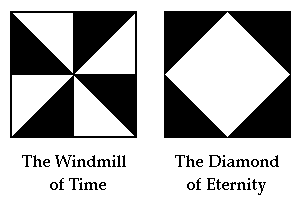
(Click on figure for details.)
A
link from
the
latter
suggests another
graphic meditation--

(Click on figure for details.)
Although less specifically
American than the late
Reverend, who was
born in the White House,
hence perhaps irrelevant
to his political views,
these figures are not
without relevance to
his religion, which is
more about
metanoia
than about
paranoia.
Saturday, October 11, 2008 4:23 PM
Volk Tale:
"In the version of the myth told by Ovid in the Metamorphoses,
Phaeton bragged to his friends that his father was the sun-god. One of
his friends, who was rumored to be a son of Zeus, refused to believe
him and said his mother was lying. So Phaeton went to his father
Helios, who swore by the river Styx to give Phaeton anything he should
ask for in order to prove his divine paternity. Phaeton wanted to drive
his chariot (the sun) for a day. Though Helios tried to talk him out of
it, Phaeton was adamant. When the day came, Phaeton panicked and lost
control of the mean horses that drew the chariot. First it veered too
high, so that the earth grew chill. Then it dipped too close, and the
vegetation dried and burned. He accidentally turned most of Africa into
desert, burning the skin of the Ethiopians black. Eventually, Zeus was
forced to intervene by striking the runaway chariot with a lightning
bolt to stop it, and Phaeton plunged into the river Eridanos. His
sisters the Heliades grieved so much that they were turned into poplar
trees that weep golden amber.
This story has given rise to two latter-day meanings of 'phaeton':
one who drives a chariot or coach, especially at a reckless or
dangerous speed, and one that would or may set the world on fire." --Wikipedia
Friday, October 10, 2008 6:14 AM
Oxford Revisited:
The Fury
Comes Later
Maureen Dowd's New York Times column, "Sound,
but No Fury," on the September 26 debate at Oxford, Mississippi--
"Who would have dreamed that when socialism finally came to
the U.S.A. it would be brought not by Bolsheviks in blue jeans but Wall
Street bankers....?"
Perhaps Ernest Lehman, author of screenplays for "The Prize" and "From
the Terrace." (See recent Log24 entries.)
Paul Krugman's column in today's online Times, "Moment
of Truth"--
"The consequences of Lehman's fall were apparent
within days, yet key policy players have largely wasted the past four
weeks. Now they've reached a moment of truth: They'd better do
something soon-- in fact, they'd better announce a coordinated rescue
plan this weekend-- or the world economy may well experience its worst
slump since the Great Depression.
Let's talk about where we are right now."
Song of Songs 8:8--
We
have a little sister,
and she hath no breasts:
what shall we do for our sister
in the day when she shall
be spoken for?
"In Lehman's fall
We sinned all."
Thursday, October 9, 2008 3:26 AM
Special to Waugh's Daily Beast:
First Draft
of History
Wednesday, October 8, 2008 12:00 PM
Annals of Philosophy:
Serious Numbers
A Yom Kippur
Meditation
"When times are mysterious
Serious numbers
Will always be heard."
-- Paul Simon,
"When Numbers Get Serious"
"There is a pleasantly discursive treatment of
Pontius Pilate's unanswered question 'What is truth?'"
-- H. S. M. Coxeter, introduction to Richard J. Trudeau's
remarks on the "story theory" of truth as opposed to the "diamond
theory" of truth in
The
Non-Euclidean Revolution
Trudeau's 1987 book uses the phrase "diamond theory" to denote the
philosophical theory, common since Plato and Euclid, that there exist
truths (which Trudeau calls "diamonds") that are certain and eternal--
for instance, the truth in Euclidean geometry that the sum of a
triangle's angles is 180 degrees. As the excerpt below shows, Trudeau
prefers what he calls the "story theory" of truth--
"There are no diamonds. People make up stories about what
they experience. Stories that catch on are called 'true.'"
(By the way, the phrase "diamond theory" was used
earlier, in 1976, as
the
title of a monograph on geometry of which Coxeter was aware.)

Excerpt from
The Non-Euclidean Revolution
What does this have to do with numbers?
Pilate's skeptical tone suggests he may have shared a certain confusion
about geometric truth with thinkers like Trudeau and the slave boy in
Plato's
Meno. Truth in a different part of mathematics--
elementary arithmetic-- is perhaps more easily understood, although
even there, the existence of what might be called "non-Euclidean number
theory"-- i.e., arithmetic over finite fields, in which 1+1 can equal
zero-- might prove baffling to thinkers like Trudeau.
Trudeau's book exhibits, though it does not discuss, a less confusing
use of numbers-- to mark the location of
pages. For some
philosophical background on this version of numerical truth that may be
of interest to devotees of the Semitic religions on this evening's High
Holiday, see
Zen
and Language Games.
For uses of numbers that are
more confusing, see-- for
instance-- the new website
The
Daily Beast and the old website
Story
Theory and the Number of the Beast.
Tuesday, October 7, 2008 12:25 AM
Something Eternal:
The Color Grey
The
previous two entries mention,
and illustrate, the color grey.
Another illustration, on the cover
of one of my favorite books:
 "A colour is eternal.
It haunts time like a spirit."
-- Alfred North Whitehead
From John Lahr's
winter 2002 review
of "Our Town"--
"We all know that something is
eternal," the Stage Manager says. "And it ain't houses and it ain't
names, and it ain't earth, and it ain't even stars-- everybody knows in
their bones that something is
eternal, and that something has to do with human beings."
The Stage Manager was played by Paul Newman. The review was
subtitled "Getting the Spirit Onstage."
Monday, October 6, 2008 1:26 PM
Annals of Religion:
Leap Day of Faith
Yesterday's
entry contained the following unattributed quotation:
"One must join forces with friends of like mind."
As the link to Leap
Day indicated, the source of the quotation is the I Ching.
Yesterday's entry also quoted the late Terence McKenna,
a confused writer on psychosis and the I Ching. Lest the reader
conclude that I consider McKenna or similar authors (for instance, Timothy
Leary in Cuernavaca) as "friends of like mind," I would point
rather to more sober students of the I Ching (cf. my June 2002
notes on philosophy,
religion, and science) and to the late Scottish theologian John
Macquarrie:

Macquarrie's connection in this journal to the I
Ching is, like that book itself, purely coincidental. For
details, click on the figure below.

The persistent reader will
find
a
further link that
leads to an entry titled
"Notes on the
I Ching."
McKenna's writing was of value to me for
its (garbled) reference to a thought of Alfred North Whitehead:
"A colour is eternal. It haunts time like a
spirit. It comes and it goes. But where it comes it is the
same colour. It neither survives nor does it live. It
appears when it is wanted."
-- Science and the Modern World, 1925
Sunday, October 5, 2008 4:23 PM
Annals of Religion:
Theologian
James Edwin Loder:
"In a game of chess, the knight's move is unique because it alone goes
around corners. In this way, it combines the continuity of a set
sequence with the discontinuity of an unpredictable turn in the middle.
This meaningful combination of continuity and discontinuity in an
otherwise linear set of possibilities has led some to refer to the
creative act of discovery in any field of research as a 'knight's move'
in intelligence."
"One must join forces with friends of like mind"
Related material:
Terence
McKenna:
"Schizophrenia is not a psychological disorder peculiar to
human beings. Schizophrenia is not a disease at all but rather a
localized traveling discontinuity of the space time matrix itself. It
is like a travelling whirl-wind of radical understanding that haunts
time. It haunts time in the same way that Alfred North Whitehead said
that the color dove grey 'haunts time like a ghost.'"
Anonymous
author:
"'Knight's move thinking' is a psychiatric term describing a
thought disorder where in speech the usual logical sequence of ideas is
lost, the sufferer jumping from one idea to another with no apparent
connection. It is most commonly found in schizophrenia."
I know more than Apollo,
For oft when he lies sleeping
I see the stars at mortal wars
In the wounded welkin weeping.
-- Tom
O'Bedlam's Song
For more on the sleep of Apollo,
see the front page of today's
New York Times Book Review.
Garrison Keillor's piece there,
"
Dying
of the Light," is
about the fear of death felt
by an agnostic British twit.
For relevant remarks by
a British non-twit, see
William Dunbar--
Timor
Mortis conturbat me.
Saturday, October 4, 2008 8:28 PM
Revelation Game, continued:
Saturday, October 4, 2008 12:00 AM
Mathematics and Narrative, continued:
"The Ambition of the Short Story," the essay by Steven Millhauser
quoted here on Tuesday,
September 30, is now
online.
Friday, October 3, 2008 4:30 PM
Not-So-Ig Nobel:
The Prize

“The secret to life, and
to love, is getting started,
keeping going, and then
getting started again.”
Nobel Laureate
Seamus Heaney
at Sanders
Theatre,
Harvard College,
September
30, 2008
On Elke Sommer:
"...Young Elke... studied
in the prestigious
Gymnasium School
in
Erlangen...."
--
Film Fatales
Erlangen
Prize Lecture:
Variations
on a Theme of
Plato,
Goethe,
and Klein
(Background:
Christmas
Knot, Sept. 26,
and
Hard
Core, July 17-18.)