From the journal of Steven H. Cullinane...
2008 April 16-30
Wednesday, April 30, 2008 11:07 PM
Happy Walpurgisnacht, continued:
Wednesday, April 30, 2008 10:30 AM
Happy Walpurgisnacht, Julie:
Lucy in the Sky
with Diamonds
and Sacred Heart
PARIS -- Albert Hofmann, the mystical Swiss chemist
who gave the world LSD, the most powerful psychotropic substance known,
died Tuesday at his hilltop home near Basel, Switzerland. He was 102.
Wednesday, April 30, 2008 9:00 AM
Annals of Philosophy, continued:
Calendar Catechism
Q: If the opposite of Christmas (December 25) is Anti-Christmas (June
25), and the opposite of Halloween (October 31) is May Day (May
1), then what is the opposite of April 30?
A: October 30... Devil's Night!
Tuesday, April 29, 2008 11:09 AM
Religious Art, continued...
Sacerdotal Jargon
at Harvard:

Thomas Wolfe
(Harvard M.A., 1922)
versus

Rosalind Krauss
(Harvard M.A., 1964,
Ph.D., 1969)
on
The Kernel of Eternity
"No culture has a pact with eternity."
-- George Steiner, interview in
The Guardian of April 19
"At that instant he saw,
in one blaze of light, an image
of unutterable conviction....
the core of life, the essential
pattern whence all other things
proceed, the kernel of eternity."
-- Thomas Wolfe, Of Time
and
the River, quoted in
Log24 on June 9, 2005
From today's online
Harvard Crimson:
"...
under the leadership of Faust,
Harvard students should look forward
to an ever-growing opportunity for
international experience
and artistic endeavor."

Pauli as Mephistopheles
in a 1932 parody of
Goethe's Faust
at Niels Bohr's
institute in Copenhagen
From a recent book
on Wolfgang Pauli,
The Innermost Kernel:

A belated happy birthday
to the late
Felix Christian Klein
(born on April 25) --

Another Harvard figure quoted here on Dec.
5, 2002:
"The theory of poetry, that is to say, the total of the
theories of poetry, often seems to become in time a mystical theology
or, more simply, a mystique. The reason for this must by now be clear.
The reason is the same reason why the pictures in a museum of modern
art often seem to become in time a mystical aesthetic, a prodigious
search of appearance, as if to find a way of saying and of establishing
that all things, whether below or above appearance, are one and that it
is only through reality, in which they are reflected or, it may be,
joined together, that we can reach them. Under such stress, reality
changes from substance to subtlety, a subtlety in which it was natural
for Cézanne to say: 'I see planes bestriding each other and
sometimes straight lines seem to me to fall' or 'Planes in color....
The colored area where shimmer the souls of the planes, in the blaze of
the kindled prism, the meeting of planes in the sunlight.' The
conversion of our Lumpenwelt went far beyond this. It was
from the point of view of another subtlety that Klee could write: 'But
he is one chosen that today comes near to the secret places where
original law fosters all evolution. And what artist would not establish
himself there where the organic center of all movement in time and
space-- which he calls the mind or heart of creation-- determines every
function.' Conceding that this sounds a bit like sacerdotal jargon,
that is not too much to allow to those that have helped to create a new
reality, a modern reality, since what has been created is nothing less."
-- Wallace Stevens, Harvard College Class of 1901, "The Relations
between Poetry and Painting" in The Necessary Angel (Knopf, 1951)
From a review of Rosalind Krauss's The
Optical Unconscious (MIT Press hardcover, 1993):
Krauss is concerned to present Modernism less in terms of
its history than its structure, which she seeks to represent by means
of a kind of diagram:
"It is more interesting to think of modernism as a graph or table than
a history." The "table" is a square with diagonally connected corners,
of the kind most likely to be familiar to readers as the Square of
Opposition, found in elementary logic texts since the mid-19th century.
The square, as Krauss sees it, defines a kind of idealized space
"within which to work out unbearable contradictions produced within the
real field of history." This she calls, using the inevitable gallicism,
"the site of Jameson's Political Unconscious" and then, in art,
the optical unconscious, which consists of what Utopian Modernism had
to kick downstairs, to repress, to "evacuate... from its field."
-- Arthur C. Danto in ArtForum, Summer 1993
Rosalind Kraus in The Optical Unconscious (MIT
Press paperback, 1994):
For a presentation of the Klein Group, see
Marc Barbut, "On the Meaning of the Word 'Structure' in Mathematics,"
in Introduction to Structuralism, ed. Michael Lane (New York:
Basic Books, 1970). Claude Lévi-Strauss uses the Klein group in
his analysis of the relation between Kwakiutl and Salish masks in The
Way of the Masks, trans. Sylvia Modelski (Seattle: University of
Washington Press, 1982), p. 125; and in relation to the Oedipus myth in
"The Structural Analysis of Myth," Structural Anthropology,
trans. Claire Jackobson [sic] and Brooke Grundfest Schoepf (New York:
Basic Books, 1963). In a transformation of the Klein Group, A. J.
Greimas has developed the semiotic square, which he describes as giving
"a slightly different formulation to the same structure," in "The
Interaction of Semiotic Constraints," On Meaning (Minneapolis:
University of Minnesota Press, 1987), p. 50. Jameson
uses the semiotic square in The Political Unconscious (see pp.
167, 254, 256, 277) [Fredric Jameson, The Political Unconscious: Narrative as a Socially
Symbolic Act (Ithaca: Cornell University Press, 1981)], as does
Louis Marin in "Disneyland: A Degenerate Utopia," Glyph, no. 1
(1977), p. 64.
For related non-sacerdotal jargon, see...
Wikipedia
on the Klein group (denoted V, for Vierergruppe):
In this representation, V is a normal subgroup of the alternating group A4
(and also the symmetric group S4)
on 4 letters. In fact, it is the kernel of a
surjective map from S4 to S3.
According to Galois theory, the existence
of the Klein four-group (and in particular, this representation of it)
explains the existence of the formula for calculating the roots of quartic equations in terms
of radicals.
Monday, April 28, 2008 7:00 AM
Annals of Aesthetics, continued:
Religious Art
The black monolith of
Kubrick's
2001 is, in
its way, an example
of religious art.

One artistic shortcoming
(or strength-- it is, after
all, monolithic) of
that artifact is its
resistance to being
analyzed as a whole
consisting of
parts, as
in
a
Joycean epiphany.
The following
figure
does
allow such
an epiphany.

One approach to
the epiphany:
"Transformations play
a major role in
modern mathematics."
- A
biography of
Felix Christian Klein
The above 2x4 array
(2 columns, 4 rows)
furnishes
an
example of
a transformation acting
on the parts of
an organized whole:

For other transformations
acting on the eight parts,
hence on the 35 partitions, see
"
Geometry
of the 4x4 Square,"
as well as Peter J. Cameron's
"The Klein Quadric
and Triality" (
pdf),
and (for added context)
"
The
Klein Correspondence,
Penrose Space-Time, and
a Finite Model."
For a related structure--
not rectangle but cube--
see
Epiphany 2008.
Sunday, April 27, 2008 8:28 AM
Annals of Aesthetics, continued:
Happy Birthday
to the late
Gian-Carlo
Rota,
mathematician and
scholar of philosophy
Rota* on his favorite philosopher:
"I believe
Husserl to be the greatest philosopher of all
times....
Intellectual honesty is the striking quality of Husserl's writings. He
wrote what he honestly believed to be true, neither more nor less.
However, honesty is not clarity; as a matter of fact, honesty and
clarity are at opposite ends. Husserl proudly refused to stoop to the
demands of showmanship that are indispensable in effective
communication."

Related material:
The
Diamond Theorem
* Gian-Carlo Rota, "Ten Remarks on
Husserl and Phenomenology," in O.K. Wiegand et al. (eds.), Phenomenology
on Kant, German Idealism, Hermeneutics and Logic, pp. 89-97, Kluwer
Academic Publishers, 2000
Saturday, April 26, 2008 10:31 AM
Annals of Aesthetics:
Mere Philosophy
In Memory of
Edmund
Husserl
"Mereology (from the Greek μερος, 'part')
is the theory of parthood relations:
of the relations of part to whole and the
relations of part to part within a whole.
Its roots can be traced back to
the early days of philosophy...."
--
Stanford
Encyclopedia of Philosophy
"Beauty is the proper conformity
of the parts to one another
and to the whole."
-- Classic definition quoted
by Werner Heisenberg
(
Log24, May 18-20, 2005)
"It seems, as one becomes older,
That the past has another pattern,
and ceases to be a mere
sequence...."
-- T. S. Eliot,
Four Quartets

See also
Time Fold
and
Theme and Variations.
Friday, April 25, 2008 8:00 AM
ART WARS continued:
Destabilizing
the Locus
"It is the intention
of this piece
to destabilize the locus
of that authorial act...."
-- Yale art student
Aliza
Shvarts,
quoted today in
The Harvard Crimson
From Log24 on
March 14:
Related material
from Google:
Other ways
of killing time:
From Log24 on April 21, the date of Mark Twain's death--
Psychoshop, by Alfred Bester and Roger Zelazny:
His manner was all charm and grace; pure
cafe society....
He purred a chuckle. "My place. If you want to
come, I'll show you."
"Love to. The Luogo Nero? The Black Place?"
"That's what the locals call it. It's really
Buoco Nero, the Black Hole."
"Like the Black Hole of Calcutta?"
"No. Black Hole as in astronomy. Corpse of a dead
star, but also channel between this universe and its next-door
neighbor."
The Pennsylvania Lottery
yesterday, April 24, 2008:
Mid-day 923, Evening 765....
and hence Log24, 9/23 (2007), and page 765 of From Here to
Eternity (Delta paperback, 1998):
He stayed that way for eight days, never what you
could really call drunk, but certainly never anywhere near sober, and
always with a bottle of Georgette's expensive scotch in one hand and a
glass in the other. He did not talk at all except to say "Yes" or "No,"
mostly "No," when confronted with a direct question, and he never ate
anything when they were there. It was like living in the same house
with a dead person.
|
Thursday, April 24, 2008 9:00 AM
Philosophy Wars continued:
Dimensions
George Steiner, interview in The Guardian of April 19:
"No culture has a pact with eternity," he says. "The
conditions which made possible the giants of the western poetic,
aesthetic, philosophic tradition no longer really obtain." Steiner
doesn't believe "there can be a Hamlet without a ghost, a Missa
Solemnis without a missa," and if you say that the questions addressed
by religion are "nonsense or baby talk or trivial, I don't believe that
certain dimensions will be available to you. Particularly today, when
the atheist case is being put, if I may say so, with such vulgarity of
mind."
Wednesday, April 23, 2008 9:00 AM
Happy Shakespeare's Birthday:
Upscale Realism
or, "Have some more
wine and cheese, Barack."
(See April 15, 5:01 AM)
Allyn Jackson on Rebecca Goldstein
in the April 2006
AMS Notices (
pdf)
"Rebecca Goldstein’s 1983 novel The
Mind-Body Problem has been widely admired among mathematicians for
its authentic depiction of academic life, as well as for its
exploration of how philosophical issues impinge on everyday life. Her
new book, Incompleteness: The Proof and Paradox of Kurt Gödel,
is a volume in the 'Great Discoveries' series published by W. W.
Norton....
In March 2005 the Mathematical Sciences Research Institute (MSRI) in
Berkeley held a public event in which its special projects director,
Robert Osserman, talked with Goldstein about her work. The
conversation, which took place before an audience of about fifty people
at the Commonwealth Club in San Francisco, was taped....
A member of the audience posed a question that has been on the minds of
many of Goldstein’s readers: Is The Mind-Body Problem based on
her own life? She did indeed study philosophy at Princeton, finishing
her Ph.D. in 1976 with a thesis titled 'Reduction, Realism, and the
Mind.' She said that while there are correlations between her life and
the novel, the book is not autobiographical....
She... talked about the relationship between Gödel and his
colleague at the Institute for Advanced Study, Albert Einstein. The two
were very different: As Goldstein put it, 'Einstein was a real mensch,
and Gödel was very neurotic.' Nevertheless, a friendship sprang up
between the two. It was based in part, Goldstein speculated, on their
both being exiles-- exiles from Europe and intellectual exiles.
Gödel's work was sometimes taken to mean that even mathematical
truth is uncertain, she noted, while Einstein's theories of relativity
were seen as implying the sweeping view that 'everything is relative.'
These misinterpretations irked both men, said Goldstein. 'Einstein and
Gödel were realists and did not like it when their work was put to
the opposite purpose.'"
|
Related material:
From Log24 on
March 22 (Tuesday of
Passion Week), 2005:
|
"'What is this Stone?' Chloe asked.... 'It is
told that, when the Merciful One made the worlds, first of all He
created that Stone and gave it to the Divine One whom the Jews call
Shekinah, and as she gazed upon it the universes arose and had being.'"
-- Many Dimensions,
by Charles Williams, 1931
For more on this theme
appropriate to Passion Week --
Jews playing God -- see

Rebecca Goldstein
in conversation with
Bob Osserman
of the
Mathematical Sciences
Research Institute
at the
Commonwealth Club,
San Francisco,
Tuesday, March 22.
Wine and cheese
reception at 5:15 PM
(San Francisco time).
|
From
UPSCALE,
a website of the
physics department at
the University of Toronto:
|
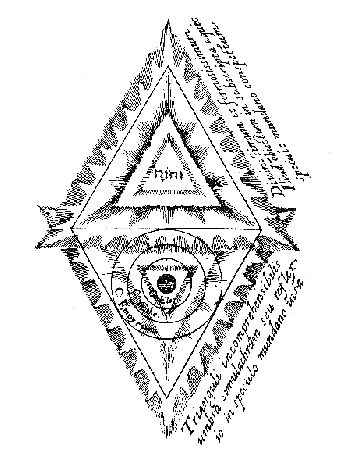
Mirror Symmetry
"The image [above]
is a depiction of
the universe as a
mirror image of God,
drawn by Robert Fludd
in the early 17th century.
The caption of the
upper triangle reads:
'That most divine and beautiful
counterpart visible below in the
flowing image of the universe.'
The caption of the
lower triangle is:
'A shadow, likeness, or
reflection of the insubstantial*
triangle visible in the image
of the universe.'"
* Sic. The original is incomprehensibilis, a technical theological
term. See Dorothy Sayers on the Athanasian Creed and John 1:5.
|
For further
iconology of the
above equilateral triangles,
see
Star Wars (May 25, 2003),
Mani Padme (March 10, 2008),
Rite of Sping (March 14, 2008),
and
Art
History: The Pope of Hope
(In honor of John Paul II
three days after his death
in April 2005).
Happy Shakespeare's Birthday.
Monday, April 21, 2008 11:07 AM
Final Arrangements, continued:
A Fresh Perspective
"... if thou bring thy gift
to the altar, and
there rememberest...."
Matthew 5:23-24
The following meditations were inspired by an ad today in the online New
York Times obituaries section--
"Been somewhere interesting? Tell us about it for a chance
to win a trip for 2 to Paris."
Country song, quoted here Dec. 17, 2003--
"Give faith a fighting chance."
Malcolm Lowry, Under the Volcano--
"I sit now in a little room off the bar at four-thirty
in the morning drinking ochas and then mescal and writing this on some
Bella Vista notepaper I filched the other night.... But this is worst
of all, to feel your soul dying. I wonder if it is because to-night my
soul has really died that I feel at the moment something like peace. Or
is it because right
through hell there is a path, as Blake well knew, and
though I may not take it, sometimes lately in dreams I have been able
to see it? ...And this is how I sometimes think of myself, as a great
explorer who has discovered some extraordinary land from which he can
never return to give his knowledge to the world: but the name of this
land is hell. It is not Mexico of course but in the heart."
From an obituary of mathematician Gian-Carlo Rota linked
to here on April 18, the anniversary of Rota's death:

Gian-Carlo Rota
From a novel, Psychoshop, quoted here in an entry on the Pope's
birthday, "The Gates of Hell" --
His manner was all charm and grace; pure cafe
society....
He purred a chuckle. "My place. If you want to come, I'll show
you."
"Love to. The Luogo Nero? The Black Place?"
"That's what the locals call it. It's really Buoco Nero, the
Black Hole."
"Like the Black Hole of Calcutta?"
"No. Black Hole as in astronomy. Corpse of a dead star, but
also channel between this universe and its next-door neighbor."
"Here? In Rome?"
"Sure. They drift around in space until they run out of gas and
come to a stop. This number happened to park here."
Saturday, April 19, 2008 5:01 AM
Philosophy Wars continued:
A Midrash for Benedict
On April 16, the Pope's birthday, the evening lottery number in
Pennsylvania was 441. The Log24 entries of April 17 and April 18 supplied commentaries based on 441's
incarnation as a page number in an edition of Heidegger's
writings. Here is a related commentary on a different incarnation
of 441. (For a context that includes both today's commentary and
those of April 17 and 18, see Gian-Carlo Rota-- a Heidegger scholar as
well as a mathematician-- on mathematical Lichtung.)
From R. D. Carmichael, Introduction
to the Theory of Groups of Finite Order (Boston, Ginn and Co.,
1937)-- an exercise from the final page, 441, of the final
chapter, "Tactical Configurations"--
"23. Let G be a multiply
transitive group of degree n
whose degree of transitivity is k;
and let G have the property
that a set S of m elements exists in G such that when k of the elements S are changed by a permutation of G into k of these elements, then all these
m elements are permuted among
themselves; moreover, let G
have the property P, namely,
that the identity is the only element in G which leaves fixed the n - m elements not in S. Then show that G permutes the m elements S into
n(
n -1) ... (
n -
k + 1)
____________________
m(
m - 1) ... (
m -
k + 1)
sets of
m elements each, these sets forming
a configuration having the property that any (whatever) set of
k elements appears in one and just
one of these sets of
m
elements each. Discuss necessary conditions on
m,
n,
k in order that the foregoing
conditions may be realized. Exhibit groups illustrating the theorem."
This exercise concerns
an
important mathematical structure said to have been discovered
independently by the American
Carmichael
and by the German
Ernst Witt.
For some perhaps more comprehensible material from the preceding page
in Carmichael-- 440-- see
Diamond
Theory in 1937.
Saturday, April 19, 2008 4:30 AM
From the Labyrinth of Solitude:
From "Today in History,"
by the Associated Press--
April 19, 2008--
"On this date....
Ten years ago....
Mexican poet-philosopher
Octavio Paz died at age 84."
"Mexico is a solar country--
but it is also a black country,
a dark country. This duality
of Mexico has preoccupied
me since I was a child."
-- Octavio Paz, as quoted
by Homero Aridjis
"And the light shineth in
darkness; and the darkness
comprehended it not."
-- John 1:5
"Ya
la ronda
llega aquí"
Friday, April 18, 2008 9:00 AM
Annals of Religion, continued:
Thursday, April 17, 2008 8:28 AM
Annals of Religion, continued:
Top Headlines
(at
Google News):
In other words:
- The best lack all conviction
- while the worst
Are full of passionate intensity.
- Surely some revelation is at hand....
-- William Butler Yeats
|
Revelation for
April 16, 2008 --
day of the Pennsylvania
Clinton-Obama debate and
of the Pope's birthday --
The Pennsylvania Lottery:

Make of this revelation
what you will.
My own interpretations:
the
Lichtung of
4/13 and
the
Dickung of
page
441
of Heidegger's
Basic Writings,
where
the terms
Lichtung and
Dickung are described.
See also "
The Shining of
May 29" (JFK's birthday).
"By groping toward the light
we are made to realize
how deep the darkness is
around us."
-- Arthur Koestler,
The Call Girls:
A Tragi-Comedy
Wednesday, April 16, 2008 10:10 AM
Annals of Religion, continued...
Poetry
for Physicists:
The Gates of Hell
From the obituary of physicist John Archibald Wheeler at Princeton:
In the fall of 1967, he was invited to
give a talk.... As he spoke, he... [mentioned] something strange...
what he called a gravitationally completely collapsed object. But such
a phrase was a mouthful, he said, wishing aloud for a better name. "How
about black hole?" someone shouted from the audience.
That was it. "I had been searching for just the right term for months,
mulling it over in bed, in the bathtub, in my car, wherever I had quiet
moments," he later said. "Suddenly this name seemed exactly right." He
kept using the term, in lectures and on papers, and it stuck.
From Log24 last year on this date ("Happy Birthday, Benedict XVI"):
"Know the one about
the Demiurge and the Abridgment of Hope?"
-- Robert Stone, A Flag for Sunrise, Knopf,
1981, the final page, 439
From Dante, The Inferno,
inscription on the gates of Hell:
"Abandon all hope, ye who enter."
From Psychoshop, an unfinished novel
by Alfred Bester completed by Roger Zelazny:
His manner was all charm and grace;
pure cafe society....
He purred a chuckle. "My place. If you want to come, I'll show you."
"Love to. The Luogo Nero? The Black Place?"
"That's what the locals call it. It's really Buoco Nero, the Black
Hole."
"Like the Black Hole of Calcutta?"
"No. Black Hole as in astronomy. Corpse of a dead star, but also
channel between this universe and its next-door neighbor."
"Here? In Rome?"
"Sure. They drift around in space until they run out of gas and come to
a stop. This number happened to park here."
"How long ago?"
"No one knows," he said. "It was there six centuries before Christ,
when the Etruscans took over a small town called Roma and began turning
it into the capital of the world."