From the journal of Steven H. Cullinane...
2007 September 16-30
Sunday, September 30, 2007 2:00 PM
Short Service, continued:
Hat Tip
Today's New York Times
on the Sept. 22 death
of William D. Rogers,
architect of United States
policy on Latin America--
When Rogers died during
a Virginia fox hunt,
"An Episcopal priest was called,
the hounds were collected
and the hunters gathered
for a short service on the spot.
'One by one, they rode past him
and tipped their hats'...."

A man returns a crucifix
to a Huichol village chapel.
Photo by Rachel Cobb
for National Geographic
"The Eagle soars in
the summit of Heaven,
The Hunter with his dogs
pursues his circuit."
|
Sunday, September 30, 2007 8:28 AM
Mr. Eliot's Sunday Sermon for...
Trinity Church
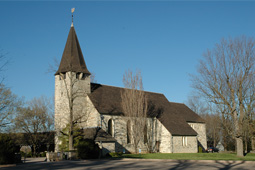
"Funeral services will be held
at Trinity Church, Upperville,
at 2 p.m. Sunday, Sept. 30."
The source:

Today's
previous entry had
a different image of Rogers
with a quotation from
Wallace Stevens's "The Rock."
Stevens, though raised as
a Presbyterian, was a
secular poet.
Since Rogers's funeral
is to take place in
a Christian church,
it seems fitting to
grant equal time to
a Christian poet of
at least equal stature:
"Though you forget the way
to the Temple,
There is one who remembers
the way to your door:
Life you may evade,
but Death you shall not.
You shall not deny the Stranger."
-- Thomas Stearns Eliot,
"Choruses from 'The Rock'" |
Sunday, September 30, 2007 3:14 AM
Short Service:
Death on Yom Kippur
"William D. Rogers, a lawyer who helped plan the
Kennedy and Johnson administrations' approach to Latin America and then
served as a principal policymaker for the region during the Ford
administration, died Sept. 22 near his home in Upperville, Va. He was
80.
Mr. Rogers, a devotee of fox hunting, died during a hunt after
suffering a heart attack while riding his favorite horse, Isaiah, his
son William said....
His son William said his father was declared dead almost
immediately by a doctor participating in the fox hunt. An Episcopal
priest was called, the hounds were collected and the hunters gathered
for a short service on the spot.
'One by one, they rode past him and tipped their hats,' William
said."
-- Douglas Martin and Sarah Abruzzese, New
York Times, Sept. 30, 2007
"Enter the rock...."
-- New
American Standard Bible

For the meaning of the Virginia
Lottery
number on the night of Rogers's death,
see
The Beauty Test.
For the meaning of the Virginia Lottery
number on the day of Rogers's death,
see
Garden Party.
Selah.
Saturday, September 29, 2007 3:09 AM
Final Arrangements, continued:
Friday, September 28, 2007 6:25 AM
Annals of Scholarship
Thursday, September 27, 2007 4:00 PM
Finite Geometry Update:
This afternoon I added a new page to finitegeometry.org and updated the Geometry
of Logic page. These changes are due to my coming across the Usenet postings of Carol von der Lin.
Thursday, September 27, 2007 6:29 AM
MacArthur Grant --
The Holy Spook
continues:
Classics 101 --

(See September 15. )
"The communication
of the dead is tongued with fire
beyond the language of the living."
-- T. S. Eliot, Four Quartets
The Boston Globe,
Tuesday, Sept. 25, 2007
By Anna Badkhen, Globe
Correspondent
"When Boston psychiatrist Jonathan Shay wanted to
understand the psychological toll of the Vietnam War on the veterans he
treated, he turned to the 'Iliad' and the 'Odyssey.'
The classical Greek epics perfectly encapsulate the
mental damage of combat, said Shay, who works for the Department of
Veterans Affairs in Boston....
Today, the John D. and Catherine T. MacArthur
Foundation will announce that Shay, 65, has been selected as a 2007
MacArthur fellow 'for his work in using literary parallels from Homer's
"Iliad" and "Odyssey" to treat combat trauma suffered by Vietnam
veterans.'....
'I was hearing elements of the story of Achilles over
and over again,' Shay said.
Achilles, the hero of the 'Iliad,' is mistreated by his
commander, who takes a girl, a prize of war, from him. Achilles is also
tormented by the loss of his best friend in the Trojan War. With his
ethical universe upended, he goes berserk.
Soon, Shay began to work on his first book, 'Achilles in Vietnam: Combat Trauma and the Undoing of
Character.'
In the book, he interspersed the story of Achilles with
examples of his patients' losses and contentious relationships with
their commanders in Vietnam to illustrate some of the causes of the
troops' psychological wounds."
The first word of the '
Iliad,'
Menin, is written in Greek
on Professor Silk's blackboard
in the photo at top.
It means "wrath."
Related material:
The wrath of a Vietnam
veteran, portrayed by
Ed Harris, in the film
"
The Human Stain,"
and a calmer Harris in
the illustration below,
from
Log24, Oct. 8, 2005:
A History of Death

Adapted from
the film
"A
History of Violence"
Tuesday, September 25, 2007 8:00 AM
A Psalm for Faust:
Monday, September 24, 2007 1:06 AM
Annals of Theology:
Psalm from
the Underworld
I reserved the time slot of this entry, 1:06 (a reference to Epiphany),
on Sept. 24 after encountering the following passages in
"At any time, God can cancel a life. 'So teach us
to number our days,' as the King James Version has it, 'that we may
apply our hearts unto wisdom.'....
The ancient Hebrew word for the shadowy underworld where the dead go, Sheol,
was Christianized as 'Hell,' even though there is no such concept in
the Hebrew Bible. Alter prefers the words 'victory' and 'rescue' as
translations of yeshu'ah, and eschews the Christian version,
which is the heavily loaded 'salvation.' And so on. Stripping his
English of these artificial cleansers, Alter takes us back to the
essence of the meaning. Suddenly, in a world without Heaven, Hell, the
soul, and eternal salvation or redemption, the theological stakes seem
more local and temporal: 'So teach us to number our days.'"
The reference to "numbering our days" recalled Saturday morning's Yom Kippur entry on the days
numbered 8/09 and 9/12. Here is another such entry, courtesy of
the Pennsylvania Lottery:
Sunday, September 23, 2007 11:07 PM
New Season--
The New Yorker,
issue dated
Sept. 24, 2007:
FALL PREVIEW
READINGS
On Oct. 10, Stephen King
opens the new season
of "Selected Shorts"
at Symphony Space as
the host of readings from
"
The Best American
Short Stories 2007,"
which he guest-edited.
(www.symphonyspace.org.)

Related material:
"When you care enough..."
(
Aug. 20 in
Summer Reading)
Update of 5:00 PM EDT
Monday, Sept. 24, 2007:
See also King's essay
"What Ails the Short Story"
on the inside back page
of next Sunday's (Sept. 30)
New York Times Book Review.
Sunday, September 23, 2007 5:51 AM
At Summer's End:
Autumn Equinox--
5:51 AM EDT today.
On Stephen King's
Birthday, 2001--
A Reading List
"to observe King's birthday,
the High Holy Days,
the autumn equinox,
et cetera"
On Stephen King's
Birthday, 2007--
The Pennsylvania Lottery
numbers were 809 and 912.
For parts of a story
about these numbers,
see "
Summer Reading"
(Aug. 7 - Sept. 22).
Sunday, September 23, 2007 5:01 AM
In the Dark Before Dawn:
Saturday, September 22, 2007 6:25 AM
Yom Kippur, Part III:
PA Lottery
Monolith
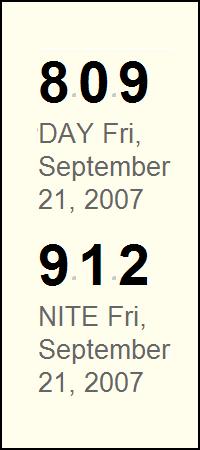
Click on image
for soundtrack.
See also
8/09,
9/12.
Saturday, September 22, 2007 6:23 AM
Yom Kippur, Part II:
Retrospect
"
It was only in retrospect
that the silliness
became profound."
-- Review of
Faust in Copenhagen
Saturday, September 22, 2007 6:22 AM
Yom Kippur, Part I:
The Magic of Numbers
"Emphasis will be placed on discovery through conjecture and
experimentation."
-- Elena Mantovan, pre-2007 undated Harvard syllabus for Quantitative Reasoning
28, "The Magic of Numbers"
"The lunatic, the lover, and the poet, said Shakespeare, are of
imagination all compact. He forgot the mathematician.... Those who win
through to the end of The Magic of Numbers will be for the rest
of their lives in touch with the accessible mystery of things."
-- Review, Harvard Magazine, Jan/Feb 2004
"Lear becomes almost lyrical. 'When thou dost
ask me blessing, I'll kneel down/ And pray, and sing, and tell old
tales, and laugh/ At gilded butterflies, and hear poor rogues/ Talk of
court news; and we'll talk with them too/ Who loses and who wins; who's
in, who's out-- And take upon's the mystery of things/ As if we were
God's spies.' That is a remarkable, haunting passage."
-- Father James V. Schall, Society of Jesus, Georgetown Hoya, undated
column (perhaps, the URL indicates, from All Hallows' Eve, 2006)
Friday, September 21, 2007 8:28 AM
On Dryness:
Word and Object
"We may recall the ideal of 'dryness' which we
associate with the symbolist movement, with writers such as T. E. Hulme
and T. S. Eliot, with Paul Valery, with Wittgenstein. This 'dryness'
(smallness, clearness, self-containedness) is a nemesis of
Romanticism.... The temptation of art... is to console. The modern
writer... attempts to console us by myths or by stories."
-- Iris Murdoch
"The consolations of form,
the clean crystalline work"
-- Iris Murdoch,
"Against Dryness"
"As a teacher Quine
was carefully organized,
precise, and conscientious,
but somewhat dry
in his classroom style."
--
Harvard Gazette
Word:

Object:
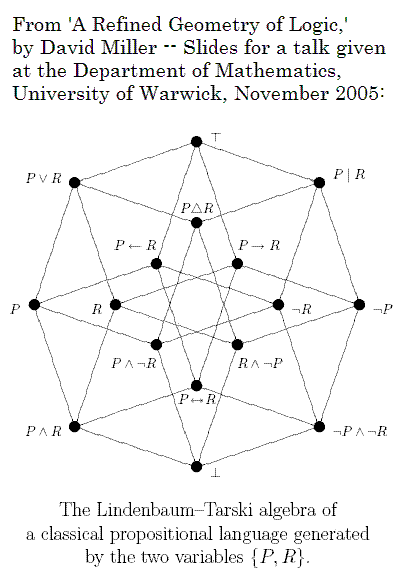 Myth and Story:
The five entries ending
Myth and Story:
The five entries ending
on Jan. 27, 2007
"There
is such a thing
as a tesseract."
--
Madeleine L'Engle
Wednesday, September 19, 2007 5:00 AM
Philosophy Wars continued:
Einstein, God, and
the Consolation of Form
"The kind of thing that would make Einstein gag"
--
Peter Woit, Sept. 18, 2007
"-- ...He did some equations that would make God cry
for the sheer beauty of them. Take a look at this.... The sonofabitch
set out equations that fit the data. Nobody believes they mean
anything. Shit, when I back off, neither do I. But now and then, just
once in a while...
-- He joined physical and mental events. In a
unified mathematical field.
-- Yeah, that’s what I think he did. But the
bastards in this department... bunch of goddamned positivists. Proof
doesn’t mean a damned thing to them. Logical rigor, beauty, that damned
perfection of something that works straight out, upside down, or
sideways-- they don’t give a damn."
-- "
Nothing Succeeds," in
The
Southern Reporter: Stories of John William Corrington, LSU
Press, 1981
"The search for images of order and the loss of them constitute the
meaning of
The Southern Reporter."
--
Louisiana State University Press
"By equating reality with the metaphysical abstraction 'contingency'
and explaining his paradigm by reference to simple images of order,
Kermode [
but see note below] defines the realist novel not as
one which attempts to get to grips with society or human nature, but
one which, in providing
the consolation of form,* makes the occasional
concession to contingency...."
--
Richard
Webster on Frank Kermode's The Sense of an Ending
"
We
are here in the
Church of St. Frank."
--
Marjorie
Garber,
Harvard University
*
"The consolations of form" is a
phrase Kermode quoted from Iris Murdoch. Webster does not mention
Murdoch. Others have quoted Murdoch's memorable phrase, which
comes from her essay "Against Dryness: A Polemical Sketch," Encounter,
No. 88, January 1961, pp. 16-20. The essay was reprinted in a Penguin
paperback collection of Murdoch's work, Existentialists and Mystics. It was also
reprinted in The Novel Today, ed. Malcolm Bradbury (Manchester,
Manchester U. Press, 1977); in Revisions, ed. S. Hauerwas and
A. MacIntyre (Notre Dame, U. of Notre Dame Press, 1981); and in Iris
Murdoch, ed. H. Bloom (New York, Chelsea House, 1986).