From the journal of Steven H. Cullinane...
2008 February 16-29
Friday, February 29, 2008 11:32 AM
Annals of Religion:
I Have a
Dreamtime

Noting today that the time was 11:32 (AM ET),
a
portentous number in
Finnegans Wake,
I decided to practice a bit of chronomancy (use of time for
augury).
My weblog's server infomed me when I pressed "enter" that it thought
the
exact time was 11:32:39. Consulting (as in
Symmetry and
Change in the Dreamtime) the
I Ching for the
meaning of (hexagram)
39,
I found the following:
The
hexagram pictures a dangerous abyss lying before us and a steep,
inaccessible mountain rising behind us.... One must join forces with
friends of like mind and put himself under the leadership of a man
equal to the situation: then one will succeed in removing the obstacles.
For the abyss and the mountain, see the five log24 entries ending on July 5, 2005, with "The
Edge of Eternity." As for "friends of like mind," see the previous entry's
references to July 2005. "The leadership of a man equal to the
situation" is more difficult to interpret. Perhaps it refers, as
a
politician recently noted, to "a king who took us to the
mountain-top and pointed the way to the promised land." Or perhaps to a
different king.

Click on image for details.
Note the time: 11:32 (of 13:09).
The moment is that of the syllable
"mount" in the quotation above.
Thursday, February 28, 2008 7:20 PM
Physics and Finite Geometry:
Popularity of MUB's
From an entry today at the weblog of Lieven Le Bruyn (U. of Antwerp):
"MUBs (for Mutually Unbiased Bases) are quite popular at the moment.
Kea is running a mini-series Mutual Unbias...."
The link to Kea (Marni Dee Sheppeard (pdf) of New Zealand) and a link
in her Mutual Unbias III (Feb. 13) lead to the following
illustration, from a talk, "Discrete phase space based on finite fields,"
by William Wootters at the Perimeter Institute in 2005:

This illustration makes clear the
close relationship of MUB's to the
finite
geometry of the 4x4 square.
The Wootters talk was on
July 20, 2005.
For related material from that July which some will find more
entertaining, see "Steven Cullinane is a Crank," conveniently
reproduced as
a
five-page thread in the Mathematics Forum at groupsrv.com.
Thursday, February 28, 2008 2:00 PM
Miles to Go...
Thursday, February 28, 2008 12:00 PM
Philosophy Wars continued:
What you mean "we"?
"After the credits, a close-up of a
lottery list shows the winning numbers drawn in the Mexican National
Lottery, dated February 14, 1925. The camera pulls back to the
hands of a man holding a lottery ticket and comparing his number with
the posted winners."
-- Review of
Treasure of the Sierra Madre
by Tim Dirks at
filmsite.org
"One heart will
wear a valentine."
-- Sinatra
Weduesday, February 27, 2008 12:00 PM
In Memoriam:
Last Things
A link for William F. Buckley,
who died today at 82:
The
five Log24 entries ending
at 3:48 PM on Nov. 25, 2005.
Weduesday, February 27, 2008 11:07 AM
Happy Birthday, Joanne Woodward::
The Plot
"Do not let me hear
Of the wisdom of old men,
but rather of their folly"
--
Four
Quartets
"Dear
friends, would those of you who know what this is all about please
raise your hands? I think if God is dead he laughed himself to death.
Because, you see, we live in Eden. Genesis has got it all
wrong-- we never left the Garden. Look about you. This is
paradise. It's hard to find, I'll grant you, but it is here.
Under our feet, beneath the surface, all around us is everything we
want. The earth is shining under the soot. We are all fools. Ha ha!
Moriarty has made fools of all of us. But together-- you and I,
tonight-- we'll bring him down."
-- George C. Scott as Justin Playfair
The earth is shining
under the soot...
| THE WORLD is charged with the
grandeur of God. |
|
| It will flame out, like shining from shook
foil; |
|
| It gathers to a greatness, like the ooze of
oil |
|
| Crushed. Why do men then now not reck his rod? |
|
| Generations have trod, have trod, have trod; |
|
| And all is seared with trade; bleared,
smeared with toil; |
|
| And wears man’s smudge and shares man’s
smell: the soil |
|
| Is bare now, nor can foot feel, being shod. |
|
| |
| And for all this, nature is never spent; |
There lives the dearest freshness deep down things; |
|
| And though the last lights off the black West went |
|
| Oh, morning, at the brown brink eastward, springs— |
|
| Because the Holy Ghost over the bent |
|
World broods with warm breast and with ah! bright
wings.
-- Gerard
Manley Hopkins, Society of Jesus
|
Tuesday, February 26, 2008 8:00 PM
Annals of Philosophy:
Eight is a Gate
(continued)
"To begin at the beginning:
Is God?..."
[very long pause]
|
Makom.
Our term “space” derives from the Latin, and is thus relatively late.
The nearest to it among earlier terms in the West are the Hebrew makom
and the Greek topos (τόπος).
The literal meaning of these two terms is the same, namely “place,” and
even the scope of connotations is virtually the same (Theol.
Wörterbuch...,
1966). Either term denotes: area, region, province; the room occupied
by a person or an object, or by a community of persons or arrangements
of objects. But by first occurrences in extant sources, makom
seems to be the earlier term and concept. Apparently, topos
is attested for the first time in the early fifth century B.C., in
plays of Aeschylus and fragments of Parmenides, and its meaning there
is a rather literal one, even in Parmenides. Now, the Hebrew book Job
is more or less contemporary with these Greek sources, but in chapter
16:18 occurs in a rather figurative sense:
O earth, cover not thou my blood, and let my
cry have no place
(makom).
Late antiquity was already debating whether this makom
is meant to be a “hiding place” or a “resting place” (Dhorme, p. 217),
and there have even been suggestions that it might have the logical
meaning of “occasion,” “opportunity.”
Long before it appears in Job, makom occurs in
the very first chapter of Genesis, in:
And God said, Let the waters under the heaven
be gathered together unto one place (makom) and the dry land
appear, and it was so
(Genesis 1:9).
This biblical account is more or less contemporary with
Hesiod's Theogony, but the makom of the biblical
account has a cosmological nuance as no corresponding term in Hesiod.
Elsewhere in Genesis (for instance, 22:3; 28:11; 28:19), makom
usually refers to a place of cultic significance, where God might be
worshipped, eventually if not immediately. Similarly, in the Arabic
language, which however has been a written one only since the seventh
century A.D., the term makām designates the place of a saint or
of a holy tomb (Jammer, p. 27).
In post-biblical Hebrew and Aramaic, in the first
centuries A.D., makom
became a theological synonym for God, as expressed in the Talmudic
sayings: “He is the place of His world,” and “His world is His place”
(Jammer, p. 26). Pagan Hellenism of the same era did not identify God
with place, not noticeably so; except that the One (τὸ ἕν) of
Plotinus (third century A.D.) was conceived as something very
comprehensive (see
for instance J. M. Rist, pp. 21-27) and thus may have been intended to
subsume God and place, among other concepts. In the much older One of
Parmenides (early fifth century B.C.), from which the Plotinian One
ultimately descended, the theological aspect was only faintly
discernible. But the spatial aspect was clearly visible, even
emphasized (Diels, frag. 8, lines 42-49).
BIBLIOGRAPHY
Paul Dhorme, Le livre de Job (Paris, 1926).
H. Diels and W. Kranz, Die Fragmente der Vorsokratiker, 6th ed.
(Berlin, 1938).
Max Jammer, Concepts of Space...
(Cambridge, Mass., 1954).
J. M. Rist, Plotinus: The Road to Reality
(Cambridge, 1967).
Theologisches Wörterbuch zum Neuen Testament (1966),
8, 187-208, esp. 199ff.
-- SALOMON BOCHNER
|
Related material:
In the previous entry --
"Father Clark seizes
at one place (p. 8)
upon the fact that...."
Father Clark's reviewer (
previous entry) called a remark by Father Clark "far
fetched." This use of "place" by the reviewer is, one might say, "near
fetched."
Tuesday, February 26, 2008 7:00 PM
Where Entertainment is Not God
The Just Word
The title of the previous entry, "Where Entertainment is God,"
comes (via Log24, Nov. 26, 2004) from Frank Rich.
The previous entry dealt, in part, with a dead Jesuit whose obituary
appears in today's Los Angeles Times.
The online obituaries page places the Jesuit, without a photo, beneath
a picture of a dead sitcom writer and to the left of a picture of a
dead guru.
"Walter
John Burghardt was born July 10, 1914, in New York, the son of
immigrants from what is now Poland. He entered a Jesuit seminary in
Poughkeepsie, N.Y., at 16, and in 1937 received a master's degree from
Woodstock College in Maryland. He was ordained in 1941." He died, by
the way, on Saturday, Feb. 16, 2008.
The reference to Woodstock College brings
to mind a fellow Jesuit, Joseph T. Clark, who wrote a
book on logic published by that college.
From a review of the book:
"In
order to show that Aristotelian logicians were at least vaguely aware
of a kind of analogy or possible isomorphism between logical relations
and mathematical relations, Father Clark seizes at one place (p. 8)
upon the fact that Aristotle uses the word, 'figure' (schema),
in describing the syllogism and concludes from this that 'it is obvious
that the schema
of the syllogism is to serve the logician precisely as the figure
serves the geometer.' On the face of it, this strikes one as a bit far
fetched...."
-- Henry Veatch in Speculum, Vol. 29, No. 2,
Part 1 (Apr., 1954), pp. 266-268 (review of Conventional Logic and
Modern Logic: A Prelude to Transition (1952), by Joseph T. Clark,
Society of Jesus)
Tuesday, February 26, 2008 11:00 AM
Where Entertainment is God, continued:
Sitcom
 Baer died Friday, Feb. 22
.
Some thoughts from
the preceding Friday,
the birthday of actor
Kevin "
You're Next"
McCarthy:
 "Many dreams have been
brought to your doorstep.
They just lie there
and they die there."
"Many dreams have been
brought to your doorstep.
They just lie there
and they die there."
"Writing
helps him find his own place within this vast comedy. He does not take
to writing seriously yet, but he is eager to write books in order to
escape the comedy he has been compelled to take part in."
|
Monday, February 25, 2008 9:29 PM
Annals of Religion:
The Passion of
the Children
Today is the fourth anniversary of the opening-- Ash Wednesday, Feb.
25, 2004-- of Mel Gibson's The Passion of the Christ.
"Tonight we look beyond the dark days to focus on happier fare,
this year's slate of Oscar-nominated psychopathic-killer movies....
I was happy to see Atonement nominated this year for best
picture, quite frankly. Very happy. Atonement: finally, a story
that captured the passion and raw sexuality of Yom Kippur."
Related material:
Monday, February 25, 2008 4:00 PM
ART WARS continued:
Monday, February 25, 2008 12:00
PM
Production Design and Oscar:
|
Robert
A. Heinlein's
Glory Road
(1963):
"I have many names. What would
you like to call me?"
"Is one of them 'Helen'?"
She smiled like sunshine and I
learned that she had dimples. She looked sixteen and in her first party
dress. "You are very gracious. No, she's not even a relative. That was
many, many years ago." Her face turned thoughtful. "Would you like to
call me 'Ettarre'?"
"Is that one of your names?"
"It is much like one of them,
allowing for different spelling and accent. Or it could be 'Esther'
just as closely. Or 'Aster.' Or even 'Estrellita.' "
" 'Aster,' " I repeated. "Star.
Lucky Star!"
"I hope that I will be your
lucky star," she said earnestly. "As you will. But what shall I call
you?"
I thought about it....
The name I had picked up in the
hospital ward would do. I shrugged. "Oh, Scar is a good enough name."
" 'Oscar,' " she repeated,
broadening the "O" into "Aw,"and stressing both syllables. "A noble
name. A hero's name. Oscar." She caressed it with her voice.
"No, no! Not 'Oscar'-- 'Scar.'
'Scarface.' For this."
"Oscar is your name," she said
firmly. "Oscar and Aster. Scar and Star."
|
Related material:
In memory of
Albert Axelrod,

who died on
February 24, 2004
(Mardi Gras) --
Road to
Nowhere
and today's comics:

See also yesterday's
entry for Oscar night
(the fourth anniversary
of Axelrod's death and of
The Crimson Passion).
Sunday, February 24, 2008 12:00
PM
For the Clueless on Oscar Night:
Labyrinth of Solitude

Chapel,
Cuernavaca, Mexico
"A labyrinthine man never seeks
the truth, but always, only, his Ariadne....
Who besides myself knows what Ariadne is?"
-- Nietzsche,
epigraph to Ariadne's Lives,
by Nina daVinci Nichols
(See yesterday's entry.)
Related material:
Entries of Feb. 13
and Feb. 19 at Log24
and the entry of Feb. 13 at
Ariachne's
Broken Woof 
Troilus and Cressida in Act 5, Scene
2:
"And
yet the spacious breadth of this division
Admits no orifex for a
point as subtle
As Ariachne's broken woof to
enter.
Instance, O instance! strong as
Pluto's gates;
Cressid is mine, tied with the
bonds of heaven:
Instance, O instance! strong as
heaven itself;
The bonds of heaven are
slipp'd, dissolved, and loosed...."
See
also Slipstream: "We've lost the plot!"
Saturday, February 23, 2008
12:00 PM
The Politics of Change:
Jumpers
"An acute study of the links
between word and fact"
-- Nina daVinci Nichols
Thanks to a Virginia reader for a reminder:
The date of the above "Liebe Frau
vBayern" inquiry, Feb. 1, 2007, suggests the following:
From Log24 on
St. Bridget's Day, 2007:
The quotation
"Science is a Faustian bargain"
and the following figure--
Change

From a short story by
the
above Princess:
"'I don't even think she
would have wanted to change you. But she for sure did not want to
change herself. And her values were simply a part of her.' It was true,
too. I would even go so far as to say that they were her basis, if you
think about her as a geometrical body. That's what they couldn't
understand, because in this age of the full understanding for stretches
of values in favor of self-realization of any kind, it was a completely
foreign concept."
To make this
excellent metaphor
mathematically correct,
change "geometrical body"
to "space"... as in
"For Princeton's
Class of 2007"--
Review of a 2004 production
of a 1972 Tom Stoppard
play, "Jumpers"--

Related material:
Knight Moves
(Log24, Jan. 16),
Kindergarten Theology
(St. Bridget's Day, 2008),
and

(Click on image for details.)
Friday, February 22, 2008 11:00
AM
Mr. Holland's Week continued:
Philosophers
Ponder
"Philosophers
ponder
the idea of identity:
what it is to give
something a name
on Monday
and have it respond
to that name
on Friday...."
-- Bernard Holland in
The New York Times
Monday, May 20, 1996
In 1564,
artist Michelangelo
died in Rome.
Non ha l'ottimo
artista in se alcun concetto,
Ch'un marmo solo in
se non circoscriva
Col suo soverchio; e
solo a quello arriva
La man che ubbidisce
all'intelletto.
(The best artist has in himself no concept
in a single block of
marble not contained;
only the hand obeying
mind will find it.)
-- Michelangelo, as quoted
by Erwin Panofsky in
Idea: A Concept
in Art Theory
... Todo lo sé por el lucero puro
que brilla en la diadema de la Muerte
-- Rubén Darío
Related material:
Yesterday's entry
and Anthony Lane
in this week's
New Yorker:
"... the whole of 'Jumper'
comes across as vastly incurious about the cultures at its command.
When David takes Millie (Rachel Bilson), a school friend from Michigan,
for a dirty day out in Rome, she stands in awe before the Colosseum. 'This place is amazing,' she
declares. 'It's so cool.' I wasn't expecting Ernst Gombrich...."
Thursday, February 21, 2008
11:07 AM
Happy New Yorker Day
The New Yorker's Anthony Lane reviewing the new film "Jumper"--
"I wasn't expecting Ernst Gombrich, but surely three writers,
among
them, could inject a touch of class."
The "Jumper" theme, teleportation, has been better developed by three
other writers-- Bester, Zelazny, and King--
"As a long-time fan of both Alfie Bester and Roger Zelazny, I was
delighted to find this posthumous collaboration. Psychoshop
is, I think, true to both authors' bodies of work. After all, Bester's
influence on Zelazny is evident in a a number of works, most notably Eye of Cat with its dazzling experimental typography so reminiscent of what Bester had done in The Demolished Man and The
Stars My Destination."
-- Amazon.com customer review
"'This is the last call for Jaunt-701,' the pleasant female voice
echoed through the Blue Concourse of New York's Port Authority
Terminal."
-- Stephen King, "The Jaunt"
From another
"Jaunt-701"--
Log24, Feb. 7:
The
Football
Mandorla
New York Lottery, 2008:


7/01
"He pointed at the football
on his desk. 'There it is.'"
-- Glory Road
"The
Wu Li
Masters know
that physicists are
doing more than
'discovering the endless
diversity of nature.' They
are dancing with Kali,
the Divine Mother of
Hindu mythology."
-- Gary Zukav,
Harvard
'64
|
"What happened?"
one of the scientists shouted....
"It's eternity in there,"
he said, and dropped dead....
-- Stephen King, "The Jaunt"
Wednesday, February 20, 2008
11:48 AM
On Time, continued
About Five Years Ago:
"Oppenheimer had learned Sanskrit
at Berkeley so as to read the Gita in the original; he always
kept a worn pink copy on the bookshelf closest to his desk. It is
therefore likely that he may have actually thought of the original,
Sanskrit, verse rather than the English translation. The closest that
fits this meaning is in the 32nd
verse from the 11th chapter of the Gita.
kalosmi lokaksaya krt pravrddho
This literally means: I am kAla,
the great destroyer of Worlds. What is intriguing about this verse,
then, is the interpretation of kAla by Jungk and others to mean
death. While death is technically one of the meanings of kAla,
a more common one is time."
"KAla" (in the Harvard-Kyoto transliteration scheme) is more
familiar to the West in the related form of Kali, a goddess
sometimes depicted as a dancing
girl; Kali is related to kAla, time, according to
one website, as "the force which governs and stops
time." See also the novel The
Fermata, by Nicholson Baker.
The fact that Oppenheimer thought of Chapter 11,
verse 32, of the Gita may, as a mnemonic device, be
associated with the use of the number 1132 in Finnegans
Wake.
See
1132 A. D. & Saint Brighid, and my weblog
entries of January 5 (Twelfth Night and the whirligig of time), January 31 (St. Brigid's Eve), and February 1 (St. Brigid's Day), 2003
|
The custom-made asterisk
above may be regarded
as a version of
the "Spider" symbol
of Fritz Leiber.
... Todo lo sé por el
lucero
puro
que brilla en la diadema de la Muerte.
-- Rubén
Darío
Related material:
The previous five entries
and the entries of
this date three years ago.
Time of this entry:
11:48:17 AM.
Tuesday, February 19, 2008 8:00
AM
Eight is a Gate, continued:
Sumerian
Cuneiform

An:
sky, heaven
also
digir
(dingir): god, goddess
"The sigil was an
eight-limbed
asterisk made of fine dark lines,,,,
An X superimposed on a plus sign.
It looked permanent."
-- Fritz Leiber,
"Damnation Morning,"
1959 short story
in Changewar

Ace edition, May 1, 1983
Monday, February 18, 2008 11:07
PM
Matrix Theory
The timestamp of this entry, 11:07 PM on
Feb. 18, was reserved for a later entry.
The appropriate entry now (3:09 PM on Feb. 24, Oscar Day) seems to be a
link in (belated) honor of Anthony
Hopkins's performance in Nixon: The
Comeback Kid.
Monday, February 18, 2008 3:00 PM
For Kala, Destroyer of Worlds
This entry's timestamp, 3 PM on Feb. 18, was
reserved for a later entry.
Feb. 18 is the date of Robert
Oppenheimer's death. The appropriate entry now (Feb. 24-- Oscar
Day-- at 3 PM) seems to be a link to Nov. 6, 2003: The Most Violent Poem.
Sunday, February 17, 2008 9:15 AM
Review:
Big
Time
Log24 on Feb. 13:
New York Times today--
"Plot Would Thicken, if the
Writers Remembered It"
"We've lost the plot!"
-- Slipstream

|
Excerpt from Fritz Leiber's
"Damnation Morning," 1959
Time traveling, which is not quite
the good clean boyish fun it's cracked up to be, started for me when
this woman with the sigil on her forehead looked in on me from the open
doorway of the hotel bedroom where I'd hidden myself and the bottles
and asked me, "Look, Buster, do you want to live?"....
Her right arm was raised and bent,
the elbow touching the door frame, the hand brushing back the very dark
bangs from her forehead to show me the sigil, as if that had a bearing
on her question.

Bordered version
of the sigil
The sigil was an eight-limbed
asterisk made of fine dark lines and about as big as a silver
dollar. An X superimposed on a plus sign. It looked
permanent....
... "Here is how it stacks up:
You've bought your way with something other than money into an
organization of which I am an agent...."
"It's a very big organization," she
went on, as if warning me. "Call it an empire or a power if you
like. So far as you are concerned, it has always existed and
always will exist. It has agents everywhere, literally.
Space and time are no barriers to it. Its purpose, so far as you
will ever be able to know it, is to change, for its own aggrandizement,
not only the present and the future, but also the past. It is a
ruthlessly competitive organization and is merciless to its employees."
"I. G. Farben?" I asked grabbing
nervously and clumsily at humor.
She didn't rebuke my flippancy, but
said, "And it isn't the Communist Party or the Ku Klux Klan, or the
Avenging Angels or the Black Hand, either, though its enemies give it a
nastier name."
"Which is?" I asked.
"The Spiders," she said.
That word gave me the shudders,
coming so suddenly. I expected the sigil to step off her forehead
and scuttle down her face and leap at me-- something like that.
She watched me. "You might call
it the Double Cross," she suggested, "if that seems better."
|
Related material:
the previous entry.
Saturday, February 16, 2008 9:29
AM
Mathematics and Narrative, continued:
Bridges
Between Two Worlds
From the world of mathematics...
"... my advisor once told me, 'If you ever find yourself drawing one of
those meaningless diagrams with arrows connecting different areas of
mathematics, it's a good sign that you're going
senile.'"
-- Scott Carnahan at Secret Blogging Seminar, December 14, 2007
Carnahan's remark in context:
"About five years ago, Cheewhye Chin gave a great year-long seminar on
Langlands correspondence for GLr over function
fields.... In the beginning, he drew a diagram....
If we remove all of the explanatory text,
the diagram looks like this:
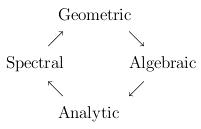
I was a bit hesitant to draw
this, because my advisor once told me, 'If you ever find yourself
drawing one of those meaningless diagrams with arrows connecting
different areas of mathematics, it's a good sign that
you're going
senile.' Anyway, I'll explain roughly how it works.
Langlands correspondence is a 'bridge between two worlds,'
or more specifically, an assertion of a bijection...."
Compare and contrast the
above...
... to the
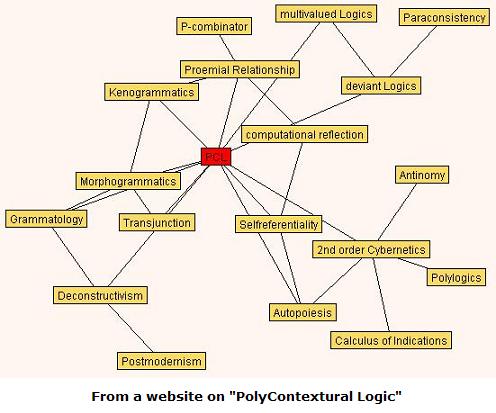
world of Rudolf Kaehr:

The above reference to
"diamond theory" is from Rudolf
Kaehr's paper titled Double Cross Playing Diamonds.
Another bridge...
Carnahan's advisor, referring to "meaningless diagrams with arrows
connecting different areas of mathematics," probably did not have in
mind diagrams like the two above, but rather diagrams like the two
below--
From the world of mathematics...

"A rough sketch of
how diamond theory is
related to some other
fields of mathematics"
-- Steven H. Cullinane
Related
material:
For further details on
the "diamond theory" of
Cullinane, see
Finite Geometry of
the
Square and Cube.
For further details on
the "diamond theory" of
Kaehr, see
Rudy's
Diamond Strategies.
Those who prefer
entertainment