Tuesday, October 31, 2006 11:00 PM
ART WARS continued
"The show has an endgame, end-time mood.... I
would call all these strategies fear of form.... the dismissal of
originality is perhaps the oldest ploy in the postmodern playbook. To
call yourself an artist at all is by definition to announce a faith,
however unacknowledged, in some form of originality, first for
yourself, second, perhaps, for the rest of us. Fear
of form above all means fear of compression-- of an artistic focus that
condenses experiences, ideas and feelings into something whole,
committed and visually comprehensible."
From 7/07, an art review from The New York Times:
Endgame Art?
It's Borrow, Sample and Multiply
in an Exhibition at Bard College
-- Roberta Smith
would consider the
following "found" art an
example of originality.
It nevertheless does
"announce a faith."

"First for yourself"
Today's mid-day
Pennsylvania number:
707
See Log24 on 7/07
and the above review.
"Second, perhaps,
for the rest of us"
Today's evening
Pennsylvania number:
384
This number is an
example of what the
reviewer calls "compression"--
"an artistic focus that condenses
experiences, ideas and feelings
into something
whole, committed
and visually comprehensible."
"Experiences"
See (for instance)
(1160 pages, 2.35 pounds)
on "the shifting phantasmagoria
which is our actual experience."
"Ideas"
See Plato.
"Feelings"
See A Wrinkle in Time.
"Whole"
The automorphisms
of the tesseract
form a group
of order 384.
"Committed"
See the discussions of
groups of degree 16 in
R. D. Carmichael's classic
Introduction to the Theory
of Groups of Finite Order.
"Visually comprehensible"
See "Diamond Theory in 1937,"
an excerpt from which
is shown below.

The "faith" announced by
the above lottery numbers
on All Hallows' Eve is
perhaps that of the artist
Madeleine L'Engle:
"There is such a thing
as a tesseract."
Tuesday, October 31, 2006 9:00 AM

"Card tricks can be used
to liven up many classes
for mathematics students."
... or Treat?
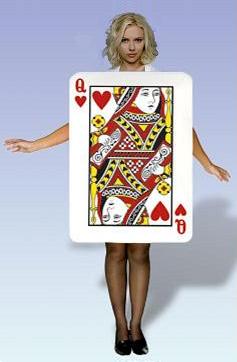
Related material:
yesterday's entry.
Monday, October 30, 2006 11:30 AM
For William Thurston's birthday:
Religion at Harvard
From The Harvard Crimson,
Monday, October 30, 2006 6:09 AM
"Why is the Task Force on General Education afraid of teaching
religion? True, their report did recommend a reason and faith
requirement, but the committee has clearly shied away from teaching
religious principles and has treated the study of religion itself with
contempt....
In the general education report... there is no
mention of the fundamental principles of religious thought, even though
the general education report stresses that students are affected by
religion and should think critically about it."
to religious thought--
Scientism-- exemplified
by Harvard's
Emperor of Math.
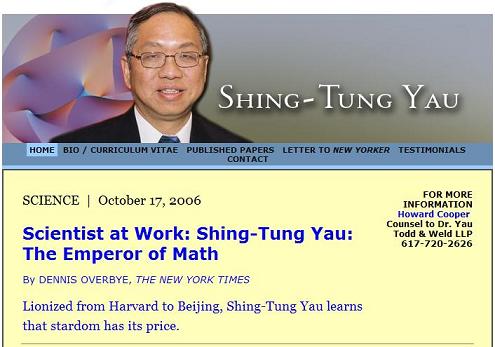
Screenshot of doctoryau.com
Here is a rather different
approach to religious thought--
| Yesterday's numbers in the Empire State:  These suggest the religious contemplation of Log24, 6/16-- Hero of His Own Story-- and of Log24, 6/30-- Summers Revels Ended. |
For more on Harvard's
real religion, Scientism,
and the political background
in which it thrives,
click on the picture below.

.
Sunday, October 29, 2006 1:00 AM
For Halloween at Harvard
Halloween season)
In 1692 on July 31, at the time of the Salem witchcraft trials, Increase Mather reportedly "delivered a sermon... in Boston in which he posed the question... 'O what makes the difference between the devils in hell and the angels of heaven?'"
Increase, the father of Cotton Mather, was president of Harvard from June 27, 1692, to Sept. 6, 1701. His name is memorialized by Harvard's Mather House.
From Log24 on Jan. 15, 2003:
Locating Hell "Noi siam venuti al loco ov' i' t'ho detto "We have come to where From a Harvard student's weblog: Heard in Mather I hope you get gingivitis You want me to get oral cancer?! Goodnight fartface Turd. Turd. Turd. Turd. Turd. Make your own waffles!! Blah blah blah starcraft blah blah starcraft blah starcraft. It's da email da email. And some blue hair! Oohoohoo Izod! 10 gigs! Yeah it smells really bad. Only in the stairs though. Starcraft blah blah Starcraft fartface. Yeah it's hard. You have to get a bunch of battle cruisers. 40 kills! So good! Oh ho ho grunt grunt squeal. I'm getting sick again. You have a final tomorrow? In What?! Um I don't even know. Next year we're draggin him there and sticking the needle in ourselves. " ... one more line/ unravelling from the dark design/ spun by God and Cotton Mather" -- Robert Lowell |
here are yesterday's numbers from
the state of Grace (Kelly, of Philadelphia):

Related material:
Log24 on 1/16,
and Hexagram 41,

Decrease
The Image
At the foot of the mountain, the lake:The image of Decrease.
Thus the superior man controls his anger
And restrains his instincts.
This suggests thoughts of
the novel Cold Mountain
(see yesterday morning)
and the following from
Log24 on St. Luke's Day
this year:

 | Established in 1916, Montreat College is a private, Christian college located in a beautiful valley in the Blue Ridge Mountains of North Carolina. |
From Nell:

"The valley spirit never dies..."
See also St. Luke's Day, 2004,
as well as a journal entry
prompted by both
the ignorant religion
of Harvard's past
and the ignorant scientism
of Harvard's present--
Hitler's Still Point:
A Hate Speech for Harvard.
This last may, of course, not
quite fit the description of
the superior man
controlling his anger
so wisely provided by
yesterday's lottery and
Hexagram 41.
Nobody's perfect.
Saturday, October 28, 2006 12:00 PM
Harvard was founded on this date.

Recommended.
Saturday, October 28, 2006 8:00 AM
Musician Charlie Daniels is 70 today.

Recommended.
Friday, October 27, 2006 12:31 PM
New Instauration, continued
Shem the Penman
Excerpt from Harvard Magazine:
"The
people who intermediate between lunatics and the world used to be
called alienists; the go-betweens for mathematicians are called
teachers. Many a student may rightly have wondered if the terms
shouldn't be reversed."
-- Review of The Magic of Numbers, a book by Benedict H. Gross, Leverett Professor of Mathematics and Dean of Harvard College
For the full review, see
On Mathematical Imagination--
Harvard Magazine
(January-February 2004) :
... part of a New Instauration
that will bring mathematics, at last, ...
Wednesday,
http://www.harvardmagazine.com/
on-line/010442.html
The Crimson Passion,
the previous entry,
Hall of Shem,
and the link, in the
Ash Wednesday, 2006,
entry, Deaconess,

to The House of God,
a novel by
Samuel Shem.
Shem is the pen-name
of Stephen J. Bergman,
Clinical Instructor in Psychiatry
at Harvard Medical School.
Thursday, October 26, 2006 12:00 PM
Hall of Shem:

"When he was taken to church
he amused himself by factorizing
the numbers of the hymns."
-- C. P. Snow, foreword to
A Mathematician's Apology,
by G. H. Hardy
An application of
lottery hermeneutics:
420 --> 4/20 -->
Hall of Shame,
Easter Sunday,
April 20, 2003;
145 --> 5*29 --> 5/29 -->
The Shining of May 29.
The Rev. Wright may also
be interested in the following
Related material:
"Shem was a sham...."
(FW I.7, 170 and Log24 Oct. 13),
and The Hebrew Word Shem:
This word occurs, notably, in Psalm (or "hymn") 145.
See http://scripturetext.com/psalms/145-1.htm:
thy name
shem (shame)
an appellation, as a mark or memorial of individuality; by implication honor, authority, character -- + base, (in-)fame(-ous), named(-d), renown, report.
from the online Crimson:

Wednesday, October 25, 2006 9:00 AM
The Deceivers (10/2/05) continued
at Harvard
-- Online Eytmology Dictionary
"... there is some virtue in tracking cultural trends in terms of their
relation to the classic Trinitarian framework of Christian thought."
-- Description of lectures
to be given Monday, Tuesday, and Wednesday of this week (on Father,
Son, and Holy Spirit, respectively, and their relationship to "cultural
trends") at Harvard's Memorial Church
I prefer more-classic trinitarian frameworks-- for example,

and the structural trinity
underlying
classic quilt patterns:

Click on pictures for further details.
These mathematical trinities are
conceits in the sense of concepts
or notions; examples of the third
kind of conceit are easily
found, especially at Harvard.
For a possible corrective to
examples of the third kind,
see
To Measure the Changes.
Tuesday, October 24, 2006 9:00 PM
Two-part invention:
of the previous entry's concept of
a "critical mass" of weblog entries,
a concept reflected in
the saying
"You can't win the lottery
if you don't buy a ticket."
Mathematics and Narrative:
A Two-Part Invention
Here are today's
numbers from the
Keystone State:

Here is an interpretation
of those numbers:
The Wikipedia article on
the Geometrization Conjecture,
revision of 13:22 UTC, 21 August 2006:
The second sentence, in bold type, was added on 8/21 by yours truly. No deep learning or original thought was required to make this important improvement in the article; the sentence was simply copied from the then-current version of the article on Grigori Perelman (who has, it seems, proved the geometrization conjecture).
This may serve as an example of the "mathematics" part of the above phrase "Mathematics and Narrative" -- a phrase which served, with associated links, as the Log24 entry for 8/21.
7/23 -- Narrative:
"Each step in the story is a work of art, and the story as a whole is a sequence of episodes of rare beauty, a drama built out of nothing but numbers and imagination." --Freeman Dyson
This quotation appeared in the Log24 entry for 7/23, "Dance of the Numbers." What Dyson calls a "story" or "drama" is in fact mathematics. (Dyson calls the "steps" in the story "works of art," so it is clear that Dyson (a former student of G. H. Hardy) is discussing mathematical steps, not paragraphs in someone's account-- perhaps a work of art, perhaps not-- of mathematical history.) I personally regard the rhetorical trick of calling the steps leading to a mathematical result a "story" as contemptible vulgarization, but Dyson, as someone whose work (pdf) led to the particular result he is discussing, is entitled to dramatize it as he pleases.
For related material on mathematics, narrative, and vulgarization, click here.
The art of interpretation (applied above to a lottery) is relevant to narrative and perhaps also, in some sense, to the arts of mathematical research and exposition (if not to mathematics itself). This art is called hermeneutics.
For more on the subject, see the Stanford Encyclopedia of Philosophy article on Hans-Georg Gadamer, "the decisive figure in the development of twentieth-century hermeneutics."
"Foreword" in Gian-Carlo Rota,
Indiscrete Thoughts,
Boston: Birkhäuser Verlag,
1996, xiii-xvii, and
"Gadamer's Theory of Hermeneutics" in
The Philosophy of Hans-Georg Gadamer,
edited by Lewis E. Hahn,
The Library of Living Philosophers, Vol. 24,
Chicago: Open Court Publishers,
1997, 223-34.
Tuesday, October 24, 2006 2:56 PM
Symmetries (4/2/03) continued...

Thanks to University Diaries for
yesterday's entry on Harvard:
See also the previous Log24 entry, on yesterday's Pennsylvania lottery, and this description of an experiment I remember fondly from my youth:
"The floor in a large room was covered with mouse traps that were 'cocked' and on each was placed a ping pong ball. At the key moment an additional ping pong ball was tossed out and triggered a single mouse trap to go off. The net result after the balls started bouncing was a classic chain reaction."
Tuesday, October 24, 2006 2:02 AM
But seriously...
to Pay Paul
Serious Numbers:

"Paul must not have been
talking about time
in a linear way."
-- Sermon at Nassau Church,
Princeton, New Jersey,
Christmas Eve, 2004
Related material:
1/19,
4/29.
Monday, October 23, 2006 12:00 AM
The Aristocrats at Midnight --
 .
.Sunday, October 22, 2006 11:59 PM
The Aristocrats at 11:59 PM --

Sunday, October 22, 2006 7:45 PM
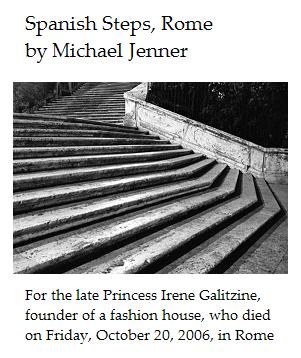
The Aristocrats
Sunday, October 22, 2006 5:01 PM
On This Date

On this date:
"In 1746,
Princeton University
in New Jersey received
its charter."
-- Today in History
by The Associated Press
"The charter... authorized
the erection of a college...."
Sunday, October 22, 2006 9:00 AM
Today's Sermon

"Every great magic trick consists of three acts. The first act is called 'The Pledge.' The magician shows you something ordinary, but of course... it probably isn't. The second act is called 'The Turn.' The magician makes his ordinary 'some thing' do something extraordinary. Now if you're looking for the secret... you won't find it. That's why there's a third act, called 'The Prestige.' This is the part with the twists and turns, where lives hang in the balance, and you see something shocking you've never seen before."
Thought for Today,
Oct. 22, 2006:
"You can fool
too many of the people
too much of the time."
-- James Thurber,
American humorist
(1894-1961)

For more detail,
Sunday, October 22, 2006 2:45 AM
Submitted for your approval...
"A World of His Own"

Twilight Zone
Season 1, Episode 36
First aired: July 1, 1960
"The best Twilight Zone
twist ending ever?"
-- Amazon.com
reviewer "Alexiel"
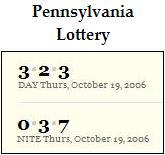
Here are the lottery
numbers in Pennsylvania
(state of Grace)
on Thursday, Oct. 19,
the day that
Phyllis Kirk died:
"I've got a little story*
you oughta know..."
-- Sinatra
* 3/23, 37:

Saturday, October 21, 2006 8:23 AM
Qubits in Phase Space
An application of the finite geometry underlying the diamond theorem:
"Qubits in phase space: Wigner function approach to quantum error correction and the mean king problem," by Juan Pablo Paz, Augusto Jose Roncaglia, and Marcos Saraceno (arXiv:quant-ph/0410117 v2 4 Nov 2004) (pdf)
Friday, October 20, 2006 12:00 PM
Conceptual Art:
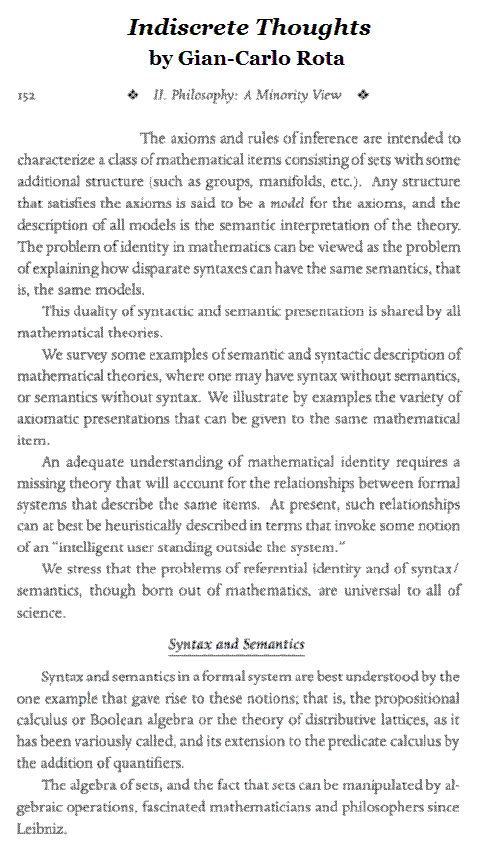
"At present, such relationships can
at best be heuristically described
in terms that invoke some notion
of an 'intelligent user standing
outside the system.'"
-- Gian-Carlo Rota in
Indiscrete Thoughts, p. 152
The Devil's Bible and
Nothing Nothings (Again).
The Context
One context for the Rota quote
is Paul Halmos's remark, quoted
in today's New York Times,
that mathematics is
"almost like being
in touch with God."
Another context is
Log24 on Aug. 29, 2005.
Here is the original context:
Friday, October 20, 2006 2:00 AM
ART WARS, continued
For one definition, see
Tombstone (typography)
at Wikipedia.
A halmos, according to
the Wikipedia definition:
Click on the halmos
for further details from
today's New York Times.
Thursday, October 19, 2006 10:31 PM
Thursday, October 19, 2006 7:59 PM
Geometry's Tombstones
(continued from Sept. 5):

Thanks to Peter Woit's weblog
for a link to the above illustration.
This picture of
"Coxeter Exhuming Geometry"
suggests the following comparison:

For the second tombstone,
see this morning's entry,
Birth, Death, and Symmetry.
Further details on the geometry
underlying the second tombstone:

The above is from
Variable Resolution 4–k Meshes:
Concepts and Applications (pdf),
by Luiz Velho and Jonas Gomes.
See also Symmetry Framed
and The Garden of Cyrus.
| "That corpse you planted last year in your garden, Has it begun to sprout? Will it bloom this year? Or has the sudden frost disturbed its bed?" -- T. S. Eliot, "The Waste Land" |
Thursday, October 19, 2006 7:59 AM
Birth, Death, and Symmetry
(Born Oct. 19, 1605,
died Oct. 19, 1682)
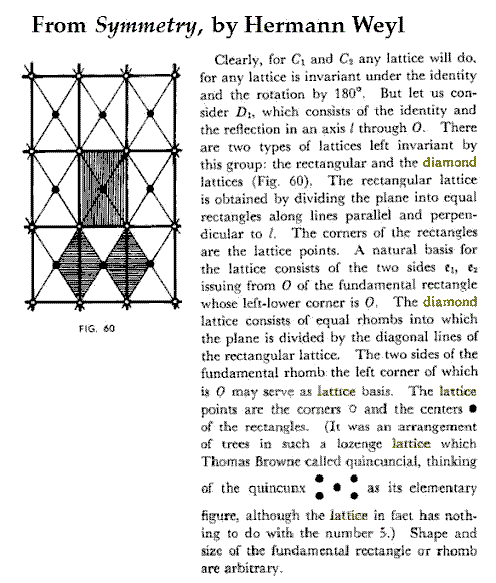
Browne is noted for
Hydriotaphia (Urne-Buriall)
and The Garden of Cyrus.
Related material:

Tombstone
and
Symmetry Framed
Wednesday, October 18, 2006 5:11 PM
For the Feast of St. Luke
Log24, May 11, 2005:
| Established in 1916, Montreat College is a private, Christian college located in a beautiful valley in the Blue Ridge Mountains of North Carolina. |
From Nell:
Tuesday, October 17, 2006 2:00 PM
The Harvard comic-book version:
the Changes
(continued
from midnight)
| "To measure the changes of time and space the smartest are nothing." |
The Emperor of Math
and Harvard philosopher
Illustrations --
To measure the changes:

The smartest are nothing:

Tuesday, October 17, 2006 12:00 AM
the Changes
(continued from
"The Legacy Codes,"
Nov. 5-6, 2003)
From this morning's
New York Times:
The Emperor
of Math

The New York Times
mathematician
Shing-Tung Yau"
Numbers
from the
Keystone State
on October 16:

of 621, see 6/21's
Beijing String and
Go with the Flow.
For an interpretation
of 596, see Wikipedia,
596 (nuclear test):
"596 is the codename of the
People's Republic of China's
first nuclear weapons test,
detonated on
October 16, 1964."

Related material:
| Beautiful indeed is the source of truth. To measure the changes of time and space the smartest are nothing." |
Monday, October 16, 2006 11:00 AM
Deep Game, continued
CharactersTwo items from a Wikipedia watchlist today:
1. User Loyola added a list of central characters to the article on The Glass Bead Game.
2. A dialogue between the Wikipedia characters Prof02 and Charles Matthews continues.
Item 2 seems almost to echo item 1.
The Bead Game, a classic novel by Hermann Hesse, is, in part, a commentary on German cultural history, and the Prof02-Matthews dialogue concerns the Wikipedia article on Erich Heller, a noted scholar of German cultural history.
Matthews is an expert on the game of Go. The Bead Game article says that
"The Game derives its name from the fact that it was originally played with tokens, perhaps analogous to those of an abacus or the game Go....
Although invented after Hesse's death, Conway's Game of Life can be seen as an example of a Go-like glass bead game with surprisingly deep properties; since it can encode Turing machines, it contains in some sense everything."
For some related thoughts on cellular automata (i.e., Conway's game) and Go, see The Field of Reason with its links Deep Game, And So To Bed.
For some related thoughts on Turing, see the November 2006 Notices of the American Mathematical Society (special issue on Turing).
For some related religious reflections, see Wolfram's Theory of Everything and the Gameplayers of Zan, as well as the Log24 entries of last Halloween.