Tuesday, May 15, 2007 2:11 PM
Perspective on the News:
The Rev. Jerry Falwell Dies

The Rev. Jerry Falwell speaks at a rally
on the steps of the Alabama Capitol
in Montgomery in this Saturday,
Aug. 16, 2003, file photo.
(AP Photo/Dave Martin)
The New York Times, Nov. 22, 2004:
"The Rev. Jerry Falwell's Liberty University [at Lynchburg, Virginia] is part of a movement around the nation that brings a religious perspective to the law."
Religious perspective:
See the five Log24 entries ending with "Dinner Theater?" (Nov. 26, 2004). Note Charles Williams's discussion of the Salem witchcraft trials.
See also yesterday's "Seven Bridges." In light of that entry's picture of Nicole Kidman in "To Die For," and of Charles Williams's remarks, a discussion of Kidman's "Practical Magic" may also interest some.
Tuesday, May 15, 2007 5:55 AM
A Flag for Sunrise
The title of the Robert Stone
novel comes from Emily Dickinson:

A Wife -- at daybreak I shall be --
Sunrise -- Hast thou a Flag for me?
At Midnight, I am but a Maid,
How short it takes to make a Bride --
Then -- Midnight, I have passed from thee
Unto the East, and Victory --

Midnight -- Good Night! I hear them call,
The Angels bustle in the Hall --
Softly my Future climbs the Stair,
I fumble at my Childhood's prayer
So soon to be a Child no more --
Eternity, I'm coming -- Sire,
Savior -- I've seen the face -- before!
Monday, May 14, 2007 11:30 AM
Classics Illustrated:
"Make me young..."
-- Kilgore Trout
For the old at heart:
The Mathematical Association
of America in this
Euler Tercentenary Year
honors the seven bridges of
Königsberg, Prussia
(birthplace of
David Hilbert).
For Kilgore Trout:
A song about the road
to (and from)
Hank Williams's
memorial marker:
"There are stars in the Southern sky
and if ever you decide
you should go
there is a taste of
time-sweetened honey
down the Seven Bridges Road
Now I have loved you like a baby
like some lonesome child
and I have loved you in a tame way
and I have loved you wild"
-- Steve Young

Nicole Kidman dances
"Sweet Home Alabama"
Monday, May 14, 2007 3:09 AM
What is Real? continued...
"Was there really a cherubim
waiting at the star-watching rock...?
Was he real?
What is real?
-- Madeleine L'Engle, A Wind in the Door,
Farrar, Straus and Giroux, 1973,
conclusion of Chapter Three,
"The Man in the Night"
"Oh, Euclid, I suppose."
Farrar, Straus and Giroux, 1962,
conclusion of Chapter Five,
Xanga footprints,
3:00 AM today:
| Texas | /431103703/item.html | 5/14/2007 3:00 AM |
The link leads to a Jan. 23, 2006 entry
on what one philosopher has claimed is
"exactly that crossing point
of constraint and freedom
which is the very essence
of man's nature."
Monday, May 14, 2007 2:22 AM
Mental Health Month continued:
-- Pope Benedict XVI
on Sunday in Brazil
"Dare to struggle,
dare to win!"
"Dare to guzzle
Gordon's gin."
-- dialogue from
Masks of the Illuminati
Sunday, May 13, 2007 12:31 PM
Dilly Dilly - Part I:
Prime Blue"To the two gods of art, Apollo and Dionysus, we owe our recognition that... there is a tremendous opposition, as regards both origins and aims, between the Apolline art of the sculptor and the non-visual, Dionysiac art of music."
-- The Birth of Tragedy,
by Friedrich Nietzsche,
Penguin, 1993, page 14.
Quoted in "A Mass for Lucero."
Half the Answer:
Commentary by spookytruth
from Log24, 2/22/2005:
"I mean, come on, Hunter, a stupid bullet through the head??? how creative, you brain-addled simpleton... if you take the assignment, if you are going to hook up your afterlife keyboard and transmit back and tell us about what it is REALLY like out there, if you decided to let your electric-shock fingers hot wire us the truth of the afterlife... if you really planned to tell us the answer to our ultimate, emotional question...... 'does God prefer beer, wine, or a shot of whiskey.' well, if that is what you decided to do well then, for God's sake, don't forget (oh, wait, yeah, you already DID FORGET, you half-baked, half brained, half witted, half-a-loaf, half pint pin head, you forgot, THE JOURNEY IS HALF THE ANSWER!!!!!!!!!!!!!!!!"
On Dionysus:
"For wine, he loves to view
his altars stain,
But prime blue ruin*--
goes against the grain."
-- page 69, Jack Randall's Diary
*name "given by
the modern Greeks to gin"
-- page 4, Jack Randall's Diary
Sunday, May 13, 2007 12:23 PM
Dilly Dilly - Part II:

Sunday, May 13, 2007 5:01 AM
A Language Game for DC:

Sunday, May 13, 2007 1:00 AM
A Language Game for Hollywood:
Dr. John K. Lattimer,
who died Thursday:

"The kind of space that the ship perceives, operates in, is to creatures such as you and I, chaotic, meaningless, and dangerous, when perceived directly, if we can at all. To confront it directly is destructive to the primate mind, indeed the whole vertebrate nervous system.... Basic to the universe: that its inmost reality cannot be perceived. A limit. So we interpose a symbolizer, and that translates the view into something we can perceive, and control...." "...I see; the symbolizer portrays a Game...." |

Click on pictures for details.
Saturday, May 12, 2007 11:07 AM
Hollywood Midrash continued...
Last night's entry "A Midrash for Hollywood" discussed a possible interpretation of yesterday's Pennsylvania Lottery numbers-- mid-day 384, evening 952.
In memory of a blacklisted Hollywood screenwriter who died yesterday, here is another interpretation of those numbers.
First, though, it seems appropriate to quote again the anonymous source from "Heaven, Hell, and Hollywood" on screenwriters-- "You can be replaced by some ping-pong balls and a dictionary." An example was given illustrating this saying. Here is another example:
Yesterday's PA lottery numbers in the dictionary--
Webster's New World Dictionary,
College Edition, 1960--
Page 384: "Defender of the Faith"
Related Log24 entries:
"To Announce a Faith," Halloween 2006,
and earlier Log24 entries from
that year's Halloween season
Page 952: "monolith"
Related Log24 entries:
"Shema, Israel," and "Punch Line"
(with the four entries that preceded it).
It may not be entirely irrelevant that a headline in last night's entry-- "Lonesome No More!"-- was linked to a discussion of Kurt Vonnegut's Slapstick, that a film version of that novel starred Jerry Lewis, and that yesterday afternoon's entry quoted a vision of "an Ingmar Bergman script as directed by Jerry Lewis."
April is Math Awareness Month.
This year's theme is "mathematics and art."

"Art isn't easy."
-- Stephen Sondheim
Friday, May 11, 2007 11:30 PM
A Midrash for Hollywood
In keeping with the spirit of previous Log24 entries, here is today's Pennsylvania Lottery commentary. This afternoon's entry suggests an interpretation of today's numbers as comments on the new film "Georgia Rule."
Mid-day 384
Evening 952
Today's mid-day number, 384, is the number of symmetries of the tesseract, a geometric figure illustrated on the cover of the novel The Gameplayers of Zan (see, for instance, May 10, 2007). That novel suggests an interpretation of today's evening number, 952, as addressing (literally) the subject of Life.
See the address mathforum.org/library/view/952.html.
From that address:
"The Game of Life is played on a field of cells, each of which has eight neighbors (adjacent cells). A cell is either occupied (by an organism) or not. The rules for deriving a generation from the previous one are these: Death - If an occupied cell has 0, 1, 4, 5, 6, 7, or 8 occupied neighbors, the organism dies (0, 1: of loneliness; 4 thru 8: of overcrowding). Survival - If an occupied cell has two or three neighbors, the organism survives to the next generation. Birth - If an unoccupied cell has three occupied neighbors, it becomes occupied."
Relevance to the film "Georgia Rule": lonesomeness, generations, and the Lord's name--
Georgia is a "lonesome and decent widow in wholesome Hull, Idaho.... her framed motto is 'Count Your Blessings' and she's ready to ram [a] soap bar into your mouth if you insult the Lord's name." --David Elliott, San Diego Union-Tribune, May 11, 2007
There is not universal agreement on just what is the Lord's name. Perhaps it includes the number 952.
From The Gameplayers of Zan:
"The Game in the Ship cannot be approached as a job, a vocation, a career, or a recreation. To the contrary, it is Life and Death itself at work there. In the Inner Game, we call the Game Dhum Welur, the Mind of God. And that Mind is a terrible mind, that one may not face directly and remain whole. Some of the forerunners guessed it long ago-- first the Hebrews far back in time, others along the way, and they wisely left it alone, left the Arcana alone."
From Bartlett's Familiar Quotations:
"Nothing can be produced out of nothing."
-- 10th edition, 1919, page 952
See also "Zen and Language Games"
and "Is Nothing Sacred?"
Friday, May 11, 2007 5:11 PM
Annals of Prose Style
Film Review"No offense to either of them, but 'Georgia Rule' suggests an Ingmar Bergman script as directed by Jerry Lewis. The subject matter is grim, the relationships are gnarled, the worldview is bleak, and, at any given moment, you suspect someone’s going to be hit with a pie." --John Anderson at Variety.com, May 8, 2007
Sounds perfect to me.
Friday, May 11, 2007 6:29 AM
A Muse of Fire:
"O for a muse of fire,
that would ascend
The brightest heaven
of invention"
-- Henry V, Prologue


Thursday, May 10, 2007 10:00 PM
O Brightening Glance...

The above scene from
The Best of Riverdance
furnishes an exercise in
what Victor Turner has called
"comparative symbology."
The circular symbol at top
may be seen as representing
the solar deity Apollo,
Leader of the Muses.
The nine female dancers
may be seen as
the nine muses,
with Jean Butler
at the center
as Terpsichore,
Muse of Dance.
Related Material --
ART WARS:
To Apollo

"This is the garden of Apollo,
the field of Reason...."
John Outram, architect
For another look at
Terpsichore in action,
see Jean Butler at
CRC Irish Dance Camp.
For those who prefer
a different sort of camp
there is of course
Xanadu.
I prefer Butler.
Thursday, May 10, 2007 10:31 AM
Midrash from JadedFey

Related material:
All Hallows' Eve, 2005 --

-- as well as
Balanchine's Birthday
and the color worn by
Jean Butler in
Women of the Sidhe
(Wednesday's entry).
Thursday, May 10, 2007 2:45 AM
ART WARS continued:
Illustrated
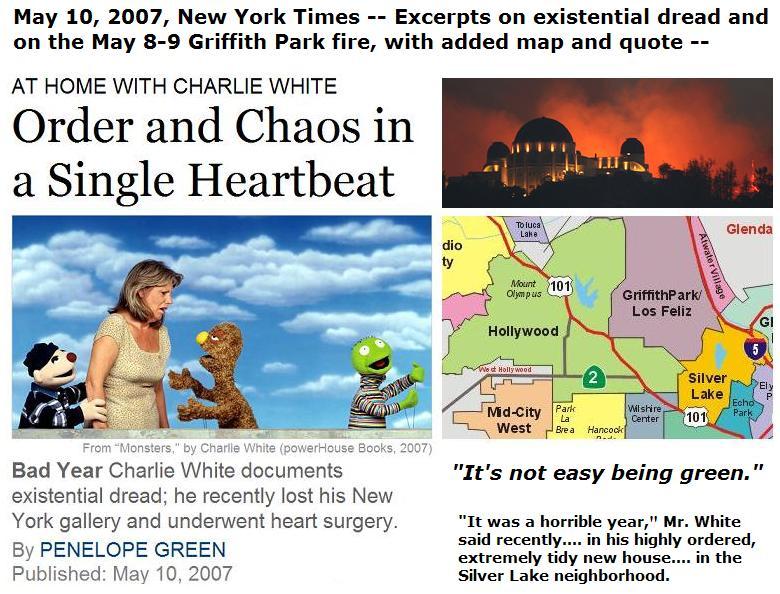
Click to enlarge.
For background on photo-surrealist
Charlie White, click here.
The Times story is another excellent
example of the New York Times's
highly sophisticated-- some might
say, degenerate-- approach to
cultural and lifestyle coverage.
The story is from the paper's
Home and Garden section.
Related material:
The Garden of Allah.
Wednesday, May 9, 2007 3:09 AM
Grace Illustrated
1. Jean Butler at CRC Irish Dance Camp2. Women of the Sidhe
Tuesday, May 8, 2007 6:29 PM
For Nanci Griffith:
News from Belfast"I was a child in the sixties
Dreams could be held through TV
With Disney and Cronkite and Martin Luther
Oh, I believed, I believed, I believed"
-- "It's a Hard Life
Wherever You Go,"
by Nanci Griffith
"Today we will witness
not hype but history."
-- Martin McGuinness, of the
republican and mainly Catholic
Sinn Fein party, on today's
home rule ceremony in Belfast
Tuesday, May 8, 2007 2:56 PM
Symbology and Communitas

Symbology:
"Also known as 'processual symbolic analysis,' this concept was developed by Victor Turner in the mid-1970s to refer to the use of symbols within cultural contexts, in particular ritual. In anthropology, symbology originated as part of Victor Turner's concept of 'comparative symbology.' Turner (1920-1983) was professor of Anthropology at Cornell University, the University of Chicago, and finally he was Professor of Anthropology and Religion at the University of Virginia." --Wikipedia
Symbology and Communitas:
| "'The
positional meaning of a symbol derives from its relationship to other
symbols in a totality, a Gestalt, whose elements acquire their
significance from the system as a whole' (Turner, 1967:51). Turner
considered himself a comparative symbologist, which suggests he valued
his contributions to the study of ritual symbols. It is in the closely
related study of ritual processes that he had the most impact. The most important contribution Turner made to the field of anthropology is his work on liminality and communitas. Believing the liminal stage to be of 'crucial importance' in the ritual process, Turner explored the idea of liminality more seriously than other anthropologists of his day. As noted earlier Turner elaborated on van Gennep's concept of liminality in rites of passage. Liminality is a state of being in between phases. In a rite of passage the individual in the liminal phase is neither a member of the group she previously belonged to nor is she a member of the group she will belong to upon the completion of the rite. The most obvious example is the teenager who is neither an adult nor a child. 'Liminal entities are neither here nor there; they are betwixt and between the positions assigned and arrayed by law, custom, convention, and ceremonial' (Turner, 1969:95). Turner extended the liminal concept to modern societies in his study of liminoid phenomena in western society. He pointed out the similarities between the 'leisure genres of art and entertainment in complex industrial societies and the rituals and myths of archaic, tribal and early agrarian cultures' (1977:43). Closely associated to liminality is communitas which describes a society during a liminal period that is 'unstructured or rudimentarily structured [with] a relatively undifferentiated comitatus, community, or even communion of equal individuals who submit together to the general authority of the ritual elders' (Turner, 1969:96). The notion of communitas is enhanced by Turner's concept of anti-structure. In the following passage Turner clarifies the ideas of liminal, communitas and anti-structure: I have used the term 'anti-structure,'... to describe both liminality and what I have called 'communitas.' I meant by it not a structural reversal... but the liberation of human capacities of cognition, affect, volition, creativity, etc., from the normative constraints incumbent upon occupying a sequence of social statuses (1982:44). It is the potential of an anti-structured liminal person or liminal society (i.e., communitas) that makes Turner's ideas so engaging. People or societies in a liminal phase are a 'kind of institutional capsule or pocket which contains the germ of future social developments, of societal change' (Turner, 1982:45). Turner's
ideas on liminality and communitas have provided scholars with language
to describe the state in which societal change takes place." Turner, V. (1967). The forest of symbols: Aspects of Ndembu ritual. Ithaca, NY: Cornell University Press. Turner, V. (1969). The ritual process: structure and anti-structure. Chicago: Aldine Publishing Co. Turner, V. (1977). Variations of the theme of liminality. In Secular ritual. Ed. S. Moore & B. Myerhoff. Assen: Van Gorcum, 36-52. Turner, V. (1982). From ritual to theater: The human seriousness of play. New York: PAJ Publications. |
Related material on Turner in Log24:
Aug. 27, 2006 and Aug. 30, 2006. For further context, see archive of Aug. 19-31, 2006.
Related material on Cuernavaca:
Google search on Cuernavaca + Log24.
Monday, May 7, 2007 5:55 AM
Valentine (4/27) continued:

New York Times,
May 7, 2007
Related material:
Social Change in the
Twentieth Century,
by Daniel Chirot
(Harvard '64)
Sunday, May 6, 2007 4:04 PM
The Art of Prose:

Sunday, May 6, 2007 3:09 PM
Philosophy Wars continued....
Masters of Chaos"Any text is constructed as a mosaic of quotations."
-- Julia Kristeva
"Paris vaut bien une messe."
-- Henri IV
"Certain details might be considered and elucidated more fully."
-- A Mass for Lucero
"There is never any ending to Paris...."
-- Ernest Hemingway
Sunday, May 6, 2007 4:02 AM
An Unholy Trinity:
Three SoulsFrom today's New York Times, Charles McGrath on Philip K. Dick:
His early novels, written in two weeks or less, were published in double-decker Ace paperbacks that included two books in one, with a lurid cover for each. "If the Holy Bible was printed as an Ace Double," an editor once remarked, "it would be cut down to two 20,000-word halves with the Old Testament retitled as 'Master of Chaos' and the New Testament as 'The Thing With Three Souls.'"
Now perhaps enjoying the afterlife together:
Philip K. Dick
Robert Anton Wilson
Kurt Vonnegut
Friday, May 4, 2007 5:01 PM
Annals of Politics:
May '68 Revisited
"At his final Paris campaign rally... Mr. Sarkozy declared himself the candidate of the 'silent majority,' tired of a 'moral crisis in France not seen since the time of Joan of Arc.'
'I want to turn the page on May 1968,' he said of the student protests cum social revolution that rocked France almost four decades ago.
'The heirs of May '68 have imposed the idea that everything has the same worth, that there is no difference between good and evil, no difference between the true and the false, between the beautiful and the ugly and that the victim counts for less than the delinquent.'
Denouncing
the eradication of 'values and hierarchy,' Mr. Sarkozy accused the Left
of being the true heirs and perpetuators of the ideology of 1968."
-- Emma-Kate Symons, Paris, May 1, 2007, in The Australian
Related material:
From the translator's introduction to Dissemination, by Jacques Derrida, translated by Barbara Johnson, University of Chicago Press, 1981, page xxxi --
"Both Numbers and 'Dissemination' are attempts to enact rather than simply state the theoretical upheavals produced in the course of a radical reevaluation of the nature and function of writing undertaken by Derrida, Sollers, Roland Barthes, Julia Kristeva and other contributors to the journal Tel Quel in the late 1960s. Ideological and political as well as literary and critical, the Tel Quel program attempted to push to their utmost limits the theoretical revolutions wrought by Marx, Freud, Nietzsche, Mallarme, Levi-Strauss, Saussure, and Heidegger."
This is the same Barbara Johnson who has served as the Frederic Wertham Professor of Law and Psychiatry in Society at Harvard.
Johnson has attacked "the very essence of Logic"--
"... the logic of binary opposition, the principle of non-contradiction, often thought of as the very essence of Logic as such....
Now, my understanding of what is most radical in deconstruction is precisely that it questions this basic logic of binary opposition....
Instead of a simple 'either/or' structure, deconstruction attempts to elaborate a discourse that says neither 'either/or', nor 'both/and' nor even 'neither/nor', while at the same time not totally abandoning these logics either."
-- "Nothing Fails Like Success," SCE Reports 8, 1980
Such contempt for logic has resulted, for instance, in the following passage, quoted approvingly on page 342 of Johnson's translation of Dissemination, from Philippe Sollers's Nombres (1966):
"The minimum number of rows-- lines or columns-- that contain all the zeros in a matrix is equal to the maximum number of zeros located in any individual line or column."
For a correction of Sollers's damned nonsense, click here.
Thursday, May 3, 2007 3:00 PM
Dreamcatcher:
of Links

Related material
Day Without Logic,
Introduction to Logic,
The Geometry of Logic,
Structure and Logic,
Spider-Man and Fan:

"There is such a thing
as a tesseract."
-- A Wrinkle in Time
Tuesay, May 1, 2007 10:20 PM
A Midrash for Law Day
by the Pennsylvania Lottery:
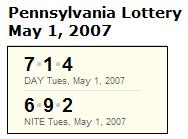
of 714, see 7/14.
For the meaning
of 692, see
Is Nothing Sacred?
Related material:
Law Day 2001:
The Devil and
Wallace Stevens