Thursday, March 15, 2007 12:07 PM
Philosophy Wars continued:
From the April Notices of the
American Mathematical Society:

From Log24
on March 15 last year,
the annual pie-eating
contest of the Harvard
Mathematics Department
on Pi Day:

From Log24 yesterday:
Click on the above sections
for further details.
Wednesday, March 14, 2007 8:00 AM
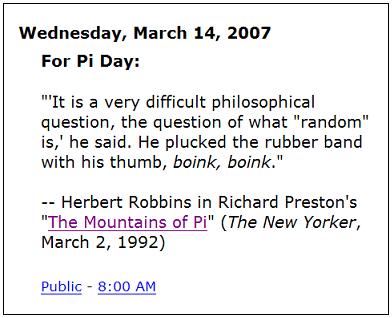
For Pi Day:
"'It is a very difficult philosophical question, the question of what "random" is,' he said. He plucked the rubber band with his thumb, boink, boink."-- Herbert Robbins in Richard Preston's "The Mountains of Pi" (The New Yorker, March 2, 1992)
Saturday, March 10, 2007 9:00 AM
ART WARS continued
The Logic of Dreams
From A Beautiful Mind--
"How could you," began Mackey, "how could you, a mathematician, a man devoted to reason and logical proof...how could you believe that extraterrestrials are sending you messages? How could you believe that you are being recruited by aliens from outer space to save the world? How could you...?"
Nash looked up at last and fixed Mackey with
an unblinking stare as cool and dispassionate as that of any bird or
snake. "Because," Nash said slowly in his soft, reasonable southern
drawl, as if talking to himself, "the ideas I had about supernatural
beings came to me the same way that my mathematical ideas did. So I
took them seriously."
Ideas:

A link in the 7/11 entry leads to a remark of Noel Gray on Plato's Meno and "graphic austerity as the tool to bring to the surface, literally and figuratively, the inherent presence of geometry in the mind of the slave."
Also Friday: an example of graphic austerity-- indeed, Gray graphic austerity-- in Log24:

(Related material: the Harvard Gazette of April 6, 2006, "Mathematician George W. Mackey, 90: Obituary"-- "A memorial service will be held at Harvard's Memorial Church on April 29 at 2 p.m.")
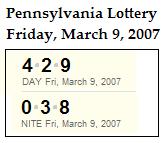
Friday's Pennsylvania evening number 038 tells two other parts of the story involving Mackey...
As Mackey himself might hope, the number may be regarded as a reference to the 38 impressive pages of Varadarajan's "Mackey Memorial Lecture" (pdf).
More in the spirit of Nash, 38 may also be taken as a reference to Harvard's old postal address, Cambridge 38, and to the year, 1938, that Mackey entered graduate study at Harvard, having completed his undergraduate studies at what is now Rice University.
Returning to the concept of graphic austerity, we may further simplify the already abstract chessboard figure above to obtain an illustration that has been called both "the field of reason" and "the Garden of Apollo" by an architect, John Outram, discussing his work at Mackey's undergraduate alma mater:

Let us hope that Mackey,
a devotee of reason,
is now enjoying the company
of Apollo rather than that of
Tom O'Bedlam:

For John Nash on his birthday:
I know more than Apollo,
For oft when he lies sleeping
I see the stars at mortal wars
In the wounded welkin weeping.
Saturday, March 10, 2007 2:00 AM
A philosopher's geometry:

Friday, March 9, 2007 9:00 AM
Chess novel:
Queen's GambitThat the topless towers be burnt
And men recall that face,
Move most gently if move you must
In this lonely place.
She thinks, part woman, three parts a child,
That nobody looks; her feet
Practise a tinker shuffle
Picked up on a street.
Like a long-legged fly upon the stream
Her mind moves upon silence.
-- W. B. Yeats, "Long-Legged Fly"
This is the epigraph to
the Walter Tevis novel
The Queen's Gambit.
Thursday, March 8, 2007 7:13 PM
Boolean Basics:
for International Women's Day
"The logic behind such utterances is the logic
of binary opposition, the principle of non-contra-
diction, often thought of as the very essence of
Logic as such....
Now, my understanding of what is most radical
in deconstruction is precisely that it questions
this basic logic of binary opposition....
Instead of a simple 'either/or' structure,
deconstruction attempts to elaborate a discourse
that says neither "either/or", nor "both/and"
nor even "neither/nor", while at the same time
not totally abandoning these logics either."
-- Harvard professor Barbara Johnson
in "Nothing Fails Like Success."
(See the previous entry, Day Without Logic.)
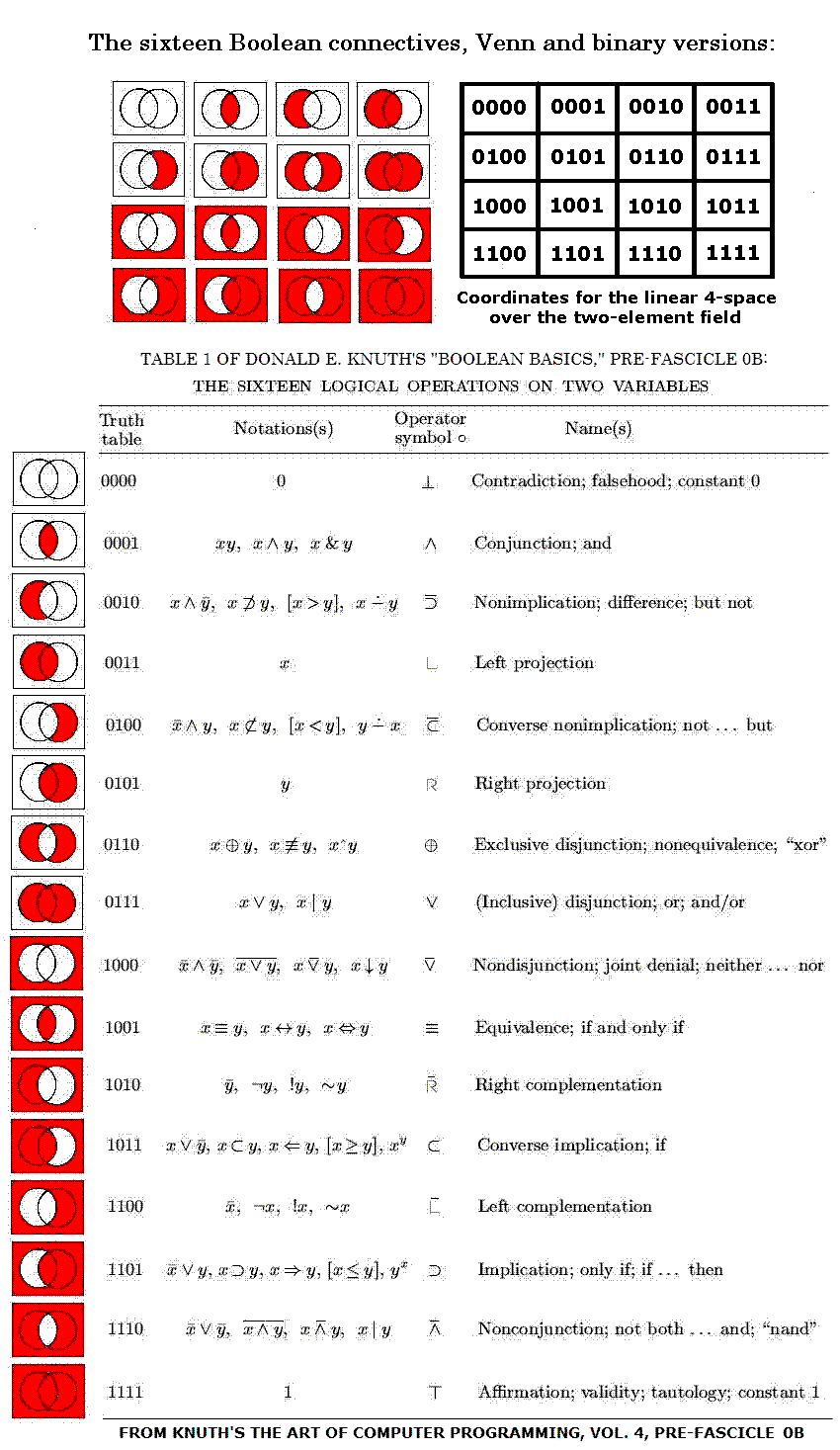
Click to enlarge.
Those who value literary theory
more than they value truth
may prefer, on this
International Women's Day,
the "mandorla" interpretation
of the above diagrams.
For this interpretation, see
Death and the Spirit III,
Burning Bright,
and
The Agony and the Ya-Ya.
Thursday, March 8, 2007 1:00 PM
Philosophy Wars continued:
Logic

Symbol of the Dec. 1
"Day Without Art"
This resembles the following symbol,
due to logician Charles Sanders Peirce,
of the logic of binary opposition:

(For futher details on the role
of this symbol in logic, see
Chinese Jar Revisited.)
On this, International Women's Day,
we might also consider the
widely quoted thoughts on logic of
Harvard professor Barbara Johnson:

Detail:

"Instead of a simple 'either/or' structure,
deconstruction attempts to elaborate a discourse
that says neither "either/or", nor "both/and"
nor even "neither/nor", while at the same time
not totally abandoning these logics either."
It may also be of interest on
International Women's Day
that in the "box style" I Ching
(suggested by a remark of
Jungian analyst
Marie-Louise von Franz)
the symbol
denotes
Hexagram 2,
The Receptive.
Thursday, March 8, 2007 9:00 AM
Time's Labyrinth continued:
Mujer Trabajadora

"Yo es que nací un 8 de marzo,
Día de la Mujer Trabajadora,
y no he hecho más que
trabajar toda mi vida."
-- Josefina Aldecoa
For background on Aldecoa,
see a paper (pdf) by
Sara Brenneis:
"Josefina Aldecoa intertwines
history, collective memory
and individual testimony in her
historical memory trilogy..."
HISTORICAL MEMORY--
The Triangle Shirtwaist Factory Fire in New York City on March 25, 1911, was the largest industrial disaster in the history of the city of New York, causing the death of 146 garment workers who either died in the fire or jumped to their deaths.
Propaganda, March 1977:
"On March 8, 1908, after the death of 128 women trapped in a fire at the Triangle Shirtwaist Factory in New York City, 15,000 women workers from the garment and textile industry marched echoing the demands of their sisters 50 years earlier..."
Propaganda, March 2006:
"First of all, on March 8th, 1857, a large number of factory workers in the United States took to the streets to demand their economic and political rights. The owners called the police who arrived immediately and opened fire, engaging in blind repression… Later on, in 1908, the same date of March 8th was once again a memorable date of struggle. On this day, capitalist bosses in Chicago set fire to a textile factory where over a thousand women worked. A very large number was terribly burnt. 120 died!"
Propaganda disguised as news, March 2007:
From today's top story in 24 HoursTM, a commuter daily in Vancouver published by Sun Media Corporation:
Fight still on for equality
By Robyn Stubbs and Carly Krug
"International Women's Day commemorates a march by female garment workers protesting low wages, 12-hour workdays and bad working conditions in New York City on March 8, 1857.
Then in 1908, after 128 women were trapped
and killed in a fire at a New York City garment and textile factory,
15,000 women workers again took their protests to the street."
Related historical fiction:
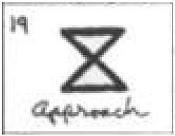
A version of the
I Ching's Hexagram 19:
Log24 12/3/05:

-- Katherine Neville, The Eight
"I saw it in a chess book Mordecai showed me. The most ancient chess
service ever discovered was found at the palace of King Minos on
Crete-- the place where the famous Labyrinth was built, named after
this sacred axe. The chess service dates to 2000 B.C. It was made of
gold and silver and jewels.... And in the center was carved a labrys."
...
"But I thought chess wasn't even invented until six or seven hundred
A.D.," I added. "They always say it came from Persia or India. How
could this Minoan chess service be so old?"
"Mordecai's written a lot himself on the history of chess," said
Lily.... "He thinks that chess set in Crete was designed by the same
guy who built the Labyrinth-- the sculptor Daedalus...."
Now things were beginning to click into place....
"Why was this axe carved on the chessboard?" I asked Lily, knowing the
answer in my heart before she spoke. "What did Mordecai say was the
connection?"....
"That's what it's all about," she said quietly. "To kill the King."
The sacred axe was used to kill the King. The ritual had been the same
since the beginning of time. The game of chess was merely a
reenactment. Why hadn't I recognized it before?
Perhaps at the center of
Aldecoa's labyrinth lurk the
capitalist bosses from Chicago
who, some say, set fire
to a textile factory
on this date in 1908.
For a Freudian perspective
on the above passage,
see yesterday's entry
In the Labyrinth of Time,
with its link to
John Irwin's essay
"The False Artaxerxes:
Borges and the
Dream of Chess."

Symbols
S. H. Cullinane
March 7, 2007
Today, by the way, is the
feast of a chess saint.
Wednesday, March 7, 2007 7:00 PM
An Endgame for Kubrick
Notes on a Hollywood ending
in memory of
Stanley Kubrick,
chessplayer and film director,
who died on this date in 1999

Assassin Joubert (Max von Sydow) is talking with intelligence agency target Turner (Robert Redford), sought by CIA deputy director Higgins (Cliff Robertson) in "Three Days of the Condor"--
Joubert: Can I drop you?
Turner: [Sigh] I'd like to go back to New York.
Joubert: You have not much future there. It will happen this way. You may be walking. Maybe the first sunny day of the spring. And a car will slow beside you, and a door will open, and someone you know, maybe even trust, will get out of the car. And he will smile, a becoming smile. But he will leave open the door of the car and offer to give you a lift.
Turner: You seem to understand it all so well. What would you suggest?
Joubert: Personally, I prefer Europe.
Turner: Europe?
Joubert: Yes. Well, the fact is, what I do is not a bad occupation. Someone is always willing to pay.
Turner: I would find it… tiring.
Joubert: Oh, no-- it's quite restful. It's… almost peaceful. No need to believe in either side, or any side. There is no cause. There's only yourself. The belief is in your own precision.
Turner: I was born in the United States, Joubert. I miss it when I'm away too long.
Joubert: A pity.
Turner: I don't think so. Is it any trouble to drop me at the Union Station?
Joubert: Oh, no. It would be my pleasure.
[Joubert pauses, then holds out a gun to Turner]
Joubert: For that day.EXT. WEST 43RD ST. -- DAY
Carolers:
Remember Christ our Savior
Was born on Christmas Day
To save us all
from Satan's power
When we are gone astray.
Oh, tidings of comfort and joy,
Comfort and joy,
Oh, tidings of comfort and joy!
Turner: Higgins!
Carolers:
Oh, tidings of comfort and joy,
Comfort and joy,
Oh, tidings of comfort and joy!
Higgins: Why'd you call so late? We were worried about you.
Turner: Likewise. The car for me?
Higgins: It's all right. It's safe. You'll have a few hours of debriefiing.
Turner: Hey, Higgins?
Higgins: Yeah?
Turner: Let's say, for the purposes of argument, I had a .45 in one of my pockets and I wanted you to walk with me. You'd do it, right?
Higgins: Which way?
Turner: West. And slowly.
TRACKING TURNER AND HIGGINS
The sound of singing grows louder.
(Dialogue reconstructed from Script-o-rama, Wikiquote, and the more detailed script (pdf) at AwesomeFilm.com.)
Wednesday, March 7, 2007 8:35 AM
Geometry and Death, continued
Baudrillard

"Was there really a cherubim
waiting at the star-watching rock...?
Was he real?
What is real?
-- Madeleine L'Engle, A Wind in the Door,
Farrar, Straus and Giroux, 1973,
conclusion of Chapter Three,
"The Man in the Night"
"Oh, Euclid, I suppose."
Farrar, Straus and Giroux, 1962,
conclusion of Chapter Five,
"The Tesseract"
In memory of the French philosopher Jean Baudrillard, who died yesterday, Tuesday, March 6, 2007.
The following Xanga footprints may be regarded as illustrating Log24 remarks of Dec. 10, 2006 on the Library of Congress, geometry, and bullshit, as well as remarks of Aug. 28, 2006 on the temporal, the eternal, and St. Augustine.
From the District of Columbia--
Xanga footprints in reverse
chronological order from
the noon hour on Tuesday,
March 6, 2007, the date
of Baudrillard's death:
| District of Columbia /499111929/item.html Beijing String | 3/6/2007 12:04 PM |
| District of Columbia /497993036/item.html Spellbound | 3/6/2007 12:03 PM |
| District of Columbia /443606342/item.html About God, Life, Death | 3/6/2007 12:03 PM |
| District of Columbia /494421586/item.html A Library of Congress Reading | 3/6/2007 12:03 PM |
| District of Columbia /500434851/item.html Binary Geometry | 3/6/2007 12:03 PM |
| District of Columbia /404038913/item.html Prequel on St. Cecelia's Day | 3/6/2007 12:03 PM |
Wednesday, March 7, 2007 8:24 AM
A Matrix for Baudrillard
of Time:
8:24:48
AM EST
Related material--
Symbols:
and
"The False Artaxerxes:
Borges and the
Dream of Chess"
This entry was inspired by
Xanga footprints yesterday
from Virginia:
| 1. Virginia Weblog ART WARS: Time and the Grid | 3/6/2007 9:48 AM |
| 2. Virginia Weblog Sequel | 3/6/2007 11:38 AM |
| 3. Virginia Weblog Games and Truth | 3/6/2007 1:25 PM |
| 4. Virginia /item.aspx?user=m759&ta... The Transcendent Signified | 3/6/2007 5:15 PM |
| 5. Virginia /item.aspx?user=m759&ta... Zen and Language Games | 3/6/2007 5:16 PM |
| 6. Virginia /item.aspx?user=m759&ta... Balanchine's Birthday | 3/6/2007 6:12 PM |
| 7. Virginia /item.aspx?user=m759&ta... The Agony and the Ya-Ya | 3/6/2007 6:12 PM |
| 8. Virginia /item.aspx?user=m759&ta... Directions Out | 3/6/2007 6:13 PM |
| 9. Virginia /item.aspx?user=m759&ta... The Four Last Things | 3/6/2007 6:13 PM |
Wednesday, March 7, 2007 8:23 AM
Philosophy Wars continued:
For the philosopher Jean Baudrillard, who died yesterday, a Xanga footprint:
| North Carolina Weblog The Prime Cut Gospel (Mental Health Month, Day 23) | 3/6/2007 5:01 PM |
Related material:
The late writer Robert A. Wilson on
the number 23,
mathematician Robert A. Wilson on
the action of the Baby Monster (pdf)
on cosets of the Fischer Group Fi23,
the recent film "The Number 23,"
and, for North Carolina on
the Feast of St. Ignatius Loyola,
The Footprints of God.
Sunday, March 4, 2007 11:00 AM
Today's sermon:
(A Sunday Sermon
Consisting of Xanga Footprints--
Delivered at 11 AM EST on
March Fourth (Purim), 2007)
Saturday, March 3, 2007 3:00 AM
Purim Play:
of the Owl
" ... an alphabet
By which to spell out holy doom and end,
A bee for the remembering of happiness."
-- Wallace Stevens,
"The Owl in the Sarcophagus"
For an alphabet and a bee,
see yesterday's entries.)
In memory of
Myer Feldman,
presidential adviser
and theatrical producer,
who died two days ago,
on Thursday, March 1:

The Samson Option:
Israel's Nuclear Arsenal and
American Foreign Policy.
Random House, 1991,
page 100.
Friday, March 2, 2007 6:00 PM
Purim for Plato
| "I was reading Durant's section on Plato, struggling to understand his theory of the ideal Forms that lay in inviolable perfection out beyond the phantasmagoria. (That was the first, and I think the last, time that I encountered that word.)" |
Part I: Phantasmagoria

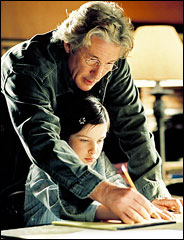
Photo by Phil Bray
Transcendence through spelling:
Richard Gere and Flora Cross
as father and daughter
in the film of Bee Season.
"Every aspect of the alef's
construction has been
Divinely designed
to teach us something."
-- Alef-- The Difference Between
Exile And Redemption,
by Rabbi Aaron L. Raskin
Related material--
Art Theory for Yom Kippur
and
Log24 entries, Nov. 2005.
Part II: Hunt for the Real
The Alphabet Versus the Goddess:
The Conflict Between Word and Image.
See also the references
to Zelazny's Eye of Cat
in the Nov. 2005 entries
as well as
today's previous entry--
with the Norton Simon motto
"Hunt for the best"-- and...

Click for details.
-- Arthur Lubow in The New York Times, Feb. 25, 2007
Friday, March 2, 2007 7:00 AM
ART WARS, continued
Jennifer Jones,
film star and arts patron;
Tom Wolfe, author of
The Painted Word.
"Hunt for the best."
-- Norton Simon

Cover detail,
soundtrack recording
of the Jennifer Jones film
"Angel, Angel, Down We Go"
The girl's left eye in the above
portrait illustrates a remark
in yesterday's New York Times
on a figure in a painting:
(This remark, by Michael Kimmelman,
comes with a headline--
Lights! Darks! Action! Cut!
Maestro of Mise-en-Scène
-- that seems to have been inspired
by Tom Wolfe's prose style.)
For further details, see
Barthes's Punctum,
by Michael Fried.
Thursday, March 1, 2007 9:00 AM
ART WARS, continued
Thursday, March 1, 2007 6:29 AM
Philosophy Wars, continued
From the obituary in today's New York Times of historian Arthur M. Schlesinger Jr.--
"Mr. Schlesinger, partly through his appreciation of history, fully realized his good fortune. 'I have lived through interesting times and had the luck of knowing some interesting people,' he wrote.
A huge part of his luck was his father, who guided much of his early research, and even suggested the topic for his [Harvard] senior honors: Orestes A. Brownson, a 19th-century journalist, novelist and theologian. It was published by Little, Brown in 1938 as 'Orestes A. Brownson: A Pilgrim's Progress.'"
-- Douglas Martin
From The Catholic Encyclopedia:
"It is sufficient for true knowledge that it affirm as real that which is truly real."
-- Article on Ontologism
From The Diamond Theory of Truth:
"Was there really a cherubim waiting at the star-watching rock...?
Was he real?
What is real?-- Madeleine L'Engle, A Wind in the Door, Farrar, Straus and Giroux, 1973, conclusion of Chapter Three, "The Man in the Night"
"Oh, Euclid, I suppose."
-- Madeleine L'Engle, A Wrinkle in Time, Farrar, Straus and Giroux, 1962, conclusion of Chapter Five, "The Tesseract"
Related material: Yesterday's first annual "Tell Your Story Day" at Harvard and yesterday's entry on Euclid.
Wednesday, February 28, 2007 7:59 AM
Parts of a Whole:
Elementsof Geometry
The title of Euclid's Elements is, in Greek, Stoicheia.
From Lectures on the Science of Language, by Max Muller, fellow of All Souls College, Oxford. New York: Charles Scribner's Sons, 1890, pp. 88-90 --
Stoicheia
"The question is, why were the elements, or the component primary parts of things, called stoicheia by the Greeks? It is a word which has had a long history, and has passed from Greece to almost every part of the civilized world, and deserves, therefore, some attention at the hand of the etymological genealogist.
Stoichos, from which stoicheion, means a row or file, like stix and stiches in Homer. The suffix eios is the same as the Latin eius, and expresses what belongs to or has the quality of something. Therefore, as stoichos means a row, stoicheion would be what belongs to or constitutes a row....
Hence stoichos presupposes a root stich, and this root would account in Greek for the following derivations:--
- stix, gen. stichos, a row, a line of soldiers
- stichos, a row, a line; distich, a couplet
- steicho, estichon, to march in order, step by step; to mount
- stoichos, a row, a file; stoichein, to march in a line
In German, the same root yields steigen, to step, to mount, and in Sanskrit we find stigh, to mount....
Stoicheia are the degrees or steps from one end to the other, the constituent parts of a whole, forming a complete series, whether as hours, or letters, or numbers, or parts of speech, or physical elements, provided always that such elements are held together by a systematic order."

The Miracle Octad Generator of R. T. Curtis
For the geometry of these stoicheia, see
The Smallest Perfect Universe and
Finite Geometry of the Square and Cube.