Spider Woman
"Time traveling, which is not quite the good clean boyish fun it's
cracked up to be, started for me when this woman with the sigil on her
forehead looked in on me from the open doorway of the hotel bedroom
where I'd hidden myself and the bottles and asked me, 'Look, Buster, do
you want to live?'....
Her right arm was raised and bent, the
elbow touching the door frame, the hand brushing back the very dark
bangs from her forehead to show me the sigil, as if that had a bearing
on her question.

Bordered version
of the sigil
The sigil was an eight-limbed asterisk made of fine dark
lines and
about as big as a silver dollar. An X superimposed on a plus
sign. It
looked permanent."
-- Fritz Leiber, "Damnation
Morning"
For Vine Deloria Jr., who died at 72 on Sunday, Nov. 13, 2005:
Things forgotten are shadows.
The shadows will be as real
as wind and rain and song
and light,
there in the old place.
Spider Woman atop your rock,
I would greet you,
but I am going the other way.
Only a fool would pursue a
Navajo
into the Canyon of Death.
Related
material:
from a Log24 entry
on the morning of
Deloria's death--
Kaleidoscope turning...
Shifting pattern
within unalterable structure...
-- Roger Zelazny, Eye of Cat
Monday, November 14, 2005 3:09 AM
Culture
Wars
'Chicken Little' Lays Golden Egg
(Dean Goodman, Reuters)
'Bee Season' Anxiety
(Leonard Klady, Movie City News):
The
mixed bag of limited release preems was highlighted by an excellent
response to the concert film Sarah Silverman: Jesus is Magic.
The film recorded a $19,000 plus per engagement average from seven
outings for a $130,000 gross. The family drama Bee Season
had a comparable gross but on three times as many screens that
translated into anxiety about the Richard Gere film's expansion
prospects.
Weekend Estimates
Nov. 11-13, 2005
| Title |
Gross (average)
|
Theaters
|
Cume
|
| Chicken
Little |
32.7 ( 8,950)
|
3658
|
81.5
|
Sarah
Silverman:
Jesus is Magic |
0.13 (19,210)
|
7
|
0.13
|
| Bee Season |
0.13 ( 6,280)
|
21
|
0.13
|
Sunday, November 13, 2005 10:48 AM
Reunion:
An Introduction
to Multispeech
From Log24, Oct. 31, 2005:
"They don't understand
what it is to be awake,
To be living
on several planes at once
Though one cannot speak
with several voices at once."
-- T. S. Eliot,
The Family Reunion
From Finnegans Wake:
"And
even if Humpty shell fall frumpty times as awkward again in the
beardsboosoloom of all our grand remonstrancers there'll be iggs for
the brekkers come to mournhim, sunny side up with care...."
From Urban Legends Reference Pages:

See also
the previous two entries,
Ten
is a Hen and Structure,
about a mother and child.
Sunday, November 13, 2005 6:40 AM
Structure
"Sunrise--
Hast thou a Flag for me?"
-- Emily Dickinson
From a
Beethoven's Birthday entry:


Kaleidoscope turning...
Shifting pattern
within unalterable structure...
-- Roger Zelazny, Eye of Cat
Related material:
Blue
(below),

Bee
Season
(below),

Halloween Meditations,
Aquarius
Jazz,
We
Are the Key,
and
Jazz
on St. Lucia's Day.
"Y'know, I never imagined
the competition version involved
so many tricky permutations."
-- David Brin, Glory
Season
Saturday, November 12, 2005 10:00 PM
Ten is a Hen
"Follow the spiritual journey
that is BEE SEASON."

"'Tikkun Olam,
the fixing of the world,'
she whispers. 'I've been
gathering up the broken vessels
to make things whole again.'"
-- Miriam in Bee Season
"Tikkun Olam, the gathering
of the divine fragments,
is a religious activity....
How do we work for
the repair of the world?
If we live in a
humpty dumpty world,
how do we get it all
put back together again?"
The Rev. Dr. Joshua Snyder,
October 5, 2003
"... the tikkun can't start
until
everyone asks what happened--
not just the Jews but everybody.
The strange thing is that
Christ evidently saw this."
-- Martha Cooley, The
Archivist
"She understands that Bloom asked for breakfast in bed. Since we were
present when Bloom fell asleep and he had not asked for breakfast in
bed before he fell asleep, Molly may have misunderstood his sleepy
murmurs about the Roc's egg."
Jorn Barger on Finnegans
Wake:
"Acknowledging
the dream as sexually harrowing, we're offered relief in a view of ALP
as a hen scratching up battle-relics from a midden heap after the
fall/Flood.
And
even if Humpty shell fall frumpty times as awkward again in the
beardsboosoloom of all our grand remonstrancers there'll be iggs for
the brekkers come to mournhim, sunny side up with care...."
Saturday, November 12, 2005 9:00 PM
Saturday, November 12, 2005 8:00 PM
Seven is Heaven,
Eight is a Gate
(continued)

"... problems are the poetry of chess.
They demand from the composer
the same virtues that characterize
all worthwhile art:
originality, invention,
harmony, conciseness,
complexity, and
splendid insincerity."
-- Vladimir
Nabokov
Saturday, November 12, 2005 7:00 PM
State of Grace
On this date in 1929,
Grace Kelly was born.
|

|
Enough --
the first
Abode
On the familiar Road
Galloped in Dreams --
-- Emily Dickinson |
|
"Nonbeing must in some sense be,
otherwise what is it that there is not? This tangled doctrine might be
nicknamed Plato's beard;
historically it has proved tough, frequently dulling the edge of
Occam's razor.... I have dwelt at length on the inconvenience of
putting up with it. It is time to think about taking steps."
-- Willard Van Orman Quine, 1948,
"On What There Is," reprinted in From a Logical Point of View,
Harvard University Press, 1980
|
"Item: Friar Guillaume's razor
ne'er shaved the barber,
it is much too dull."
-- Robert A. Heinlein
Glory Road
Related material:
Plato, Pegasus, and
the Evening Star
Saturday, November 12, 2005 1:28 PM
Glory Season
"...his eyes ranged the Consul's books disposed quite neatly... on high
shelves around the walls: Dogme et Ritual de la Haute Magie, Serpent
and Siva Worship in Central America,
there were two long shelves of this, together with the rusty leather
bindings and frayed edges of the numerous cabbalistic and alchemical
books, though some of them looked fairly new, like the Goetia of
the Lemegaton of Solomon the King, probably they were treasures,
but the rest were a heterogeneous collection...."
-- Malcolm
Lowry, Under the Volcano, Chapter VI
"... when Saul does reach for a slim leather-bound volume Eliza cannot
help but feel that something momentous is about to happen. There
is
care in the way he carries the book on the short journey from its
shelf, as if it were constructed not of leather and parchment but of
flesh and blood....
"Otzar Eden HaGanuz," Saul says. "The
Hidden Eden.
In this book, Abulafia describes the process of permutation.... Once
you have mastered it, you will have mastered words, and once you have
mastered words, you will be ready to receive shefa."
-- Bee
Season: A Novel
"In the Inner Game, we call the Game Dhum Welur, the Mind of
God."
-- The
Gameplayers of Zan, a novel featuring games based on cellular
automata
"Regarding cellular automata, I'm trying to think in
what SF books I've seen them mentioned. Off the top of my head, only
three come to mind:
The Gameplayers of Zan M.A.
Foster
Permutation City Greg Egan
Glory Season David Brin"
-- Jonathan L. Cunningham, Usenet
"If all that 'matters' are fundamentally
mathematical
relationships, then there ceases to be any important difference between
the actual and the possible. (Even if you aren't a mathematical
Platonist, you can always find some collection of particles of dust to
fit any required pattern. In Permutation City this is called
the 'logic of the dust' theory.)....
... Paul Durham is convinced by the 'logic of the
dust' theory
mentioned above, and plans to run, just for a few minutes, a complex
cellular automaton (Permutation City) started in a 'Garden of Eden'
configuration — one which isn't reachable from any other, and which
therefore must have been the starting point of a simulation.... I
didn't understand the need for this elaborate set-up, but I guess it
makes for a better story than 'well, all possible worlds exist, and I'm going to tell you
about one of them.'"
-- Danny Yee, review of Permutation
City
"Y'know, I never imagined the competition version involved so many
tricky permutations."
-- David Brin, Glory Season, 1994 Spectra paperback, p. 408
Related material:

|
Figure
2
"... matter is consciousness expressed in the intermixing of force and
form, but so heavily structured and constrained by form that its
behaviour becomes describable using the regular and simple laws
of
physics. This is shown in Figure 2.
The glyph in Figure 2 is
the basis for a kabbalistic diagram called the Etz Chaiim, or Tree of
Life. The first principle of being or consciousness is called Keter,
which means Crown. The raw energy of consciousness is called Chokhmah
or Wisdom, and the capacity to give form to the energy of consciousness
is called Binah, which is sometimes translated as Understanding, and
sometimes as Intelligence. The outcome of the interaction of force and
form, the physical world, is called Malkhut or Kingdom. This is
shown... in Figure 3." |
Figure
3
"This
quaternary is a Kabbalistic representation of God-the-Knowable, in the
sense that it the most abstract representation of God we are capable of
comprehending....
God-the-Knowable has four aspects, two male
and two female: Keter and Chokhmah are both represented as male, and
Binah and Malkhut are represented as female. One of the titles of
Chokhmah is Abba, which means Father, and one of the titles of Binah is
Imma, which means Mother, so you can think of Chokhmah as
God-the-Father, and Binah as God-the-Mother. Malkhut is the daughter,
the female spirit of God-as-Matter, and it would not be wildly wrong to
think of her as Mother Earth. And what of God-the-Son? Is there also a
God-the-Son in Kabbalah? There is...."
-- A Depth of Beginning: Notes on Kabbalah by Colin Low
(pdf)
|
See also
Cognitive
Blending and the Two Cultures,
Mathematics
and Narrative,
Deep Game,
and the previous entry.
Friday, November 11, 2005 3:26 PM
720 in the Book
(continued)
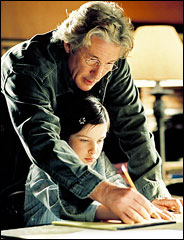
Phil Bray
Transcendence through spelling:
Richard Gere and Flora Cross
as father and daughter
in "Bee Season."
Words Made Flesh: Code, Culture, Imagination--
The earliest known
foundation of the Kabbalah is the Sefer Yetzirah (Book of
Creation) whose origin and history is unknown....
... letters create things by the virtue of an algorithm...
"From
two letters or forms He composed two dwellings; from three,
six; from four, twenty-four; from five, one hundred and twenty; from
six, seven hundred and twenty...."
-- Sefer Yetzirah
Foucault's Pendulum--
Mystic
logic, letters whirling in infinite change, is the world of bliss, it
is the music of thought, but see that you proceed slowly, and with
caution, because your machine may bring you delirium instead of
ecstasy. Many of Abulafia's disciples were unable to walk the fine line
between contemplation of the names of God and the practice of magic.
Bee Season--
"The exercises we've
been doing are Abulafia's. His methods are
primarily a kind of Jewish yoga, a way to relax. For most, what
Abulafia describes as shefa, the influx of the Divine, is a
historical curiosity to be discussed and interpreted. Because, while
anyone can follow Abulafia's instructions for permutation and chanting,
very few can use them to achieve transcendence....
Spelling is
a sign, Elly. When you win the national bee, we'll know that you are
ready to follow in Abulafia's footsteps. Once you're able to let the
letters guide you through any word you are given, you will be ready to
receive shefa."
In the quiet of the room, the sound of Eliza and her father breathing
is everything.
"Do you mean," Eliza whispers, "that I'll be able to talk to God?"
Related material:

Log24, Sept. 3, 2002,
Diamond Theory notes
of Feb. 4, 1986,
of April
26, 1986, and
of May 26, 1986,
Sacerdotal Jargon
(Log24, Dec. 5, 2002),
and 720 in the Book
(Log24, Epiphany 2004).
Thursday, November 10, 2005 4:00 PM
"... the
Board of Education went as far as to redefine what science is: it's no
longer just a search for natural explanations for natural phenomena.
Now it's a search for... well, that's a bit hard to say. Any sort of
explanation, apparently. Pixies, ghosts, telekinesis, auras, ancient
astronauts, excesses of choleric humor, they all seem to be fair game
in the interest of 'academic freedom.'"
-- John
Rennie, editor in chief of
Scientific
American, Nov. 8, 2005
The shocking redefinition
(with changes highlighted):
Kansas Definition of Science
Adopted Feb. 14, 2001
"Science
is the human activity of seeking natural explanations for what we
observe in the world around us. Science does so through the use
of
observation, experimentation, and logical argument while maintaining
strict empirical standards and healthy skepticism. Scientific
explanations are built on observations, hypotheses, and theories. A
hypothesis is a testable statement about the natural world that can be
used to build more complex inferences and explanations. A theory is a
well-substantiated explanation of some aspect of the natural world that
can incorporate observations, inferences, and tested hypotheses |
Kansas Definition of Science
Approved Nov. 8, 2005
"Science
is a systematic method of continuing investigation that uses
observations, hypothesis testing, measurement, experimentation, logical
argument and theory building to lead to more adequate explanations of
natural phenomena. Science does so while maintaining strict empirical
standards and healthy skepticism. Scientific explanations are
built on observations, hypotheses, and theories. A hypothesis is a
testable statement about the natural world that can be used to build
more complex inferences and explanations. A theory is a
well-substantiated explanation of some aspect of the natural world that
can incorporate observations, inferences, and tested hypotheses. |
| Scientific
explanations must meet certain criteria. Scientific explanations are
consistent with experimental and/or observational data and testable by
scientists through additional experimentation and/or observation.
Scientific explanation must meet criteria that govern the repeatability
of observations and experiments. The effect of these criteria is to
insure that scientific explanations about the world are open to
criticism and that they will be modified or abandoned in favor of new
explanations if empirical evidence so warrants. Because all scientific
explanations depend on observational and experimental confirmation, all
scientific knowledge is, in principle, subject to change as new
evidence becomes available. The core theories of science have been
subjected to a wide variety of confirmations and have a high degree of
reliability within the limits to which they have been tested. In areas
where data or understanding are incomplete, new data may lead to
changes in current theories or resolve current conflicts. In situations
where information is still fragmentary, it is normal for scientific
ideas to be incomplete, but this is also where the opportunity for
making advances may be greatest. Science has flourished in different
regions during different time periods, and in history, diverse cultures
have contributed scientific knowledge and technological inventions.
Changes in scientific knowledge usually occur as gradual modifications,
but the scientific enterprise also experiences periods of rapid
advancement. The daily work of science and technology results in
incremental advances in our understanding of the
world about us." |
Scientific
explanations must meet certain criteria. Scientific explanations are
consistent with experimental and/or observational data and testable by
scientists through additional experimentation and/or observation.
Scientific explanation must meet criteria that govern the repeatability
of observations and experiments. The effect of these criteria is to
insure that scientific explanations about the world are open to
criticism and that they will be modified or abandoned in favor of new
explanations if empirical evidence so warrants. Because all scientific
explanations depend on observational and experimental confirmation, all
scientific knowledge is, in principle, subject to change as new
evidence becomes available. The core theories of science have been
subjected to a wide variety of confirmations and have a high degree of
reliability within the limits to which they have been tested. In areas
where data or understanding is incomplete, new data may lead to changes
in current theories or resolve current conflicts. In situations where
information is still fragmentary, it is normal for scientific ideas to
be incomplete, but this is also where the opportunity for making
advances may be greatest. Science has flourished in different regions
during different time periods, and in history, diverse cultures have
contributed scientific knowledge and technological inventions. Changes
in scientific knowledge usually occur as gradual modifications, but the
scientific enterprise also experiences periods of rapid advancement.
The daily work of science and technology results in incremental
advances in understanding
the world." |
From both old
(2001) and
new (2005) Kansas standards:
Teaching With Tolerance and
Respect
"A
teacher is an important role model for demonstrating respect,
sensitivity, and civility. Teachers should not ridicule, belittle or
embarrass a student for expressing an alternative view or belief."
It's a very ancient saying,
But a true and honest thought,
That if you become a teacher,
By your pupils you'll be taught.
-- Oscar Hammerstein,
"Getting to Know You"
Scientism and Civility:
A Google blog search for
fucking kansas
evolution standards -fuck
yields "about 47" entries.
A search for
fuck kansas
evolution standards -fucking
yields "about 34" entries.
A search for
fuck fucking
kansas evolution standards
yields "about 42" entries.
Wednesday, November 9, 2005 7:59 PM
Butterfly Effect
From today's
online New York Times:
John Fowles on two of his novels:
"I wanted to show the seeds of an intense future evolution in a
particular period."
Ray Bradbury, "A
Sound of Thunder" (1952), on the death of a butterfly:
"It
fell to the floor, an exquisite thing, a small thing that could upset
balances and knock down a line of small dominoes and then big dominoes
and then gigantic dominoes, all down the years across Time."
Zhuangzi:
"Once Zhuang Zhou dreamt he was a butterfly, a butterfly flitting and
fluttering around, happy with himself and doing as he pleased. He
didn't know he was Zhuang Zhou. Suddenly he woke up and there he
was,
solid and unmistakable Zhuang Zhou. But he didn't know if he was
Zhuang Zhou who had dreamt he was a butterfly, or a butterfly dreaming
he was Zhuang Zhou. Between Zhuang Zhou and a butterfly there
must be some
distinction! This is called the Transformation of Things."
Related material:
Wednesday, November 9, 2005 1:24 PM
In honor of the 120th anniversary
of the birth of Hermann Weyl:
Tuesday, November 8, 2005 7:59 AM
Review:
A
Constant Idea and
A
Constant Idea: 759.
Monday, November 7, 2005 9:00 PM
Butterfly and Wheel
Monday, November 7, 2005 2:02 PM
"Two years after The Collector had brought him
international recognition and a year before he published The Magus, John Fowles set out his
ideas on life in The Aristos.
The chief inspiration behind them was the fifth century BC philosopher
Heraclitus. In the world he posited of constant and chaotic flux
the
supreme good was the Aristos, 'of a person or thing, the best or most
excellent of its kind.'"
-- Random House Australia
Monday, November 7, 2005 1:20 AM
But
seriously...
 "Sir Frederick Gray, Minister of Defence, is a
dignified, upper-class
gentleman who is well respected in intelligence circles. However for
most of his appearances, Gray is a strict by-the-book person who plays
it seriously at all times. Consequently he despises Bond's playful
attitude towards life and his disregard to take his missions seriously."
"Sir Frederick Gray, Minister of Defence, is a
dignified, upper-class
gentleman who is well respected in intelligence circles. However for
most of his appearances, Gray is a strict by-the-book person who plays
it seriously at all times. Consequently he despises Bond's playful
attitude towards life and his disregard to take his missions seriously."
-- jamesbondmm.co.uk
Geoffrey Keen, who played Sir Frederick Gray in six
James Bond films, died on November 3, 2005.
Related material:
The Log24 entry of 11:07
AM on the date of Keen's death, and the five Log24 entries ending on January 20, 2005.
Sunday, November 6, 2005 10:30 AM
For Mike Nichols,
whose birthday is today:
Angels in Arabia
Yesterday's entries discussed an angel and a fugue; this suggests Clive
Barker's classic tale Weaveworld,
which in turn suggests the following links:
1. the Log24 archive,
Aug. 1-6, 2005, and
2. C. S. Lewis, George Orwell, and
the Corruption of Language,
an essay at the website of
St.
Christopher's Cathedral
in Bahrain,
Arabia.
Nichols, who is Jewish, may of course prefer the following remark of comedian Sarah Silverman:
"I wear this St. Christopher medal sometimes because-- I’m Jewish, but
my boyfriend is Catholic-- it was cute the way he gave it to me. He
said if it doesn’t burn through my skin it will protect me."
Saturday, November 5, 2005 4:24 PM
Contrapuntal Themes
in a Shadowland
(See previous entry.)
Douglas Hofstadter on his magnum opus:
"... I realized that to me, Gödel and Escher and Bach were only shadows
cast in different directions by some central solid essence. I tried to
reconstruct the central object, and came up with this book."
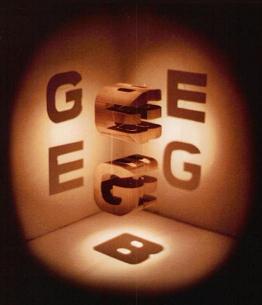
Hofstadter's cover
Here are three
patterns,
"shadows" of a sort,
derived from a different
"central object":
Saturday, November 5, 2005 12:06 PM
Coincidence
and Design
Headline from a local newspaper this morning:
Area Catholics Receive
St. Thomas Aquinas Awards
Headline from today's New
York Times:
Closing Arguments Made
in Trial on Intelligent Design
Taken together, these headlines suggest
that the following link (pdf) may be appropriate for today:
Neutral Evolution
and Aesthetics:
Vladimir Nabokov
and Insect Mimicry.
Related material
on Nabokov and theology:
A Contrapuntal Theme
Today's birthday:
Tilda Swinton,
angel in
"Constantine."
"Gnostic also is the
preposterous stage-direction at the end of Elizabeth Barrett Browning's
Drama of Exile...
The
stars shine on brightly while ADAM and EVE pursue their way into the
far wilderness. There is a sound through the silence, as of the falling
tears of an angel.
'How much noise,'
inquires G. K. Chesterton with brutal common sense, 'is made by an
angel's tears? Is it a sound of emptied buckets, or of mountain
cataracts?'"
-- Dorothy Sayers,
The Mind of the Maker,
Chapter 10
Thursday, November 3, 2005 11:07 AM
Bond
USA Today on last night's White House dinner:
"In his toast, Bush said the royal visit was 'a
reminder of the unique and enduring bond' between the two countries."
| From Log24, July 18, 2003:
The
use of the word "idea" in my entries' headlines yesterday was not
accidental. It is related to an occurrence of the word in Understanding: On
Death and Truth, a set of journal entries from May 9-12. The relevant passage on "ideas" is
quoted there, within commentary by an Oberlin professor:
"That the truth we understand must be a truth we stand under
is brought out nicely in C. S. Lewis' That Hideous Strength
when Mark Studdock gradually learns what an 'Idea' is. While Frost
attempts to give Mark a 'training in objectivity' that will destroy in
him any natural moral sense, and while Mark tries desperately to find a
way out of the moral void into which he is being drawn, he discovers
what it means to under-stand.
'He had never before
known what an Idea meant: he had always thought till now that they were
things inside one's own head. But now, when his head was continually
attacked and often completely filled with the clinging corruption of
the training, this Idea towered up above him-something which obviously
existed quite independently of himself and had hard rock surfaces which
would not give, surfaces he could cling to.'
This too,
I fear, is seldom communicated in the classroom, where opinion reigns
supreme. But it has important implications for the way we understand
argument."
-- "On Bringing One's Life to a Point," by Gilbert
Meilaender, First Things, November 1994
The
old philosophical conflict between realism and nominalism can, it
seems, have life-and-death consequences. I prefer Plato's
realism,
with its "ideas," such as the idea of seven-ness. A reductio
ad absurdum of nominalism may be found in the Stanford
Encyclopedia of Philosophy under Realism:
"A
certain kind of nominalist rejects the existence claim which the
platonic realist makes: there are no abstract objects, so sentences
such as ‘7 is prime’ are false...."
The claim that 7 is not prime is, regardless of its
motives, dangerously stupid.
|
The New York Lottery
evening number
for All Souls' Day, Nov. 2, 2005, was
007.
Related material:
Entries for Nov. 1, 2005 and
the song Planned Obsolescence
by the 10,000 Maniacs
(Hope
Chest:
The
Fredonia Recordings)
Wednesday, November 2, 2005 3:24 PM
To Serve Man
Starring
Sir
Anthony Hopkins
as Smithers
(See previous entry.)
In memory of Lloyd Bochner,
who died on Oct. 29, 2005:
"In
his most memorable television role, Mr. Bochner starred as Michael
Chambers in the famous 1962 'Twilight Zone' episode 'To Serve Man.'
Chambers and his assistant are decoding experts in charge of
translating a book given to Earth by visiting extraterrestrials. The
assistant learns that it is a cookbook, but is too late to save Mr.
Bochner's character from boarding a spaceship and heading toward
becoming an alien meal."
-- Monica Potts in today's New York Times
Wednesday, November 2, 2005 1:00 PM
All
Souls' Day
Malcolm Lowry, Under the Volcano:
"... Let me see, he was
only praelector in my time...."
"He was still praelector in mine."
(In my time?... But what, exactly, does that mean?....)
....
"He was beginning to get the wines and the first editions
slightly mixed up in my day."....
"Bring me a bottle of the very best John Donne, will you,
Smithers?... You know, some of the genuine old 1611."
"God how
funny... Or isn't it?...."
In memory of Malcolm Lowry, a quotation from Donne,
1611:
And,
Oh, it can no more be questioned,
That beauties best, proportion, is dead,
Since euen griefe it selfe, which now alone
Is left vs, is without proportion.
Shee by whose lines proportion should bee
Examin'd measure of all Symmetree,
Whom had the Ancient seene, who thought soules made
Of Harmony, he would at next haue said
That Harmony was shee, and thence infer.
That soules were but Resultances from her,
Here is a link to a later Cambridge praelector, Robert Alexander Rankin. Rankin, a purveyor of
pure mathematics, may help to
counteract the pernicious influence on souls of Sir Michael Atiyah (see
previous two entries and Plato,
Pegasus, and the Evening Star).
Tuesday, November 1, 2005 9:00 PM
The above seal is from an
ad (pdf) for an Oct. 21 lecture, "The Nature of Space," by Sir
Michael Atiyah, sponsored by the American Mathematical Society.
The picture in the seal is of Plato's Academy.
"The great philosopher Plato excluded from his Academy
anyone who had
not studied geometry. He would have been delighted to admit Sir
Michael Atiyah, who was for a time Savilian Professor of Geometry at
Oxford..."
Would he?
Sir Michael Atiyah's
Anti-Platonism
"Mathematics
is an evolution from the human brain, which is responding to outside
influences, creating the machinery with which it then attacks the
outside world. It is our way of trying to reduce complexity into
simplicity, beauty and elegance....
I
tend to think that science and mathematics are ways the human mind
looks and experiences-- you cannot divorce the human mind from it.
Mathematics is part of the human mind. The question whether there is a reality independent of
the human mind, has no meaning-- at least, we cannot answer it."
-- Sir Michael Atiyah, interview in Oslo, May 2004
"For Plato, the Forms represent truth, or reality.... these
Forms are independent
of the mind: they are eternal, unchanging and perfect."
-- Roy Jackson (pdf)
Atiyah's denial of a reality independent of the human mind may have
something to do with religion:
"Socrates and Plato were considered 'Christians before Christ'; they
paved the way for the coming of Christianity by providing it with
philosophical and theoretical foundations that would be acceptable to
the western mind.
In the analogy of the cave, the sun
represents the Form of the Good. In the same way that the sun is the
source of all things and gives light to them, the Form of the Good is
over and above the other Forms, giving them light and allowing us to
perceive them. Therefore, when you have awareness of the Form of the
Good you have achieved true enlightenment. In Christianity, the Form of
the Good becomes God: the source of all things."
-- Roy Jackson, The
God of Philosophy (pdf)
See also the previous
entry.
Tuesday, November 1, 2005 12:00 PM
Antidote
to Atiyah
In a recent talk, "The
Nature of Space,"
Sir Michael Atiyah gave a misleading description of Plato's doctrine of
"ideas," or "idealism." Atiyah said that according to Plato,
ideas
reside in "an imaginary world-- the world of the mind," and
that what
we see in the external world is "some pale reflection" of ideas in the
mind.
An antidote to Atiyah's nonsense may be found in the Catholic
Encyclopedia:
"So it came to pass that the word idea
in various languages took on more and more the meaning of
'representation,' 'mental image,' and the like. Hence too, there was
gradually introduced the terminology which we find in the writings of
Berkeley, and according to which idealism is the doctrine that ascribes
reality to our ideas, i.e. our representations, but denies the reality
of the physical world. This sort of idealism is
just the reverse of that which was held by the philosophers of antiquity
and their Christian
successors; it does away with the reality of ideal principles by
confining them exclusively to the thinking subject; it is a spurious
idealism...."
Atiyah contrasts his mistaken view of Plato with
what he calls the "realism" of Hume. He does not mention that
Plato's
doctrine of ideas is also known as "realism." For details, see,
again,
the Catholic
Encyclopedia:
"The conciliation of the one and the many, the changing and the
permanent, was a favourite problem with the Greeks; it leads to the
problem of universals. The typical affirmation of Exaggerated
Realism, the most outspoken ever made, appears in Plato's
philosophy;
the real must possess the attributes of necessity, universality, unity,
and immutability which are found in our intellectual representations.
And as the sensible world contains only the contingent, the particular,
the unstable, it follows that the real exists outside and above the
sensible world. Plato calls it eîdos, idea. The idea is
absolutely stable and exists by itself (ontos
on; auta kath' auta), isolated from the phenomenal world, distinct from the Divine
and human intellect.... The exaggerated Realism of Plato... is
the principal doctrine of his metaphysics."
Atiyah's misleading remarks may appeal to believers in the contemptible
religion of Scientism, but they have little to do with either
historical reality or authentic philosophy.