the Broadway Scenes
Friday, December 31, 2004 4:00 AM
-- Last words of Larry Hart,A: The Quest for the 36.
according to
St. Mark's Episcopal Church,
Washington, DC.
-- A Force Behind
the Broadway Scenes
Wednesday, December 29, 2004 12:00 PM
The Dark Door
From Log24.net, Dec. 22, 2003:
"One, two, three, and we began to sing, our voices high and seemingly distant in the snow-felted darkness round the house that was occupied by nobody we knew. We stood close together, near the dark door.
Good King Wenceslas looked out
On the Feast of Stephen."
-- Dylan Thomas,
A Child's Christmas in Wales
"The day after Christmas
turned out to be a living nightmare."
-- Arthur C. Clarke, Dec. 27, 2004
Adapted from the logo of the
Arthur C. Clarke Foundation:

Dabo claves regni caelorum. By silent shore
Ripples spread from castle rock. The metaphor
For metamorphosis no keys unlock.
-- "Endgame," Steven H. Cullinane,
November 7, 1986
Saturday, December 25, 2004 8:00 AM
8:00:00
For related iconology, see Star Wars and
Show Business according to Fritz Leiber.
Wednesday, December 22, 2004 7:59 AM
Geometry Update
Added a new section,
"How the MOG works," to
Geometry
of the 4x4 Square.
Wednesday, December 22, 2004 7:20 AM
The Longest Night
This year's longest night (either Dec. 20-21 or Dec. 21-22, I don't
know which) is over. (See Frost's famous poem describing that night.) No
notable news to report, although it seems a good sign that many
churches held a "Longest Night" ("Blue Christmas") service around
this time. Elvis would be pleased.
Sunday, December 19, 2004 2:56 PM

Friday, December 17, 2004 9:00 PM
Friday, December 17, 2004 12:05 PM


From today's New York Times:
Agnes Martin, Abstract Painter, Dies at 92
Background: entry of 7 PM Wednesday.
Thursday, December 16, 2004 3:00 AM
Nothing Nothings
(Again)
Background: recent Log24 entries (beginning with Chorus from the Rock on Dec. 5, 2004) and Is Nothing Sacred? (quotations compiled on March 9, 2000).
From an obituary of Paul Edwards, a writer on philosophy, in this morning's New York Times:
"Heidegger's Confusions, a collection of Professor Edwards's scholarly articles, was published last month by Prometheus."Edwards, born in Vienna in 1923 to Jewish parents, died on December 9.
Some sites I visited earlier this evening, before reading of Edwards's death:
Wednesday, December 15, 2004 7:00 PM
Judeo-Christian
Heritage:
The Wiener Kreis
The meditation below was suggested by this passage:
"... the belief that any sensible discourse had to be formulated within the rules of the scientific language, avoiding the non sense of the ordinary language. This belief, initially expressed by Wittgenstein as aphorisms, was later formalized by the Wiener Kreis [Vienna Circle] as a 'logical construction of the world'...."
"Deeply Vulgar"
-- Epithet applied in 2003 to
Harvard President Lawrence Summers.
"Examples are the stained-glass
windows of knowledge."
-- Vladimir Nabokov
|
In today's Crimson:
 Only moderately vulgar, with
its sniggering pop-culture reference. But it should be
Frankfurter Professor of Law. |
 |
Those seeking relief from
Judeo-Christian vulgarity may enjoy
the Buddhist Suzanne Vega's
|
|
|
"Mercilessly tasteful"
-- Andrew Mueller
Monday, December 13, 2004 1:00 AM
Three in One

"The theory of poetry, that is to say, the total of the theories of poetry, often seems to become in time a mystical theology or, more simply, a mystique. The reason for this must by now be clear. The reason is the same reason why the pictures in a museum of modern art often seem to become in time a mystical aesthetic, a prodigious search of appearance, as if to find a way of saying and of establishing that all things, whether below or above appearance, are one and that it is only through reality, in which they are reflected or, it may be, joined together, that we can reach them."
-- "The Relations between Poetry and Painting,"
by Wallace Stevens
Sunday, December 12, 2004 7:59 PM
Ideas, Stories, Values:
Literati in Deep Confusion
"We tell ourselves stories in order to live....
We interpret what we see, select the most workable of multiple choices. We live entirely, especially if we are writers, by the imposition of a narrative line upon disparate images, by the 'ideas' with which we have learned to freeze the shifting phantasmagoria which is our actual experience.
Or at least we do for a while. I am talking here about a time when I began to doubt the premises of all the stories I had ever told myself, a common condition but one I found troubling."
Interview with Joseph Epstein:
"You can do in stories things that are above those in essays," says Epstein. "In essays and piecework, you are trying to make a point, whereas in stories you are not quite sure what the point is. T.S. Eliot once said of Henry James, 'He had a mind so fine no idea could violate it,' which, I think, is the ultimate compliment for an author. Stories are above ideas."
Harvard President Lawrence H. Summers, Sept. 12, 2004:
"You are entering a remarkable community, the Harvard community. It is a community built on the idea of searching for truth... on the idea of respect for others....
... we practice the values we venerate. The values of seeking truth, the values of respecting others...."
"... Hegel discusses 'culture' as the 'world of self-alienated spirit.' The idea seems to be that humans in society not only interact, but that they collectively create relatively enduring cultural products (stories, dramas, and so forth) within which they can recognise their own patterns of life reflected."
The "phantasmagoria" of Didion seems related to the "phenomenology" of Hegel...
From Michael N. Forster, Hegel's Idea of a Phenomenology of Spirit:
"This whole system is conceived, on one level at least, as a defense or rational reworking of the Christian conception of God. In particular, its three parts are an attempt to make sense of the Christian idea of a God who is three in one -- the Logic depicting God as he is in himself, the Philosophy of Nature God the Son, and the Philosophy of Spirit God the Holy Spirit."
and, indeed, to the phenomenology of narrative itself....
From Patrick Vert,
The Narrative of Acceleration:
"There are plenty of anecdotes to highlight the personal, phenomenological experience of railway passage...
... a unique study on phantasmagoria and the history of imagination. The word originates [in] light-projection, the so-called ghost-shows of the early 19th century....
... thought becomes a phantasmagorical process, a spectral, representative location for the personal imagination that had been marginalized by scientific rationalism....
Truly, 'immediate experience is [or becomes] the phantasmagoria of the idler' [Walter Benjamin, The Arcades Project. Cambridge: Harvard University Press, 1999. Page 801.]....
Thought as phantasm is a consequence of the Cartesian split, and... a further consequence to this is the broad take-over of perceptual faculty.... What better example than that of the American railway? As a case-study it offers explanation to the 'phantasmagoria of the idler'....
This phantasmagoria became more mediated over time.... Perception became increasingly visually oriented.... As this occurred, a narrative formed to encapsulate the phenomenology of it all...."
For such a narrative, see
the Log24.net entries of
November 5, 2002, 2:56 AM,
November 5, 2002, 6:29 AM,
January 3, 2003, 11:59 PM,
August 17, 2004, 7:29 PM,
August 18, 2004, 2:18 AM,
August 18, 2004, 3:00 AM, and
November 24, 2004, 10:00 AM.
Sunday, December 12, 2004 2:45 AM
So Set 'Em Up, Joe

For Sinatra's birthday:
One For His Baby,
One
More for the Road, and
The Twelve Steps of Christmas.
Friday, December 10, 2004 2:14 PM
Review
"Philosophers ponder the idea of identity:
what it is to give something a name
on Monday and have it respond
to that name on Friday...."
-- Bernard Holland
in the New York Times
of Monday, May 20, 1996
Log24.net on Monday:
|
Zen and the Trinity (See entries of Zen: The Trinity: |
 |
Friday, December 10, 2004 3:00 AM
Gray Particular
in Hartford
From Wallace Stevens,
"The Rock, Part III:
Forms of the Rock in a Night-Hymn" --
The rock is
the gray particular of man's life,
The stone from which
he rises, up--and--ho,
The step to
the bleaker depths of his descents...
From this morning's
New York Times obituaries--
 leve
Gray, a painter admired for his large-scale, vividly
colorful and lyrically gestural abstract compositions, died on
Wednesday in Hartford. He was 86.
leve
Gray, a painter admired for his large-scale, vividly
colorful and lyrically gestural abstract compositions, died on
Wednesday in Hartford. He was 86.
The cause was a massive subdural hematoma suffered after he fell on
ice and hit his head on Tuesday outside his home in Warren, Conn., said
his wife, the writer Francine du Plessix Gray.
*******************************
... in 1999 [he] received the Wallace Stevens Award, which carries a
$100,000 prize, from the Academy of American Poets.
A Wallace Stevens Award,
in Seven Parts:
I. From a page linked to in
Tuesday's entry White Christmas:
"A bemused Plato reasoned that nonbeing must in some sense be, otherwise what is it that there is not? In our own day Martin Heidegger ventured that das Nichts nichtet -- 'the nothing nothings' -- evidently still sensing a problem."
-- W. V. Quine in Quiddities
II. "As if nothingness
contained a métier..."
-- Wallace Stevens, "The Rock"
III. "Massive subdural hematoma"
-- Three-word poem
performed
on Tuesday in Connecticut
IV. mé·tier n.
V. "ho"An occupation, a trade, or a profession. Work or activity for which a person is particularly suited; one's specialty.
[French, from Old French mestier, from Vulgar Latin misterium, from Latin ministerium. See ministry.]
Source: The American Heritage® Dictionary of the English Language, Fourth Edition
VII. From an entry of April 29, 2004:July 16, 1992: Splendor and Miseries, review of
Women for Hire: Prostitution and Sexuality in France after 1850 by Alain Corbin, translated by Alan Sheridan
La Vie quotidienne dans les maisons closes, 1830–1930 by Laure Adler
Figures of Ill Repute: Representing Prostitution in Nineteenth-Century France by Charles Bernheimer
Painted Love: Prostitution in French Art of the Impressionist Era by Hollis Clayson
Thursday, December 9, 2004 4:44 PM

Thursday, December 9, 2004 4:44 PM
Thursday, December 9, 2004 4:44 AM
String Theory:From a Log24 entry of Friday, December 3, 2004:
"Anything but the void. And so we keep hoping to luck into a winning
combination, to tap into a subtle harmony, trying like lock pickers to
negotiate a compromise with the 'mystery tramp,' as Bob Dylan put
it...."
-- Dennis Overbye, Quantum Baseball,
New York Times, Oct. 26, 2004
From this morning's New York Times:
|
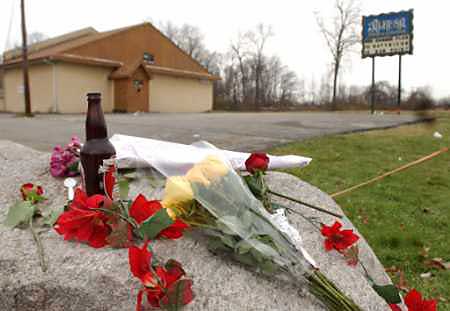
BLOUNTVILLE, Tenn., Dec. 8 (AP) - Ralph Blizard, a renowned fiddler who began his career playing on the radio, died here on Friday [Dec. 3, 2004], according to a funeral home in Kingsport. He was 85. Mr. Blizard started playing at age 7. He began his career on
the radio in |
In memory of Mr. Blizard:
| From Cold Mountain, by Charles Frazier, 367-368: They consulted and twisted the pegs again to make the dead man's tuning, and they then set in playing a piece slightly reminiscent of Bonaparte's Retreat, which some name General Washington's tune. This was softer, more meditative, yet nevertheless grim as death. When the minor key drifted in it was like shadows under trees, and the piece called up something of dark woods, lantern light. It was awful old music in one of the ancient modalities, music that sums up a culture and is the true expression of its inner life. Birch said, Jesus wept. The fit's took them now. None of the Guard had ever heard fiddle and banjo played together in that tuning, nor had they heard playing of such strength and rhythm applied to musical themes so direful and elegiac. Pangle's use of the thumb on the fifth string and dropping to the second was an especial thing of arrogant wonder. It was like ringing a dinner bell, yet solemn. His other two fingers worked in a mere hard, groping style, but one honed to brutish perfection. Stobrod's fingers on the fiddle neck found patterns that seemed set firm as the laws of nature. There was a deliberation, a study, to their clamping of the strings that was wholly absent from the reckless bowing of the right hand. What lyric Stobrod sang recounted a dream -- his or some fictive speaker's -- said to have been dreamed on a bed of hemlocks and containing a rich vision of lost love, the passage of awful time, a girl wearing a mantle of green. The words without music would have seemed hardly fuller in detail than a telegraphic message, but together they made a complete world. When the song fell closed, Birch said to Teague, Good God, these is holy men. Their mind turns on matters kept secret from the likes of you and me. |
Wednesday, December 8, 2004 12:00 PM
24 Years Later:"A dead shepherd brought
tremendous chords from hell
And bade the sheep carouse."
Tuesday, December 7, 2004 1:00 PM
White Christmas
Starring W. V. Quine as
the Ghost of Christmas Past
"Birthday, death-day --
what day is not both?"
-- John Updike
"We tell ourselves stories in order to live....
We interpret what we see, select the most workable of multiple choices.
We live entirely, especially if we are writers, by the imposition of a
narrative line upon disparate images, by the 'ideas' with which we have
learned to freeze the shifting phantasmagoria which is our actual
experience.
Or at least we do for a while. I am talking here about a time when I began to doubt the premises of all the stories I had ever told myself, a common condition but one I found troubling."
-- Joan Didion, The White Album

0! = 1
-- Quine's Shema
Tuesday, December 7, 2004 10:00 AM

Monday, December 6, 2004 3:00 PM
Zen and the Trinity
(See entries of December 6, 2002.)
Zen: The time is now 3:00:00 PM.
The Trinity: "Three illustrations will suffice."
Sunday, December 5, 2004 3:00 PM
Chorus fromThe American Sublime
How does one stand
To behold the sublime,
To confront the mockers,
The mickey mockers
And plated pairs?
When General Jackson
Posed for his statue
He knew how one feels.
Shall a man go barefoot
Blinking and blank?
But how does one feel?
One grows used to the weather,
The landscape and that;
And the sublime comes down
To the spirit itself,
The spirit and space,
The empty spirit
In vacant space.
What wine does one drink?
What bread does one eat?
-- Wallace Stevens
A search of the Internet for "Wallace Stevens" + "The Rock" +
"Seventy Years Later" yields only one quotation...
Log24 entries of Aug. 2, 2002:
From "Seventy Years Later," Section I of "The Rock," a poem by Wallace Stevens:
A theorem proposed
between the two --
Two figures in a nature
of the sun....
From page 63 of The New Yorker issue dated August 5, 2002:
From Didion's Play It As It Lays:"Birthday, death-day --
what day is not both?"
-- John Updike
Everything goes. I am working very hard at not thinking about how everything goes. I watch a hummingbird, throw the I Ching but never read the coins, keep my mind in the now.From Play It As It Lays:
-- Page 8
I lie here in the sunlight, watch the hummingbird. This morning I threw the coins in the swimming pool, and they gleamed and turned in the water in such a way that I was almost moved to read them. I refrained.
-- Page 214
Saturday, December 4, 2004 3:00 PM
From Midnight, Dec. 28, 2002:
|
Kylie |
Our site music for today is Ravel's classic, "Bolero." For bolero purposes, some may prefer Kylie Minogue's rendition of "Locomotion." |
Related material:
 |
|
From a synopsis of Cinderella:
"Cinderella is in the Palace garden and is found by the Prince, who
is dejected at the lack of success in the quest and throws the slipper
away. Happily the Godmother (hidden in the bushes) catches it and
replaces it on the bench next to the Prince, just as he remembers he
should try it on Cinderella.
Saturday, December 4, 2004 12:00 AM
X

At midnight: A letter for
"a
complete unknown" --
"Once
upon a time
you dressed so fine..."
Friday, December 3, 2004 2:56 PM
Crimson
on St. Cecilia's Day
"... from the Age that is past,
To the Age that is waiting before."
-- Samuel Gilman, "Fair Harvard"
Published by The Harvard Crimson
on Monday, November 22, 2004:
|
Dylan Performs By KATHERINE CHAN Shouts of "Make way! Moses is here!" filled a restless crowd
as legendary musician Bob Dylan closed off his College tour last night
jamming in front of a sold out audience of Harvard undergraduates and
Cambridge residents.... |

|
"Each epoch has its singer." "Anything but the void. And so we keep hoping to luck into a
winning combination, to tap into a subtle harmony, trying like lock
pickers to negotiate a compromise with the 'mystery tramp,' as Bob
Dylan put it...." With the mystery tramp, but now you realize He's not selling any alibis As you stare into the vacuum of his eyes And ask him do you want to make a deal?" -- Bob Dylan, Like a Rolling Stone |
From The New York Times today:
"It's official, I guess. Forty years after he recorded it, Bob Dylan's
'Like a Rolling Stone' was just named the greatest rock 'n' roll song
of all time...."
Friday, December 3, 2004 1:09 PM
Triple Play
(See entry of All Hallows' Eve, 2004.)
On December 3...
In 1947, the Tennessee Williams play "A
Streetcar Named Desire" opened on Broadway.
In 1953, the musical "Kismet" opened on Broadway.
In 1960, the musical "Camelot" opened on Broadway.
-- AP, Today in History
Friday, December 3, 2004 2:01 AM
 1. |
 2. |
 3. |
 4. |
Thursday, December 2, 2004 8:23 PM
The Poem of Pure Reality
"We seek
The poem of pure reality, untouched
By trope or deviation,
straight to the word,
Straight to the transfixing object,
to the object
At the exactest point at which it is itself,
Transfixing by being purely what it is...."
-- Wallace Stevens (1879-1955)
"An Ordinary Evening in New Haven" IX,
from The Auroras of Autumn (1950)
(Collected Poems, pp. 465-489)
I have added new material to Geometry of the 4x4 Square, including links to a new commentary on a paper by Burkard Polster.
"It is a good light, then, for those
That know the ultimate Plato,
Tranquillizing with this jewel
The torments of confusion."
-- Wallace Stevens,
Collected Poetry and Prose, page 21,
The Library of America, 1997