
Thursday, April 15, 2004 12:30 PM
Today's Kerry Misery Index
70%: Karl Rove is smiling today.
"The Sharon-Bush partnership creates a ticklish tactical problem for John Kerry. The Democrats (like the GOP) have traditionally regarded Jewish settlements in the West Bank as 'obstacles to peace.'
Now that Bush has ruled that some of them are kosher, Kerry is in an awkward position.
If he follows President Bush's new policy direction he will bump up hard against the Jimmy Carter-NPR wing of his own party, not to mention polite European society. If, on the other hand, he decides to stand pat he will, much to his dismay, find himself running for commander in chief as the favorite son of Arafat and Hamas."
-- Zev Chafets, columnist for the New York Daily News, April 15, 2004
Wednesday, April 14, 2004 3:14 AM
President Queeg,
continued
Compare and contrast:
The President of the United States
and Captain Queeg.
From last night's press conference:
"....you never admit a mistake. Is that a fair criticism.... ?"

From The Caine Mutiny:
"... Naturally, I can only cover these things from memory... If I've left anything out, why, just ask me specific questions and I'll be glad to answer them... one-by-one..."
For further details, see
Tuesday, April 13, 2004 1:26 PM
Lies, Damned Lies, and Statistics
The previous entry dealt with politicians' lies and clergymen's damned lies. This entry deals with statistics (often grouped with the former two sins).
Group: Kerry's Misery Index
Selective, Makes Bush Look Bad
Tuesday, April 13, 2004 11:40 AM ET
WASHINGTON -(Dow Jones)- U.S. Sen. John Kerry, D-Mass., claims middle-class Americans are miserable under the economic stewardship of President George W. Bush. A new report released Tuesday says Kerry's campaign selectively designed a "misery index" to make Bush look bad.
Sunday, April 11, 2004 11:59 PM
Easter Politics
At Fort Hood, Texas, a sermon for the President of the United States:
" 'Christianity is based on one historic event-- it happened Easter morning.' Members of the congregation responded with cries of 'Amen!'."
-- Scott Lindlaw, The Associated Press
This, of course, is a damned lie. Christianity is, in fact, based on damned lies, not on Easter or any other alleged historic events.
Meanwhile, in Boston, the President's political rival John Kerry received communion at a Catholic Easter service, implying his endorsement of the Catholic dogma of transubstantiation -- one of the blackest of Christianity's many damned lies.
So voters have a choice this year between a damned Protestant liar and a damned Catholic liar... just as in 1960. Plus ça change, plus c'est la même chose.
For my own Easter sermon, see the previous entry.
Sunday, April 11, 2004 3:28 PM
Good Friday and
Descartes's Easter Egg
"The use of z, y, x . . . to represent unknowns is due to René Descartes, in his La géometrie (1637).... In a paper on Cartesian ovals, prepared before 1629, x alone occurs as unknown.... This is the earliest place in which Descartes used one of the last letters of the alphabet to represent an unknown."
-- Florian Cajori, A History of Mathematical Notations. 2 volumes. Lasalle, Illinois: The Open Court Publishing Co., 1928-1929. (Vol. 1, page 381)
This is from
http://members.aol.com/jeff570/variables.html.
Descartes's Easter Egg is found at
EggMath: The Shape of an Egg --
Cartesian Ovals.
An Easter Meditation
on Humpty Dumpty
The following is excerpted from a web page headed "Catholic Way." It is one of a series of vicious and stupid Roman Catholic attacks on Descartes. Such attacks have been encouraged by the present Pope, who today said "may the culture of life and love render vain the logic of death."
The culture of life and love is that of the geometry (if not the philosophy) of Descartes. The logic of death is that of Karol Wojtyla, as was made very clear in the past century by the National Socialist Party, which had its roots in Roman Catholicism.
|
Humpty Dumpty sat on a wall. "In the century just completed, the human race found itself in a position not unlike the scrambled mess at the base of an imaginary English wall.... ... we are heirs to a humanity that is broken, fractured, confused, unsure of what to make of itself.... ... 'postmodernism' is merely the articulation of the fractured, dissipated state of the human being.... Without relating a history of modern philosophy, our unfortunate human shell has suffered a continual fragmentation for a period of roughly 500 years. (You philosophers out there will recognize immediately that I am referring to the legacy of René Descartes.) And this fragmentation has been a one-way street: one assault after another on the integrity and dignity of the human person until you have, well, the 20th Century. But now it’s the 21st Century. The beauty … the marvel … the miracle of our time is the possibility that gravity will reverse itself: Humpty Dumpty may be able, once again, to assume his perch." — Ted Papa, |
Voilà .

The upper part
of the above icon
is from EggMath.
For the lower part,
see Good Friday.
Saturday, April 10, 2004 3:19 PM
Couleurs

In memory of
René Descartes
(born March 31)
and
René Gruau
(died March 31)
On the former:
"The predominant use of the letter x
to represent an unknown value
came about in an interesting way."
On the latter:
"The women he drew
often seemed to come alive."
Saturday, April 10, 2004 1:23 AM
Harrowing
"The Ferris wheel came into view again, just the top, silently burning high on the hill, almost directly in front of him, then the trees rose up over it. The road, which was terrible and full of potholes, went steeply downhill here; he was approaching the little bridge over the barranca, the deep ravine. Halfway across the bridge he stopped; he lit a new cigarette from the one he'd been smoking, and leaned over the parapet, looking down. It was too dark to see the bottom, but: here was finality indeed, and cleavage! Quauhnahuac was like the times in this respect, wherever you turned the abyss was waiting for you round the corner. Dormitory for vultures and city of Moloch! When Christ was being crucified, so ran the sea-borne, hieratic legend, the earth had opened all through this country ..."
-- Malcolm Lowry, Under the Volcano, 1947. (Harper & Row reissue, 1984, p. 15)
Comment by Stephen Spender:
"There is a suggestion of Christ descending into the abyss for the harrowing of Hell. But it is the Consul whom we think of here, rather than of Christ. The Consul is hurled into this abyss at the end of the novel."
-- Introduction to Under the Volcano
Edward Gibbon, Decline and Fall of the Roman Empire, Chapter XXI --
Gibbon, discussing the theology of the Trinity, defines perichoresis as
"... the internal connection and spiritual penetration which indissolubly unites the divine persons59 ....
59 ... The
or 'circumincessio,' is perhaps the deepest and darkest corner of the whole theological abyss."
"Whoever fights monsters should see to it that in the process he does not become a monster. And when you look long into an abyss, the abyss also looks into you."
William Golding:
"Simon's head was tilted slightly up. His eyes could not break away and the Lord of the Flies hung in space before him.
'What are you doing out here all alone? Aren't you afraid of me?'
Simon shook.
'There isn't anyone to help you. Only me. And I'm the Beast.'
Simon's mouth labored, brought forth audible words.
'Pig's head on a stick.'
'Fancy thinking the Beast was something you could hunt and kill!' said the head. For a moment or two the forest and all the other dimly appreciated places echoed with the parody of laughter. 'You knew, didn't you? I'm part of you? Close, close, close!' "
"Thought of the day:
You can catch more flies with honey than vinegar... if you're into catchin' flies."
-- Alice Woodrome, Good Friday, 2004
Anne Francis,
also known as
Honey West:

"Here was finality indeed,
and cleavage!"
-- Under the Volcano
From the official
Anne Francis Web Site:
Come into my parlor....

For some background,
see the use of the word
"spider" in Under the Volcano:
by Patrick A. McCarthy.
See, too, Why Me?
Friday, April 9, 2004 5:36 PM
Lost in Translation?
In memory of

Friday, April 9, 2004 4:35 PM
Meanwhile, back at the ranch...
Bush Seeks to Shore Up
Support for Iraq
Fri Apr 9, 2004 03:49 PM ET
By Jeremy Pelofsky
CRAWFORD, Texas (Reuters) - President Bush on Friday won renewed pledges of support for U.S. efforts in Iraq from allies Italy, Poland and El Salvador, the White House said, as casualties and kidnappings mounted.
-- Jim Carrey at
the 1996 Academy Awards
Friday, April 9, 2004 3:00 PM
3 PM
Good
Friday

Friday, April 9, 2004 2:45 PM
Temptation

Kylie sings
Locomotion.
In memory of Victor Argo,
who died Tuesday, April 6, 2004.
Today's New York Times
says Mr. Argo was cast
"somewhat against type"
by Martin Scorsese as

The Apostle Peter in
"The Last Temptation of Christ."
Friday, April 9, 2004 2:29 PM
Odd Massing
"An odd massing of consciousness takes place."
-- David Kalstone,
On "Lost in Translation"
Friday, April 9, 2004 1:44 PM
We Call This Friday Good
-- T. S. Eliot
| Welcome to our imaginative and inspiring toy catalog! |
| Today is Friday 9-April 2004. On this day in 1914 1st full color film shown "The World, The Flesh & the Devil" (London) |
| What you will discover in this site is what we have been able to find in our everlasting search for the most original, innovative, amusing and mind bending toys from around the world. Have Fun. |
Friday, April 9, 2004 1:00 AM
Triple Crown, Part II
(See previous entry.)
The winner is Mike Sullivan, far and away.

An essay, by Sullivan's son,
from Harper's magazine, Oct. 2002 --
Horseman, Pass By:
Glory, Grief, and the Race for
the Triple Crown
by John Jeremiah Sullivan
Far back, far back in our dark soul
the horse prances.
-- D. H. Lawrence
"As opposed to the typical sportswriter, who has a passion for the subject and can put together a sentence, my father's ambition had been to Write (poetry, no less), and sports were what he knew, so he sort of stumbled onto making his living that way....
Two years ago, in May, I sat with him in his hospital room at Riverside Methodist, in Columbus....
I asked him to tell me what he remembered from all those years of writing about sports, for he had seen some things in his time.... This is what he told me:
I was at Secretariat's Derby, in '73, the year before you were
I wrote that down when I got back to my father's apartment, where my younger sister and I were staying the night. He lived two more months, but that was the last time I saw him alive."
Thanks to the New York Times for today's review of John Jeremiah Sullivan's new book, which includes the above.
See, too,
Words Are Events.
Thursday, April 8, 2004 12:00 AM
Triple Crown
"The tug of an art that unapologetically sees itself as on a par with science and religion is not to be underestimated.... Philosophical ambition and formal modesty still constitute Minimalism's bottom line."
________________
From Hans Reichenbach's
Ch. 18 - The Old and the New Philosophy
"The speculative philosophers allotted to art a dignified position by putting art on a par with science and morality: truth, beauty and the good were for them the triple crown of human searching and longing."
Ch. 15 - Interlude: Hamlet's Soliloquy
"I have good evidence. The ghost was very conclusive in his arguments. But he is only a ghost. Does he exist? I could not very well ask him. Maybe I dreamed him. But there is other evidence....
It is really a good idea: that show I shall put on. It will be a crucial experiment. If they murdered him they will be unable to hide their emotions. That is good psychology. If the test is positive I shall know the whole story for certain. See what I mean? There are more things in heaven and earth than are dreamt of in your philosophy, my dear logician.
I shall know it for certain? I see your ironical smile. There is no certainty....
There I am, the eternal Hamlet. What does it help me to ask the logician....? His advice confirms my doubt rather than giving me the courage I need for my action. One has to have more courage than Hamlet to be always guided by logic."
________________
On this Holy Thursday, the day of Christ's Last Supper, let us reflect on Quine's very pertinent question in Quiddities (under "Communication"):
"What transubstantiation?"
"It is easiest to tell what transubstantiation is by saying this: little children should be taught about it as early as possible. Not of course using the word...because it is not a little child's word. But the thing can be taught... by whispering..."Look! Look what the priest is doing...He's saying Jesus' words that change the bread into Jesus' body. Now he's lifting it up. Look!"
From "On Transubstantiation" by Gertrude Elizabeth Margaret Anscombe, Collected Philosophical Papers, V.III: Ethics, Religion, and Politics, 1981, Univ. of Minnesota Press, as quoted in the weblog of William Luse, Sept, 28, 2003
A perhaps more credible instance of transubstantiation may be found in this account of Anscombe on the Feast of Corpus Christi:
"In her first year at Oxford, she converted to Catholicism. In 1938, after mass at Blackfriars on the Feast of Corpus Christi, she met Peter Geach, a young man three years her senior who was also a recent convert to Catholicism. Like her, Geach was destined to achieve eminence in philosophy, but philosophy played no role in bringing about the romance that blossomed. Smitten by Miss Anscombe’s beauty and voice, Geach immediately inquired of mutual friends whether she was 'reliably Catholic.' Upon learning that she was, he pursued her and, swiftly, their hearts were entangled."
-- John M. Dolan, Living the Truth
Christ plays in ten thousand places,
Lovely in limbs, and
lovely in eyes not his
To the Father through
the features of men’s faces.-- Gerard Manley Hopkins
Concluding reflections for Holy Thursday:
Truth, Beauty, and The Good
Art is magic delivered from
the lie of being truth.
-- Theodor Adorno, Minima moralia,
London, New Left Books, 1974, p. 222
(First published in German in 1951.)
The director, Carol Reed, makes...
impeccable use of the beauty of black....
-- V. B. Daniel on The Third Man
I see your ironical smile.
-- Hans Reichenbach (see above)
Adorno, The Third Man, and Reichenbach
are illustrated below (l. to r.) above the names of cities with which they are associated.

In keeping with our transubstantiation theme, these three cities may be regarded as illustrating the remarks of Jimmy Buffett
Wednesday, April 7, 2004 2:00 PM
Today's birthdays:
Francis Ford Coppola and
Russell Crowe.
From MindfulGroup.com:
|
Welcome to our imaginative and inspiring toy catalog! Today is Wednesday 7-April 2004. On this day in 30 Jesus crucified by Roman troops in Jerusalem (scholars' estimate) What you will discover in this site is what we have been able to find in our everlasting search for the most original, innovative, amusing and mind bending toys from around the world. Have Fun. Coliseum Tell me more |
Wednesday, April 7, 2004 3:30 AM
ART WARS:
Mother of Beauty
In memory of architect Pierre Koenig...
Mother of Beauty: A Note on Modernism.
"... Case Study House #22 ... was high drama — one in which the entire city becomes part of the architect's composition. Approached along a winding street set high in the Hollywood Hills, the house first appears as a blank concrete screen. From here, the visitor steps out onto a concrete deck that overlooks a swimming pool. Just beyond it, the house's living room — enclosed in a glass-and steel-frame — cantilevers out from the edge of the hill toward the horizon.
The house was immortalized in a now famous image taken by the architectural photographer Julius Shulman. In it, two women, clad in immaculate white cocktail dresses, are perched on the edge of their seats in the glass-enclosed living room, their pose suggesting a kind of sanitized suburban bliss. A night view of the city spreads out beneath them, an endless grid of twinkling lights that perfectly captures the infinite hopes of the postwar American dream....

"My blue dream..."
-- F. Scott Fitzgerald
Perhaps no house, in fact, better sums up the mix of outward confidence and psychic unease that defined Cold War America...."
-- Los Angeles Times, Nicolai Ouroussoff
Tuesday, April 6, 2004 10:00 PM
Ideas and Art, Part III
The first idea was not our own. Adam
In Eden was the father of Descartes...
-- Wallace Stevens, from
Notes Toward a Supreme Fiction
"Quaedam ex his tanquam rerum imagines sunt, quibus solis proprie convenit ideae nomen: ut cùm hominem, vel Chimaeram, vel Coelum, vel Angelum, vel Deum cogito."
-- Descartes, Meditationes III, 5
"Of my thoughts some are, as it were, images of things, and to these alone properly belongs the name idea; as when I think [represent to my mind] a man, a chimera, the sky, an angel or God."
-- Descartes, Meditations III, 5
Begin, ephebe, by perceiving the idea
Of this invention, this invented world,
The inconceivable idea of the sun.
You must become an ignorant man again
And see the sun again with an ignorant eye
And see it clearly in the idea of it.
-- Wallace Stevens, from
Notes Toward a Supreme Fiction
"... Quinimo in multis saepe magnum discrimen videor deprehendisse: ut, exempli causâ, duas diversas solis ideas apud me invenio, unam tanquam a sensibus haustam, & quae maxime inter illas quas adventitias existimo est recensenda, per quam mihi valde parvus apparet, aliam verò ex rationibus Astronomiae desumptam, hoc est ex notionibus quibusdam mihi innatis elicitam, vel quocumque alio modo a me factam, per quam aliquoties major quà m terra exhibetur; utraque profecto similis eidem soli extra me existenti esse non potest, & ratio persuadet illam ei maxime esse dissimilem, quae quà m proxime ab ipso videtur emanasse."
-- Descartes, Meditationes III, 11
"... I have observed, in a number of instances, that there was a great difference between the object and its idea. Thus, for example, I find in my mind two wholly diverse ideas of the sun; the one, by which it appears to me extremely small draws its origin from the senses, and should be placed in the class of adventitious ideas; the other, by which it seems to be many times larger than the whole earth, is taken up on astronomical grounds, that is, elicited from certain notions born with me, or is framed by myself in some other manner. These two ideas cannot certainly both resemble the same sun; and reason teaches me that the one which seems to have immediately emanated from it is the most unlike."
-- Descartes, Meditations III, 11
"Et quamvis forte una idea ex aliâ nasci possit, non tamen hîc datur progressus in infinitum, sed tandem ad aliquam primam debet deveniri, cujus causa sit in star archetypi, in quo omnis realitas formaliter contineatur, quae est in ideâ tantùm objective."
-- Descartes, Meditationes III, 15
"And although an idea may give rise to another idea, this regress cannot, nevertheless, be infinite; we must in the end reach a first idea, the cause of which is, as it were, the archetype in which all the reality [or perfection] that is found objectively [or by representation] in these ideas is contained formally [and in act]."
-- Descartes, Meditations III, 15
Michael Bryson in an essay on Stevens's "Notes Toward a Supreme Fiction,"
The Quest for the Fiction of the Absolute:
"Canto nine considers the movement of the poem between the particular and the general, the immanent and the transcendent: "The poem goes from the poet's gibberish to / The gibberish of the vulgate and back again. / Does it move to and fro or is it of both / At once?" The poet, the creator-figure, the shadowy god-figure, is elided, evading us, "as in a senseless element." The poet seeks to find the transcendent in the immanent, the general in the particular, trying "by a peculiar speech to speak / The peculiar potency of the general." In playing on the senses of "peculiar" as particular and strange or uncanny, these lines play on the mystical relation of one and many, of concrete and abstract."
Brian Cronin in Foundations of Philosophy:
"The insight is constituted precisely by 'seeing' the idea in the image, the intelligible in the sensible, the universal in the particular, the abstract in the concrete. We pivot back and forth between images and ideas as we search for the correct insight."
-- From Ch. 2, Identifying Direct Insights
Michael Bryson in an essay on Stevens's "Notes Toward a Supreme Fiction":
"The fourth canto returns to the theme of opposites. 'Two things of opposite natures seem to depend / On one another . . . . / This is the origin of change.' Change resulting from a meeting of opposities is at the root of Taoism: 'Tao produced the One. / The One produced the two. / The two produced the three. / And the three produced the ten thousand things' (Tao Te Ching 42) ...."
|
From an entry of March 7, 2004: From the web page Introduction to the I Ching-- "He who has perceived the meaning of change fixes his attention no longer on transitory individual things but on the immutable, eternal law at work in all change. This law is the tao of Lao-tse, the course of things, the principle of the one in the many. That it may become manifest, a decision, a postulate, is necessary. This fundamental postulate is the 'great primal beginning' of all that exists, t'ai chi -- in its original meaning, the 'ridgepole.' Later Chinese philosophers devoted much thought to this idea of a primal beginning. A still earlier beginning, wu chi, was represented by the symbol of a circle. Under this conception, t'ai chi was represented by the circle divided into the light and the dark, yang and yin,
This symbol has also played a significant part in India and Europe. However, speculations of a gnostic-dualistic character are foreign to the original thought of the I Ching; what it posits is simply the ridgepole, the line. With this line, which in itself represents oneness, duality comes into the world, for the line at the same time posits an above and a below, a right and left, front and back-in a word, the world of the opposites." The t'ai chi symbol is also illustrated on the web page Cognitive Iconology, which says that "W.J.T. Mitchell calls 'iconology' A variation on the t'ai chi symbol appears in a log24.net entry for March 5:
The Line, See too my web page Logos and Logic, which has the following:
Logos Alogos, In the conclusion of Section 3, Canto X, of "Notes," Stevens says
This is the logoi alogoi of Simone Weil. |
In "Notes toward a Supreme Fiction,"
Wallace Stevens lists three criteria
for a work of the imagination:
It Must Be Abstract
The Line,
by S.H. Cullinane
It Must Change
It Must Give Pleasure

Related material:
Tuesday, April 6, 2004 2:45 AM
Ideas and Art, Part II
"We do not, of course, see ideas."
-- Roger Kimball, Minimalist Fantasies, 2003
"Idea (Lat. idea, forma, species; Gk. idea, eidos, from idein, to see; Fr. idée; Ger. Bild; Begriff)
Probably to no other philosophical term have there been attached so many different shades of meaning as to the word idea. Yet what this word signifies is of much importance. Its sense in the minds of some philosophers is the key to their entire system. But from Descartes onwards usage has become confused and inconstant. Locke, in particular, ruined the term altogether in English philosophical literature...."
-- The Catholic Encylopedia, 1910
James Hillman, A Blue Fire, p. 53:
"For us ideas are ways of regarding things (modi res considerandi), perspectives. Ideas give us eyes, let us see .... Ideas are ways of seeing and knowing....
Our word idea comes from the Greek eidos, which meant originally in early Greek thought, and as Plato used it, both that which one sees -- an appearance or shape in a concrete sense -- and that by means of which one sees. We see them, and by means of them. Ideas are both the shape of events, their constellation in this or that archetypal pattern, and the modes that make possible our ability to see through events into their pattern. By means of an idea we can see the idea cloaked in the passing parade. The implicit connection between having ideas to see with and seeing ideas themselves suggests that the more ideas we have, the more we see, and the deeper the ideas we have, the deeper we see. It also suggests that ideas engender other ideas, breeding new perspectives for viewing ourselves and world.
Moreover, without them we cannot 'see' even what we sense with the eyes in our heads, for our perceptions are shaped according to particular ideas .... And our ideas change as changes take place in the soul, for as Plato said, soul and idea refer to each other, in that an idea is the 'eye of the soul,' opening us through its insight and vision."
Hillman does not say where in Plato this extraordinary saying, that an idea is the eye of the soul, occurs. He is probably wrong.
Both Kimball and Hillman seem confused.
A more sensible approach to these matters is available in Brian Cronin's Foundations of Philosophy:
"3.4 An Insight Pivots between the Abstract and the Concrete
On the one hand, an insight is dealing with data and images which are concrete and particular: Archimedes had one chalice, one King, and one particular problem to solve. On the other hand, what the insight grasps is an idea, a relation, a universal, a law; and that is abstract. The laws that Archimedes eventually formulated were universal, referring not only to this chalice but also to any other material body immersed in any other liquid at any time or any place. The insight is constituted precisely by 'seeing' the idea in the image, the intelligible in the sensible, the universal in the particular, the abstract in the concrete. We pivot back and forth between images and ideas as we search for the correct insight. First let us now clarify the difference between images, ideas and concepts...."
-- From Ch. 2, Identifying Direct Insights
Monday, April 5, 2004 4:03 AM
Ideas and Art

— Motto of
Plato's Academy
|
From Minimalist Fantasies, All I want anyone to get out of my paintings, and all I ever get out of them, is the fact that you can see the whole idea without any confusion. … What you see is what you see. Minimal Art remains too much a feat of ideation, and not enough anything else. Its idea remains an idea, something deduced instead of felt and discovered. The artists even questioned whether art needed to be a tangible object. Minimalism ... Conceptualism — suddenly art could be nothing more than an idea, a thought on a piece of paper.... There was a period, a decade or two ago, when you could hardly open an art journal without encountering the quotation from Frank Stella I used as an epigraph. The bit about “what you see is what you see” was reproduced ad nauseam. It was thought by some to be very deep. In fact, Stella’s remarks—from a joint interview with him and Donald Judd—serve chiefly to underscore the artistic emptiness of the whole project of minimalism. No one can argue with the proposition that “what you see is what you see,” but there’s a lot to argue with in what he calls “the fact that you can see the whole idea without any confusion.” We do not, of course, see ideas. Stella’s assertion to the contrary might be an instance of verbal carelessness, but it is not merely verbal carelessness. At the center of minimalism, as Clement Greenberg noted, is the triumph of ideation over feeling and perception, over aesthetics. |
|
From How Not Much Is a Whole World, Decades on, it's curious how much Minimalism, the last great high modern movement, still troubles people who just can't see why ... a plain white canvas with a line painted across it
should be considered art. That line might as well be in the sand: on this side is art, it implies. Go ahead. Cross it. .... The tug of an art that unapologetically sees itself as on a par with science and religion is not to be underestimated, either. Philosophical ambition and formal modesty still constitute Minimalism's bottom line. If what results can sometimes be more fodder for the brain than exciting to look at, it can also have a serene and exalted eloquence.... That line in the sand doesn't separate good art from bad, or art from nonart, but a wide world from an even wider one. |
I maintain that of course
we can see ideas.
Example: the idea of
invariant structure.

"What modern painters
are trying to do,
if they only knew it,
is paint invariants."
-- James J. Gibson, Leonardo,
Vol. 11, pp. 227-235.
Pergamon Press Ltd., 1978
For a discussion
of how this works, see
Block Designs,
4x4 Geometry, and
Diamond Theory.
Incidentally, structures like the one shown above are invariant under an important subgroup of the affine group AGL(4,2)... That is to say, they are not lost in translation. (See previous entry.)
Sunday, April 4, 2004 3:48 PM
Links for Palm Sunday
Google's "sunlit paradigm" and
my own "Lost in Translation."
Friday, April 2, 2004 2:29 PM
ART WARS Update
Two New York Times reviews today are relevant to the themes of ART WARS:
Minimal Art, by Michael Kimmelman

Hannah and Martin, by Margo Jefferson.
The themes of these reviews
-- a minimalist dividing line,
and polar opposites --
are combined in my March 15 page,
Thursday, April 1, 2004 9:17 PM
Loretta's Rainbow
AMC April 1, 2004:
8:00 PM Coal Miner's Daughter
10:30 PM Love with the Proper Stranger
From an interview
with Iris Dement
(b. 5 January, 1961, Paragould, Arkansas)
Your songs are filled with hints of a very complicated, difficult life.
ID: Well, I turned 36 this year, and I feel like I've been through some difficult things in my life. By far the most difficult thing was leaving the church. My whole life revolved around the church, all through growing up and even as an adult. I didn't leave it out of rebelliousness, because I loved the feeling of being in the church, with the music and the preaching. But there was an awakening one day, a realization that I didn't believe in a large part of this stuff, and I could either go on and pretend to be a part of the group or acknowledge that it was not me or something I could live with.
What's your first musical memory?
ID: The first music that I consciously remember, no doubt about it, was a Loretta Lynn record. I was very young, maybe four, and it was the middle of the day when my mom and dad brought it home from the store. It was a Loretta Lynn gospel record and on the cover she was wearing a lacy yellow dress and she had pretty red hair. I immediately liked it before even hearing it, she was so pretty.
My parents's first record player was one of those suitcase types with the lid that flipped up and I listened to it over and over again and probably had that whole album memorized in a week. We didn't have a lot of records so I played the same ones over and over, and I think there's something really neat about not having too much coming at you so you really absorb just one or two things. Because something really gets into your bones when you don't have a lot of choices. You get to know things inside out.
So now with all the choices out there, are you listening to more stuff?
ID: No, I don't really listen to a whole lot of music. I never did. I had a few things I really liked like the Loretta Lynn record that I listened to constantly. I'm kind of embarrassed to say this, but I still listen to those same records. When I'm out on the road, I take them with me. I put on my Merle, my Johnny, my Loretta.
Loretta Lynn, Hymns, 1965

|
|
|
"And the rain’s comrade,
the bow of Iris,
wove her many colours
into a rounded track."
-- Dionysiaca 2.200
Thursday, April 1, 2004 6:23 PM
Thursday, April 1, 2004 3:33 PM
Thirty-Three and Three
"Continue a search for thirty-three and three.
Veiled forever is the secret door."
-- Katherine Neville, aka Cat Velis, in The Eight,
Ballantine Books, January 1989, page 140
Thursday, April 1, 2004 12:00 AM
Poetry Month:
Stevens as a Riviera Presbyterian
He never supposed
That he might be truth, himself, or part of it,
That the things that he rejected might be part
And the irregular turquoise, part, the perceptible blue
Grown denser, part, the eye so touched, so played
Upon by clouds, the ear so magnified
By thunder, parts, and all these things together,
Parts, and more things, parts. He never supposed divine
Things might not look divine, nor that if nothing
Was divine then all things were, the world itself,
And that if nothing was the the truth, then all
Things were the truth, the world itself was the truth.
Had he been better able to suppose:
He might sit on a sofa on a balcony
Above the Mediterranean, emerald
Becoming emeralds. He might watch the palms
Flap green ears in the heat. He might observe
A yellow wine and follow a steamer's track
And say, "The thing I hum appears to be
The rhythm of this celestial pantomime."
-- from Wallace Stevens, "Landscape with Boat"
(See the previous entry, which mentions Stevens and Jeffers as poets with a Presbyterian background, and also an essay by Justin Quinn that compares Stevens with Jeffers in the context of the poem quoted above.)
Wednesday, March 31, 2004 3:33 PM
Presbyterian Poets Society
The Wrinkle in Time link in my previous entry led to a sermon for St. Andrew's day, 2003, at the Riviera Presbyterian Church in Miami.
I belong to no church, but have a vague recollection of being confirmed in the Presbyterian church in early adolescence. That ceremony meant nothing to me then, and means nothing to me now. It was the culmination of fitful attendance at Presbyterian Sunday School, which I recall, reluctantly, only as a course of training in ugliness, lies, and stupidity.
There seems, however, to be a paradox here. The same religion I so detested seems to have inspired in others works of beauty, truth, and intelligence.
To wit, three poets, each with a Presbyterian background:
It may be that I am becoming reconciled to the religion that was urged upon me in my youth... becoming, at last, a Riviera Presbyterian.

For more details,
click on the above picture.
Wednesday, March 31, 2004 2:18 AM
Literary Archaeology
"Mrs. Who's spectacles shone out
at them triumphantly,
'And the light shineth in darkness;
and the darkness
comprehended it not.' "
-- A Wrinkle in Time

See, too,
Shining Forth and
Wednesday, March 31, 2004 12:25 AM
To Be
A Jesuit cites Quine:
"To be is to be the value of a variable."
-- Willard Van Orman Quine, cited by Joseph T. Clark, S. J., in Conventional Logic and Modern Logic: A Prelude to Transition, Woodstock, MD: Woodstock College Press, 1952, to which Quine contributed a preface.
Quine died in 2000 on Xmas Day.
From a July 26, 2003, entry,
The Transcendent Signified,
on an essay by mathematician
Michael Harris:
|
Kubrick's |
Harris's |
From a December 10, 2003, entry:
Putting Descartes Before Dehors

"Descartes déclare que c'est en moi, non hors de moi, en moi, non dans le monde, que je pourrais voir si quelque chose existe hors de moi."
For further details, see ART WARS.
The above material may be regarded as commemorating the March 31 birth of René Descartes and death of H. S. M. Coxeter.
For further details, see
Plato, Pegasus, and the Evening Star.
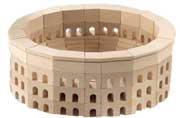 The Coliseum Builder Block System can be used to recreate the Roman Coliseum. Reenact ancient Gladiator matches and bring Ancient Rome into your home.
  .
. 


