From the journal of Steven H. Cullinane...
2004 Feb. 16-28
Sunday, February 29, 2004 3:22 PM
Types of Ambiguity
1. Oscar: military
phonetic for the letter 'O'
2. "... this symbol among the Greeks was more circle
than dot, but among those in India, more dot than circle."
-- Robert Kaplan, The Nothing That Is:
A Natural History
of Zero
3. A bindi is an auspicious mark worn by young girls and women. Bindi is derived from
bindu, the Sanskrit word for dot. It is usually a red dot made with
vermilion powder which is worn by women between their eyebrows on their
forehead. Considered a symbol of Goddess Parvati, a bindi signifies female
energy....
bindi is an auspicious mark worn by young girls and women. Bindi is derived from
bindu, the Sanskrit word for dot. It is usually a red dot made with
vermilion powder which is worn by women between their eyebrows on their
forehead. Considered a symbol of Goddess Parvati, a bindi signifies female
energy....
-- Indian Customs & Traditions
4. Sometimes I feel so reckless and wild
Sometimes
I feel like a motherless child
I gave nobody life, I am nobody's wife
And
I seem to be nobody's daughter
So red is the color that I like the
best
It's your Indian skin and the badge
On my chest
The heat of my
pride
The lips of a bride
The sad heart of the truth
And the flag of
youth
And blood that is thicker than water
-- Shawn
Colvin of Vermillion, SD,
"The Story"
lyrics
5. Hamlet Do you think I meant country
matters?
Ophelia I think nothing, my
lord.
Hamlet That's a fair thought to lie between maid's
legs.
Ophelia What is, my
lord?
Hamlet Nothing.
6. Macbeth ".... a tale
Told
by an idiot, full of sound and fury,
Signifying nothing."
7. Enter a Messenger.
Sunday, February 29, 2004 3:28 AM
Vita Brevis
"In many ways, the arts are the highest achievements of man."
-- Harvard President
Lawrence H. Summers,
Feb. 26, 2004
''We intensively train children in the Arts and ritual because deep down we
know that these are the only things that really MATTER. This is what we must
share first with the young, in case they DIE."
-- Lucy Ellmann, Dot in the Universe,
quoted in today's New York Times
Saturday, February 28, 2004 7:00 PM
Inner Truth
and Outer
Style
Inner Truth:

Outer Style:

Joan Didion
"Everything I learned,
I learned at Vogue."
-- Joan Didion, Nov. 2001 interview
with Amy Spindler.
Spindler died on Friday, Feb. 27, 2004.
For related material, see
Truth and
Style: ART WARS at Harvard
and
blogs.law.harvard.edu/m759/.
Saturday, February 28, 2004 1:00 PM
Truth and Style
From today's New York Times obituary for Amy M. Spindler, former fashion
critic of The New York Times and style editor of its magazine, who died
yesterday at 40:
"Anna Wintour, the editor in chief of Vogue, whom Ms. Spindler regarded as a
competitor when she became style editor of The Times Magazine, in 1998, said:
'She took criticism in a new direction. She wasn't afraid to tell the
truth.' "
"I don't believe in truth. I believe in style."
-- Hugh Grant in
Vogue magazine, July 1995
Again from Spindler's obituary:
"In a front-page article on Sept. 5, 1995, she [Spindler] noted a new piety
on parade, marked by store windows and catalogs full of monastic robes,
pilgrim's boots and dangling crosses. Perhaps, she wrote, 'the financially
strained fashion industry is seeking salvation from above.' "
Perhaps.

Amy M. Spindler
See also
Strike
That Pose (August 1995)
and the two previous log24.net entries
on art and religion at
Harvard.
For even more context, see
Truth and Style: ART WARS at
Harvard.
Thursday, February 26, 2004 4:07 PM
ART WARS at Harvard
From
today's Harvard Crimson:
"The VES [Visual and
Environmental Studies] department is still recovering, both internally and
in public perception, from the firing of former chair Ellen Phelan in spring
2001. Phelan, a distinguished painter who brought in top New York artists, was
replaced by Kenan Professor of English Marjorie Garber, an English scholar with no formal background in
the practice of visual arts."
Here's more on Phelan and art at Harvard
(rated R for colorful
language).
See also Strike That Pose.
|
Follow-up from the Harvard Crimson,
Friday, Feb.
27, 2004:

Crimson/Gloria B. Ho
Harvard
President
Lawrence H. Summers
struck a thoughtful pose
while
meeting with students
last night.
By Lauren A. E. Schuker
Crimson Staff Writer
Summers... expressed his strong commitment to the visual and
performing arts at Harvard.
“In many ways, the arts are the highest achievements of man,” Summers
said, “and universities have always been focused on humanities.”
Summers added that he was concerned that there is a disparity between
critiquing and creating works of art.
“You don’t have to be particularly accomplished to study macroeconomic
theory or European history,” he said, “but you do if you want to study
creative writing or musical performance. That is problematic.”
Summers also added that he hoped to see the University develop more
respect for the arts and more “explicit academic evaluation” in the
future. |
Thursday, February 26, 2004 1:01 PM
The Oscar for best picture goes to...
Aldous Huxley, 1925
"... And when at last one has arrived at San Sepolcro, what is there to be
seen? A little town surrounded by walls, set in a broad flat valley between
hills; some fine Renaissance palaces with pretty balconies of wrought iron; a
not very interesting church, and finally, the best picture in the world.

The best picture in the world is painted in fresco on the wall of a room in
the town hall.... Its clear, yet subtly sober colours shine out from the
wall with scarcely impaired freshness.... We need no imagination to help
us figure forth its beauty; it stands there before us in entire and actual
splendour, the greatest picture in the world.
The greatest picture in the world…. You smile. The expression is ludicrous,
of course."
Yet not as ludicrous as the following
Cheesy Consolation
Doonesbury 2/26/04:

Maureen Dowd on
The Passion of the
Christ:
"I went with a Jewish pal, who tried to stay sanguine. 'The Jews may have
killed Jesus,' he said. 'But they also gave us 'Easter Parade.' "
-- New York Times, Feb. 26, 2004
For a truly cheesy Easter parade at Harvard University, see
The Crimson
Passion.
Ash Wednesday, February 25, 2004 2:00 PM
Modernism as a Religion
In light of the controversy over Mel Gibson's bloody passion play that opens
today, some more restrained theological remarks seem in order.
Fortunately, Yale University Press has provided a framework
-- uniting physics, art, and literature in what amounts to
a new religion -- for making such remarks. Here is some
background.
From a review by Adam White Scoville of Iain Pears's novel titled
An Instance
of the Fingerpost:
"Perhaps we are meant to see the story as a cubist retelling of
the crucifixion, as Pilate, Barabbas, Caiaphas, and Mary Magdalene might have
told it. If so, it is sublimely done so that the realization gradually and
unexpectedly dawns upon the reader. The title, taken from Sir Francis Bacon,
suggests that at certain times, 'understanding stands suspended' and in that
moment of clarity (somewhat like Wordsworth's 'spots of time,' I think), the answer will become
apparent as if a fingerpost were pointing at the way."
Recommended related material --
By others:
Inside
Modernism: Relativity Theory, Cubism, Narrative, Thomas Vargish
and Delo E. Mook, Yale University Press, 1999
Signifying Nothing: The Fourth Dimension in Modernist Art and
Literature
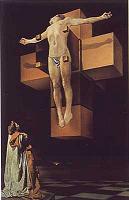
Corpus Hypercubus,
by Dali. Not cubist,
perhaps "hypercubist."
By myself:
Finite
Relativity
The Crucifixion of John
O'Hara
Block
Designs
The Da Vinci Code and
Symbology at Harvard
The Crimson
Passion
Material that is related, though not recommended --
The
Aesthetics of the Machine
Connecting Physics and the Arts
Tuesday, February 24, 2004 2:30 PM
The Crimson
Passion
Monday, February 23, 2004 3:00 PM
Solving for X

Frederick Morgan
in 2001
On the Hudson Review, whose longtime editor Frederick
Morgan died on Friday, Feb. 20, 2004:
"The first issue featured... poetry by Wallace Stevens...." -- NY Times
2/23/04
A search on "Wallace Stevens" "Hudson Review"
yields a reference to
Jarman, Mark.
“Solving for X:
The Poetry and Prose
of
Wallace Stevens.”
The Hudson Review,
51.1 (Fall 1998): 250(7).
A further search on "Mark Jarman" leads
to
The Excitement,
by Mark Jarman,
The Hudson
Review,
55th Anniversary Issue,
Spring 2003,
a poem in which X himself makes an appearance:
The years into old age and death
were set then.
And I have often thought
about those
years.
For this was the peak moment
in family
history,
The Lord come unto Granddad....
We may imagine Granddad as played by the recipient of last
night's Screen Actors Guild lifetime achievement award:
"This is the peak for me."
-- Karl Malden, Feb. 22,
2004
Sunday, February 22, 2004 8:53 AM
Invariants
"What modern painters are trying to do,
if they only knew it,
is paint invariants."
-- James J. Gibson in Leonardo

(Vol. 11, pp. 227-235.
Pergamon Press Ltd.,
1978)
Those who have clicked
on the title above
may find the
following of interest.
|
Sean Socha
Imagination/Reality:
Wallace Stevens' Harmonium
and the Visual Arts
I see modern art's usefulness for Stevens in its
reconfiguration of the relationship between imagination and reality....
Stevens will incorporate a device from painting to illustrate his poetic
idea. For instance, "Metaphors of a Magnifico" (Harmonium)
illustrates an idea about the fragmentation and/or subjectivity of reality
and the importance of perspective by incorporating the Cubist technique of
multiple perspectives. |
Also perhaps relevant:
|
Einstein wanted to know what was invariant (the same) for all observers. The original
title for his theory was (translated from German) "Theory of Invariants."
-- Wikipedia |
Friday, February 20, 2004 3:24 PM
Finite Relativity
Today is the 18th birthday of my note
"The Relativity Problem in Finite Geometry."
That note begins with a quotation from Weyl:
"This is the relativity problem: to fix objectively a class of equivalent
coordinatizations and to ascertain the group of transformations S mediating
between them."
-- Hermann Weyl, The Classical Groups, Princeton University Press,
1946, p. 16
Here is another quotation from Weyl, on the profound branch of mathematics
known as Galois theory, which he says
"... is nothing else but the relativity theory for the set Sigma, a set
which, by its discrete and finite character, is conceptually so much simpler
than the infinite set of points in space or space-time dealt with by ordinary
relativity theory."
-- Weyl, Symmetry, Princeton University Press, 1952, p. 138
This second quotation applies equally well to the much less profound, but
more accessible, part of mathematics described in Diamond Theory and in my
note of Feb. 20, 1986.
Friday, February 20, 2004 12:00 AM
The Da Vinci Code
and Symbology at
Harvard
The protagonist of the recent bestseller The Da Vinci Code
is Robert Langdon, "a
professor of Religious Symbology at Harvard University." A prominent
part in the novel is played by the well-known Catholic organization Opus
Dei. Less well known (indeed, like Langdon, nonexistent) is the academic
discipline of "symbology." (For related disciplines that do
exist, click here.) What might a course in this subject at Harvard be
like?
|
Harvard Crimson, April 10,
2003:
While Opus Dei members said that they do not refer to their practices
of recruitment as "fishing," the Work’s founder does describe the process
of what he calls "winning new apostles" with an aquatic metaphor.
Point #978 of The Way invokes a passage in the New
Testament in which Jesus tells Peter that he will make him a "fisher of
men." The point reads:
" ‘Follow me, and I will make you into fishers of men.’ Not
without reason does our Lord use these words: men—like fish—have to be
caught by the head. What evangelical depth there is in the ‘intellectual
apostolate!’ ” |
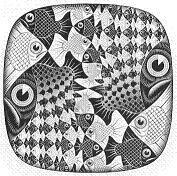
Exercise for Symbology 101:
Describe the symmetry
in each of the pictures above.
Show
that the second picture
retains its underlying structural
symmetry under a
group of
322,560 transformations.
Having reviewed yesterday's notes
on Gombrich, Gadamer, and
Panofsky,
discuss the astrological meaning
of
the above symbols in light of
today's date, February 20.
Extra credit:
Relate the above astrological
symbolism to the
four-diamond
symbol in Jung's Aion.
Happy metaphors!
Robert Langdon
Thursday, February 19, 2004 9:22 PM
What is Poetry, Part II --
Gombrich
vs. Gadamer
Excerpts from
Tetsuhiro Kato on
Gombrich and the
Hermeneutics of Art
Kato on Gombrich
"... according to Gombrich, an image is susceptible to become a target for
'symbol detectives'.... But the hidden authorial intention... ([for
example]... astrology, recalling the famous warning of Panofsky [1955: 32])
almost always tends to become a reproduction of the interpreter's own
ideological prejudice. Not to give into the irrationalism such
psychological overinterpretation might invite.... we have to look for the origin
of meaning... in... the social context.... The event of image making is
not the faithful transcription of the outside world by an innocent eye, but it
is the result of the artist's act of selecting the 'nearest equivalence'...
based on social convention...."
Kato on Gadamer
"For [Gadamer], picture reading is a process where a beholder encounters a
picture as addressing him or her with a kind of personal question, and the
understanding develops in the form of its answer (Gadamer 1981: 23-24; Gadamer
1985: 97,102-103). But, it must be noted that by this Gadamer does not mean to
identify the understanding of an image with some sort of 'subsumption' of the
image into its meaning (Gadamer 1985: 100). He insists rather that we can
understand an image only by actualizing what is implied in the work, and engage
in a dialogue with it. This process is ideally repeated again and again, and
implies different relations than the original conditions that gave birth to the
work in the beginning (Gadamer 1985: 100).
What matters here for Gadamer is to let the aesthetic aspect of image take
its own 'Zeitgestalt' (Gadamer 1985: 101)."
Example (?) -- the Zeitgestalt
of today's previous
entry:

See, too,
The Quality of Diamond.
Kato's References:
Gadamer, Hans-Georg. 1981. "Philosophie und Literatur: Was ist die
Literatur?," Phänomenologische Forschungen 11 (1981): 18-45.
Gadamer, Hans-Georg. 1985. "Über das Lesen von Bauten und Bildern."
Modernität und Tradition: Festschrift für Max Imdahl zum 60.
Geburtstag. Ed. Gottfried Boehm, Karlheinz Stierle, Gundorf Winter.
Munchen: Wilhelm Fink. 97-103.
Panofsky, Erwin. 1955. Meaning in the Visual Arts: Papers in and on Art
History. New York: Anchor.
Thursday, February 19, 2004 12:00 PM
Five Easy Pieces
for
Lee Marvin's Birthday
Wednesday, February 18, 2004 7:20 PM
Diamonds and Whirls
New applets have rotating 3D versions of the diamond
and whirl cubes in Block Designs.
Wednesday, February 18, 2004 12:25 PM
Story
"Oh, Sara!" she whispered joyfully. "It is like a story!"
"It IS a story," said Sara. "EVERYTHING'S a story. You are a story-- I am a
story."
-- Frances Hodgson Burnett,
A Little Princess
For further details, see Why Narrative?
Wednesday, February 18, 2004 11:11 AM
Hard Core, Part II:
Star
of Africa
In memory of St. Katharine Hepburn,
who died on St. Peter's
Day, 2003:
"Although the greater saints
are more acceptable to God
than
the lesser,
it is sometimes profitable
to pray to the lesser."
-- St. Thomas
Aquinas
From The Times, UK, Feb. 18, 2004:
Straw denies
a
big-three takeover
at EU summit
Britain's Foreign Secretary "said that there were no plans to set up a small
body within the EU to take control of its affairs.
However, he told a news conference at the Foreign Office that it made sense
for the three biggest economies to work 'collaboratively' on matters of common
interest....
At tonight’s summit Mr Blair, Gerhard Schröder, the German Chancellor, and
President Chirac of France will discuss initiatives to co-ordinate and
strengthen the EU’s industrial policy....
German commentators regard the summit as a sea-change in British policy
towards Europe — a signal that London’s main aim is no longer to split Paris and
Berlin."
Tuesday, February 17, 2004 4:35 PM
Hard Core
From USATODAY.com,
Posted 2/16/2004 11:16 PM
Diamond at heart of star
outweighs any on
Earth
Astronomers announced Friday that a white dwarf star
they've been studying is a chunk of crystallized carbon that weighs 5 million
trillion trillion pounds. That's the same as a diamond that is approximately 10
billion trillion trillion carats, or a one followed by 34 zeros.
 |
Twinkle-twinkle indeed: An artist's conception of the diamond core of a
dead white-dwarf star.
Harvard-Smithsonian
Center for
Astrophysics. |
"It's the mother of all diamonds," said astronomer Travis Metcalfe,
Harvard-Smithsonian Center for Astrophysics....
The biggest diamond on Earth is the 530-carat Star of
Africa, part of the Crown Jewels of England. It was cut from a 3,100-carat gem*,
the biggest ever found.
* The
Cullinan diamond
Tuesday, February 17, 2004 1:20 PM
Black History Month

Monday, February 16, 2004 8:19 PM
Gestalt Update
Updated Block
Designs page with material on Gestalt aesthetics and the work of James J.
Gibson.


