|
Tuesday, April 15, 2003 |
Green and Burning After posting the 2:42 PM entry at a public library this afternoon, I picked up the following at a "Friends of the Library" used-book sale: The Green and Burning Tree: by Eleanor Cameron (Little, Brown and Company, Boston and Toronto, 1969). Cameron, on page 73, gives the source of her title; it is from the Mabinogion: "And they saw a tall tree by the side of the river, one half of which was in flames from the root to the top, and the other half was green and in full leaf." Cameron finds the meaning of this symbol in Dylan Thomas: His Life and Work, by John Ackerman (Oxford University Press, 1964), p. 6: "Another important feature of the old Welsh poetry is an awareness of the dual nature of reality, of unity in disunity, of the simultaneity of life and death, of time as an eternal moment rather than as something with a past and future." For part of a Nobel Prize lecture on this topic — time as an eternal moment — see Architecture of Eternity, a journal note from December 8, 2002. That lecture is from an author, Octavio Paz, who wrote in Spanish. Here are some other words in that language: Mi verso es de un verde claro, My verse is a clear green, These lyrics to the song "Guantanamera" (see Palm Sunday) were on my mind this afternoon when Cameron's book caught my eye. Green and crimson are, of course, also the colors of Christmas, or "Christ Mass." In view of the fact that Cameron's book is about children's literature, this leads, like it or not, to the following meditation. From a religious site: Matthew 18:3 - And said, Truly I say to you, Unless you are converted, and become like little children, you shall not enter into the kingdom of heaven. Mark 10:15 - Truly I say to you, Whoever shall not receive the kingdom of God as a little child shall not enter it at all. Luke 18:17 - Truly I say to you, Whoever does not receive the kingdom of God as a little child shall by no means enter it. A meditation from a less religious site: "What I tell you three times is true." Finally, from what I now consider to be an extremely religious site, a picture: |
|
Tuesday, April 15, 2003 |
Once Upon a Time On Tuesday, April 15, 2003, at 5:01 PM EST, this place was reserved for later use. It now seems an appropriate spot to put Maurice Rapf, a screenwriter, a blacklisted Communist fellow-traveler, and later a professor of film studies at Dartmouth, his alma mater. Rapf died on April 15, 2003, at the age of 88. He contributed to the screenplay for Disney's "Cinderella" (1950). According to his Washington Post obituary, "he said he gave the character of Cinderella a spirit of class struggle." Rapf described his Hollywood childhood in Back Lot: Growing Up With the Movies, 1999. "A dream is a wish your heart makes." Entered Friday, April 18, 2002, 3:24 AM EST. |
|
Tuesday, April 15, 2003 |
Certain Things by Murray L. Bob DEATH: TAXPAYER COMPLAINT: The people who benefit the most from research are never the people who pay for it. Both items above are from A Contrarian's Dictionary Strikes Again! — Murray, a library director, checked out during National Library Week, April 6-12, 2003. From the work quoted above, two of his classic parting shots: LIBRARY: When you look at everything else in this town you know there shouldn't be a great library here. Fortunately, the librarians don't know this. LIBRARIANS: Old librarians never die, they just close the books. |
|
Sunday, April 13, 2003 |
Palm Sunday, Part II: Cold Mountain From the notes to the CD of Songs From the Mountain (John Herrmann, Dirk Powell, Tim O'Brien): "John [Herrmann, banjo player] would like to dedicate his work on this recording to Philip Kapleau Roshi, Kalu Rimpoche, and Harada Tangen Roshi, who all know the way to Cold Mountain...." See Buddha's Birthday (April 8) and The Diamond Project. "What are you thinking of? What thinking? What? — Tom Eliot, The Waste Land "I am thinking... — Suzanne Vega, "Tom's Diner" Once upon a time... "De donde crece la palma" — Song lyric From On Beauty, by Elaine Scarry, Princeton University Press, 1999, a quotation from Homer — "in Delos, beside Apollo's altar -- See also A Mass for Lucero and The Shining of Lucero. — George Balanchine |
|
Sunday, April 13, 2003 |
3:07 PM Palm Sunday "The folk scene, in reality, was a strange coming together of liberal ideals, rural traditions, marketing and youth culture...." — David Hajdu, review of "A Mighty Wind" in The New York Times of Palm Sunday, April 13, 2003 Those who recognize the church below will understand the caption. For Peter, Paul, and Murray: |
|
Saturday, April 12, 2003 |
2:23 PM "This world is not conclusion; Today's birthday: dancer/actress Ann Miller. "In 1937, she was discovered by Lucille Ball...." Lucille Ball, Desi Arnaz, "Just goes to show star quality shines through...." "It'll shine when it shines." "Shine on, you crazy diamond." "Well we all shine on..." |
|
Saturday, April 12, 2003 |
Rhetoric Happens "Rhetoric is concerned with the state of Babel after the Fall." — Kenneth Burke, A Rhetoric of Motives, quoted by Douglas Robinson at the site Linguistics and Language CNN.com headline, Saturday, April 12, 2003, Posted at 12:24 AM EDT: Rumsfeld on looting in Iraq: For further rhetoric, see A Short Comparative Guide to Religion and Philosophy. This site has the added attraction of a midi of Lennon's classic, "Instant Karma," mentioned in yesterday's entry "Heaven's Gate."
|
|
Friday, April 11, 2003 |
Heaven's Gate "Rhetoric is concerned with the state of Babel after the Fall." — Kenneth Burke, A Rhetoric of Motives, quoted by Douglas Robinson at the site Linguistics and Language "Location: present-day Iraq, between the Tigris and Euphrates Cities: Babylon, founded 2300 BC, 70 miles south of present Baghdad, on the Euphrates.... Babylon = Bab-ilu, "gate of God," Hebrew: Babel or Bavel." Modern rendition Kenneth Perhaps the real heaven's gate is at Instant karma update: At 5:09 PM I read the following in the New York Review of Books, dated May 1, 2003, which arrived today. From a review of Terror and Liberalism, by Paul Berman: "As a general analysis of the various enemies of liberalism, and what ties them together, it is superb. All — Nazis, Islamists, Bolsheviks, Fascists, and so on — are linked by Berman to the 'ur-myth' of the fall of Babylon." Speaking of Ur, Berman likes to quote a non-Biblical Abraham, named Lincoln. The first, Biblical, Abraham was a damned homicidal lunatic, and the later American Abraham also delighted in blood sacrifice. But that's just my opinion. For a different view, see the Chautauqua Abrahamic Program.
|
|
Wednesday, April 09, 2003 |
The Poet as Prophet In honor of Wallace Stevens, quoted in
|
|
Wednesday, April 09, 2003 |
The Shadow and the Valley Bad news this morning. An old friend is gone. |
|
Wednesday, April 09, 2003 |
Hearts of Darkness Today's birthdays: Charles Baudelaire, poet, b. 1821 Leopold II, King of Belgium, b. 1835 Tom Lehrer, mathematician, b. 1928 In view of these birthdays and of yesterday's entry quoting Eliot on "the Shadow," the following trilogy of links seems appropriate: The Lamont Cranston: Nota bene: Today is also the birthday of |
|
Tuesday, April 08, 2003 |
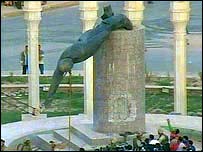
Death's Dream Kingdom April 7, 2003, Baghdad - A US tank blew a huge statue of President Saddam Hussein off its pedestal in central Baghdad on Monday with a single shell, a US officer said.... "One shot, one kill." "When smashing monuments, save the pedestals; they always come in handy." "In death's dream kingdom.... Between the idea — T. S. Eliot, Harvard 1910, The Hollow Men "A light check in the shadow — Edward H. Adelson, Yale 1974, Illusions and Demos "point A / In a perspective that begins again / At B" — Wallace Stevens, Harvard 1901, "The Rock" See also |
|
Tuesday, April 08, 2003 |
In memory of Cécile de Brunhoff, discoverer of "Here we see the imagined universe of Babar's Dream by Jean de Brunhoff. In an archetypal battle between good and evil, the graceful winged elephants — the angels of kindness, intelligence, courage, patience, perseverance, knowledge, work, hope, love, health, joy, and happiness — drive out the demons of misfortune, anger, stupidity, discouragement, sickness, spinelessness, despair, fear, ignorance, cowardice, laziness." — Source cited: Edward R. Tufte, Visual Explanations Today is Buddha's birthday. For the |
|
Tuesday, April 08, 2003 |
x 12:30 am |
|
Tuesday, April 08, 2003 |
x 12:29 am |
|
Tuesday, April 08, 2003 |
Buddha's Birthday Song As I'm listening |
|
Monday, April 07, 2003 |
Math Awareness Month April is Math Awareness Month. |
|
Monday, April 07, 2003 |
x 11:11 pm |
|
Monday, April 07, 2003 |
An Offer He Couldn't Refuse Today's birthday: Francis Ford Coppola is 64.
From a note on geometry of April 28, 1985:
|
|
Saturday, April 05, 2003 |
Art Wars: From Maureen Dowd's New York Times column of June 9, 2002: "The shape of the government is not as important as the policy of the government. If he makes the policy aggressive and pre-emptive, the president can conduct the war on terror from the National Gallery of Art." NY Times, April 5, 2003: Meanwhile, at the Washington Post, another example of great determination and strength of character:
Donald Coxeter Dies: Leader in Geometry By Martin Weil "Donald Coxeter, 96, a mathematician who was one of the 20th century's foremost specialists in geometry and a man of great determination and strength of character as well, died March 31 at his home in Toronto." From another Coxeter obituary: In the Second World War, Coxeter was asked by the American government to work in Washington as a code-breaker. He accepted, but then backed out, partly because of his pacifist views and partly for aesthetic reasons: "The work didn't really appeal to me," he explained; "it was a different sort of mathematics." For a differing account of how geometry is related to code-breaking, see the "Singer 7-cycle" link in yesterday's entry, "The Eight," of 3:33 PM. This leads to a site titled An Introduction to the "Now I have precisely the right instrument, at precisely the right moment of history, in exactly the right place." — "Patton," Added Sunday, April 6, 2003, 3:17 PM: The New York Times Magazine of April 6 The military nature of our Art Wars theme appears in the Times's choice of words for its cover headline: "The Greatest Generation." (This headline appears in the paper, but not the Internet, version.) Some remarks in today's Times Magazine article seem especially relevant to my journal entry for Michelangelo's birthday, March 6. "...Conceptualism — suddenly art could be nothing more than an idea.... LeWitt moved between his syntax of geometric sculptures and mental propositions for images: concepts he wrote on paper that could be realized by him or someone else or not at all. Physical things are perishable. Ideas need not be." — Michael Kimmelman, chief art critic of the New York Times, April 6, 2003 Compare this with a mathematician's aesthetics: "A mathematician, like a painter or a poet, is a maker of patterns. If his patterns are more permanent than theirs, it is because they are made with ideas." — G. H. Hardy, A Mathematician's Apology (1940), reprinted 1969, Cambridge U. Press, p. 84 It seems clear from these two quotations that the real conceptual art is mathematics and that Kimmelman is peddling the emperor's new clothes.
|
|
Friday, April 04, 2003 |
Mathematics Awareness Month April is the cruellest month.... Do you know nothing? — T. S. Eliot, The Waste Land, 1922 From Michael Pearson, Director of Programs and Services for the Mathematical Association of America, in his Liaison Newsletter of January 2003: "For this year's Mathematics Awareness Month, April 2003, the Joint Policy Board for Mathematics has selected the theme of Mathematics and Art.... From a ReelWavs.com transcript of nsa.mp3 (436K) From an eulogy for Ivan Illich: "He frequently cited the Latin maxim 'corruptio optimi pessima,' the corruption of the best is the worst."
|
|
Friday, April 04, 2003 |
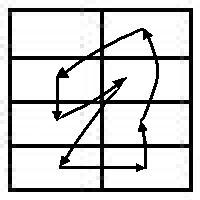
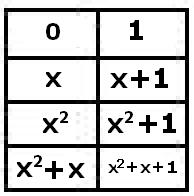
The Eight Today, the fourth day of the fourth month, plays an important part in Katherine Neville's The Eight. Let us honor this work, perhaps the greatest bad novel of the twentieth century, by reflecting on some properties of the number eight. Consider eight rectangular cells arranged in an array of four rows and two columns. Let us label these cells with coordinates, then apply a permutation.
The resulting set of arrows that indicate the movement of cells in a permutation (known as a Singer 7-cycle) outlines rather neatly, in view of the chess theme of The Eight, a knight. This makes as much sense as anything in Neville's fiction, and has the merit of being based on fact. It also, albeit rather crudely, illustrates the "Mathematics and Art" theme of this year's Mathematics Awareness Month. (See the 4:36 PM entry.) The visual appearance of the "knight" permutation is less important than the fact that it leads to a construction (due to R. T. Curtis) of the Mathieu group M24 (via the Curtis Miracle Octad Generator), which in turn leads logically to the Monster group and to related "moonshine" investigations in the theory of modular functions. See also "Pieces of Eight," by Robert L. Griess. |
|
Thursday, April 03, 2003 |
Musical Metaphysics Some background for my journal entries of April 2, 2003 (Symmetries), of March 31, 2003 (Sunday Lottery), and of March 28, 2003 (Bright Star): In memory of Today's site music (see midi console at top right of screen) is "All or Nothing at All." In view of the Sunday Lottery entry of March 31 and of Starr's hits, this song might be retitled "007 or 256." In view of Draper's hit "Tell all the folks that the following article is of interest: "GOD MAY PLAY DICE with the universe, as Einstein once feared, but serious gamblers, scorning metaphysical crapshoots and the casino's house edge, prefer no-limit Texas hold'em poker...." — James McManus, Boston Globe, Sunday, March 30, 2003 Two other quotes, epigraphs to the classic novel Cosmic Banditos, seem relevant: God does not play dice with the universe. Not only does God play dice with the universe, but sometimes he throws them where they cannot be seen. Those who prefer Jewish metaphysics can consult the related book Seinfeld and Philosophy:
|
|
Wednesday, April 02, 2003 |
Symmetries.... May 15, 1998 The following journal note, from the day after Sinatra died, was written before I heard of his death. Note particularly the quote from Rilke. Other material was suggested, in part, by Alasdair Gray's Glasgow novel 1982 Janine. The "Sein Feld" heading is a reference to the Seinfeld final episode, which aired May 14, 1998. The first column contains a reference to angels -- apparently Hell's Angels -- and the second column provides a somewhat more serious look at this theological topic.
Sein Feld 1984 Janine "But Angels love their own "Logos means above all relation." "Gesang ist Dasein.... Geometry and Theology PA lottery May 14, 1998: Django "In the middle of 1982 Janine there are pages in which Jock McLeish is fighting with drugs and alcohol, attempting to either die or come through and get free of his fantasies. In his delirium, he hears the voice of God, which enters in small print, pushing against the larger type of his ravings. Something God says is repeated on the first and last pages of Unlikely Stories, Mostly, complete with illustration and the words 'Scotland 1984' beside it. God's statement is 'Work as if you were in the early days of a better nation.' It is the inherent optimism in that statement that perhaps best captures the strength of Aladair Gray's fiction, its straightforwardness and exuberance." For another look at angels, see "Winging It," by Christopher R. Miller, The New York Times Book Review Bookend page for Sunday, May 24, 1998. May 24 is the feast day of Sara (also known by the Hindu name Kali), patron saint of Gypsies. For another, later (July 16, 1998) reply to Dyson, from a source better known than myself, see Why Religion Matters, by Huston Smith, Harper Collins, 2001, page 66. |