The Grid and the Quilt:
Left Brain, Right Brain,
The Two Cultures,
and Mathematics
|
|
The Grid and the Quilt: |
|
|
Preface
From a 2002
review by Stacy G. Langton of Sherman Stein's book on mathematics,
How the Other Half Thinks:
"The title of Stein's book (perhaps chosen by the publisher?)
seems to refer to the popular left brain/right brain dichotomy. As Stein writes
(p. ix): 'I hope this book will help bridge that notorious gap that separates
the two cultures: the humanities and the sciences, or should I say the right
brain (intuitive, holistic) and the left brain (analytical, numerical). As the
chapters will illustrate, mathematics is not restricted to the analytical and
numerical; intuition plays a significant role.' Stein does well to avoid
identifying mathematics with the activity of just one side of the brain. He
would have done better, however, not to have endorsed the left brain/right brain
ideology. While it does indeed appear to be the case that the two sides of our
brain act in rather different ways, the idea that the right brain is 'intuitive,
holistic,' while the left brain is 'analytical, numerical,' is a vast
oversimplification, and goes far beyond the actual evidence."
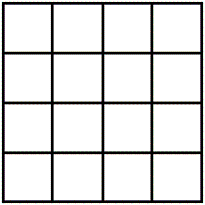
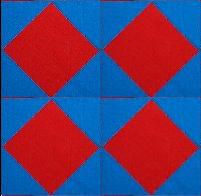
Despite the evidence, it is tempting to view the pictures below
as illustrating, on the left, the line-diagram side, a
cold, analytical approach to a mathematical theory, and, on the right, the
colored-pattern side, a warm, intuitive approach to the same
|
 |
"Projective spaces over a finite field, otherwise known as Galois
geometries, find wide application in coding theory, algebraic geometry,
design theory, graph theory, and group theory as well as being beautiful
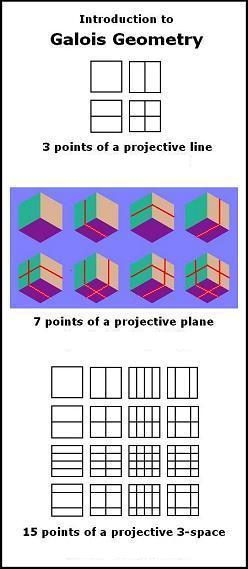
objects of study in their own right." The line diagrams at left are related to the two-color patterns at right as follows.
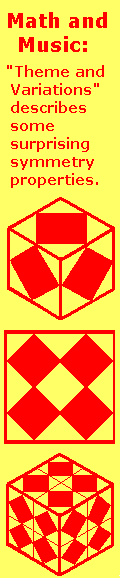
The three line diagrams above result from the three partitions, into pairs of 2-element sets, of the 4-element set from which the entries of the bottom colored figure are drawn. Taken as a set, these three line diagrams describe the structure of the bottom colored figure. After coordinatizing the figure in a suitable manner, we find that this set of three line diagrams is invariant under the group of 16 binary translations acting on the colored figure. A more remarkable invariance -- that of symmetry -- Steven H. Cullinane |
 |
|
Postscript
Of course, left and right sides are reversed when the information on this page reaches the brain, so that the diagrams on the left side of the page go to the right side of the brain, and the patterns on the right side of the page go to the left side of the brain. This page layout may or may not help the reader integrate the analytical and the intuitive natures of the pictures. More likely to be helpful in such an integration, playing the role of a corpus callosum, is the combination of line diagrams and colored pattern in the central illustration, "Invariant." |
For a large downloadable folder
containing many related
web pages,
see Notes on Finite
Geometry.
Page created July 18, 2004..
