An Offer He Couldn't Refuse
Today's birthday: Francis Ford Coppola is 64.
"There is a pleasantly discursive treatment
of Pontius
Pilate's unanswered question
'What is
truth?'."
— H. S. M. Coxeter, 1987, introduction to Richard J.
Trudeau's remarks on the "Story Theory" of truth as opposed to the
"Diamond Theory" of truth in The Non-Euclidean
Revolution
From a website titled simply Sinatra:
"Then came From Here to Eternity. Sinatra lobbied
hard for the role, practically getting on his knees to secure the role of
the street smart punk G.I. Maggio. He sensed this was a role that could
revive his career, and his instincts were right. There are lots of stories
about how Columbia Studio head Harry Cohn was convinced to give the role
to Sinatra, the most famous of which is expanded upon in the horse's head
sequence in The Godfather. Maybe no one will know the truth about
that. The one truth we do know is that the feisty New Jersey actor won the
Academy Award as Best Supporting Actor for his work in From Here to
Eternity. It was no looking back from then on."
From a note on
geometry of April 28, 1985:
Art Wars:
Mathematics and the
Emperor's New Art
From Maureen Dowd's New York Times column of June
9, 2002:
"The shape of the government is not as important as the policy of the
government. If he makes the policy aggressive and pre-emptive, the
president can conduct the war on terror from the National Gallery of
Art."
Meanwhile, at the Washington Post, another example of great
determination and strength of character:
Donald Coxeter Dies: Leader in
Geometry
By Martin Weil
Washington Post Staff
Writer
Saturday, April 5, 2003
"Donald Coxeter, 96, a mathematician who was one of the 20th century's
foremost specialists in geometry and a man of great determination and
strength of character as well, died March 31 at his home in Toronto."
From another Coxeter obituary:
In the Second World War, Coxeter was asked by the
American government to work in Washington as a code-breaker. He
accepted, but then backed out, partly because of his pacifist views and
partly for aesthetic reasons: "The work didn't really appeal to me," he
explained; "it was a different sort of mathematics."
For a differing account of how geometry is related to
code-breaking, see the "Singer 7-cycle" link in yesterday's entry, "The
Eight," of 3:33 PM. This leads to a site titled
An Introduction to the
Applications of Geometry in
Cryptography.
"Now I have precisely the right instrument, at
precisely the right moment of history, in exactly the right place."
— "Patton,"
the
film

Quod erat
demonstrandum.
Added Sunday, April 6,
2003, 3:17 PM:
The New York Times Magazine of April
6
continues this Art Wars theme.

(Cover typography revised)
The military nature of our Art Wars theme
appears in the Times's choice of words for its cover headline: "The
Greatest Generation." (This headline appears in the paper, but not the
Internet, version.)
Some remarks in today's Times Magazine article seem especially relevant to
my journal entry for Michelangelo's birthday, March 6.
"...Conceptualism — suddenly art could be nothing more
than an idea....
LeWitt moved between his syntax of geometric sculptures
and mental propositions for images: concepts he wrote on paper that
could be realized by him or someone else or not at all. Physical
things are perishable. Ideas need not be."
— Michael Kimmelman, chief art critic of
the New York Times, April 6, 2003
Compare this with a mathematician's aesthetics:
"A mathematician, like a painter or a poet, is a maker
of patterns. If his patterns are more permanent than theirs, it is
because they are made with ideas."
— G. H. Hardy, A Mathematician's Apology (1940), reprinted
1969, Cambridge U. Press, p. 84
It seems clear from these two quotations that the
real conceptual art is mathematics and that Kimmelman is peddling
the emperor's new clothes.
The Eight
Today, the fourth day of the fourth month, plays an important
part in Katherine Neville's The Eight. Let us honor this work, perhaps
the greatest bad novel of the twentieth century, by reflecting on some
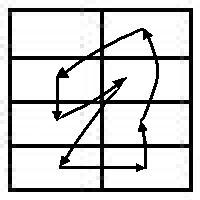
properties of the number eight. Consider eight rectangular
cells arranged in an array of four rows and two columns. Let us
label these cells with coordinates, then apply a permutation.
|

Decimal
labeling
|

Binary
labeling |
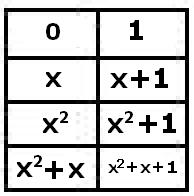
Algebraic
labeling
|
Permutation
labeling
|
The resulting set of arrows that indicate the movement of cells in a
permutation (known as a Singer 7-cycle) outlines rather neatly, in view of the
chess theme of The Eight, a knight. This makes as much
sense as anything in Neville's fiction, and has the merit of being based
on fact. It also, albeit rather crudely, illustrates the
"Mathematics and Art" theme of this year's Mathematics Awareness
Month. (See the 4:36 PM entry.)
The visual appearance of the "knight" permutation
is less important than the fact that it leads to a construction (due to R. T. Curtis) of the
Mathieu group M24 (via the Curtis Miracle Octad Generator),
which in turn leads logically to the Monster group and to
related "moonshine" investigations in the theory of modular
functions. See also "Pieces of
Eight," by Robert L. Griess.
ART WARS:
Art at the Vanishing Point
Two readings from The New York Times Book Review of
Sunday,
March 9, 2003 are relevant
to our recurring "art wars" theme. The essay on Dante by Judith Shulevitz on page 31 recalls his
"point at which all times are present." (See my March 7
entry.) On page 12 there is a review of a novel about the alleged
"high culture" of the New York art world. The novel
is centered on Leo Hertzberg, a fictional Columbia University art
historian. From Janet Burroway's review of What I Loved, by Siri Hustvedt:
"...the 'zeros' who inhabit the book... dramatize its speculations
about the self.... the spectator who is 'the true vanishing point, the
pinprick in the canvas.'''
Here is a canvas by Richard McGuire for April Fools' Day
1995, illustrating such a spectator.

For more on the "vanishing point," or "point at infinity,"
see
"Midsummer Eve's
Dream."
Connoisseurs of ArtSpeak may appreciate Burroway's summary of Hustvedt's
prose: "...her real canvas is philosophical, and here she explores the
nature of identity in a structure of crystalline complexity."
For another "structure of crystalline
complexity," see
my March 6 entry,
"Geometry for
Jews."
For a more honest account of the
New York art scene,
see Tom Wolfe's
The Painted
Word.
Lovely, Dark and Deep

On this date in 1923, "Stopping by Woods on a Snowy Evening," by Robert Frost,
was published. On this date in 1999, director Stanley Kubrick
died. On this date in 1872, Piet Mondrian was born.
"....mirando il punto
a cui tutti li
tempi son presenti"
— Dante, Paradiso, XVII, 17-18

Chez Mondrian
Kertész, Paris, 1926
6:23 PM Friday, March 7:
From Measure Theory, by Paul R. Halmos, Van Nostrand, 1950:
"The symbol  is used throughout the entire book in place of such phrases as
'Q.E.D.' or 'This completes the proof of the theorem' to signal the end of
a proof." is used throughout the entire book in place of such phrases as
'Q.E.D.' or 'This completes the proof of the theorem' to signal the end of
a proof."
ART WARS:
Geometry for Jews
Today is Michelangelo's birthday.
Those who prefer the Sistine Chapel to the Rothko Chapel may invite
their Jewish friends to answer the following essay question:

Discuss the geometry underlying the above picture. How
is this geometry related to the work of Jewish artist Sol
LeWitt? How is it related to the work of Aryan artist Ernst Witt? How is it related to the Griess "Monster" sporadic simple group whose elements number
808 017 424 794 512 875 886 459 904 961 710 757 005 754
368 000 000 000?
Some background:
-
From Nobel Prize Women in Science, by Sharon Bertsch
McGrayne, Second Edition (2001), Joseph Henry Press:
"Storm trooper Ernst Witt, resplendent in the Brownshirt
uniform of Hitler's paramilitary, knocked on a Jew's apartment door in
1934. A short, rotund woman opened the door. Emmy Noether smiled,
welcomed the young Nazi into her home, and started her underground math class.
The Brownshirt was one of her favorite pupils."
-
On this date
in 1962, Frank Sinatra recorded "I Gotta Right To Sing The Blues" for Capitol Records. This was his last recording for Capitol. He had already started
recording for Reprise Records.
-
Related reading:
Song of Not-Self
A
critic on the abstract expressionists:
"...they painted that reality -- that song of self -- with a passion,
bravura, and decisiveness unequaled in modern art."
Painter Mark Rothko:
"I don't express myself in painting.
I express my not-self."
On this day in 1957, Buddy Holly and his group recorded the hit
version of "That'll Be the Day."
On this day in 1970, painter Mark Rothko committed suicide in his New
York City studio.
On February 27, 1971, the Rothko Chapel was formally dedicated in Houston,
Texas.
On May 26, 1971, Don McLean recorded "American Pie."
Rothko was apparently an alcoholic; whether he spent his last day
enacting McLean's lyrics I do not know.
Rothko is said to have written that
"The progression of a painter's work, as it travels in time from point
to point, will be toward clarity: toward the elimination of all obstacles
between the painter and the idea, and between the idea and the observer.
As examples of such obstacles, I give (among others) memory, history or
geometry, which are swamps of generalization from which one might pull out
parodies of ideas (which are ghosts) but never an idea in itself. To
achieve this clarity is, inevitably, to be understood."
-- Mark Rothko, The Tiger's Eye, 1, no. 9 (October 1949), p.
114
Whether Holly's concept "the day that I die" is a mere parody of an
idea or "an idea in itself," the reader may judge. The reader may
also judge the wisdom of building a chapel to illustrate the clarity of
thought processes such as Rothko's in 1949. I personally feel that
someone who can call geometry a "swamp" may not be the best guide to
religious meditation.
For another view, see this essay by Erik Anderson Reece.
Update of June 1, 2003 --
For an example of geometry as conceptual
art, see
The Eightfold
Way and Solomon's Seal.
Update of June 4, 2003 --
For more on Kimmelman peddling the
emperor's new clothes, see an essay by Roger Kimball,
Minimalist
Fantasies. | 
