From the journal of Steven H. Cullinane...
2009 July 16-31
Friday, July 31, 2009 4:09 PM
Culture Wars continued:
Again with the...
at
The New York Times.
For previous notes on
allure at the
Times, see
St.
Luke's Day, 2008,
and its links.
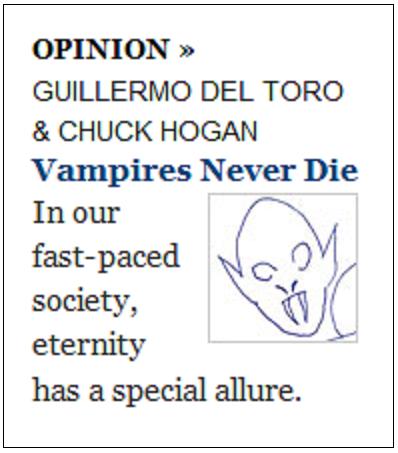
Teaser at the top of
this afternoon's
Times's
online front
page:
"
Vampires Never Die:
In our fast-paced society,
eternity has a special
allure." (With fanged
illustration)--
 Yesterday's
afternoon entry
Yesterday's
afternoon entry was
related to both the July 13th death
of avant-garde artist Dash Snow
and the beauty of Suzanne Vega.
A reference to Vega's album
"Beauty & Crime" apppeared here
on
the date of Snow's death.
(See "
Terrible End for an
Enfant Terrible,"
NY Times,
story dated July 24.)
The Vega entry yesterday was, in
part, a reference to that context.

In view of today's
Times
teaser, the large picture of
Vega shown here yesterday
(a detail of the above cover)
seems less an image of
pure beauty than of, well,
a
lure... specifically, a
vampire lure:

What healthy vampire
could resist that neck?
To me, the key words in the
Times teaser are "allure"
(discussed above) and "eternity."
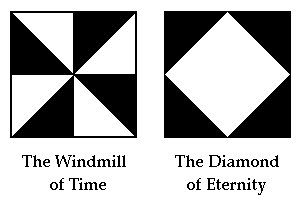
For both allure and eternity
in the same picture
(with interpretive
symbols added above)
see this journal on
January
31, 2008:

This image from "Black Narcissus"
casts Jean Simmons as
Allure
and Deborah Kerr, in a pretty
contrast, as
Eternity.
For different approaches to
these concepts, see Simmons
and Kerr in other films,
notably those co-starring
Burt Lancaster.
Lancaster seems to have had
a pretty good grasp of
Allure
in his films with Simmons
and Kerr. For
Eternity, see
"Rocket Gibraltar" and
"Field of Dreams."
For less heterosexual approaches
to these concepts, see the
continuing culture coverage of
the
Times-- for instance, the
vampire essay above and the
Times's
remarks Monday on
choreographer Merce Cunningham--
who always reminded me of
Carmen Ghia in "The Producers"--
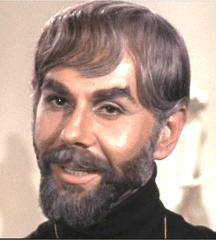 Related material:
"Dance of the Vampires"
in "At the Still Point"
(
this journal, 1/16/03).
Thursday, July 30, 2009 4:23 PM
Cast a Cold Eye:
The Discreet Charm
of Suzanne Vega
We keep coming back
and coming back
To the real: to the hotel
instead of the hymns....
-- Wallace Stevens |


"In the room the women come and go"
-- Stephen King, The Shining:
"The Wasps' Nest"
Thursday, July 30, 2009 9:00 AM
Annals of Aesthetics, continued:
Academy Awards
for Cambridge
"First of all, I'd like
to thank the Academy."
-- Remark attributed to Plato

"A poem cannot exhaust reality,
but it can arrest it."
-- At War with the Word:
Literary Theory and
Liberal Education,
by R. V. Young,
Chapter One
For one such poem, see
"Life and Death United:
An Intimate Portrait of
a Man Named Miles Davis,"
from a seminar's weblog
at DePauw University on
Sunday, November 21, 2004.
See also the four Log24
entries
on that date as well
as yesterday's
entry on Davis
and the entries preceding it.
Wednesday, July 29, 2009 9:29 PM
Annals of Aesthetics:
Lydian Mode
In memory of composer
George Russell, who
died at 86 on Monday --
Russell's thoughts on the Lydian mode
strongly influenced Miles Davis,
notably in Davis's "
Kind of Blue."
"The power of the Lydian mode,
Russell realized, is
freedom from
time's restraints.
The major scale is in a state of becoming.
The Lydian scale already is."
-- The Gravity Man, by Alice
Dragoon,
quoted at LydianChromaticConcept.com
Related material:
"Field Dance," from the
date of Russell's death.
"The Tables of Time," from Nov.
13, 2003,
and the four entries that preceded it.
Today's previous entry and
The
Reversible Diamond Puzzle
(from St. Nicholas, November
1874)--
Wednesday, July 29, 2009 12:21 PM
Church of the Forbidden Planet:
Kaleideion
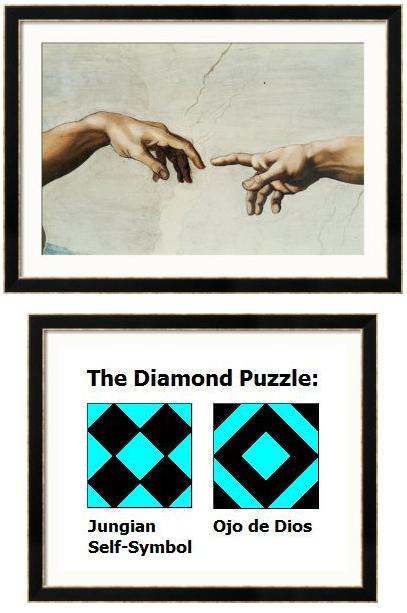 Related material:
"A great deal has been made of the fact that
Forbidden Planet
is essentially William Shakespeare’s
The Tempest (1611) in an
science-fiction setting. It is this that transforms
Forbidden Planet
into far more than a mere pulp science-fiction story" --
Richard Scheib
Dialogue
from Forbidden Planet --
"... Which makes it a gilt-edged priority that one of us
gets into that Krell lab and takes that brain boost."
Dialogue from another story --
"They thought they were doing a linear
magnification, sort of putting me through a magnifying glass."
"Sizewise?"
"Brainwise, but what they did was multiply me by myself into a
quadratic."
-- Psychoshop, by Bester and
Zelazny, 1998 paperback, p. 7
"... which would produce a special being-- by means of that 'cloned
quadratic crap.' [P. 75] The proper term sounds something like 'Kaleideion'...."
"So Adam is a Kaleideion?"
She shook her head.
"Not a Kaleideion. The Kaleideion...."
-- Psychoshop, 1998
paperback, p. 85
Tuesday, July 28, 2009 1:06 PM
Annals of Harvard Symbology:
Tuesday, July 28, 2009 6:00 AM
Detective Story:
Monumental
Anniversary

The Associated Press this morning --
"Today's Highlight in History:
On July 28, 1609, the English ship Sea
Venture, commanded by Admiral Sir George Somers, ran ashore on Bermuda
after nearly foundering at sea during a storm."
"... the Sea Venture story is two tales
in one. There's the hurricane at sea, and then there is the Bermuda
wreck becoming an inspiration for 'The Tempest.' The first is one of
the most dramatic adventures of the era, and the second is a
fascinating detective story."
Robert Sean Brazil,
scholar
--
"It has been a
commonplace in English literary criticism that Shakespeare’s play, 'The
Tempest,' was modeled on these accounts.... However, this common wisdom
is almost certainly a falsity. A monumental error."
Related material:
Plot summary by "Anonymous"
at
imdb.com of a feminist film version of "The Tempest" (now in
post-production):
"In Julie Taymor's version of 'The
Tempest,' the gender of Prospero has been switched to Prospera. Going
back to the 16th or 17th century, women practicing the magical arts of
alchemy were often convicted of witchcraft."
Taymor's
"Tempest" stars, as
Prospera, the famed portrayer of monarchs Helen Mirren. Another work
dealing with alchemy suitable for Mirren (who is also known as
Detective Inspector Jane Tennison):
The Eight, by
Katherine Neville, is perhaps
the greatest bad novel of the twentieth century. If
it were made into a movie, who should be cast as the Black Queen?
("...the dignified silver-haired woman danced sinuously..." -- p. 241)

Monday, July 27, 2009 2:29 PM
Requiem for a Choreographer:
Field Dance
The New York Times
on June 17, 2007:
Design Meets Dance,
and Rules Are Broken
Yesterday's
evening
entry was
on the fictional sins of a fictional
mathematician and also (via a link
to
St.
Augustine's Day, 2006), on
the geometry of the
I Ching*
--
The eternal
combined with
the temporal:

The fictional mathematician's
name, noted here (with the Augustine-
I Ching link as a gloss) in yesterday's
evening
entry, was Summerfield.
From the above Times article--
"Summerspace," a work by
choreographer Merce Cunningham
and artist Robert Rauschenberg
that offers a competing
vision of summer:

Cunningham died last night.
 From left, composer John Cage,
choreographer Merce Cunningham,
and artist Robert Rauschenberg
in the 1960's
"When shall we three meet again?"
* Update of ca. 5:30 PM 7/27-- today's
online
New York Times
(with added links)-- "The
I Ching
is the 'Book of Changes,' and Mr. Cunningham's choreography became an
expression of the nature of
change
itself. He presented successive images without
narrative sequence or
psychological causation, and the audience was
allowed to watch dance as one might watch successive events in a
landscape or on a street corner."
Sunday, July 26, 2009 8:28 PM
Mathematics and Narrative, continued:
Sunday, July 26, 2009 4:23 AM
Finite Jest, continued:
Saturday, July 25, 2009 11:07 AM
ART WARS continued:
Icon

"Unsheathe
your dagger definitions."
-- James Joyce, Ulysses
The entry of 12:06
PM Thursday, July 23, contained a link to the
journal Red Kite Prayer. The "red kite" is the red flag posted
near the end of the Tour de France.
Thanks for a
definition are due to the journal Flahute. A quotation from that
journal:
"There's only one shot that's in harmony with the field. The home of
your authentic swing. That flag... and all that you are."
-- The Legend of Bagger Vance
See also yesterday's
Log24 post.
Friday, July 24, 2009 6:23 PM
Mathematics and Narrative:
Thursday, July 23, 2009 12:06 PM
ART WARS continued:
On Chris
Hipp, who died of an apparent heart attack at 47 on July 14
(Bastille Day), 2009:
"'He was the father of blade technology when he was with RLX,' Jim
Hall, president of the Blade System Alliance, said in an interview. 'He
invented the blade server.'"
"Hall said Hipp was a natural inventor who wanted to be on the cutting edge."
-- Jeffrey Burt at eWeek.com
Epitaph by a friend:
"He was known as a determined, fearsome and fair
competitor."
-- Red Kite Prayer
Hipp's motto
was "pounding idiots."*
From a website celebrating the life and family (cf. previous
two entries) of Leonard Shlain, author of Art & Physics and pioneering
surgeon:
"Shlain n: unique last name of Russian origins.
Possible meanings: 1: Sound sword makes as it’s pulled
from sheath" --Shlain.com
A more authentic sound:
"The blade actually does
sing. When it is withdrawn from the sheath it makes a 'Tshuiiing'
sound as one hears in the movies. It rings like a bell."

Steel Addiction,
Custom Knives
A less authentic sound:

* The
residents of Id (as in the above cartoon) are known,
affectionately, as Idiots.
Thursday, July 23, 2009 5:01 AM
ART WARS:
A Tangled Tale
Proposed
task for a quantum computer:
"Using Twistor Theory to determine the plotline of Bob Dylan's 'Tangled
up in Blue'"
One approach to a solution:
"In this scheme the structure of spacetime is intrinsically quantum
mechanical.... We shall demonstrate that the breaking of symmetry in a
QST [quantum space-time] is intimately linked to the notion of quantum
entanglement."
-- "Theory
of Quantum Space-Time," by Dorje C. Brody and Lane P. Hughston, Royal
Society of London Proceedings Series A, Vol. 461, Issue 2061,
August 2005, pp. 2679-2699
(See also The
Klein Correspondence, Penrose Space-Time, and a Finite Model.)
For some less technical examples of broken symmetries, see yesterday's
entry, "Alphabet
vs. Goddess."
That entry displays a painting in 16 parts by Kimberly Brooks (daughter
of Leonard Shlain-- author of The Alphabet Versus the
Goddess-- and wife of comedian Albert Brooks (real name:
Albert Einstein)). Kimberly Brooks is shown below with another of her
paintings, titled "Blue."

Click image to enlarge.
"She was workin' in a topless place
 And I stopped in for a beer,
 I just kept lookin' at the side of her face
 In the spotlight so clear.
 And later on as the crowd thinned out
 I's just about to do the same,
 She was standing there in back of my chair
 Said to me, 'Don't I know your name?'
 I muttered somethin' underneath my breath,
 She studied the lines on my face.
 I must admit I felt a little uneasy
 When she bent down to tie the laces of my shoe,
 Tangled up in blue."

-- Bob Dylan
Further entanglement with blue:
The website of the Los Angeles
Police Department, designed
by Kimberly Brooks's firm, Lightray Productions.
Further entanglement with shoelaces:
"Entanglement can be transmitted through chains of cause and effect--
and if you speak, and another hears, that too is cause and
effect. When you say 'My shoelaces are untied' over a cellphone,
you're sharing your entanglement with your shoelaces with a friend."
-- "What is
Evidence?," by Eliezer Yudkowsky
Wednesday, July 22, 2009 9:48 AM
ART WARS:
Alphabet vs. Goddess
Continued...

... from
June
11, 2008.
"Just as both tragedy and comedy can be written by
using the same letters of the alphabet, the vast variety of events in
this world can be realized by the same atoms through their different
arrangements and movements. Geometry and kinematics, which were made
possible by the void, proved to be still more important in some way
than pure being."
,
Kimberly;
Kimberly,
Werner.

Happy Feast of
St. Mary Magdalene.
Tuesday, July 21, 2009 9:00 AM
Man and His Symbols 101
Today's Readings:
- The
White Itself
Plato and the "concrete universal"--
Log24 on Thursday, July 16, 2009
- Edged
with Brown
Context for a Log24 entry of July 16:

"So we moved, and they, in a formal pattern,
Along the empty alley, into the box circle,
To look down into the drained pool.
Dry the pool, dry concrete, brown edged,
And the pool was filled with water out of sunlight,
And the lotos rose, quietly, quietly,
The surface glittered out of heart of light...."
- Signifying
Nothing
An essay on Harvard professor
Henry Louis Gates, Jr.
- Professor
Gates Arrested
A racial incident in Cambridge
on Thursday, July 16, 2009
- New England White
Race relations in Academia
- Notes
on Mathematics
and Narrative
"... the glue that binds the brotherhood
is ultimately made not of
love and interracial harmony,
but of something stronger and more
enduring: shame, fear, and greed."

-- Review of New England White
- Don't
Forget Hate
Cf. Eugene Burdick and The Word, 1966.
More recently, Tom Wolfe and The Word
and Pig and Rat Get Lost.
Monday, July 20, 2009 7:00 PM
Seven Years Ago Today...
The First Post
in this weblog:
The
Diamond Theorem
Related material:
From
Sunday's New York Times, Tom Wolfe on the moon landing
forty years ago:
What NASA needs now is the power of the Word. On Darwin's tongue,
the Word created a revolutionary and now well-nigh universal conception
of the nature of human beings, or, rather, human beasts. On Freud's
tongue, the Word means that at this very moment there are probably
several million orgasms occurring that would not have occurred had
Freud never lived. Even the fact that he is proved to be a quack has
not diminished the power of his Word.
July 20, 1969, was the moment NASA needed, more than anything else
in this world, the Word. But that was something NASA's engineers had no
specifications for. At this moment, that remains the only solution to
recovering NASA's true destiny, which is, of course, to build that
bridge to the stars.
Tom Wolfe is the author of "The
Right Stuff," an account of the Mercury Seven astronauts.
Commentary
The Word according to St. John:

Sunday, July 19, 2009 7:11 AM
Today's Sermon:
Blaise
Pascal:
"L’unité jointe à l’infini ne l’augmente de rien, non
plus qu’un pied à une mesure infinie. Le fini s’anéantit
en présence de l’infini, et devient un pur néant....
Nous connaissons qu’il y a un infini, et ignorons sa nature. Comme nous
savons qu’il est faux que les nombres soient finis, donc il est vrai
qu’il y a un infini en nombre. Mais nous ne savons ce qu’il est: il est
faux qu’il soit pair, il est faux qu’il soit impair; car, en ajoutant 1
unité, il ne change point de nature; cependant c’est un nombre,
et tout nombre est pair ou impair (il est vrai que cela s’entend de
tout nombre fini). Ainsi...."
"Unity joined to infinity adds nothing
to it, no more than one foot to an infinite measure. The finite is
annihilated in the presence of the infinite, and becomes a pure
nothing....
We know that there is an infinite, and are ignorant of its nature. As
we know it to be false that numbers are finite, it is therefore true
that there is an infinity in number. But we do not know what it is. It
is false that it is even, it is false that it is odd; for the addition
of a unit can make no change in its nature. Yet it is a number, and
every number is odd or even (this is certainly true of every finite
number). So...."
-- Pensées
(trans. W. F. Trotter), Courier Dover Publications, 2003
"
Le fini s’anéantit
en présence de l’infini,
et devient un pur néant...."
Un Pur Néant:
"So did God cause the big bang?
Overcome by metaphysical lassitude,
I finally reach over to my bookshelf
for
The Devil's Bible.
Turning to Genesis I read:
'In the beginning
there was nothing.
And God said,
'Let there be light!'
And there was still nothing,
but now you could see it.'"
-- Jim Holt,
Big-Bang
Theology,
Slate's "High Concept" department
Illustration:
Ainsi....
"In the Garden of Adding
live Even and Odd...."
-- E. L. Doctorow
Illustration:

4 + 5 = 9.
Saturday, July 18, 2009 7:00 AM
Legacy Codes, continued:
Thursday, July 16, 2009 7:00 PM
Annals of Aesthetics:

Thursday, July 16, 2009 4:00 PM
Annals of Philosophy:
The White Itself
David
Ellerman has written
that
"The notion of a concrete universal occurred in Plato's
Theory of Forms [Malcolm 1991]."
A check shows that Malcolm indeed discussed this notion ("the Form as
an Ideal Individual"), but not
under the name "concrete universal."
See Plato on
the Self-Predication of Forms, by John Malcolm, Oxford U.
Press, 1991.
From the publisher's
summary:
"Malcolm.... shows that the middle dialogues do indeed take
Forms to be both universals and paradigms.... He shows that Plato's
concern to explain how the truths of mathematics can indeed be true
played an important role in his postulation of the Form as an Ideal
Individual."
Ellerman also cites another
discussion of Plato published by Oxford:
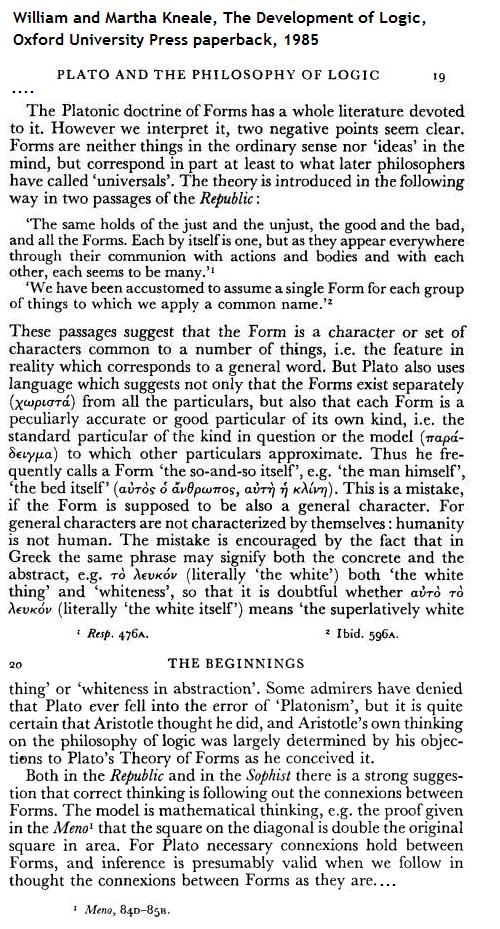
For a literary context, see W. K. Wimsatt, Jr., "The
Structure of the Concrete Universal," Ch. 6 in Literary Theory:
An Anthology, edited by Julie Rivkin and Michael Ryan,
Wiley-Blackwell, 2004.
Other uses of the phrase "concrete universal"-- Hegelian and/or
theological-- seem rather distant from the concerns of Plato and
Wimsatt, and are best left to debates between Marxists and Catholics.
(My own sympathies are with the Catholics.)
Two views of "the white itself" --
"So did God cause the big bang?
Overcome by metaphysical lassitude,
I finally reach over to my bookshelf
for The Devil's Bible.
Turning to Genesis I read:
'In the beginning
there was nothing.
And God said,
'Let there be light!'
And there was still nothing,
but now you could see it.'"
-- Jim Holt, Big-Bang Theology,
Slate's "High Concept" department

"The world was warm and white when I was born:
Beyond the windowpane the world was white,
A glaring whiteness in a leaded frame,
Yet warm as in the hearth and heart of light."
-- Delmore Schwartz