From the journal of Steven H. Cullinane...
2009 January 01-15
Thursday, January 15, 2009 6:00 PM
Signs of the Times:
Harvard, Magic,
and The New York Times
The New York Times Magazine for
next Sunday:
The
Edge of the Mystery, by Matt Bai--
"Weeks before the election of 1960, Norman
Mailer, already an accomplished novelist, sat down to write his first
major work of political journalism, an essay for
Esquire in which he argued that
only John F. Kennedy could save America... the only kind of leader who
could rescue it, who could sweep in an era of what Mailer called
'existential' politics, was a 'hipster' hero-- someone who welcomed
risk and adventure, someone who sought out new experience, both for
himself and for the country....
... Mailer essentially created a new genre for a generation of would-be
literary philosophers covering politics.... By 1963, Mailer and
other idealists were crushed to discover that Kennedy was in fact a
fairly conventional and pragmatic politician, more Harvard Yard than
Fortress of Solitude."
The New York Times today:
Magic
and Realism, by Roger Cohen--
"... what I want from the Obama administration is something more than
Harvard-to-the-Beltway smarts. I want magical realism."
Mailer and Cohen, taken together, suggest I should review two authors--
Picard and Hesse-- I encountered as a Harvard freshman in 1960.
Max Picard:
"In the 'Prologue in Heaven' in
Goethe's Faust a powerful
silence is produced by the powerful word after each verse. There is an
active, audible silence after every verse. The things that were moved
into position by the word stand motionless in the silence, as if they
were waiting to be called back into the silence and to disappear
therein. The word not only brings the things out of silence; it also
produces the silence in which they can disappear again."
Goethe:
DER HERR:
Kennst du den Faust?
MEPHISTOPHELES:
Den Doktor?
DER HERR:
Meinen Knecht!
Online
Etymology Dictionary:
knight
O.E. cniht
"boy, youth, servant," common W.Gmc. (cf. O.Fris. kniucht, Du. knecht, kneht "boy, youth,
lad," Ger. Knecht "servant, bondsman,
vassal"), of unknown origin. Meaning "military follower of a
king or other superior" is from c.1100. Began to be used in a specific
military sense in Hundred Years War, and gradually rose in importance
through M.E. period until it became a rank in the nobility 16c. The
verb meaning "to make a knight of (someone)" is from c.1300. Knighthood is O.E. cnihthad M.H.G.
"the period between childhood and manhood;" sense of "rank or dignity
of a knight" is from c.1300. The chess piece so called from c.1440.
Further background on the word "Knecht"--
Epigraph
to Magister Ludi
(Joseph Knecht's translation):
"... For although in a certain sense and for light-minded persons
non-existent things can be more easily and irresponsibly represented in
words than existing things, for the serious and conscientious historian
it is just the reverse. Nothing is harder, yet nothing is more
necessary, than to speak of certain things whose existence is neither
demonstrable nor probable. The very fact that serious and conscientious
men treat them as existing things brings them a step closer to
existence and to the possibility of being born."
Thursday, January 15, 2009 2:45 AM
Heaven's...
Wednesday, January 14, 2009 7:00 PM
It's still the same old story:
A Fight for
Love and Glory
The 8-point star
of Venus:

This star is suggested by
the Spanish name "Lucero"
and by the following
passage from Heinlein's
classic novel Glory Road:
|
"I have many names. What
would you like to call me?"
"Is one of them 'Helen'?"
She smiled like sunshine and I
learned that she had dimples. She looked sixteen and in her first party
dress. "You are very gracious. No, she's not even a relative. That was
many, many years ago." Her face turned thoughtful. "Would you like to
call me 'Ettarre'?"
"Is that one of your names?"
"It is much like one of them,
allowing for different spelling and accent. Or it could be 'Esther'
just as closely. Or 'Aster.' Or even 'Estrellita.'"
"'Aster,'" I repeated. "Star.
Lucky Star!"
|

Que descanse en paz.

Later the same
evening...
an update in memory
of Patrick McGoohan:

"There is one story and one story only
That will prove worth your telling....
...of the undying snake from chaos hatched,
Whose coils contain the ocean,
Into whose chops with naked sword he springs,
Then in black water, tangled by the reeds,
Battles three
days and nights,
To be spewed up beside her scalloped shore...."
-- Robert Graves,
"To Juan at the Winter Solstice" |
Wednesday, January 14, 2009 2:45 AM
Mathematics and Narrative, continued:
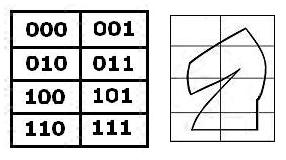
Eight is a Gate


From the most highly
rated negative review:
"I never did figure out
what 'The Eight' was."
Various approaches
to this concept
(click images for details):



Tuesday, January 13, 2009 1:00 PM
Annals of Aesthetics:
Something Traditional --
"German Chancellor Dr. Angela Merkel is the Charlemagne Prize
laureate of 2008.... The prize will be awarded on 1 May, Ascension
Day."
-- The
City of Aachen
Something Modern --
Previously undescribed in this journal:

A NOTE BY THE DESIGNER
"The traditional
chess set, with its naturalistic images of medieval armies, suggests a
game between combatants who enjoy the winning of battles. This chess
set, with its articulated images of abstract force, suggests a game
between contestants who enjoy the process of thinking.
The primary principle of this design... is that the operating reality
or function of each piece-- both its value and how it moves-- is
embodied in a simple self-expressive form....
Design
Copyright F. Lanier Graham 1967
These pieces are designed to have the look and feel of little packages
of power. The hardwoods (walnut and korina) are left unfinished, not
only because of tactile values, but also to emphasize the simplicity of
the design. The interlocking blocks are packaged to reflect the
essential nature of the game-- rational recreation, played with basic
units whose fields of force continuously interact in subtle, complex
patterns."
-- F. Lanier Graham, 1967
|
For those whose tastes in recreation are
less rational, there is also the legendary chess set of Charlemagne
described in novels by Katherine Neville. (See
ART WARS.)
Related material: this journal on the
First
of May, 2008, the date of last year's Charlemagne award.
Tuesday, January 13, 2009 4:30 AM
ART WARS continued:
"Typically, each piece depicts a monumentally sized object that often
comments archly on its surroundings...."
|

Architectural
Vesica Piscis
|

Arch at
Glastonbury Tor
|
For some context, see

The ashes of Bradley,
who wrote
about Camelot
in
The Mists of Avalon,
are said to have been
scattered at Glastonbury Tor.
For material on the afterlife
and Brooklyn, see
Only the Dead.
Sunday, January 11, 2009 7:59 AM
Pre-Sermon:
Sunday, January 11, 2009 6:24 AM
Today's Sermon:
A Minor Metaphor
... we know that we use
Only the eye as faculty, that the mind
Is the eye, and that this landscape of the mind
Is a landscape only of the eye; and that
We are ignorant men incapable
Of the least, minor, vital metaphor....
-- Wallace Stevens, "Crude Foyer"
... So, so,
O son of man, the ignorant night, the travail
Of early morning, the mystery of the beginning
Again and again,
while History is unforgiven.
-- Delmore Schwartz,
"In the Naked Bed, in Plato's Cave" |
Saturday, January 10, 2009 10:10 AM
O Tannenbaum:
Friday, January 9, 2009 5:01 PM
In Loco Citato:
Stories
for Mary Karr
"In reality, my prose books
probably sit between
I Was a Teenage Sex Slave
and some other contemporary
memoir written in five minutes...."
-- Mary
Karr in the NY Times
of July
6, 2007
 See also
Ballet
Blanc
and the true story
0,
1, 2, 3, ....
See also
Ballet
Blanc
and the true story
0,
1, 2, 3, ....
"In a dream scenario, my memoirs...
would find another shelf.
They’d sit between St. Augustine
and Nabokov’s Speak, Memory...."
-- Mary Karr, loc. cit.
Recall the
mnemonic rhyme
"Nine is
a Vine."
Friday, January 9, 2009 5:01 AM
Annals of Theology:
Teaser head from the
online NY Times
this morning:
Thursday, January 8, 2009 11:07 PM
Religion and Narrative, continued:
Report of Arrival
A
PBS broadcast of Cyrano de Bergerac was shown yesterday
nationally and this evening, a day late, by WNED TV, Buffalo.
From the translation
by Anthony Burgess:
Cyrano speaks of falling leaves--
They fall well. With a sort of panache.
They plume down in their last
Loveliness, disguising their fear
Of being dried and pounded to ash
To mix with the common dust.
They go in grace, making their fall appear
Like flying.
ROXANE You're melancholy today.
CYRANO Never. I'm not the melancholy sort.
ROXANE Very well, then. We'll let
The leaves of the fall fall while you
Turn the leaves of my gazette.
What's new at court?
CYRANO ... There have been some scandals
To do with witches. A bishop went to heaven,
Or so it's believed: there's been as yet no report
Of his arrival...."
Later....
CYRANO ... See it there, a white plume
Over the battle-- A diamond in the ash
Of the ultimate combustion--
My panache."
Thursday, January 8, 2009 7:00 PM
Religion and Narrative, continued:
A Public Square
In memory of
Richard
John Neuhaus,
who died today at 72:
"It seems, as one becomes older,
That the past has another pattern,
and ceases to be a mere sequence...."
-- T. S. Eliot, Four Quartets

See also The
Folding.
Tuesday, January 6, 2009 12:00 AM
Epiphany 2009:
Archetypes, Synchronicity,
and Dyson on Jung
The current (Feb. 2009) Notices of the American Mathematical Society
has a
written version of Freeman Dyson's 2008 Einstein Lecture, which was
to have been given in October but had to be canceled. Dyson paraphrases
a mathematician on Carl Jung's theory of archetypes:
"... we do not need to accept Jung’s theory as true in
order to find it illuminating."
The same is true of Jung's remarks on synchronicity.
For example --
Yesterday's entry, "A
Wealth of Algebraic Structure," lists two articles-- each, as it
happens, related to Jung's four-diamond
figure from Aion as well as to my own Notes on Finite Geometry.
The articles were placed online recently by Cambridge University Press
on the following dates:
R. T. Curtis's 1974 article defining his Miracle Octad Generator (MOG)
was published online on Oct. 24, 2008.
Curtis's 1987 article on geometry and algebraic structure in the MOG
was published online on Dec. 19, 2008.
On these dates, the entries in this journal discussed...
Oct. 24:
Cube
Space, 1984-2003
Material related to that entry:
Dec. 19:
Art
and Religion: Inside the White Cube
That entry discusses a book by Mark C. Taylor:
The Picture
in Question: Mark Tansey and the Ends of Representation (U. of
Chicago Press, 1999).
In Chapter 3, "Sutures of Structures," Taylor asks --
"What, then, is a frame, and what is frame work?"
One possible answer --
Hermann Weyl
on the relativity problem in the context of the 4x4 "frame of
reference" found in the above Cambridge University Press articles.
"Examples are the stained-glass
windows of knowledge."
-- Vladimir Nabokov
Monday, January 5, 2009 9:00 PM
Annals of Geometry:
A 1987 article by R. T. Curtis on the geometry of his Miracle Octad Generator
(MOG) as it relates to the geometry of the 4x4 square is now available
online ($20):
Further
elementary techniques using the miracle octad generator, by R.
T. Curtis. Abstract:
"In this paper we describe various techniques, some of which are
already used by devotees of the art, which relate certain maximal
subgroups of the Mathieu group M24, as seen in the
MOG, to matrix groups over finite fields. We hope to bring out the wealth of algebraic
structure* underlying the device and
to enable the reader to move freely between these matrices and
permutations. Perhaps the MOG was mis-named as simply an 'octad
generator'; in this paper we intend to show that it is in reality a
natural diagram of the binary Golay code."
(Received July 20 1987)
-- Proceedings of the Edinburgh Mathematical Society (Series 2)
(1989), 32: 345-353, doi:10.1017/S0013091500004600.
(Published online by Cambridge University Press 19 Dec 2008.)
In the above article, Curtis explains how two-thirds of his 4x6 MOG
array may be viewed as the 4x4 model
of the four-dimensional affine space over GF(2). (His earlier
1974 paper (below) defining the MOG discussed the 4x4 structure in a
purely combinatorial, not geometric, way.)
For further details, see The Miracle Octad
Generator as well as Geometry of the
4x4 Square and Curtis's original 1974 article, which is now also
available online ($20):
A
new combinatorial approach to M24, by R.
T. Curtis. Abstract:
"In this paper, we define M24 from scratch as the
subgroup of S24 preserving a Steiner system S(5,
8, 24). The Steiner system is produced and proved to be unique and the
group emerges naturally with many of its properties apparent."
(Received June 15 1974)
-- Mathematical Proceedings of the Cambridge Philosophical Society
(1976), 79: 25-42,
doi:10.1017/S0305004100052075.
(Published online by Cambridge University Press 24 Oct 2008.)
* For instance:

Click for details.
Saturday, January 3, 2009 7:20 PM
Literature and...
"The entire sequence of moves in these... chapters reminds one-- or
should remind one-- of a certain type of chess problem where the point
is not merely the finding of a mate in so many moves, but what is
termed 'retrograde
analysis'...."
-- Vladimir Nabokov, foreword to "The Defense"
Friday, January 2, 2009 5:48 AM
A Mystery for Westlake:
Signs and Symbols
continued...
from the five entries
ending
on June 3, 2008
and from yesterday,
New
Year's Day
The end of
a
story by Vladimir Nabokov in
The New Yorker of May 15,
1948:
"You have the incorrect number. I will tell you what you
are doing: you are turning the letter O instead of the zero."
They sat down to their unexpected festive midnight tea. The birthday
present stood on the table. He sipped noisily; his face was flushed;
every now and then he imparted a circular motion to his raised glass so
as to make the sugar dissolve more thoroughly. The vein on the side of
his bald head where there was a large birthmark stood out conspicuously
and, although he had shaved that morning, a silvery bristle showed on
his chin. While she poured him another glass of tea, he put on his
spectacles and re-examined with pleasure the luminous yellow, green,
red little jars. His clumsy moist lips spelled out their eloquent
labels: apricot, grape, beech plum, quince. He had got to crab apple,
when the telephone rang again.
Click for details.
Thursday, January 1, 2009 8:28 PM
A Stitch in Time:
Thursday, January 1, 2009 6:11 PM
Elective Concurrences:
Feliz Cumpleaños
See also Log24 on the date
this picture was uploaded:
November
16, 2008.
Thursday, January 1, 2009 3:00 AM
With Honors:
The Becket List
Monday, Dec. 29, 2008, was St. Thomas Becket's
Day.
On that day in
this journal there was a note from
the New York Times on the screenwriter of the 1969
film "A Walk With Love and Death"--
"He
feuded with... John
Huston, who gave the lead female role in 'Walk' to his teenage
daughter... against Mr. Wasserman's wishes."
Legacy.com
this morning:
Liz Evett
WEST RICHLAND, Wash. (AP) - Liz Evett, a teen who inspired people
across the nation by creating a "bucket list" of things she wanted to
do before she died, has died. She was 18.
Her mother, Angie Ivey, said Evett died Monday [Dec. 29, 2008] of
leukemia. The West Richland teen was diagnosed with cancer nearly three
years ago and relapsed in April.
When she stopped responding to treatment in June, Evett created a
"bucket list" of things she wanted to do before dying and spent the
last six months crossing them off.
Her list included feeding giraffes, meeting Seattle Mariner Ichiro
Suzuki and graduating
from high school.