From the journal of Steven H. Cullinane...
2008 July 16-31
Thursday, July 31, 2008 12:00 PM
Mathematics and Metaphor:
Symmetry in Review
"Put bluntly, who is kidding whom?"
--
Anthony
Judge, draft of
"Potential Psychosocial Significance
of Monstrous Moonshine:
An Exceptional Form of Symmetry
as a Rosetta Stone for
Cognitive Frameworks,"
dated
September 6, 2007.
Good question.
Also from
September 6, 2007 --
the date of
Madeleine L'Engle's death --
Related material:
1. The performance of a work by
Richard Strauss,
"
Death and Transfiguration,"
(
Tod und Verklärung, Opus 24)
by the Chautauqua Symphony
at Chautauqua Institution on
July 24, 2008
2. Headline of a music review
in today's
New York Times:
Welcoming a Fresh Season of
Transformation and Death
3. The picture of the R. T.
Curtis
Miracle
Octad Generator
on the cover of the book
Twelve Sporadic Groups:
 4.
4. Freeman Dyson's hope, quoted
by
Gorenstein in 1986,
Ronan
in 2006,
and
Judge in 2007, that the Monster
group is "built in some way into
the structure of the universe."
5. Symmetry
from Plato to
the Four-Color Conjecture
6. Geometry
of the 4x4 Square
7. Yesterday's entry,
"
Theories of Everything"
Coda:
"There is such
a thing
 as a tesseract."
-- Madeleine L'Engle
as a tesseract."
-- Madeleine L'Engle

For a profile of
L'Engle, click on
the Easter eggs.
Wednesday, July 30, 2008 11:48 AM
Annals of Science:
Like
Garrett Lisi's,
it is based on an unusual and highly symmetric mathematical structure.
Lisi's approach is related to the exceptional simple Lie group E
8.*
Dharwadker uses
a
structure long associated with the sporadic simple Mathieu group M
24.
GRAND UNIFICATION
OF THE STANDARD MODEL WITH QUANTUM GRAVITY
by Ashay Dharwadker
Abstract
"We show that the mathematical proof of the four
colour theorem [1] directly implies the existence of the
standard model, together with quantum gravity, in its physical
interpretation. Conversely, the experimentally observable standard
model and quantum gravity show that nature applies the mathematical
proof of the four colour theorem, at the most fundamental level. We
preserve all the established working theories of physics: Quantum
Mechanics, Special and General Relativity, Quantum Electrodynamics
(QED), the Electroweak model and Quantum Chromodynamics (QCD). We build
upon these theories, unifying all of them with Einstein's law of
gravity. Quantum gravity is a direct and unavoidable consequence of the
theory. The main construction of the Steiner system in the proof of the
four colour theorem already defines the gravitational fields of all the
particles of the standard model. Our first goal is to construct all the
particles constituting the classic standard model, in exact agreement
with t'Hooft's table [8]. We are able to predict the exact mass of
the Higgs particle and the CP violation and mixing angle of weak
interactions. Our second goal is to construct the gauge groups and
explicitly calculate the gauge coupling constants of the force fields.
We show how the gauge groups are embedded in a sequence along the
cosmological timeline in the grand unification. Finally, we calculate
the mass ratios of the particles of the standard model. Thus, the
mathematical proof of the four colour theorem shows that the grand
unification of the standard model with quantum gravity is complete,
and rules out the possibility of finding any other kinds of particles." |
* See, for instance, "
The Scientific Promise of Perfect Symmetry" in
The New York Times of March 20,
2007.
Tuesday, July 29, 2008 10:31 AM
Short Story --
Monday, July 28, 2008 12:00 PM
The Lottery:
Continued
"There is a
body on
the cross in my church."
-- Mary Karr, quoted
here
on July 10, 2007
From Jan. 20, 2004,
opening day of the first
Tennessee lottery--
Song of the Father
"Gonna buy me a shotgun,
long as I am tall,
Buy me a shotgun,
long as I am tall,
Gonna shoot po' Thelma,
just to see her jump and fall."
-- Jimmie Rodgers, known as
"the father of country music."
Sunday, July 27, 2008 10:04 AM
Today's Sermon
For Brother
Taylor:
Bobbie
Gentry is 64 today.
"It was the third of June,
another sleepy, dusty Delta day...."
Third of June, 2007
Third of June, 2008
Saturday, July 26, 2008 10:22 PM
Annals of Philosophy--
From Josephine Klein, Jacob's
Ladder: Essays on Experiences of the Ineffable in the Context of
Contemporary Psychotherapy, London, Karnac Books,
2003--
Page 14 --
Gerard Manley Hopkins
"Quiddity
and haeccity were contentious topics in medieval
discussions about the nature of reality, and the poet Gerard Manley
Hopkins would have encountered these concepts during his Jesuit
training. W. H. Gardner, who edited much of Hopkins's work, writes that
in 1872, while studying medieval philosophy... Hopkins came
across the writing of Duns Scotus, and in that subtle thinker's Principles
of Individuation and Theory of Knowledge he discovered what
seemed to be a philosophical corroboration of his own private theory of
inscape and instress. [Gardner, Gerard Manley
Hopkins: Poems and Prose, Penguin, 1953, p. xxiii]
In this useful introduction to his selection of Hopkins's work, Gardner
writes that Hopkins was always looking for the law or principle that
gave an object 'its delicate and surprising uniqueness.' This was for
Hopkins 'a fundamental beauty which is the active principle of all true
being, the source of all true knowledge and delight.' Clive Bell called
it 'significant form'; Hopkins called it 'inscape'-- 'the rich and
revealing oneness of the natural object' (pp. xx-xxiv). In this
chapter, I call it quiddity."
Saturday, July 26, 2008 3:09 PM
Irish Dance Camp, continued:
Friday, July 25, 2008 6:01 PM
Arrangements for...
56 Triangles

"This wonderful picture was drawn by Greg Egan with the help of ideas from Mike Stay
and Gerard Westendorp. It's probably the best way for a
nonmathematician to appreciate the symmetry of Klein's quartic. It's a
3-holed torus, but drawn in a way that emphasizes the tetrahedral
symmetry lurking in this surface! You can see there are 56 triangles: 2
for each of the tetrahedron's 4 corners, and 8 for each of its 6 edges."
Exercise:
Click on image for further details.
Note that if eight points are arranged
in a cube (like the centers of the
eight subcubes in the figure above),
there are 56 triangles formed by
the 8 points taken 3 at a time.
Baez's
discussion says that the Klein quartic's 56 triangles can be
partitioned into 7 eight-triangle Egan "cubes" that correspond to the 7
points of the Fano plane in such a way that automorphisms of the Klein
quartic correspond to automorphisms of the Fano plane. Show that the 56
triangles within the eightfold cube can also be partitioned into 7
eight-triangle sets that correspond to the 7 points of the Fano plane
in such a way that (affine) transformations of the eightfold cube
induce (projective) automorphisms of the Fano plane.
Thursday, July 24, 2008 8:24 AM
Site Trial
Monday, July 21, 2008 12:00 PM
Mathematics and Narrative, continued:
Knight Moves:
The Relativity Theory
of Kindergarten Blocks
(Continued from
January
16, 2008)
Something:
From Friedrich
Froebel,
who invented kindergarten:

Click on image for details.
An Unusually
Complicated Theory:
From Christmas 2005:
Click on image for details.
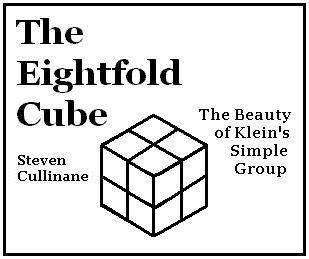
For the eightfold cube
as it relates to Klein's
simple group, see
"A
Reflection Group
of Order 168."
For an even more
complicated theory of
Klein's simple group, see

Click on image for details.
Saturday, July 19, 2008 2:00 PM
Annals of Mathematics:
Bertram
Kostant, Professor Emeritus of Mathematics at MIT, on an object
discussed in this week's New Yorker:
"
A word about E(8). In my opinion, and shared by
others, E(8) is the most magnificent 'object' in all of mathematics. It
is like a diamond with thousands of facets. Each facet offering a
different view of its unbelievable intricate internal structure."
Hermann Weyl on the hard core of objectivity:
"Perhaps the philosophically most
relevant feature of modern science is the emergence of abstract
symbolic structures as the hard core of objectivity behind-- as
Eddington puts it-- the colorful tale of the subjective storyteller
mind." (Philosophy of Mathematics and
Natural Science, Princeton, 1949, p. 237)
Steven H. Cullinane on the symmetries
of a 4x4 array of points:
|
A
Structure-Endowed Entity
"A guiding principle in modern mathematics is this lesson: Whenever
you have to do with a structure-endowed entity S, try to determine its
group of automorphisms, the group of those element-wise
transformations which leave all structural relations undisturbed.
You can expect to gain a deep insight into the constitution of S in
this way."
-- Hermann Weyl in Symmetry
Let us apply Weyl's lesson to the following
"structure-endowed entity."

What is the order of the resulting group of
automorphisms?
|
The above group of
automorphisms plays
a role in what Weyl,
following Eddington,
called a "colorful tale"--
Friday, July 18, 2008 12:00 PM
Mathematics and Narrative, continued:
Hard Core
David Corfield quotes Weyl in a weblog
entry, "
Hierarchy and Emergence," at the n-Category Cafe
this morning:
"Perhaps the philosophically most
relevant feature of modern science is the emergence of abstract
symbolic structures as the hard core of objectivity behind-- as
Eddington puts it-- the colorful tale of the subjective storyteller
mind." (Philosophy of Mathematics and
Natural Science [Princeton, 1949], p. 237)
For the same quotation in a combinatorial context, see the foreword by
A.
W. Tucker, "Combinatorial Problems," to a special issue of the
IBM Journal of Research and Development,
November 1960 (
1-page pdf).
See also
yesterday's Log24 entry.
Thursday, July 17, 2008 4:28 PM
Annals of Philosophy:
CHANGE
FEW CAN BELIEVE IN |
Continued from
June 18.
Jungian Symbols
of the Self --

Compare and contrast:
Jung's four-diamond figure from
Aion
--
a
symbol of the self --

Jung's
Map of the Soul,
by Murray Stein:
"... Jung thinks of the self as
undergoing continual transformation during the course of a lifetime....
At the end of his late work
Aion, Jung presents a diagram to
illustrate the dynamic movements of the self...."


