From the journal of Steven H. Cullinane... 2008 June 16-30

Monday, June 30, 2008  8:00 PM

8:00 PM:

Summer Reading

The King and the Corpse: Tales of the Soul's Conquest of Evil

Subtitle:
Tales of the Soul's
Conquest of Evil


Sunday, June 29, 2008  8:00 AM

Sermon for St. Peter's Day:

Big Rock

"I'm going to hit this problem
with a big rock."

-- Mathematical saying,
quoted here
in July of 2006

June 28, 2007:


A professor discusses a poem by Wallace Stevens:

"Professor Eucalyptus in 'Ordinary Evening' XIV, for example, 'seeks/ God in the object itself,' but this quest culminates in his own choosing of 'the commodious adjective/ For what he sees... the description that makes it divinity, still speech... not grim/ Reality but reality grimly seen/ And spoken in paradisal parlance new'...."

-- Douglas Mao, Solid Objects:Modernism and the Test of Production, Princeton University Press, 1998, p. 242

"God in the object" seems
unlikely to be found in the
artifact pictured on the
cover of Mao's book:

Cover of 'Solid Objects,' by Douglas Mao

I have more confidence
that God is to be found
in the Ping Pong balls of
  the New York Lottery....

These objects may be
regarded as supplying
a parlance that is, if not
paradisal, at least
intelligible-- if only in
the context of my own
personal experience.


June 28, 2008:

NY Lottery June 28, 2008: Mid-day 629, Evening 530

These numbers can, of course,
be interpreted as symbols of
the dates 6/29 and 5/30.

The last Log24 entry of
 6/29 (St. Peter's Day):


"The rock cannot be broken.
It is the truth."
-- Wallace Stevens,
"Credences of Summer"


The last Log24 entry of
5/30 (St. Joan's Day):


The Nature of Evil


Saturday, June 28, 2008  4:00 PM

Annals of Poetry, continued:

The Motive for Metaphor

You like it under the trees in autumn,
Because everything is half dead.
The wind moves like a cripple among the leaves
And repeats words without meaning.

In the same way, you were happy in spring
With the half colors of quarter-things,
The slightly brighter sky, the melting clouds,
The single bird, the obscure moon--

The obscure moon lighting an obscure world
Of things that would never be quite expressed,
Where you yourself were never quite yourself
And did not want nor have to be,

Desiring the exhilarations of changes:
The motive for metaphor, shrinking from
The weight of primary noon,
The A B C of being,

The ruddy temper, the hammer
Of red and blue, the hard sound--
Steel against intimation-- the sharp flash,
The vital, arrogant, fatal, dominant X.


-- Wallace Stevens,
    Transport to Summer (1947)

Related material:

Today's noon entry
(the A B C of being)
and entries of 3/22
in 2006 and 2007.


Saturday, June 28, 2008  12:00 PM

Lottery Revisited:

The God Factor

NY Lottery June 23, 2008: Mid-day 322, Evening 000

The following poem of Emily Dickinson is quoted here in memory of John Watson Foster Dulles, a scholar of Brazilian history who died at 95 on June 23.  He was the eldest son of Secretary of State John Foster Dulles, a nephew of Director of Central Intelligence Allen Dulles, brother of Roman Catholic Cardinal Avery Dulles, and a grandson of Presbyterian minister Allen Macy Dulles, author of The True Church.

I asked no other thing,   
No other was denied.   
I offered Being for it;   
The mighty merchant smiled.   
 
Brazil? He twirled a button,           
Without a glance my way:   
"But, madam, is there nothing else   
That we can show to-day?"

"He twirled a button...."

Plato's diamond figure from the 'Meno'

The above figure
of Plato
(see 3/22)
was suggested by
Lacan's diamond
Lacan's lozenge - said by some to symbolize Derrida's 'differance'
(losange or poinçon)
as a symbol --
according to Frida Saal --
of Derrida's
différance --
which is, in turn,
"that which enables and
results from Being itself"
--  according to
Professor John Lye

I prefer Plato and Dulles
to Lacan and Lye.


Saturday, June 28, 2008  8:07 AM

The Soul and...

The Cocktail

Bogart and Lorre in 'Casablanca' with chessboard and cocktail

G. H. Hardy on chess problems--

"... the key-move should be followed by a good many variations, each requiring its own individual answer."

(A Mathematician's Apology, Cambridge at the University Press, first edition, 1940)

Brian Harley on chess problems--

"It is quite true that variation play is, in ninety-nine cases out of a hundred, the soul of a problem, or (to put it more materially) the main course of the solver's banquet, but the Key is the cocktail that begins the proceedings, and if it fails in piquancy the following dinner is not so satisfactory as it should be."

(Mate in Two Moves, London, Bell & Sons, first edition, 1931)


Friday, June 27, 2008  12:00 PM

ART WARS continued:

For Drink Boy

Log24, Oct. 8, 2006:

Jack Nicholson and Matt Damon in 'The Departed'

"Cubistic"

-- New York Times review
of Scorsese's The Departed


DrinkBoy.com ad for Old Mr. Boston Bartender's Guide, 1946 edition

Click on image for further details.


Friday, June 27, 2008  8:07 AM

From the Cartoon Graveyard:

Deadpan

Obituary in today's New York Times
of New Yorker cartoonist Ed Arno:
"Mr. Arno... dealt in whimsy
and deadpan surrealism."

In his memory:
a cartoon by Arno combined
with material shown here,
under the heading
"From the Cartoon Graveyard,"
 on May 27, the date of
Arno's death --

'Dear Theo' cartoon of van Gogh by Ed Arno, adapted to illustrate the eightfold cube

Related material:

Yesterday's entry.  The key part of
that entry is of course the phrase
"the antics of a drunkard."

Ray Milland in
"The Lost Weekend"
(see June 25, 10:31 AM)--

"I'm van Gogh
painting pure sunlight."

It is not advisable,
 in all cases,
to proceed thus far.


Thursday, June 26, 2008  10:04 AM

After Anti-Christmas:

Review

Yesterday, June 25, was the 100th anniversay of W.V. Quine's birth and also the day on the calendar opposite Christmas--  In the parlance of Quine's son Douglas, Anti-Christmas.

Having survived that ominous date, I feel it is fitting to review what Wallace Stevens called "Credences of Summer"-- religious principles for those who feel that faith and doubt are best reconciled by art.

"Credences of Summer," VII,

by Wallace Stevens, from
Transport to Summer (1947)

"Three times the concentred
     self takes hold, three times
The thrice concentred self,
     having possessed
The object, grips it
     in savage scrutiny,
Once to make captive,
     once to subjugate
Or yield to subjugation,
     once to proclaim
The meaning of the capture,
     this hard prize,
Fully made, fully apparent,
     fully found."


Definition of Epiphany

From James Joyce's Stephen Hero, first published posthumously in 1944. The excerpt below is from a version edited by John J. Slocum and Herbert Cahoon (New York: New Directions Press, 1959).

Three Times:


... By an epiphany he meant a sudden spiritual manifestation, whether in the vulgarity of speech or of gesture or in a memorable phase of the mind itself. He believed that it was for the man of letters to record these epiphanies with extreme care, seeing that they themselves are the most delicate and evanescent of moments. He told Cranly that the clock of the Ballast Office was capable of an epiphany. Cranly questioned the inscrutable dial of the Ballast Office with his no less inscrutable countenance:

-- Yes, said Stephen. I will pass it time after time, allude to it, refer to it, catch a glimpse of it. It is only an item in the catalogue of Dublin's street furniture. Then all at once I see it and I know at once what it is: epiphany.

-- What?

-- Imagine my glimpses at that clock as the gropings of a spiritual eye which seeks to adjust its vision to an exact focus. The moment the focus is reached the object is epiphanised. It is just in this epiphany that I find the third, the supreme quality of beauty.

-- Yes? said Cranly absently.

-- No esthetic theory, pursued Stephen relentlessly, is of any value which investigates with the aid of the lantern of tradition. What we symbolise in black the Chinaman may symbolise in yellow: each has his own tradition. Greek beauty laughs at Coptic beauty and the American Indian derides them both. It is almost impossible to reconcile all tradition whereas it is by no means impossible to find the justification of every form of beauty which has ever been adored on the earth by an examination into the mechanism of esthetic apprehension whether it be dressed in red, white, yellow or black. We have no reason for thinking that the Chinaman has a different system of digestion from that which we have though our diets are quite dissimilar. The apprehensive faculty must be scrutinised in action.

-- Yes ...

-- You know what Aquinas says: The three things requisite for beauty are, integrity, a wholeness, symmetry and radiance. Some day I will expand that sentence into a treatise. Consider the performance of your own mind when confronted with any object, hypothetically beautiful. Your mind to apprehend that object divides the entire universe into two parts, the object, and the void which is not the object. To apprehend it you must lift it away from everything else: and then you perceive that it is one integral thing, that is a thing. You recognise its integrity. Isn't that so?

-- And then?

-- That is the first quality of beauty: it is declared in a simple sudden synthesis of the faculty which apprehends. What then? Analysis then. The mind considers the object in whole and in part, in relation to itself and to other objects, examines the balance of its parts, contemplates the form of the object, traverses every cranny of the structure. So the mind receives the impression of the symmetry of the object. The mind recognises that the object is in the strict sense of the word, a thing, a definitely constituted entity. You see?

-- Let us turn back, said Cranly.

They had reached the corner of Grafton St and as the footpath was overcrowded they turned back northwards. Cranly had an inclination to watch the antics of a drunkard who had been ejected from a bar in Suffolk St but Stephen took his arm summarily and led him away.

-- Now for the third quality. For a long time I couldn't make out what Aquinas meant. He uses a figurative word (a very unusual thing for him) but I have solved it. Claritas is quidditas. After the analysis which discovers the second quality the mind makes the only logically possible synthesis and discovers the third quality. This is the moment which I call epiphany. First we recognise that the object is one integral thing, then we recognise that it is an organised composite structure, a thing in fact: finally, when the relation of the parts is exquisite, when the parts are adjusted to the special point, we recognise that it is that thing which it is. Its soul, its whatness, leaps to us from the vestment of its appearance. The soul of the commonest object, the structure of which is so adjusted, seems to us radiant. The object achieves its epiphany.

Having finished his argument Stephen walked on in silence. He felt Cranly's hostility and he accused himself of having cheapened the eternal images of beauty. For the first time, too, he felt slightly awkward in his friend's company and to restore a mood of flippant familiarity he glanced up at the clock of the Ballast Office and smiled:

-- It has not epiphanised yet, he said.


Under the Volcano,

by Malcolm Lowry,
1947, Chapter VI:

"What have I got out of my life? Contacts with famous men... The occasion Einstein asked me the time, for instance. That summer evening.... smiles when I say I don't know. And yet asked me. Yes: the great Jew, who has upset the whole world's notions of time and space, once leaned down... to ask me... ragged freshman... at the first approach of the evening star, the time. And smiled again when I pointed out the clock neither of us had noticed."

An approach of
the evening star yesterday:

Four-elements figure from webpage 'The Rotation of the Elements'

This figure is from a webpage,
"The Rotation of the Elements,"
cited here yesterday evening.

As noted in yesterday's early-
morning entry on Quine
, the
figure is (without the labels)
a classic symbol of the
evening star.

"The appearance of the evening star brings with it long-standing notions of safety within and danger without. In a letter to Harriet Monroe, written December 23, 1926, Stevens refers to the Sapphic fragment that invokes the genius of evening: 'Evening star that bringest back all that lightsome Dawn hath scattered afar, thou bringest the sheep, thou bringest the goat, thou bringest the child home to the mother.' Christmas, writes Stevens, 'is like Sappho's evening: it brings us all home to the fold' (Letters of Wallace Stevens, 248)."

-- Barbara Fisher,
"The Archangel of Evening,"
Chapter 5 of Wallace Stevens:
The Intensest Rendezvous
,
The University Press of Virginia, 1990


Wednesday, June 25, 2008  7:20 PM

Philosophers' Stone:

The Cycle of
the Elements


John Baez, Week 266
(June 20, 2008):

"The Renaissance thinkers liked to
organize the four elements using
a chain of analogies running
from light to heavy:

fire : air :: air : water :: water : earth

They also organized them
in a diamond, like this:"

Diamond of the four ancient elements, figure by John Baez

This figure of Baez
is related to a saying
attributed to Heraclitus:

Diamond  showing transformation of the four ancient elements

For related thoughts by Jung,
see Aion, which contains the
following diagram:

Jung's four-diamond figure showing transformations of the self as Imago Dei

"The formula reproduces exactly the essential features of the symbolic process of transformation. It shows the rotation of the mandala, the antithetical play of complementary (or compensatory) processes, then the apocatastasis, i.e., the restoration of an original state of wholeness, which the alchemists expressed through the symbol of the uroboros, and finally the formula repeats the ancient alchemical tetrameria, which is implicit in the fourfold structure of unity."

-- Carl Gustav Jung

That the words Maximus of Tyre (second century A.D.) attributed to Heraclitus imply a cycle of the elements (analogous to the rotation in Jung's diagram) is not a new concept. For further details, see "The Rotation of the Elements," a 1995 webpage by one  "John Opsopaus."

Related material:

Log24 entries of June 9, 2008, and

"Quintessence: A Glass Bead Game,"
by Charles Cameron.


Wednesday, June 25, 2008  10:31 AM

Gracias y...

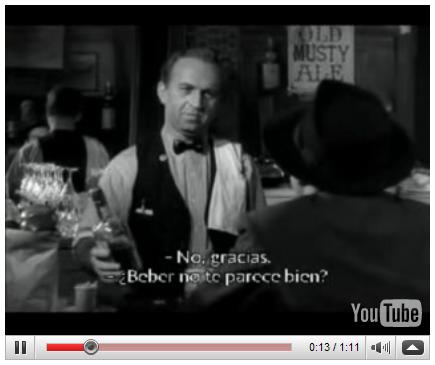
Desconvencida's weblog today:

'The Lost Weekend,' with Spanish subtitles

"Art, being bartender, is never drunk."

-- Peter Viereck


Wednesday, June 25, 2008  8:06 AM

Annals of Philosophy:

Prize Dance

"I would not know what the spirit
of a philosopher might wish more
 to be than a good dancer.
For the dance is his ideal,
also his art, and finally also his
only piety, his 'service of God.'"

-- Nietzsche

Charles Taylor, winner
of this year's Kyoto Prize
in arts and philosophy:


"... the object sets up
 a kind of frame or space or field
   within which there can be epiphany."


Kylie Minogue does the Locomotion

"My little baby sister
can do it with ease.
It's easier to learn
  than those ABC's."

-- Kylie Minogue 


Wednesday, June 25, 2008  2:02 AM

Quine Redux

Born 100 years ago today:

Willard Van Orman Quine, picture from cover of his autobiography


From A Logical Point of View,  Harvard U. Press, 1980, p. 72
From A Logical Point of View,  Harvard U. Press, 1980, p. 73
Other approaches to the
eight-ray star figure

Figure by Quine for an argument against univesals in 'From a Logical Point of View'

have been sketched in
various Log24 entries.

See, for instance, the
June 21 entries on
the Kyoto Prize for
arts and philosophy.
Quine won this prize
 in 1996.

Quine's figure, cited in an
argument against universals,
is also a classic symbol for
the morning or evening star.

This year's winner http://www.log24.com/images/asterisk8.gif
of the Kyoto Prize has
a more poetic approach
to philosophy:

"... the object sets up
 a kind of frame or space or field
   within which there can be epiphany."

For one such frame or space,
a Mexican cantina, see
Shining Forth.

See also Damnation Morning and
The Devil and Wallace Stevens.

http://www.log24.com/images/asterisk8.gif Charles Taylor.  See
"Epiphanies of Modernism,"
Chapter 24 of Sources of the Self
  (Cambridge U. Press, 1989, p. 477)


Tuesday, June 24, 2008  1:00 PM

The Work of a Comedian:

Random Walk with
X's and O's


Part I: Random Walk


NY Lottery June 23, 2008: Mid-day 322, Evening 000

Part II: X's


3/22:


Actor contemplating the Chi-rho Page of the Book of Kells

"Shakespeare, Rilke, Joyce,
Beckett and Levi-Strauss are
instances of authors for whom
chiasmus and chiastic thinking
are of central importance,
for whom chiasmus is a
generator of meaning,
tool of discovery and
  philosophical template."
 
-- Chiasmus in the
Drama of Life


Part III: O's --

A Cartoon Graveyard
in honor of the late
Gene Persson

Today's Garfield --

Garfield cartoon of June 24, 2008

See also
Midsummer Eve's Dream:

"The meeting is closed
with the lord's prayer
and refreshments are served."

Producer of plays and musicals
including Album and
The Ruling Class

Lower case in honor of
Peter O'Toole, star of
the film version of
The Ruling Class.

(This film, together with
O'Toole's My Favorite Year,
may be regarded as epitomizing
Hollywood's Jesus for Jews.)

Those who prefer
less randomness
in their religion
 may consult O'Toole's
more famous film work
involving Islam,
as well as
the following structure
discussed here on
the date of Persson's death:

5x5 ultra super magic square

"The Moslems thought of the
central 1 as being symbolic
of the unity of Allah.
"


Tuesday, June 24, 2008  5:01 AM

ART WARS --

Plato's Cave, continued:

                     ... we know that we use
Only the eye as faculty, that the mind
Is the eye, and that this landscape of the mind


Is a landscape only of the eye; and that
We are ignorant men incapable
Of the least, minor, vital metaphor....


-- Wallace Stevens, "Crude Foyer"


                                               ... So, so,
O son of man, the ignorant night, the travail
Of early morning, the mystery of the beginning
Again and again,
                         while history is unforgiven.


-- Delmore Schwartz,
  "In the Naked Bed, in Plato's Cave"

The Echo in Plato's Cave:

Somewhere between
a flagrant triviality and
a resplendent Trinity we
have what might be called
"a resplendent triviality."

For further details, see
"A Four-Color Theorem."


Tuesday, June 24, 2008  4:13 AM

Philosophy at 4:13 --

Damnation Morning
 Revisited:

See Notes on
Kosinski's Birthday


and
Sunday in the Park with Death.

See also 4:13 and 4/13.


Tuesday, June 24, 2008  4:00 AM

Critique of Paradise:

Crude Foyer

Thought is false happiness: the idea
That merely by thinking one can,
Or may, penetrate, not may,
But can, that one is sure to be able--

That there lies at the end of thought
A foyer of the spirit in a landscape
Of the mind, in which we sit
And wear humanity's bleak crown;

In which we read the critique of paradise
And say it is the work
Of a comedian, this critique;
In which we sit and breathe

An innocence of an absolute,
False happiness, since we know that we use
Only the eye as faculty, that the mind
Is the eye, and that this landscape of the mind

Is a landscape only of the eye; and that
We are ignorant men incapable
Of the least, minor, vital metaphor, content,
At last, there, when it turns out to be here.

-- Wallace Stevens


Monday, June 23, 2008  6:00 AM

And continues...

George Carlin
Dies at 71

Comedian George Carlin died
yesterday in Santa Monica at
about 6 PM PDT (9 PM EDT).

Earlier this month, told he would
receive this year's Mark Twain
award for comedy, Carlin said,

"Thank you, Mr. Twain.
Have your people
call my people."

7 AM yesterday:

Philadelphia stories: Catholic and Protestant versions, starring Grace Kelly and Katharine Hepburn

11 AM yesterday:


Heaven's Gate
continues:

A Sermon
by and for
Kris Kristofferson,
who is 72 today:

By   For

... and Of --

George Carlin
in the Air Force:
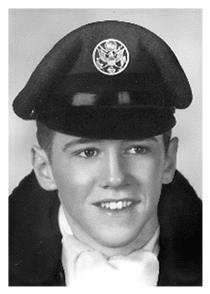
George Carlin in the Air Force

Photo from
georgecarlin.com

Arthur Harttman, Air Force veteran and Bowery resident, in NY Times April 30, 2006

New York Times video
April 30, 2006

Arthur Harttman, Air Force veteran
and resident of the Bowery's recently
refurbished Andrews House


Sunday, June 22, 2008  11:00 AM

Heaven's Gate continues:

A Sermon
by and for
Kris Kristofferson,
who is 72 today:

By   For


Sunday, June 22, 2008  7:00 AM

Theology Today:

Salvation by Grace

Today's New York Times has an obituary of Henry Chadwick, an Anglican priest and expert on church history who believed strongly in ecumenism.

Church history and ecumenism may interest few Americans, who have not recently suffered the sort of conflicts familiar to Northern Ireland.

Nevertheless, here are some thoughts on the matter.

From a statement of "the five points of Calvinism"--

Irresistible Grace

"'Irresistible grace' refers to the grace of regeneration by which God effectually calls His elect inwardly, converting them to Himself, and quickening them from spiritual death to spiritual life.  Regeneration is the sovereign and immediate work of the Holy Spirit...."
Calvinism is, of course, a deeply serious and powerful approach to spiritual matters.

(See 6/3/08 and 2/20/05.)

Still, I prefer the following visions of grace:

How does one stand
To behold the sublime,
To confront the mockers,
The mickey mockers
And plated pairs?

-- Wallace Stevens, 1936

Philadelphia stories: Catholic and Protestant versions, starring Grace Kelly and Katharine Hepburn

On the left, a Catholic answer.
On the right, a Protestant answer.

For further details, see 10/16/05.

The above two
Philadelphia stories
have met in a different
vision of Grace:

Grace Kelly and James Stewart in 'Rear Window'

Click image for a (much) larger version.

This tableau, in the larger version showing details in the background buildings, seems to me an apt, if more Calvinist and less Catholic, version of what Paul Simon, in his Graceland album, has memorably called "angels in the architecture."

Let us hope that the late Henry Chadwick now has a place among such angels.

Related material:

Yesterday's entries and
what T. S. Eliot might call
their "objective correlatives"
in the Pennsylvania Lottery
and in this journal:

PA Lottery Saturday, June 21, 2008: Mid-day 529, Evening 501

5/29

5/01


Saturday, June 21, 2008  8:00 PM

Annals of Philosophy:
For Mary Gaitskill

(See Eight is a Gate and
Faith, Doubt, Art, and
The New Yorker
.)

A structure from
today's previous entry:

Gates of Rick's Cafe Americain, abstract version

September 2, 2006:

From Notre-Dame de Paris:

"Un cofre de gran riqueza   
 Hallaron dentro un pilar,    
 Dentro del, nuevas banderas
 Con figuras de espantar."  

"A coffer of great richness
 In a pillar's heart they found,
 Within it lay new banners,
 With figures to astound."

For some further details, see the brief Log24 narrative "Indiana Jones and the Hidden Coffer" as well as Symmetry Framed and the design of the doors to Rick's Cafe Americain:

Rick's Cafe Americain


Everybody comes to Rick's.


Saturday, June 21, 2008  6:00 AM

Epiphany at Kyoto:

The Kyoto Prize

for lifetime achievement
in arts and philosophy
this year goes to
Charles Taylor,

Charles Margrave Taylor, professor emeritus of philosophy at McGill University

Montreal philosophy professor.

"The Kyoto Prize has been given in three domains since 1984: advanced technology, basic sciences, and the arts and philosophy. It is administered by the Inamori Foundation, whose president, Kazuo Inamori, is founder and chairman emeritus of Kyocera and KDDI Corporation, two Japanese telecommunications giants."

-- Montreal Gazette, June 20, 2008


Kyocera Logo

"The Kyocera brand symbol is composed of a corporate mark and our corporate logotype. The mark represents the initial 'K' (for Kyocera) encircling a 'C' (for ceramics). It was introduced in October 1982 when the company name was changed from 'Kyoto Ceramic' to 'Kyocera.'"

-- global.kyocera.com


Related material --

Wittgenstein and Fly from Fly-Bottle

Fly from Fly Bottle:


Graphic structures from Diamond Theory and from Kyocera logo

Charles Taylor,
"Epiphanies of Modernism,"
Chapter 24 of Sources of the Self
  (Cambridge U. Press, 1989, p. 477) --

"... the object sets up
 a kind of frame or space or field
   within which there can be epiphany."

See also Talking of Michelangelo.


Frisday, June 20, 2008  9:00 AM

Annals of Religion:

Drunkard's Walk

In memory of Episcopal priest
and Jungian analyst
Brewster Yale Beach,
who died on Tuesday,
June 17, 2008

"A man walks down the street..."

-- Paul Simon, Graceland album 

NY Times obituaries, Tuesday, June 17, 2008-- Tony Schwartz, Walter Netsch, Tim Russert


Related material:

In the above screenshot of New York Times obituaries on the date of Brewster Beach's death, Tim Russert seems to be looking at the obituary of Air Force Academy chapel architect Walter Netsch.

This suggests another chapel, more closely related to my own experience, in Cuernavaca, Mexico. Some background...

Walter Netsch in Oral History (pdf, 467 pp.):
"I also had a book that inspired me-- this is 1947-- called Communitas by Percival and Paul Goodman. Percival Goodman was the architect, and Paul Goodman was the writer and leftist. And this came out of the University of Chicago-- part of the leftist bit of the University of Chicago....

I had sort of in the back of my mind, Communitas appeared from my subconscious of the new town out of town, and there were other people who knew of it...."
Log24, May 8, 2007:

Center of Town, Cuernavaca, from Paul Goodman's Communitas

Log24, Feb. 24, 2008:

Candela's 'Capilla Abierta' chapel, Cuernavaca, Mexico

Chapel, Cuernavaca, Mexico

"God As Trauma"
by Brewster Yale Beach:
"The problem of crucifixion is
  the beginning of individuation."

"Si me de veras quieres,
deja me en paz
."

-- Lucero Hernandez,
Cuernavaca, 1962


A more impersonal approach
to my own drunkard's walk
(Cuernavaca, 1962, after
reading the above words):

Cognitive Blending
and the Two Cultures


An approach from the culture
(more precisely, the alternate
religion) of Scientism--
The Drunkard's Walk:
How Randomness
Rules Our Lives
--
is sketched in
Today's Sermon:
The Holy Trinity vs.
The New York Times

(Sunday, June 8, 2008).

The Times illustrated its review
of The Drunkard's Walk
with facetious drawings
by Jessica Hagy, who uses
Venn diagrams to make
cynical jokes.

A less cynical use of
a Venn diagram:

"No se puede vivir sin amar."

-- Malcolm Lowry,
Under the Volcano

Photo by Gerry Gantt

(March 3, 2004)


Thursday, June 19, 2008  3:14 AM

Final Arrangements, continued:

Soul Theorem

"The soul of the commonest object,
the structure of which is so adjusted,
seems to us radiant. The object
achieves its epiphany."

-- James Joyce, Stephen Hero

NY Times obituaries June 19, 2008

Above: Screenshot of today's
New York Times obituary for
mathematician Detlef Gromoll,
known for the "soul theorem."

Gromoll died on May 31
according to his son
Hans Christian.

From his obituary:

"Detlef Gromoll was born in Berlin
 in 1938, and his childhood
 was disrupted by the falling
bombs of World War II."

Related material:

The discussion here
 on June 1 of a lottery number
from the date of Gromoll's death,
childhood, mathematics,
and prewar Berlin.


Wednesday, June 18, 2008  3:00 PM

Bloomsday for Nash, continued:

CHANGE
 FEW CAN BELIEVE IN

What I Loved, a novel by Siri Hustvedt (New York, Macmillan, 2003), contains a paragraph on the marriage of a fictional artist named Wechsler--

Page 67 --

"... Bill and Violet were married. The wedding was held in the Bowery loft on June 16th, the same day Joyce's Jewish Ulysses had wandered around Dublin. A few minutes before the exchange of vows, I noted that Violet's last name, Blom, was only an o away from Bloom, and that meaningless link led me to reflect on Bill's name, Wechsler, which carries the German root for change, changing, and making change. Blooming and changing, I thought."

For Hustvedt's discussion of Wechsler's art-- sculptured cubes, which she calls "tightly orchestrated semantic bombs" (p. 169)-- see Log24, May 25, 2008.

Related material:

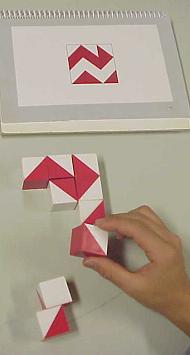
Wechsler cubes

(after David Wechsler,
1896-1981, chief
psychologist at Bellevue)

Wechsler blocks for psychological testing

These cubes are used to
make 3x3 patterns for
psychological testing.

Related 3x3 patterns appear
in "nine-patch" quilt blocks
and in the following--

Don Park at docuverse.com, Jan. 19, 2007:

"How to draw an Identicon

Designs from a web page on Identicons

A 9-block is a small quilt using only 3 types of patches, out of 16 available, in 9 positions. Using the identicon code, 3 patches are selected: one for center position, one for 4 sides, and one for 4 corners.

Positions and Rotations

For center position, only a symmetric patch is selected (patch 1, 5, 9, and 16). For corner and side positions, patch is rotated by 90 degree moving clock-wise starting from top-left position and top position respectively."
    
From a weblog by Scott Sherrill-Mix:

"... Don Park came up with the original idea for representing users with geometric shapes...."

Claire | 20-Dec-07 at 9:35 pm | Permalink

"This reminds me of a flash demo by Jarred Tarbell
http://www.levitated.net/daily/lev9block.html"

ScottS-M | 21-Dec-07 at 12:59 am | Permalink
    
Jared Tarbell at levitated.net, May 15, 2002:

"The nine block is a common design pattern among quilters. Its construction methods and primitive building shapes are simple, yet produce millions of interesting variations.

Designs from a web page by Jared Tarbell

Figure A. Four 9 block patterns,
arbitrarily assembled, show the
grid composition of the block.


Each block is composed of 9 squares, arranged in a 3 x 3 grid. Each square is composed of one of 16 primitive shapes. Shapes are arranged such that the block is radially symmetric. Color is modified and assigned arbitrarily to each new block.

The basic building blocks of the nine block are limited to 16 unique geometric shapes. Each shape is allowed to rotate in 90 degree increments. Only 4 shapes are allowed in the center position to maintain radial symmetry.

Designs from a web page by Jared Tarbell

Figure B. The 16 possible shapes allowed
for each grid space. The 4 shapes allowed
in the center have bold numbers."
   
Such designs become of mathematical interest when their size is increased slightly, from square arrays of nine blocks to square arrays of sixteen.  See Block Designs in Art and Mathematics.

(This entry was suggested by examples of 4x4 Identicons in use at Secret Blogging Seminar.)


Tuesday, June 17, 2008  8:44 AM

But seriously...

Final Arrangements,
continued:


"I need a photo-opportunity...."

NY Times obituaries, June 17, 2008

Click on image for details.


Tuesday, June 17, 2008  7:01 AM

ART WARS continued:

Nightmare Alley

"History, Stephen said,
is a nightmare from which
I am trying to awake."
-- Ulysses

When?

Going to dark bed there was a square round Sinbad the Sailor roc's auk's egg in the night of the bed of all the auks of the rocs of Darkinbad the Brightdayler.

Where?

Black disc from end of Ch. 17 in Ulysses

-- Ulysses, conclusion of Chapter 17

When in Rome...


His manner was all charm
and grace; pure cafe society....


He purred a chuckle.
"My place. If you want to come,
I'll show you."


"Love to. The Luogo Nero?
The Black Place?"


"That's what the locals call it.
It's really Buoco Nero,
the Black Hole."

--
Psychoshop, by
Alfred Bester and Roger Zelazny

In memory of
special effects wizard
Stan Winston,
who died Sunday at 62:

http://www.log24.com/log/pix08/080617-StanWinston.jpg

"The energetic Winston
was always looking
 to the next project."

-- Today's LA Times,
story by
Dennis McLellan


Monday, June 16, 2008  9:00 PM

Bedtime Story --

Bloomsday for Nash:
The Revelation Game

(American Mathematical Society Feb. 2008
review of Steven Brams’s Superior Beings:
If They Exist, How Would We Know?)

(pdf, 15 megabytes)

"Brams does not attempt to prove or disprove God. He uses elementary ideas from game theory to create situations between a Person (P) and God (Supreme Being, SB) and discusses how each reacts to the other in these model scenarios....

In the 'Revelation Game,' for example, the Person (P) has two options:
1) P can believe in SB's existence
2) P can not believe in SB's existence
The Supreme Being also has two options:
1) SB can reveal Himself
2) SB can not reveal Himself

Each player also has a primary and secondary goal. For the Person, the primary goal is to have his belief (or non-belief) confirmed by evidence (or lack thereof). The secondary goal is to 'prefer to believe in SB’s existence.' For the Supreme Being, the primary goal is to have P believe in His existence, while the secondary goal is to not reveal Himself. These goals allow us to rank all the outcomes for each player from best (4) to worst (1). We end up with a matrix as follows (the first number in the parentheses represents the SB's ranking for that box; the second number represents P's ranking):

Revelation Game payoff matrix

The question we must answer is: what is the Nash equilibrium in this case?"

Analogously:

Lotteries on
Bloomsday,
June 16,
2008
Pennsylvania
(No revelation)
New York
(Revelation)
Mid-day
(No belief)
418

The Exorcist

No belief,
no revelation
064

4x4x4 cube summarizing geometry of the I Ching

Revelation
without belief
Evening
(Belief)
709

Human Conflict Number Five album by The 10,000 Maniacs

Belief without
revelation
198

(A Cheap
Epiphany)

Black disc from end of Ch. 17 of Ulysses

Belief and
revelation

The holy image

Black disc from end of Ch. 17 of Ulysses

denoting belief and revelation
may be interpreted as
a black hole or as a
symbol by James Joyce:

When?

Going to dark bed there was a square round Sinbad the Sailor roc's auk's egg in the night of the bed of all the auks of the rocs of Darkinbad the Brightdayler.

Where?

Black disc from end of Ch. 17 in Ulysses

-- Ulysses, conclusion of Chapter 17