Fathers' Day, Part II:
I want a shot at redemption.
Don't want to end up a cartoon
In a cartoon graveyard."
-- Paul Simon


Sunday, June 15, 2008 7:00 AM
Fathers' Day, Part I:

Click to enlarge.

From Fathers' Day Meditation:

For further details,
click on the well.
Saturday, June 14, 2008 11:09 AM
Lyric Poetry:
An online tribute to Tim Russert
this morning had a song by a
Russert favorite, Bruce Springsteen:
Hard Lessons

five Log24 entries
ending on July 20, 2006,
which contain the following
example of what might be
caled "sacred order"
(see yesterday's entries)--

See also "Grave Matters" here
on November 8, 2006, and
the same date four years earlier,
as well as
"O Grave, Where Is Thy Victory?"
(pdf), a lecture by Jack Miles
at Clark Art Institute
(see Oct. 7-9, 2002)
on November 9, 2002.
The Miles lecture may be of
more comfort to Russert's
mourners than the
cross/wheel symbolism,
which has its dark side.
The cross, the wheel,
the Catholic faith, and
Russert's field of expertise,
politics, are of course
notably combined in the
crux gammata, discussed
here in a 2002 entry on
the Triumph of the Cross
and the Death of Grace
(Princess of Monaco).
Friday, June 13, 2008 6:11 AM
For Philip Rieff *
Edward Rothstein last Monday:
"What is being said?
What does it mean?
Where does it come from
and where else is it used?"
A partial answer:
today's previous entry,
"For Philip Rieff,"
and an midrash on
the word "Pahuk"
(as in "Pahuk Pride,"
the name of this week's
Boy Scout gathering
in Iowa at which
a tornado killed four) --
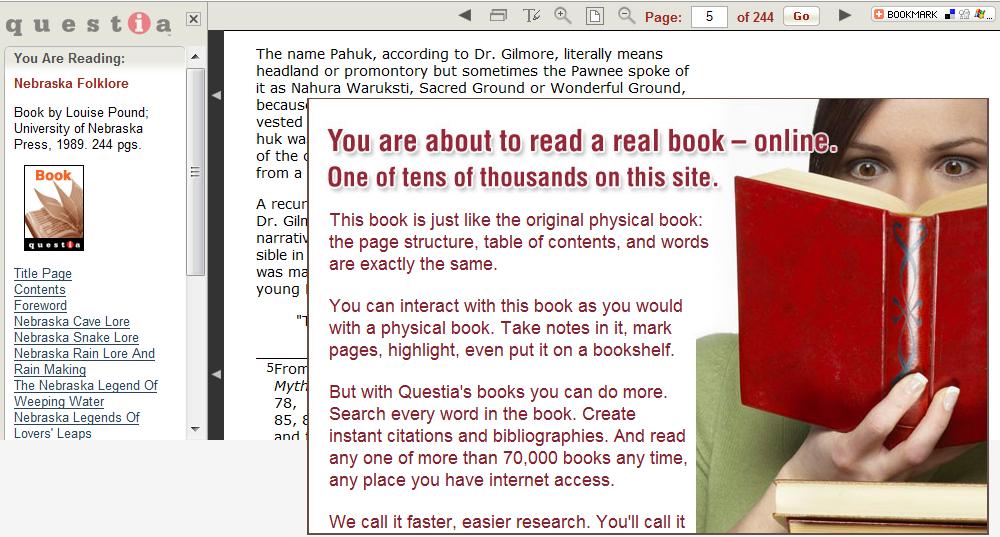
Click on image for further details.
Rieff was the author of
Sacred Order/Social Order,
Volume 1--
My Life among the Deathworks:
Illustrations of the
Aesthetics of Authority
(University of Virginia Press, 2006)
Rieff's concept of sacred order
was Jewish rather than Pawnee,
but his writings still seem relevant.
Thursday, June 12, 2008 10:31 AM
Journalism Camp:
for the staff of
The New York Times:
Eyewitness accounts of
Scout Camp tornado
that killed four
(continued from
Today's Sermon,
Sunday, June 8)
Related material:
Log24 entry of
one year ago today --
On Framing Science --
Frame this.
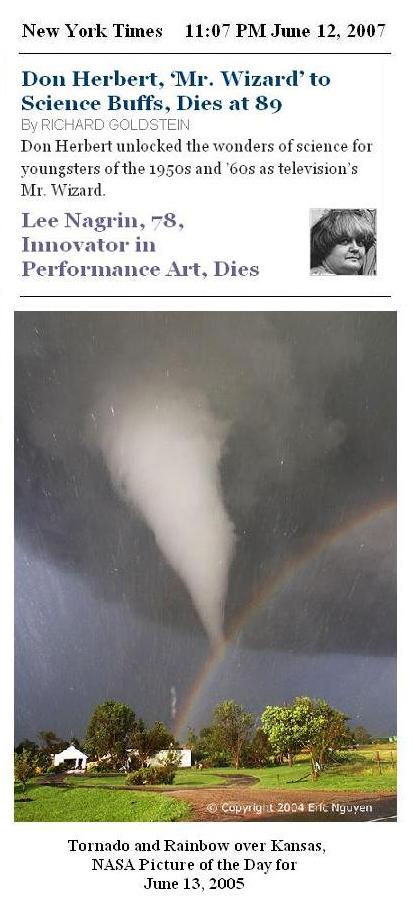
See also the four previous entries.
Thursday, June 12, 2008 1:06 AM
Annals of Scholarship, continued:

"The scientific mind does not so much
provide the right answers as
ask the right questions."
-- Claude Lévi-Strauss
(The Raw and the Cooked,
1964, English translation 1969 --
paperback, U. of Chicago Press,
1983, "Overture," p. 7)

A Venn diagram --
shown here last Sunday --

by the illustrator of last Sunday's
New York Times review of
The Drunkard's Walk:
How Randomness
Rules Our Lives
Well, do you?

Related material:
6/10
(San Francisco's new
Contemporary Jewish Museum
as a vision of Hell)
9/28
(A less theological,
more personal, discussion
of Venn diagrams)
Wednesday, June 11, 2008 8:00 PM
For a Hollywood Birthday:
Worst Camping Trip Ever
Part I:
"Today's Sermon"
from last Sunday --
The Holy Trinity vs.
The New York Times --
| http://indexed.blogspot.com/ Thursday, February 15, 2007 Scary stories. Posted by Jessica Hagy at 10:31 PM 39 comments Labels: faith, family |
Part II:
Today's previous entries

Part III:

Susan Sontag,
Notes on "Camp"
Wednesday, June 11, 2008 6:01 PM
Signs of the Times:
vs. the Alphabet
in today's New York Times:

(continued from
Einstein's birthday, 2003)
Links from the above image:
The Painter and Letters
Wednesday, June 11, 2008 4:01 PM
Annals of Fiction:
Amazon Delivery


Click on images for details.
Related material:
From the Grave,
Indiana Jones and the
Diadem of Death, and
MoMA Goes to Kindergarten
Wednesday, June 11, 2008 5:01 AM
Fields of Dreams:

Asinof married Jocelyn Brando, the sister of actor Marlon Brando, after meeting when she was appearing on Broadway.

Tuesday, June 10, 2008 5:31 AM
For James Michener:
My own concept of paradise is closer to the Gary Cooper film "Return to Paradise," which impressed me greatly when I saw it on TV when I was in 10th grade.
A related vision: two frames from the Jodie Foster film "Contact"--
 |
 |
See Storyline and Time Fold.
See also another Michener-based
production, the current
Lincoln Center "South Pacific."
"Who can explain it,
who can tell you why?"
Monday, June 9, 2008 10:20 PM
Interpret This, continued:
Readers of the previous entry
who wish to practice their pardes
may contemplate the following:

The evening 563 may, as in other recent entries, be interpreted as a page number in Gravity's Rainbow (Penguin Classics, 1995). From that page:
'What's it mean?'
[....]
Slothrop gives him the mandala. He hopes it will work like the mantra that Enzian told him once, mba-kayere (I am passed over), mba-kayere... a spell [...]. A mezuzah. Safe passage through a bad night...."

This 1495 image is found in
The Janus Faces of Genius:
The Role of Alchemy
in Newton's Thought,
by B. J. T. Dobbs,
Cambridge University Press,
2002, p. 85
Related mandalas:
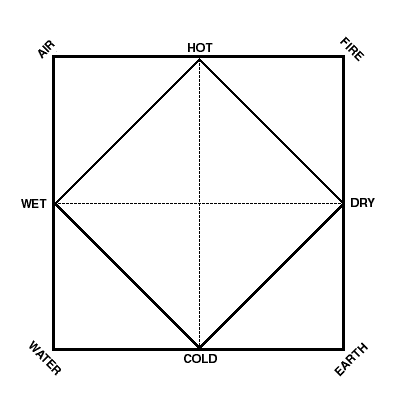
and

For further details,
click on any of the
three mandalas above.
"For every kind of vampire,
there is a kind of cross."
-- Thomas Pynchon, quoted
here on 9/13, 2007
Time of entry: 10:20:55 PM
Monday, June 9, 2008 12:00 PM
Happy Birthday, Aaron Sorkin:
"With respect, you only interpret."
"Countries have gone to war
after misinterpreting one another."
-- The Interpreter
it must have been a revolutionary
and creative move to design works
of art so that they might be
experienced on several levels."
-- Susan Sontag,
"Against Interpretation"
"An introductory wall panel tells us that in the Jewish mystical tradition the four letters [in Hebrew] of pardes each stand for a level of biblical interpretation: very roughly, the literal, the allusive, the allegorical and the hidden. Pardes, we are told, became the museum’s symbol because it reflected the museum’s intention to cultivate different levels of interpretation: 'to create an environment for exploring multiple perspectives, encouraging open-mindedness' and 'acknowledging diverse backgrounds.' Pardes is treated as a form of mystical multiculturalism.
But even the most elaborate interpretations of a text or tradition require more rigor and must begin with the literal. What is being said? What does it mean? Where does it come from and where else is it used? Yet those are the types of questions-- fundamental ones-- that are not being asked or examined [...].
How the data arrange
themselves inside it."
-- Gravity's Rainbow
"Examples are the stained-
glass windows of knowledge."
-- Vladimir Nabokov

Click on image to enlarge.
Sunday, June 8, 2008 7:35 PM
Annals of Religion, continued:
Pennsylvania Lottery
Sunday, June 8, 2008:
Mid-day 638
Evening 913
Midrash:
638 --
"It's the system that matters.
How the data arrange
themselves inside it."
-- Gravity's Rainbow,
page 638
913 --
"For every kind of vampire,
there is a kind of cross."
-- Thomas Pynchon, quoted
here on 9/13, 2007
Sunday, June 8, 2008 10:00 AM
Today's Sermon:
The New York Times
From the illustrator of
today's NY Times review of
The Drunkard's Walk --
| http://indexed.blogspot.com/ Thursday, February 15, 2007 Scary stories. Posted by Jessica Hagy at 10:31 PM 39 comments Labels: faith, family |
The book under review--
The Drunkard's Walk:
How Randomness Rules Our Lives,
by the author of Euclid's Window--
is, appropriately, published by
Random House:

Click image for
related material.
Sunday, June 8, 2008 2:02 AM
Annals of Religion:
| CHANGE TO BELIEVE IN |
Part I:

Part II:

16
|
Thus the ancient kings made music
In order to honor merit, And offered it with splendor To the Supreme Deity, Inviting their ancestors to be present. When, at the beginning of summer, thunder--electrical energy--comes rushing forth from the earth again, and the first thunderstorm refreshes nature, a prolonged state of tension is resolved. Joy and relief make themselves felt. So too, music has power to ease tension within the heart and to loosen the grip of obscure emotions. The enthusiasm of the heart expresses itself involuntarily in a burst of song, in dance and rhythmic movement of the body. From immemorial times the inspiring effect of the invisible sound that moves all hearts, and draws them together, has mystified mankind. Rulers have made use of this natural taste for music; they elevated and regulated it. Music was looked upon as something serious and holy, designed to purify the feelings of men. It fell to music to glorify the virtues of heroes and thus to construct a bridge to the world of the unseen. In the temple men drew near to God with music and pantomimes (out of this later the theater developed). Religious feeling for the Creator of the world was united with the most sacred of human feelings, that of reverence for the ancestors. The ancestors were invited to these divine services as guests of the Ruler of Heaven and as representatives of humanity in the higher regions. This uniting of the human past with the Divinity in solemn moments of religious inspiration established the bond between God and man. The ruler who revered the Divinity in revering his ancestors became thereby the Son of Heaven, in whom the heavenly and the earthly world met in mystical contact. These ideas are the final summation of Chinese culture. Confucius has said of the great sacrifice at which these rites were performed: "He who could wholly comprehend this sacrifice could rule the world as though it were spinning on his hand." -- Richard Wilhelm, commentary on Hexagram 16 of the I Ching |

Saturday, June 7, 2008 2:45 AM
Requiem for a Poet:
"At the still point,
there the dance is."
-- T. S. Eliot,
quoted here in the entry
of 2:45 AM Friday
In memory of
Eugenio Montejo,
Venezuelan poet who
died at around midnight
on Thursday night:

From an obituary:
In one scene, Sean Penn's character quoted a line from a 1988 poem by Montejo. It reads: 'The earth turned to bring us closer. It turned on itself and in us, until it finally brought us together in this dream.'"
Related material:A link in the entry of
2:45 AM Friday to
"The Cha-Cha-Cha Theory
of Scientific Discovery"
and a news story from the
Cannes Film Festival
dated May 18, 2007,
that features Inarritu:
"Filmmakers form
cha cha cha"
Friday, June 6, 2008 1:00 PM
For MIT's Commencement Day:

Midrash:
The Dance of Chance
Associated Press
"Today in History"
Thought for Today:
"Two dangers constantly threaten
the world: order and disorder."
-- Paul Valery, French poet
(1871-1945).
[La Crise de l'Esprit]
Also from Valéry:
«Notre esprit est fait d'un désordre,
plus un besoin de mettre en ordre.»
(Mauvaises Pensées et Autres)
«L’ordre pèse toujours à
l’individu. Le désordre lui fait désirer la police ou la
mort. Ce sont deux circonstances extrêmes où la nature
humaine n’est pas à l’aise. L’individu recherche une
époque tout agréable, où il soit le plus libre et
le plus aidé. Il la trouve vers le commencement de la fin d’un
système social. Alors,
entre l’ordre et le désordre, règne un moment
délicieux. Tout le bien possible que procure l’arrangement
des pouvoirs et des devoirs étant acquis, c’est maintenant que
l’on peut jouir des premiers relâchements de ce système.
Les institutions tiennent encore. Elles sont grandes et imposantes.
Mais sans que rien de visible soit altéré en elles, elles
n’ont guère plus que cette belle présence; leurs vertus
se sont toutes produites; leur avenir est secrètement
épuisé; leur caractère n’est plus sacré, ou
bien il n’est plus que sacré; la critique et le mépris
les exténuent et les vident de toute valeur prochaine. Le corps
social perd doucement son lendemain. C’est l’heure de la
jouissance et de la consommation générale.»
-- Paul Valéry, Préface aux Lettres Persanes (1926), recueillie dans Variété, II, 1930
Friday, June 6, 2008 2:45 AM
Wonders of the Invisible World:
"Harvard seniors have
every right to demand a
Harvard-calibre speaker."
-- Adam Goldenberg in
The Harvard Crimson
"Look down now, Cotton Mather"
-- Wallace Stevens,
Harvard College
Class of 1901
For Thursday, June 5, 2008,
commencement day for Harvard's
Class of 2008, here are the
Pennsylvania Lottery numbers:
Mid-day 025
Evening 761
Thanks to the late
Harvard professor
Willard Van Orman Quine,
the mid-day number 025
suggests the name
"Isaac Newton."
(For the logic of this suggestion,
see On Linguistic Creation
and Raiders of the Lost Matrix.)
Thanks to Google search, the
name of Newton, combined with
Thursday's evening number 761,
suggests the following essay:
PHILOSOPHY OF SCIENCE:
Daniel E. Koshland Jr.* |
Perhaps the Log24 entries for
the date of Koshland's death:
The Philosopher's Stone
and The Rock.
Or perhaps the following
observations:
On the figure of 25 parts
discussed in
"On Linguistic Creation"--

central 1 as being symbolic
of the unity of Allah. "
-- Clifford Pickover
"At the still point,
there the dance is."
-- T. S. Eliot,
Harvard College
Class of 1910
Tuesday, June 2, 2008 4:23 AM
Annals of Religion:
and The New Yorker
Among the varieties of Christian monotheism, none is more totalitarian, none lodges more radical claims for God's omnipotence, than Calvinism-- and within America, the chief analogue of Calvinist theology, Puritanism. According to Calvin every particle of dust, every act, every thought, every creature is governed by the will of God, and yields clues to the divine plan."
On Doubt:
"a Puritan reflex of seeking other orders beyond the visible, also known as paranoia"
-- Thomas Pynchon, Gravity's Rainbow (Penguin Classics, 1995), p. 188
On Art:
I suggest that faith and doubt are best reconciled by art-- as in A Contrapuntal Theme and in the magazine's current online podcast of Mary Gaitskill reading a 1948 New Yorker story by Vladimir Nabokov.
For the text of the story, see "Signs and Symbols." For an excellent discussion of Nabokov's art, see "The Signs and Symbols in Nabokov's 'Signs and Symbols,'" by Alexander Dolinin.
Sunday, June 1, 2008 2:14 PM
ART WARS continued:
The conclusion of yesterday's commentary on the May 30-31 Pennsylvania Lottery numbers:
Thomas Pynchon, Gravity's Rainbow:
"The fear balloons again inside his brain. It will not be kept down with a simple Fuck You.... A smell, a forbidden room, at the bottom edge of his memory. He can't see it, can't make it out. Doesn't want to. It is allied with the Worst Thing.What are we to make of this enigmatic 286? (No fair peeking at page 287.)
He knows what the smell has to be: though according to these papers it would have been too early for it, though he has never come across any of the stuff among the daytime coordinates of his life, still, down here, back here in the warm dark, among early shapes where the clocks and calendars don't mean too much, he knows that's what haunting him now will prove to be the smell of Imipolex G.
Then there's this recent dream he is afraid of having again. He was in his old room, back home. A summer afternoon of lilacs and bees and
286"
One possible meaning, given The Archivist's claim that "existence is infinitely cross-referenced"--
Page 286 of Ernest G. Schachtel, Metamorphosis: On the Conflict of Human Development and the Psychology of Creativity (first published in 1959), Hillsdale NJ and London, The Analytic Press, 2001 (chapter-- "On Memory and Childhood Amnesia"):
"Both Freud and Proust speak of the autobiographical [my italics] memory, and it is only with regard to this memory that the striking phenomenon of childhood amnesia and the less obvious difficulty of recovering any past experience may be observed."The concluding "summer afternoon of lilacs and bees" suggests that 286 may also be a chance allusion to the golden afternoon of Disney's Alice in Wonderland. (Cf. St. Sarah's Day, 2008)
Some may find the Disney afternoon charming; others may see it as yet another of Paul Simon's dreaded cartoon graveyards.
More tastefully, there is poem 286 in the 1919 Oxford Book of English Verse-- "Love."
For a midrash on this poem, see Simone Weil, who became acquainted with the poem by chance:
"I always prefer saying chance rather than Providence."
-- Simone Weil, letter of about May 15, 1942
Weil's brother André might prefer Providence (source of the Bulletin of the American Mathematical Society.)

White, Geometric, and Eternal--
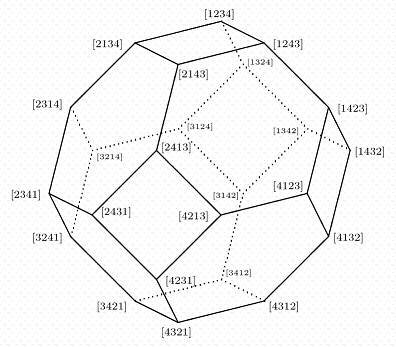
For more on the mathematical significance of this figure, see (for instance) Happy Birthday, Hassler Whitney, and Combinatorics of Coxeter Groups, by Anders Björner and Francesco Brenti, Graduate Texts in Mathematics, vol. 231, Springer, New York, 2005.
This book is reviewed in the current issue (July 2008) of the above-mentioned Providence Bulletin.
The review in the Bulletin discusses reflection groups in continuous spaces.