From the journal of Steven H. Cullinane...
2007 December 01-31
Monday, December 31, 2007 12:25 PM
Alms for Oblivion:
Happy New Year
from Steven Priest
"... and the girl in the corner
is everyone's mourner...."

The Priest quotation appeared here
on Grammy Night 2003 with
another musical meditation:
"Her wallet's filled with pictures,
She gets 'em one by one."
-- "Sweet Little Sixteen,"
by Chuck Berry
(Chess Records, January 1958)
Sunday, December 30, 2007 1:00 PM
Culture Wars continued...
The Christmas Tiger
Part I:
The Gauntlet
On Jonah
Goldberg's new book Liberal Fascism-- an attack on, among
others, Woodrow Wilson:
"'...
at some point,' Goldberg writes, 'it is necessary to throw down the
gauntlet, to draw a line in the sand, to set a boundary, to cry at long
last, "Enough is enough."'"
The Goldberg declaration is from a
review in today's New York Times titled "Heil Woodrow!"
Part II:
Uncle
Duke
Goes to Washington
Today's Doonesbury:

Part III:
A Holiday Tradition
Dialogue
from the classic Capra film "Mr. Smith Goes to Washington"--
SUMMERS: When the country needs men up
there who know and have courage as it never did before, he's
just gonna decorate a chair and get himself honored.
DARRELL: Oh, but he'll vote! Sure. Just like his colleague tells him
to.
DIZ: "Yes, sir," like a Christmas
tiger. He'll nod his head and vote...
REPORTERS: "Yes."
DIZ: You're not a Senator! You're an honorary stooge! You ought to be
shown up!
Part IV:
The Tigers of Princeton
The
Christmas evening Pennsylvania Lottery 4-digit number was 0666, the
Christian "number of the beast." For the beast itself, see the Dec. 3
Log24 entry "Santa's Polar Opposite?" with its link
to a discussion of a metaphorical tiger at the South Pole. A
more realistic version of the beast appeared in the news on
Christmas evening.
The Christmas number may also be interpreted as a reference to 6/6/6,
the graduation date of the Class of 2006 at Princeton University.
Friday, December 28, 2007 7:11 AM
Good Friday 2006 continued...
The Gospel according to
Harvard Business School:
Last Temptation
The New York Times today:

|
Teen Vogue
From The Harbus, the Harvard Business School independent
weekly, a 4/28/03 interview with the late Steven Florio:
HARBUS: It seems you attribute the ability to 'invest in quality' and
to say 'we're going this direction because it's going to help us be the
best' directly to being a private company.
SF: For the 10
years I've been CEO, that has been the marching order I've given to my
staff, to all the Editors and Publishers, and quite frankly the order
that has been given to me by Newhouse. Now, this doesn't mean that I
don't get memos from him saying 'I noticed that we spent an additional
$100,000 last year on Christmas parties, can you please cut this
back?'. He's not a guy who's just standing on top of the building
throwing off $100 bills. He wants the company run efficiently.
On the other hand, if I say to him we really ought to take a hard look
at this idea called 'Teen Vogue', he'll smile, as he did, and say 'The
rest of the industry is cutting back, and you want to do a $50 million
launch?'.
And I said 'It's time. It is time for this
magazine, it is time for line extension, and we should do it'. I have a
management meeting once a week, which he [Newhouse] attends more often
than not, where I presented the new magazine idea to the whole
management team, which is only 6 or 7 people. I looked at him and said
'We're doing it', and he said 'Go ahead, it's a great idea'.
|
A Great Idea:
Related material:
Plato's "Heaven of Ideas"
Welcome to the Cave
April 22, 2007
Thursday, December 27, 2007 8:22 AM
ART WARS continued...
Chronicles
"Fullness... Multitude."
-- The missing last words
of Inman in Cold Mountain,
added here on the
Feast of St. Luke, 2004
II Chronicles 1:
7: In that night did God appear unto Solomon, and said unto
him, Ask what I shall give thee.
8: And Solomon said unto God, Thou hast shewed great mercy unto
David my father, and hast made me to reign in his stead.
9:
Now, O LORD God, let thy promise unto David my father be established:
for thou hast made me king over a people like the dust of the earth in
multitude.
10: Give me now wisdom and knowledge, that I
may go out and come in before this people: for who can judge this thy
people, that is so great?
On Kirk Varnedoe
"At 42-- a professor with no museum experience-- he was named curator
of painting and sculpture at the Museum of Modern Art. It was, and is,
the most influential job in the fluid, insular, fiercely contentious
world of modern art. Just two decades past his last Amherst game, the
lineman from Savannah was sitting in the chair where the most critical
decisions in his profession are made-- 'the conscientious, continuous,
resolute distinction of quality from mediocrity,' according to his
Olympian predecessor Alfred Barr. The Modern and its chief curator
serve the American art establishment as a kind of aesthetic Supreme
Court, and most of their rulings are beyond appeal."
-- Hal Crowther
On Quality
Varnedoe, in his final
Mellon lecture at
the
National Gallery,
quoted "Blade Runner"--
"I've seen things
you people wouldn't believe...."
Frank Rich of The New York Times
on the United States of America:
"A country where
entertainment is god."
Rich's description may or may not
be true of the United States, but
it certainly seems true of
The New York Times:

Click on image to enlarge.
Related material:
Art Wars
Wednesday, December 26, 2007 12:00 PM
Context-Sensitive Theology
A Wonderful Life
Part I:
Language Games
on December 19:
See also the noir
entry on
"Nightmare Alley" for
Winter Solstice 2002,
as well as a solstice-related
commentary on I Ching
Hexagram 41, Decrease. |
Part II:
Language Game
on Christmas Day
Pennsylvania Lottery
December 25, 2007:

Part III:
A Wonderful Life
"Thine,
O LORD is the greatness, and the power, and the glory, and the victory,
and the majesty: for all that is in the heaven and in the earth is
thine; thine is the kingdom, O LORD, and thou art exalted as head above
all."
This verse is sometimes cited as influencing the Protestant conclusion
of the Lord's Prayer:
"Thine is the kingdom, and the power, and
the glory, forever" (Mt 6.13b; compare 1 Chr 29.11-13)....
This
traditional epilogue to the Lord's prayer protects the petition for the
coming of the kingdom from being understood as an exorcism, which we
derive from the Jewish prayer, the Kaddish,
which belonged at the time to the synagogical liturgy.
-- World
Alliance of Reformed Churches
The
Pennsylvania Lottery on Christmas evening paired 173 with the beastly
number 0666. The latter number suggests that perhaps being "understood as an exorcism"
might not, in this case, be such a bad thing. What, therefore, might
"173" have to do with exorcism? A search in the context of the
phrase
"language games" yields a reference to Wittgenstein's
Zettel, section 173:

From Charles L. Creegan, Wittgenstein and Kierkegaard:
Language-games give general guidelines of the
application of language. Wittgenstein suggests that there are
innumerably many language-games: innumerably many kinds of use of
the components of language.24 The grammar of the language-game
influences the possible relations of words, and things, within that
game. But the players may modify the rules gradually. Some utterances
within a given language-game are applications; others are
'grammatical remarks' or definitions of what is or should be possible.
(Hence Wittgenstein's remark, 'Theology as grammar'25 - the grammar of religion.)
The idea of the 'form of life' is a reminder about
even more basic
phenomena. It is clearly bound up with the idea of language. (Language
and 'form of life' are explicitly connected in four of the five
passages from the Investigations in which the term 'form of
life' appears.) Just as grammar is subject to change through language-uses,
so 'form of life' is subject to change through changes in language.
(The Copernican revolution is a paradigm case of this.) Nevertheless,
'form of life' expresses a deeper level of 'agreement.' It is the level
of 'what has to be accepted, the given.'26 This is an agreement prior to
agreement in opinions and decisions. Not everything can be doubted or
judged at once.
This suggests that 'form of life' does not denote
static phenomena of
fixed scope. Rather, it serves to remind us of the general need for
context in our activity of meaning. But the context of our meaning is a
constantly changing mosaic involving both broad strokes and fine-grained
distinctions.
The more commonly understood point of the 'Private
Language Argument' -
concerning the root of meaning in something public - comes into play
here. But it is important to show just what public phenomenon
Wittgenstein has in mind. He remarks: 'Only in the stream of
thought and life do words have meaning.'27
- 24
- Investigations, sec. 23.
- 25
- Investigations, sec. 373; compare Zettel,
sec. 717.
- 26
- Investigations, p. 226e.
- 27
- Zettel,
sec. 173. The thought is expressed many times in similar words.
And from an earlier chapter of Creegan:
The 'possibility of religion' manifested itself in
considerable reading
of religious works, and this in a person who chose his reading matter
very carefully. Drury's recollections include conversations about
Thomas à Kempis, Samuel Johnson's Prayers, Karl Barth,
and, many times, the New Testament, which Wittgenstein had clearly read
often and thought about.25
Wittgenstein had also thought about what it would mean to be a
Christian. Some time during the 1930s, he remarked to Drury: 'There is
a sense in which you and I are both Christians.'26 In this context it is certainly
worth noting that he had for a time said the Lord's Prayer each day.27
Wittgenstein's
last words were: 'Tell them I've had a wonderful life!'28
- 25
- Drury (1981) 'Conversations with Wittgenstein,'
in Ludwig Wittgenstein: Personal Recollections, pp. 112ff.
- 26
- Drury, 'Conversations,' p. 130.
- 27
- Drury, 'Some notes,' p. 109.
- 28
- Reported by Mrs. Bevan, the wife of the doctor
in whose house Wittgenstein was staying. Malcolm, Memoir, p. 81.
Part IV:
L'Envoi
For more on the Christmas evening
number of the beast, see Dec. 3:
"Santa's Polar Opposite?" --
"Did he who made the Lamb
make thee?"
Monday, December 24, 2007 9:00 AM
A Christmas Production:
From Saturday's entry
(Log24, Dec. 22, 2007)
a link goes to--
The five entries of June 14, 2007.
From there, the link
"One Two Three Four,
Who Are We For?"
goes to--
Princeton: A Whirligig Tour
(Log24, June 5, 2007).
From there, the link
"Taking Christ to Studio 60"
goes to--
The five Log 24 entries
prior to midnight Sept. 18, 2006.
From there, the link
"Log24, January 18, 2004"
goes to--
A
Living Church.
From there, the link
"click here"
goes to--
In the
Bleak Midwinter
(Internet Movie Database)...
Tagline:
The drama. The passion. The intrigue... And the
rehearsals haven't even started.
Plot Summary:
Out of work actor Joe volunteers to help try and save
his sister's
local church for the community by putting on a Christmas production of
Hamlet...
"... were it not that
I have bad dreams."
-- Hamlet
Related material:
The New York Times online
obituaries of December 22,
Ike Turner's
"Bad Dreams" album
(see Log24, July 12, 2004),
"Devil Music," a composition
by H. S. M. Coxeter,
and
King of Infinite Space.
Those desiring more literary depth
may consult the G. K. Chesterton
play "Magic"
for which Coxeter
wrote his "Devil Music" and
the Ingmar Bergman film
"The
Magician" said to have
been inspired by Chesterton.
Sunday, December 23, 2007 9:00 AM
Review:
Saturday, December 22, 2007 8:00 AM
Review:
Saturday, December 22, 2007 7:59 AM
Mathematics and Narrative
A Story for Aaron
"It
has been said that the unexamined life isn't worth living. Nachman
wasn't against examining his life, but then what was a life? ....
...
As for 'a life,' it was what you read about in newspaper obituaries. He
didn't need one. He would return to California and think only about
mathematics."
-- Leonard Michaels, "Cryptology"
Related material:
Today's online
New York Times
obituaries
Friday, December 21, 2007 1:00 PM
Mr. Holland's Week, continued:
My
books are about
Killing God
-- Philip Pullman
God was apparently not
available this week;
record producer Joel Dorn,
who died on Monday,
will have to do.

"...
when you get the feel of it, and the record actually transports you
back to that time, then it's a real explanation of what's going on...
of what went on. And here I think you can-- it's one thing to get the
music, it's another thing to get the place and the people and the
interaction. When it's really right, the audience is the fifth member
of a quartet." --Joel Dorn
"Daddy's like
an old knight."
--Allison in "Meet Joe Black"
For Joe Black himself,
see the previous entry.
Friday, December 21, 2007 9:29 AM
Marketing 101:
Soft-Rock Jesus
An entry in memory of...

Reflections of a screenwriter:
"I began to doubt the premises
of all the stories I had ever
told myself, a common condition
but one I found troubling."
-- Joan Didion in
The White Album
On Fogelberg's "Leader of the Band"
tribute to his father:
"Dan included his father's arrangement
of 'The Washington Post March'....
Dan even showed up during the band's
recording session to play cymbals...."
"Gosh, does this movie
have it all or what?"
-- The Washington Post,
Dec. 21, 2007

Such, Denise, is the language of love.
Thursday, December 20, 2007 10:00 AM
Man and His Cymbals
From Drummers
for Jesus:
"Explosive, complex, full and dark. The
first cymbal with VIBRATO. Nothing else comes close!
Serpent
Cymbals enters the special effects cymbal market with a stunning new
cymbal boasting a radical new sound and design. 'This cymbal sounds
like a cross between a china cymbal, crash cymbal, gong and thunder
sheet with a stick of dynamite tossed in for fun'...."
Wednesday, December 19, 2007 9:00 AM
Language Game:
Tutelary Figures
An entry in memory of
Dr. Joseph L. Henderson,
Jungian analyst, who died
on Nov. 17 at 104
(An obituary appears in
today's New York Times.)
Some remarks by Dr. Henderson:
 The myth of the hero is
the most common and the best known myth in the
world... classical mythology... Greece and Rome... Middle Ages... Far
East... contemporary primitive tribes. It also appears in dreams...
obvious dramatic... profound... importance. P. 101
The myth of the hero is
the most common and the best known myth in the
world... classical mythology... Greece and Rome... Middle Ages... Far
East... contemporary primitive tribes. It also appears in dreams...
obvious dramatic... profound... importance. P. 101
...
structurally very similar... universal pattern... over and over
again... a tale of... miraculous... humble birth... early proof of
superhuman strength... rapid rise to prominence... triumphant struggle
with the forces of evil... fallibility to the sin of pride (hybris)...
and his fall through betrayal or a "heroic" sacrifice that ends in his
death. P. 101
...
another important characteristic... provides a clue... the early
weakness... is balanced by... strong "tutelary" figures... who enable
him to perform the superhuman tasks that he cannot accomplish unaided.
Theseus had Poseidon... Perseus had Athena... Achilles had Cheiron...
the wise centaur, as his tutor. P. 101
And Stan Carlisle had
Dr. Lilith Ritter:
Sunday, December 16, 2007 1:09 PM
Today's Sermon:
Mad Phaedrus
Meets Mad Ezra
"Plato's
Good was a fixed and eternal and unmoving Idea, whereas for the
rhetoricians it was not an Idea at all. The Good was not a form of
reality. It was reality itself, ever changing, ultimately unknowable in
any kind of fixed, rigid way."
--Phaedrus in Zen
and the Art of Motorcycle Maintenance
This apparent conflict between eternity and time, fixity and motion,
permanence and change, is resolved by the philosophy of the I Ching
and by the Imagism of Ezra Pound. Consider, for example, the
image of The Well

as discussed here on All Saints' Day 2003 and in the previous entry.
As background, consider the following
remarks of James Hillman in "Egalitarian Typologies Versus the
Perception of the Unique," Part III: Persons as Images--
"To
conceive images as static is to forget that they are numens that
move.
Charles Olson, a later poet in this tradition, said: 'One
perception
must immediately and directly lead to a further perception... always,
always one perception must must must move instanter, on another.' 80
Remember Lavater and his insistence on instantaneity for reading the
facial image. This is a kind of movement that is not narrational,
and
the Imagists had no place for narrative. 'Indeed the great poems
to
come after the Imagist period-- Eliot’s The Waste Land and Four
Quartets; Pound’s Cantos; Williams’s Paterson--
contain no defining narrative.' 81 The
kind of movement Olson urges is an inward deepening of the image, an
in-sighting of the superimposed levels of significance within it. 82
This is the very mode that Jung suggested for grasping dreams-- not as
a sequence in time, but as revolving around a nodal complex. If
dreams, then why not the dreamers. We too are not only a sequence
in
time, a process of individuation. We are also each an image of
individuality."
80 The New American Poetry (D. M. Allen, ed.) N.Y.:
Evergreen, Grove, 1960, pp. 387-88. from Jones, p. 42.
81 Jones,* p. 40.
82
H. D. later turned narration itself into image by writing a novel in
which the stories were "compounded like faces seen one on top of
another," or as she says "superimposed on one another like a stack of
photographic negatives" (Jones, p. 42). Cf. Berry,** p. 63: "An
image
is simultaneous. No part precedes or causes another part, although all
parts are involved with each other... We might imagine the dream as a
series of superimpositions, each event adding texture and thickening to
the rest."
* Imagist Poetry (Peter
Jones, ed.) London: Penguin, 1972
** The contrast between image simultaneity and narrative succession,
and the different psychological effects of the two modes, is developed
by Patricia Berry, "An Approach to the Dream," Spring 1974 (N.
Y./Zürich: Spring Publ.), pp. 63, 68-71
|
Hillman also says that
"Jung’s
'complex' and Pound's definition of Image and Lavater's 'whole heap of
images, thoughts, sensations, all at once' are all remarkably
similar.
Pound calls an Image, 'that which presents an intellectual and
emotional complex in an instant of time'... 'the Image is more than an
Idea. It is a vortex or cluster of fused ideas and is endowed
with
energy'... 'a Vortex, from which and through which, and into which,
ideas are constantly rushing.' 79 Thus the movement,
the dynamics, are within the complex and not only between complexes,
as tensions of opposites told about in narrational sequences, stories
that require arbitrary syntactical connectives which are unnecessary
for reading an image where all is given at once."
79 These definitions of Image by Pound come from his various
writings and can all be found in Jones, pp. 32-41. Further
on complex and image, see J. B. Harmer, Victory in Limbo: Imagism
1908-17, London: Secker & Warburg, 1975, pp. 164-68.
|
These remarks may help the reader to identify with Ada during her
well-viewing in Cold Mountain (previous entry):
"She
was dazzled by light and shade, by the confusing duplication of
reflections and of frames. All coming from too many directions for the
mind to take account of. The various images bounced against each other
until she felt a desperate vertigo...."
If such complexity can be suggested by Hexagram 48, The
Well, alone, consider the effect of the "cluster of fused ideas...
endowed with energy" that is the entire 64-hexagram I Ching.
Friday, December 14, 2007 9:00 AM
Alethiometry continued:
"Well, it changes."
Nicole Kidman at a press conference
for the London premiere of
"The Golden Compass"
on November 27:

A related Log24 link from
that same date, November 27:
Deep Beauty
See also
Zen and the Art of
Motorcycle
Maintenance --
"Plato
hadn’t tried to destroy areté. He had encapsulated it; made a
permanent, fixed Idea out of it; had converted it to a rigid, immobile
Immortal Truth. He made areté the Good, the highest form, the
highest
Idea of all. It was subordinate only to Truth itself, in a synthesis of
all that had gone before.
That was why the Quality that Phaedrus
had arrived at in the classroom had seemed so close to Plato’s Good.
Plato’s Good was taken from the rhetoricians. Phaedrus searched, but
could find no previous cosmologists who had talked about the Good. That
was from the Sophists. The difference was that Plato’s Good was a fixed
and eternal and unmoving Idea, whereas for the rhetoricians it was not
an Idea at all. The Good was not a form of reality. It was reality
itself, ever changing, ultimately unknowable in any kind of fixed,
rigid way."
-- as well as Cold Mountain --
Page 48: "It's claimed that if
you take a mirror and look
backwards into a well, you'll
see your future down in the water."
"So
in short order Ada found herself bent backward over the mossy well lip,
canted in a pose with little to recommend it in the way of dignity or
comfort, back arched, hips forward, legs spraddled for balance.
She
held a hand mirror above her face, angled to catch the surface of the
water below.
Ada had agreed to the well-viewing as a variety of
experiment in local custom and as a tonic for her gloom. Her thoughts
had been broody and morbid and excessively retrospective for so long
that she welcomed the chance to run counter to that flow, to cast
forward and think about the future, even though she expected to see
nothing but water at the bottom of the well.
She shifted her
feet to find better grip on the packed dirt of the yard and then tried
to look into the mirror. The white sky above was skimmed over
with
backlit haze, bright as a pearl or as a silver mirror itself. The
dark
foliage of oaks all around the edges framed the sky, duplicating the
wooden frame of the mirror into which Ada peered, examining its picture
of the well depths behind her to see what might lie ahead in her life.
The bright round of well water at the end of the black shaft was
another mirror. It cast back the shine of sky and was furred
around
the edges here and there with sprigs of fern growing between stones.
Ada
tried to focus her attention on the hand mirror, but the bright sky
beyond kept drawing her eye away. She was dazzled by light and
shade,
by the confusing duplication of reflections and of frames. All coming
from too many directions for the mind to take account of. The various
images bounced against each other until she felt a desperate vertigo,
as if she could at any moment pitch backward and plunge head first down
the well shaft and drown there, the sky far above her, her last vision
but a bright circle set in the dark, no bigger than a full moon.
Her
head spun and she reached with her free hand and held to the stonework
of the well. And then just for a moment things steadied, and
there
indeed seemed to be a picture in the mirror."
-- and Log24 on December 3 --
Thursday, December 13, 2007 11:09 AM
Mathematics and Narrative continued:
Prime Suspect
Well, she was
just seventeen...
"Mazur introduced the topic of prime numbers with a story from Don
Quixote
in which Quixote asked a poet to write a poem with 17 lines. Because 17
is prime, the poet couldn't find a length for the poem's stanzas and
was thus stymied."
-- Undated American Mathematical Society news item about a Nov.
1, 2007, event
You know
what I mean...
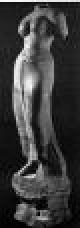
Durga
|
"... a spectacular seventh-century figure of the
Hindu goddess Durga,
whose hip-slung pose and voluptuous torso, as plush
and taut as
ripe fruit, combine the naturalism and idealism of the very finest
Indian work." --The New York Times
"The Wu Li Masters know
that physicists are doing more than 'discovering the endless diversity
of nature.' They are dancing with Kali [or Durga],
the Divine Mother of Hindu mythology." --Gary Zukav, Harvard '64
|

Veronica
|
Or do you?
"I think transformation becomes the main word in my
life, transformation.
Because you don't want to just put a mirror in front
of people and say, here, look at yourself. What do you see?
You
want to have a skewed mirror. You want a mirror that says, you didn't
know you could see the back of your head. You didn't know that you
could... almost cubistic, see all aspects at the same time.
And
what that does for human beings is it allows them to step out of their
lives and to revisit it and maybe find something different about it." --Julie Taymor
Related material:
The previous two entries and
readings for the Feast of
the Triumph of the Cross
in 2006 and in 2003.
Wednesday, December 12, 2007 9:00 AM
Alethiometry continued...
Found in Translation:
Words and Images

From today's New York Times:
"Thomas P. Whitney, a former diplomat and writer on Russian affairs who
was best known for translating the work of the dissident writer Aleksandr
Solzhenitsyn into English, died on [Sunday] Dec. 2 in Manhattan. He
was 90....
During World War II, he was an analyst in Washington with the Office of
Strategic Services, a forerunner of the Central Intelligence Agency....
In the late 1960s and afterward, he bred thoroughbred horses....
On one occasion, Mr. Whitney took Mr. Solzhenitsyn to
Saratoga Racetrack...."
-- Margalit Fox
Related material:
Words
Adam Gopnik on C. S. Lewis
in The New Yorker, issue
dated Nov. 21, 2005:
Prisoner of Narnia
"Lewis began with
a number of haunted images...."
"The best of the books are the ones...
where the allegory is at a minimum
and the images just flow."
"'Everything began with images,'
Lewis wrote...."
Images
Yesterday's entry on
Solzhenitsyn and The Golden Compass
and the following illustrations...
from Sunday
in the Park with Death,
a Log24 entry commemorating
Trotsky's birthday--

--and from Log24 on the date
of Whitney's death,
Sunday, Dec. 2, 2007--

Personal Emblem
of psychiatrist
Harry Stack Sullivan
The horses may refer to
the Phaedrus of Plato.
See also Art Wars.
Tuesday, December 11, 2007 8:00 AM
Annals of Alethiometry:
The Solzhenitsyn Compass
"The Golden Compass is a $180
million movie that opens this weekend....
In
the book, the golden compass is actually called 'the alethiometer.' As
any student of Greek would expect, this instrument has to do with alethia--
the truth. In the fourth chapter of the book, the Master of Jordan
College tells Lyra, the protagonist of the story, that the alethiometer
'tells you the truth. As for how to read it, you'll have to learn by
yourself.'"
-- Sermon by Paul Lundberg, Holy Cross Greek Orthodox
Seminary, Tuesday, December 4, 2007.
"Harvard's motto is Veritas.
Many of you have already found out, and others will find out in the
course of their lives, that truth eludes us as soon as our
concentration begins to flag, all the while leaving the illusion that
we are continuing to pursue it. This is the source of much discord.
Also, truth seldom is sweet; it is almost invariably bitter."
-- Aleksandr Solzhenitsyn, commencement address,
Harvard University, June 8, 1978
Friday, December 7, 2007 12:00 PM
New geometry page:
Reflection Groups in Finite Geometry
Friday, December 7, 2007 6:20 AM
New geometry page:
A Reflection Group of Order 168
Wednesday, December 5, 2007 6:19 PM
Harvard Death
Zeph Stewart, 86, a classics professor and former
Lowell House master at Harvard, died, according to today's online Crimson, on Saturday.
Related material: Saturday's Log24 entry "Plato's Horses" and its link to a
Harvard education.
Wednesday, December 5, 2007 6:19 AM
Final Arrangements, continued:
The New York
Review of Songs

"Which one will the fountain bless?"
-- Sinatra, 1954
Monday, December 3, 2007 9:00 AM
Santa's Polar Opposite?
Sunday, December 2, 2007 9:00 AM
Down to Earth:
Icarus
Part I: Matisse

The Wisdom of the Ego,
by George E. Vaillant,
Harvard University Press (1993)
Cover illustration:
"Icarus," from Jazz, by Henri Matisse
Publisher's description of author:
George E. Vaillant is Professor of Psychiatry;
Director of the Study of Adult Development,
Harvard University Health Services;
and Director of Research in
the Division of Psychiatry,
Brigham and
Women's Hospital.
A review:
"This
is a remarkable synthesis of the best current thinking on ego
psychology as well as a many-faceted picture of what Robert White would
call 'lives in progress.' It makes on its own not only a highly
innovative contribution to ego psychology but an equally original and
impressive contribution to longitudinal research. A remarkable and
many-faceted work."
-- The late George W.
Goethals
of Harvard University
Part II:
The Hospital
Cached from
http://bostonist.com/2007/12/01/boston_blotter_164.php
December 1, 2007
Boston Blotter: More on Harvard Student Found
Dead
 --John Edwards, the
Harvard sophomore whose body was found yesterday at Harvard Medical School,*
committed suicide. People who knew him, such as a professor and his
roommate are mystified. Eva Wolchover
lists Edwards' many accomplishments. He was a top science student (and
that's saying something around here), a stem cell researcher, and a
guitar player. --John Edwards, the
Harvard sophomore whose body was found yesterday at Harvard Medical School,*
committed suicide. People who knew him, such as a professor and his
roommate are mystified. Eva Wolchover
lists Edwards' many accomplishments. He was a top science student (and
that's saying something around here), a stem cell researcher, and a
guitar player.
A Facebook group named "In
Memory of John Edwards" has already been established.
* Other reports say the body was found at about 11 PM
on Thursday, Nov. 29-- the presumed date of Edwards's death.
Edwards was said to have conducted stem cell research at Brigham and
Women's Hospital, a teaching affiliate of Harvard Medical School.
|
Part III:
Down to Earth
The reviewer in Icarus, Part I, above,
Dr. Goethals, was my teacher in a
1960-61 freshman seminar at Harvard.
He admired the work of
Harry Stack Sullivan.
The cover of the Sullivan book below
may serve to illustrate yesterday's
"Plato's Horses" remarks.

The ego defenses of today's
Harvard students seem to need some
strengthening. Perhaps Vaillant, Sullivan,
and the philosophies of Pirsig and of Plato
discussed in yesterday's entry
may be of use in this regard.
Related material:
In the Details and
The Crimson Passion.
Saturday, December 1, 2007 2:45 AM
Plato's Horses:
Rhetoric,
1; Dialectic, 0.
-- Robert M. Pirsig,
Zen
and the Art of
Motorcycle Maintenance
(Pirsig
is describing the response of Phaedrus to an obnoxious member of the
Academy in a discussion of Plato's figure of the horses and charioteer.)

Wallace Stevens,
opening lines of
The Necessary Angel:
"In the Phaedrus, Plato speaks of the
soul in a figure. He says:
Let our figure be of a composite nature-- a pair of winged horses and a
charioteer. Now the winged horses and the charioteer of the gods are
all of them noble, and of noble breed, while ours are mixed; and we
have a charioteer who drives them in a pair, and one of them is noble
and of noble origin, and the other is ignoble and of ignoble origin;
and, as might be expected, there is a great deal of trouble in managing
them. I will endeavor to explain to you in what way the mortal differs
from the immortal creature. The soul or animate being has the care of
the inanimate, and traverses the whole heaven in divers forms
appearing;-- when perfect and fully winged she soars upward, and is the
ruler of the universe; while the imperfect soul loses her feathers, and
drooping in her flight at last settles on the solid ground.
We recognize at once, in this figure, Plato's pure poetry; and at the
same time we recognize what Coleridge called Plato's dear, gorgeous
nonsense. The truth is that we have scarcely read the passage before we
have identified ourselves with the charioteer, have, in fact, taken his
place and, driving his winged horses, are traversing the whole heaven."
Stevens, who was educated at Harvard, adds:
"Then
suddenly we remember, it may be, that the soul no longer exists and we
droop in our flight and at last settle on the solid ground. The figure
becomes antiquated and rustic."
Many who lack a Harvard education
to make them droop will prefer to remember Robert Craig Knievel (Oct.
17, 1938 - Nov. 30, 2007) not as antiquated and rustic but as young and
soaring.