|
Aesthetics for Jesuits
Joke
The Guardian, July 26,
on a work by the
late playwright
George Tabori:
"... inspired satire, laced with Jewish and Christian polemics, sparkling wit and dazzlingly simple effects. For Golgotha a stagehand brings on three crosses. 'Just two,' says Jay. 'The boy is bringing his own.' Tabori often claimed that the joke was the most perfect literary form."
"When may we expect to have
something from you on the
esthetic question? he asked."
-- A Portrait of the Artist
as a Young Man
From The Gag Seven - Eleven Dice Throw
a seven or eleven every time. Set consists of a pair of regular dice
and another set that can't miss. A product of the S. S. Adams Company.
Make your friends and family laugh with this great prank!

July 11, 2003
New York State Lottery
7-11
Evening Number: 000.
Tuesday, July 31, 2007 6:00 AM
For St. Ignatius Loyola's Day:
Italian Director AntonioniFiled with The New York Times at 5:14 a.m. ET
"ROME (AP) -- Italian director Michelangelo Antonioni, best known for his movies 'Blow-Up' and 'L'Avventura,' has died, officials and news reports said Tuesday. He was 94.
The ANSA news agency said that Antonioni died at his home on Monday evening.
'With Antonioni dies not only one of the greatest directors but also a master of modernity,' Rome Mayor Walter Veltroni said in a statement.
In
1995, Hollywood honored Antonioni's career work-- 25 films and several
screenplays-- with a special Oscar for lifetime achievement."
Related material:


Monday, July 30, 2007 7:00 PM
Harry Potter and...

Could these coiling serpents of smoke be foreshadowing events to come in Deathly Hallows where Harry learns to 'awaken the serpent' within himself? Could the snake's splitting in two symbolize the dual nature of the kundalini?"The instrument tinkled into life at once with rhythmic clinking noises. Tiny puffs of pale green smoke issued from the minuscule silver tube at the top. Dumbledore watched the smoke closely, his brow furrowed, and after a few seconds, the tiny puffs became a steady stream of smoke that thickened and coiled into he air... A serpent's head grew out of the end of it, opening its mouth wide. Harry wondered whether the instrument was confirming his story; He looked eagerly at Dumbledore for a sign that he was right, but Dumbledore did not look up.
"Naturally, Naturally," muttered Dumbledore apparently to himself, still observing the stream of smoke without the slightest sign of surprise. "But in essence divided?"
Harry could make neither head not tail of this question. The smoke serpent, however split instantly into two snakes, both coiling and undulating in the dark air. With a look of grim satisfaction Dumbledore gave the instrument another gentle tap with his wand; The clinking noise slowed and died, and the smoke serpents grew faint, became a formless haze, and vanished.


Monday, July 30, 2007 9:00 AM
Nine is a Vine, continued:
"But not, perhaps,
in the Garden of Apollo":

-- "Garden Party" --
Log24, April 9, 2007
Related material:
"When, on the last day of February 1953 Francis told her excitedly of the double helix discovery, she took no notice: 'He was always saying that kind of thing.' But when nine years later she heard the news of the Nobel Prize while out shopping, she immediately rushed to the fishmonger for ice to fill the bath and cool the champagne: a party was inevitable."
-- Matt Ridley on Odile Crick (The Independent, July 20, 2007), who drew what "may be the most famous [scientific] drawing of the 20th century, in that it defines modern biology," according to Terrence J. Sejnowski, a neuroscientist at the Salk Institute for Biological Studies in La Jolla quoted by Adam Bernstein in The Washington Post, July 21, 2007
See also "Game
Boy"
(Log24 on the Feast
of the Transfiguration--
August 6, 2006):

Monday, July 30, 2007 8:00 AM
Eight is a Gate, continued:

| Odile Crick with her husband, Francis H.C. Crick, in Cambridge, England. Mrs. Crick, an artist, illustrated the work of her husband, whose team received a Nobel Prize for its DNA research. |
| Photo Credit: Courtesy
Of The Salk Institute For Biological Studies -- Washington Post, July 21, 2007 |
"Her graceful drawing of the double-helix structure of DNA with intertwined helical loops has become a symbol of the achievements of science and its aspirations to understand the secrets of life. The image represents the base pairs of nucleic acids, twisted around a center line to show the axis of the helix. Terrence J. Sejnowski, a neuroscientist at the Salk Institute for Biological Studies in La Jolla, where Francis Crick later worked, said: 'Mrs. Crick's drawing was an abstract representation of DNA, but it was accurate with regard to its shape and size of its spacing.
'The models you see now have all the atoms in them,' Sejnowski said. 'The one in Nature was the backbone and gave the bare outline. It may be the most famous [scientific] drawing of the 20th century, in that it defines modern biology.'"
Monday, July 30, 2007 7:59 AM
Final Arrangements, continued:
April is Math Awareness Month.
This year's theme is "mathematics and art."


Monday, July 30, 2007 7:00 AM
Seven is Heaven, continued:

Sunday, July 29, 2007 9:00 AM
Nordic Truth, continued:

"This translation plane is defined by
a spreadset in a 2-dimensional
vector space over the field GF(3),
consisting of the following matrices."


Sunday, July 29, 2007 8:00 AM
Jewish Fiction, continued:
Sunday, July 29, 2007 7:59 AM
Variations on Truth and Fiction
| Nordic Truth: |
Jewish Fiction: |
| Snowball |
In Hell |
From The New York Times in 2005: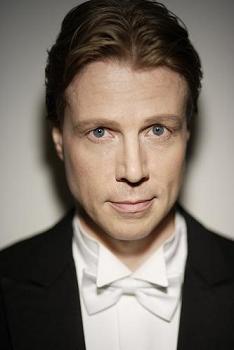 PITTSBURGH "HE'S the hottest conductor you've never heard of.... In music, as in most other pursuits, one person's misfortune can be another's opportunity. Many a podium career has been built on successful substitutions.... typically, the process is cumulative and measured. In Mr. Remmereit's case, it seems a sort of spontaneous combustion.... he seems destined for big things, and soon. Regarding his sudden change in stature, he spoke as if from afar. 'The snowball has reached such a size that it has started to roll,' he said matter-of-factly.... 'It's terrifying when it happens,' he said, 'but I can't tell you how naively happy I am when it goes well. These are such major steps that I wasn't even hoping for a few weeks ago.' ARILD REMMEREIT (pronounced AHR-eeld REMM-uh-right, with the r's heavily rolled) was born in a village in Norway, between Bergen and Trondheim, and has lived in Vienna since 1987. Slim and fresh-faced at 43, he has had a busy but low-level career in Europe.... So here he was, on April 15, conducting the Pittsburgh Symphony... in a vintage... Germanic program.... Wagner's 'Siegfried Idyll,' Schumann's Fourth Symphony and Brahms's Second Piano Concerto...." Review: Württemberg Philharmonic February 2004 Nielsen, Sibelius, Grieg. Reutlinger Nachrichten. "Distant closeness, close distance. Arild Remmereit as a guest conductor: 'As when the sun rises in the North.' The Philharmonics and their brilliant guest conductor fetched the mind-blowing, tempting and exciting Scandinavia. It was like a lucky strike to see the Norwegian conductor on stage with the Philharmonic. When he conducts the Dane Nielsen, the Finn Sibelius and the Norwegian Grieg, one can really feel that this man has the locally marked music floating in his blood." |
From The New York Times today: Discussion of
a new novel:  Variations on the Beast, by psychoanalyst Henry Grinberg An interview with Henry Grinberg conducted by James R. Oestreich: "For those who find inspiration and edification in great art, it is always painful to be reminded that artists are not necessarily admirable as people and that art is powerless in the face of great evil. That truth was baldly evident in Nazi Germany and in the way the regime used and abused music and musicians, to say nothing of the way it used and abused human beings of all kinds. [A new novel touches on] these issues.... In Variations on
the Beast
(Dragon Press), Henry Grinberg, a psychoanalyst, posits Hermann
Kapp-Dortmunder, a powerful maestro, as a fictional rival of Wilhelm
Furtwängler (whose qualms about working under the regime he does
not
share) and Herbert von Karajan (whose vaulting ambition he does)." GRINBERG: "And it soon occurred to me... that, my God, a lot of the famous, the notable, the moving, the magnificent composers in the 18th and 19th centuries and earlier were Germans. And I tried to understand, how did such a nation turn out to be so bestial and cruel, so indifferent to the suffering of others? And I have no explanation for it. As a practicing psychoanalyst, I can see individual expressions of rage and their causes and their so-called justifications. But for a whole nation to be consumed, to be seduced by an overwhelming idea-- well, there are rationalizations, I guess, but not explanations. There's no forgiveness for this. And I tried to put together a story of a person who was a participant and a causer of these kinds of things.... So I sort of poured my feelings of contempt and rage into the character I was devising. And I have to admit, after having been psychoanalyzed myself in preparation for the training, that something of Hermann Kapp-Dortmunder exists in me. I shudder to think that this may be so, but I have to accept the possibility. Murderous thoughts may have occurred to me, but, thank God, I've never killed anyone." |
Saturday, July 28, 2007 6:15 AM
Tabori's Wit:
Thurs, July 26, 2007 4:00 AM
Lottery Hermeneutics, continued:

|
57:
"The author takes the place of the omniscient narrator. He heightens the tension by using striking dialogue. To decrease the tension he uses some light forms of comedy, like the commands for the Dobermans of the little boy: 'Ketchup' for retreating, 'Pickles' for attacking, and 'Mustard' for killing." |
|
225:
 Log24 on 2/25, 2007: "I caught the sudden look of some dead master...." -- T. S. Eliot, Four Quartets |
Wednesday, July 25, 2007 9:00 AM
Variations:
George Tabori
"BERLIN (AP) -- Hungarian-born playwright and director George Tabori, a legend in Germany's postwar theater world whose avant-garde works confronted anti-Semitism, died Monday [July 23, 2007]. He was 93.
Tabori, who as recently as three years ago dreamed of returning to stage to play the title role in Shakespeare's 'King Lear,' died in his apartment near the theater, the Berliner Ensemble said Tuesday, noting that friends and family had accompanied him through his final days. No cause of death was given.
Born into a Jewish family in Budapest on May 24, 1914, Tabori fled in 1936 to London, where he started working for the British Broadcasting Corp., and became a British citizen. His father, and other members of his family, were killed at Auschwitz.
Tabori moved to Hollywood in the 1950s, where he worked as a scriptwriter, most notably co-writing the script for Alfred Hitchcock's 1953 film, 'I Confess.'
He moved to Germany in the 1970s and launched a theater career that spanned from acting to directing to writing. He used sharp wit and humor in his plays to examine the relationship between Germany and the Jews, as well as attack anti-Semitism.
Among
his best-known works are 'Mein Kampf,' set in the Viennese hostel where
Adolf Hitler lived from 1910-1913, and the 'Goldberg Variations,' both
dark farces that poke fun at the Nazis."
From Year of
Jewish Culture:
"The year 2006 marks the 100th anniversary of the
establishment of the Jewish Museum in Prague."
From the related page Programme
(October-December):
"Divadlo
v Dlouhé
George Tabori: GOLDBERGOVSKÉ VARIACE / THE GOLDBERG
VARIATIONS, 19 October, 7 p.m. A comedy on creation and martyrdom."
|
From Log24 on the date of  The above is from Variable Resolution 4–k Meshes: Concepts and Applications (pdf), by Luiz Velho and Jonas Gomes. See also Symmetry Framed and The Garden of Cyrus. |
|
Theme (Plato, Meno) 
Click on "variations" above |
Tuesday, July 24, 2007 7:11 AM
Quotations for...
The fundamental difference between the two is this: magic wants to get, mysticism wants to give [...] In mysticism the will is united with the emotions in an impassioned desire to transcend the sense-world in order that the self may be joined by love to the one eternal and ultimate Object of love [...] In magic, the will unites with the intellect in an impassioned desire for supersensible knowledge. This is the intellectual, aggressive, and scientific temperament trying to extend its field of consciousness [...] (Underhill 84; see also 178ff.)
-- Underhill, Evelyn. Mysticism: A Study in the Nature and Development of Man's Spiritual Consciousness. New York: Dutton, 1911.
For more on what Bloom calls the "Will-to-Power over
nature," see Faust in Copenhagen and the recent (20th- and
21st-century) history of Harvard University. These matters are
also discussed in "Log24 - Juneteenth through Midsummer Night."
For more on what Underhill calls "the intellectual, aggressive, and
scientific temperament trying to extend its field of consciousness,"
see the review, in the August 2007 Notices of the American Mathematical
Society, of a book by Douglas Hofstadter-- a writer on the nature of consciousness-- by magician Martin
Gardner.
Monday, July 23, 2007 8:00 AM
8:00 AM - The Rock

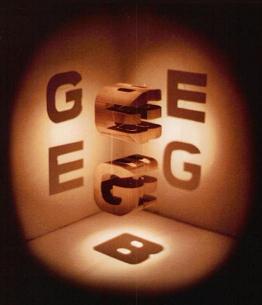
At Midsummer Noon:"In Many Dimensions (1931)
Williams sets before his reader the
mysterious Stone of King Solomon,
an image he probably drew from
a brief description in Waite's
The Holy Kabbalah (1929) of
a supernatural cubic stone
on which was inscribed
'the Divine Name.'"
 Related material:  Solomon's Cube, Geometry of the 4x4x4 Cube, The Klein Correspondence, Penrose Space-Time, and a Finite Model |
Of the ground, a
cure
beyond forgetfulness.
And yet the leaves,
if they broke into bud,
If they broke into bloom,
if they bore fruit,

Monday, July 23, 2007 7:59 AM
7:59 AM - The Philosopher's Stone

Theme
(Plato, Meno)
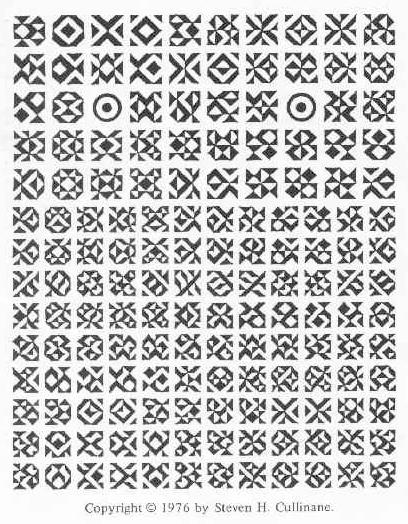
Click on picture for details
"A diamond jubilance
beyond the fire,
That gives its power
to the wild-ringed eye"
-- Wallace Stevens,
"The Owl in the Sarcophagus"
Saturday, July 21, 2007 9:45 AM
For Hemingway's birthday:
Death of a Nominalist"Before introducing algebraic semiotics and structural blending, it is good to be clear about their philosophical orientation. The reason for taking special care with this is that, in Western culture, mathematical formalisms are often given a status beyond what they deserve. For example, Euclid wrote, 'The laws of nature are but the mathematical thoughts of God.' Similarly, the 'situations' in the situation semantics of Barwise and Perry, which resemble conceptual spaces (but are more sophisticated-- perhaps too sophisticated), are considered to be actually existing, real entities [23], even though they may include what are normally considered judgements.5 The classical semiotics of Charles Sanders Peirce [24] also tends towards a Platonist view of signs. The viewpoint of this paper is that all formalisms are constructed in the course of some task, such as scientific study or engineering design, for the heuristic purpose of facilitating consideration of certain issues in that task. Under this view, all theories are situated social entities, mathematical theories no less than others; of course, this does not mean that they are not useful."
5 The “types” of situation theory are even further removed from concrete reality.
[23] Jon Barwise and John Perry. Situations and Attitudes. MIT (Bradford), 1983.
[24] Charles Sanders Peirce. Collected Papers. Harvard, 1965. In 6 volumes; see especially Volume 2: Elements of Logic.
From Log24 on the date of Goguen's death:
Requiem for a clown:
"At times, bullshit can only be
countered with superior bullshit."
-- Norman Mailer
This same Mailer aphorism was quoted, along with an
excerpt from the Goguen passage above, in Log24 this year on the date of Norman Mailer's birth. Also
quoted on that date:
Sophia. Then these thoughts of Nature are also thoughts of God.
Alfred. Undoubtedly so, but however valuable the expression may be, I would rather that we should not make use of it till we are convinced that our investigation leads to a view of Nature, which is also the contemplation of God. We shall then feel justified by a different and more perfect knowledge to call the thoughts of Nature those of God....
Whether the above excerpt-- from Hans Christian Oersted's The
Soul in Nature (1852)-- is superior to the similar remark of
Goguen, the reader may decide.
Thursday, July 19, 2007 10:31 AM
Hocus Pocus and...
Volta da Morte:
Friday the 13th
TV listing from Brazil
for Friday, Jan. 13th, 2006:
| Veja quais são os melhores filmes DESTA SEMANA na TV! Sexta, 13 de Janeiro --
http://www.jornalonorte.com.br/ |
Related material:
If Cullinane College
were Hogwarts,
Friday the 13th
of January, 2006,
and
Thursday, July 19, 2007 2:00 AM
Found in Translation:
Death FlightWednesday, July 18, 2007 6:28 PM
Varieties of Religious Experience:
| Reminder Reuters News Agency, Wed., July 18, 2007, 3:48 PM EDT By Mauricio Savarese SAO
PAULO (Reuters) - The flames from Brazil's worst plane crash were
contained around dawn on Wednesday, but the smell of smoke and death
wafted over travelers at Sao Paulo's airport as a reminder of
disaster.... The airport resumed flights on an alternate runway. Despite the deterioration of Brazil's air safety record over the past year, Guilherme Braghetto, 72, showed little concern for his son, whom he brought to the airport for a flight to Goiania. 'I feel for those who lost loved ones, but I don't think lightning so strong will hit twice,' he said. On September 29, 2006, a Boeing 737 operated by Brazilian carrier Gol Linhas Aereas Inteligentes crashed after clipping wings with a Legacy business jet over the Amazon rainforest, killing 154 people. |
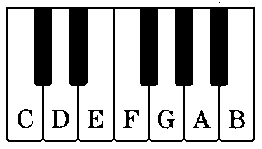
"...consonant intervals
as an example of alleged
'perceptual universals.'
Related material on universals
suitable for today, the Feast of
St. Michael and All Angels:
Shining Forth...."

Wednesday, July 18, 2007 7:03 AM
Lottery Phenomenology:


Tuesday, July 17, 2007 7:00 AM
Latin Mass:

Here is a rhetorical exercise
for Jesuits that James Joyce
might appreciate:
Discuss Bobbi's "little squares"
of bread as the Body of Christ.
Formulate, using Santayana's
criteria, a definition of beauty
that includes this sacrament.
Monday, July 16, 2007 8:06 AM
Short Story:
"I know"-- she was getting excited-- "it could be a magic country like Narnia, and the only way you can get in is by swinging across on this enchanted rope." Her eyes were bright. She grabbed the rope. "Come on," she said.
LOS ANGELES - Roger Cardinal Mahony, leader of the Los Angeles Catholic Archdiocese, the nation's largest, apologized yesterday for what he called a "terrible sin and crime" as the church confirmed it would pay a record $660 million to people sexually abused by priests.
"Magic Time"--
Mary Karr,
"Facing Altars:
Poetry and Prayer"--
"There is a body
on the cross
in my church."

