In other Catholic news...
in priest abuses
"The Archdiocese of Los Angeles agreed Saturday to a $660-million settlement with 508 people who have accused priests of sexual abuse, by far the biggest payout in the child molestation scandal that has rocked the Roman Catholic Church nationwide....
The agreement will end all of the pending abuse litigation against the most populous archdiocese in the U.S....
Although the settlement will effectively end a chapter in the sad saga of clerical abuse that has spanned decades, the resolution will come at a huge cost to the church. More than $114 million has been promised in previous settlements, bringing the total liability for clergy misconduct in the Los Angeles Archdiocese to more than $774 million. The figure dwarfs the next largest settlements in the U.S., including those reached in Boston, at $157 million, and in Portland, Ore., at $129 million."
-- Los Angeles Times, July 15, 2007
Saturday, July 14, 2007 4:07 AM
Against Reductionism:
Catholic University
of America
The August 2007 issue of Notices of the American Mathematical Society contains tributes to the admirable personal qualities and mathematical work of the late Harvard professor George Mackey. For my own tributes, see Log24 on March 17, 2006, April 29, 2006, and March 10, 2007. For an entry critical of Mackey's reductionism-- a philosophical, not mathematical, error-- see Log24 on May 23, 2007 ("Devil in the Details").
Here is another attack on reductionism, from a discussion of the work of another first-rate mathematician, the late Gian-Carlo Rota of MIT:
"Another theme developed by Rota is that of 'Fundierung.' He shows that throughout our experience we encounter things that exist only as founded upon other things: a checkmate is founded upon moving certain pieces of chess, which in turn are founded upon certain pieces of wood or plastic. An insult is founded upon certain words being spoken, an act of generosity is founded upon something's being handed over. In perception, for example, the evidence that occurs to us goes beyond the physical impact on our sensory organs even though it is founded upon it; what we see is far more than meets the eye. Rota gives striking examples to bring out this relationship of founding, which he takes as a logical relationship, containing all the force of logical necessity. His point is strongly antireductionist. Reductionism is the inclination to see as 'real' only the foundation, the substrate of things (the piece of wood in chess, the physical exchange in a social phenomenon, and especially the brain as founding the mind) and to deny the true existence of that which is founded. Rota's arguments against reductionism, along with his colorful examples, are a marvelous philosophical therapy for the debilitating illness of reductionism that so pervades our culture and our educational systems, leading us to deny things we all know to be true, such as the reality of choice, of intelligence, of emotive insight, and spiritual understanding. He shows that ontological reductionism and the prejudice for axiomatic systems are both escapes from reality, attempts to substitute something automatic, manageable, and packaged, something coercive, in place of the human situation, which we all acknowledge by the way we live, even as we deny it in our theories."
-- Robert Sokolowski, foreword to Rota's Indiscrete Thoughts
 Fr. Robert Sokolowski, Ph.D., is Professor of Philosophy at The Catholic University of America in Washington, D.C. Ordained a Roman Catholic priest in 1962, he is internationally recognized and honored for his work in philosophy, particularly phenomenology. In 1994, Catholic University sponsored a conference on his work and published several papers and other essays under the title, The Truthful and the Good, Essays In Honor of Robert Sokolowski. -- Thomas Aquinas College newsletter |
The tributes to Mackey are contained in the first of two feature
articles in the August 2007 AMS
Notices.
The second feature article is a review of a new book by Douglas
Hofstadter. For some remarks related to that article, see
Thursday's
Log24 entry "Not Mathematics but Theology."
Friday, July 13, 2007 7:00 AM
Object Lesson, continued:
Harrison Ford is 65.

| "Three times the concentred self takes hold, three times The thrice concentred self, having possessed The object, grips it in savage scrutiny, Once to make captive, once to subjugate Or yield to subjugation, once to proclaim The meaning of the capture, this hard prize, Fully made, fully apparent, fully found." -- "Credences of Summer," VII, by Wallace Stevens, from Transport to Summer (1947) |
Thursday, July 12, 2007 7:00 PM
Not Mathematics but Theology:
or Coinherence, of Souls
The August 2007 issue of Notices of the American Mathematical Society contains a review of a new book by Douglas Hofstadter, I Am a Strange Loop. (2007, Basic Books, New York. $26.95, 412 pages.)
A better review, in the Los Angeles Times of March 18, 2007, notes an important phrase in the book, "interpenetration of souls," that the AMS Notices review ignores.
Here is an Amazon.com search on "interpenetration" in the Hofstadter book:
| 1. | on Page 217: |
| "... described does not create a profound blurring of two people's identities. Tennis and driving do not give rise to deep interpenetrations of souls. ..." | |
| 2. | on Page 237: |
| "... What seems crucial here is the depth of interpenetration of souls the sense of shared goals, which leads to shared identity. Thus, for instance, Carol always had a deep, ..." | |
| 3. | on Page 270: |
| "... including the most private feelings and the most confidential confessions, then the interpenetration of our worlds becomes so great that our worldviews start to fuse. Just as I could jump to California when ..." | |
| 4. | on Page 274: |
| "... we choose to downplay or totally ignore the implications of the everyday manifestations of the interpenetration of souls. Consider how profoundly wrapped up you can become in a close friend's successes and failures, in their very ..." | |
| 5. | on Page 276: |
| "... Interpenetration of National Souls Earlier in this chapter, I briefly offered the image of a self as analogous to a country ..." | |
| 6. | from Index: |
| "... birthday party for, 350 "bachelor", elusiveness of concept, 178 bad-breath analogy, 150 bandwidth of communication as determinant of degree of interpenetration, 212 213, 220, ..." | |
| 7. | from Index: |
| "... phrases denying interpenetration of souls, 270 271; physical phenomena that lack consciousness, 281 282; physical structures lacking hereness, 283; potential personal attributes, 183; ..." |
The American Mathematical Society editors and reviewer seem to share Hofstadter's ignorance of Christian doctrine; they might otherwise have remembered a rather famous remark: "This is not mathematics, it is theology."
For more on the theology of interpenetration, see Log24 on "Perichoresis, or Coinherence" (Jan. 22, 2004).
For a more mathematical approach to this topic, see Spirituality Today, Spring 1991:
"... the most helpful image is perhaps the ellipse often used to surround divine figures in ancient art, a geometrical figure resulting from the overlapping, greater or lesser, of two independent circles, an interpenetration or coinherence which will, in some sense, reunify divided humanity, thus restoring to some imperfect degree the original image of God."
See also the trinitarian doctrine implicit in related Log24 entries of July 1, 2007, which include the following illustration of the geometrical figure described, in a somewhat confused manner, above:

"Values are rooted
in narrative."
-- Harvey Cox,
Hollis Professor
of Divinity
at Harvard,
Atlantic Monthly,
November 1995
Related material:
Steps Toward Salvation:
An Examination of
Co-Inherence and
Substitution in
the Seven Novels
of Charles Williams,
by Dennis L. Weeks
Thursday, July 12, 2007 1:00 PM
Texas Cheer:
kind of a hat
on the universe,
a lid that kept
everything underneath it
where it belonged."
— Carrie Fisher,
Postcards from the Edge


5/11:
"Going Up."
-- "Love at the
Five and Dime,"
by
Nanci Griffith
234:
"One two three four,
who are we for?"
Wednesday, July 11, 2007 2:45 AM
Magic Time: Quarter to Three...
for the Road
In memory of Doug Marlette,
cartoonist and author
of Magic Time.
Marlette died in a highway
accident yesterday at about
10 AM CT. He was
"on his way to Oxford
[Mississippi]... to help a
troupe of high school students
put on a play based on
his nationally syndicated
comic strip, Kudzu."
-- Chris Joyner,
Clarion-Ledger,
Jackson, Mississippi
Log24 yesterday,
7:59 AM ET:
Mary Karr,
"Facing Altars:
Poetry and Prayer"--
"There is a body
on the cross
in my church."

Kudzu, by Doug Marlette

Tuesday, July 10, 2007 9:00 AM
Nine is a Vine...
for Mary Karr

Tuesday, July 10, 2007 8:00 AM
Eight is a Gate...

Tuesday, July 10, 2007 7:59 AM
Catholic Tastes, continued:
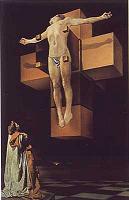
Corpus Hypercubus,
by Dali.
"Does the word 'tesseract'
mean anything to you?"
-- Robert A. Heinlein
Tuesday, July 10, 2007 12:01 AM
It's 12:01 AM, time to...
wand work
-- Web page for the
"Harry Potter and the
Order of the Phoenix"
Xbox 360 game
Sounds to me
more like Harry Reems.
Monday, July 9, 2007 11:59 PM
Random Tasks:
the Xbox 360
Harry Potter and the Order of The Phoenix for Xbox 360 "is based on the fifth book and is timed to coincide with the release of the movie of the same name.... The game consists of Harry walking around and talking to characters and performing spells and tasks in order to advance the plot. I jokingly considered calling this review 'Harry Potter and the Order of the Random Tasks Needed to Advance the Plot.'" --July 9 review at Digital Joystick
in the Keystone State:
Mid-day 220
Evening 034
Related material:
2/20 and
Hexagram 34 in the
box-style I Ching:

The Power
of the Great
"If Cullinane College
were Hogwarts"
(continued) and
the four entries
that preceded it
on July 5-6, 2007
Monday, July 9, 2007 2:35 AM
A Stone for Johnny Frigo
|
Mystic River Song
continued from June 18: From the Harvard Math Department:  From the late jazz violinist Johnny Frigo:
From a film version of Somerville... A Stone for Johnny Frigo  Mystic River, 2003
Related material: Human Conflict Number Five (Album title, 10,000 Maniacs)  This album contains
"Planned Obsolescence": any modern man can see obsolete ritual obsolete martyrdom obsolete prophetic vision obsolete mysticism obsolete commitment obsolete sacrament obsolete revelation obsolete Noam Elkies: Folk are humpin' "By all means accept the invitation to hell, should it come. It will not take you far-- from Cambridge to hell is only a step; or at most a hop, skip, and jump. But now you are evading-- you are dodging the issue.... after all, Cambridge is hell enough." |

Saturday, July 7, 2007 2:22 PM
Dead Time:
"Dead time lasts for one hour-- from half an hour before midnight to half an hour after midnight. The half-hour before midnight is for doin' good. The half-hour after midnight is for doin' evil...." --Voodoo Justice
Lois Wyse (previous entry) died "shortly after midnight" on the morning of Friday, July 6, 2007.
Death on the Feast
of Saint Nicholas

Saint Francis Borgia at the Deathbed
of an Impenitent, by Francisco Goya
(1746-1828) in 1788
Saturday, July 7, 2007 1:48 AM
7/7/7 Finale:
John Lahr, review of a production of Tom Stoppard's "Jumpers"--
The play is about a philosophy professor, George, and his wife, Dotty, who "exudes a sumptuous sexuality.... She has a pert round head, high cheekbones, and a deep voice, which, like her acting, is full of playfulness and longing. George is lost in thought; Dotty is just lost. 'Heaven, how can I believe in Heaven?' she sings at the finale. 'Just a lying rhyme for seven!' She is promise and heartbreak in one."

"With a name like Frigo..."
Related material:
Eight is a Gate
Saturday, July 7, 2007 12:00 AM
Midnight Dreamscapes and...
A New York Times review
of the new Geoffrey Wright
film of "Macbeth"--
"... dreamscape of nymphet witches....
In this telling, the three witches
are first glimpsed in the
opening scene vandalizing
tombstones"
For a rather different dreamscape
of nymphets and tombstones, see
the five previous entries.
As the Times notes,
"'Macbeth' has been made as
a gangster picture before."
A truly surreal production,
perhaps to be made in
the next world, might star the
young (again) George Melly

as Macbeth,
introduced by
the following
tombstone:
|
GEORGE MELLY
1926 - 2007 WHAT AFTERLIFE HE NOW ENJOYS GOD ONLY KNOWS |
For further details,
click on Melly's picture.
"A tale told by an idiot...
signifying nothing...."
Friday, July 6, 2007 11:07 PM
11:07:02 Review
(see last 3 entries)--
11:07:02 PM:

Sex and Art
in a
Chinese Poem
See also the entries
of St. Stephen's Day
(Boxing Day), 2006.
Friday, July 6, 2007 8:00 PM
For Loulou Brooks
"Last to the Lost,"
continued from
July 1, 2007
Finnegans Wake 293:
| Vieus Von DVbLIn, 'twas one of dozedeams |
| a darkies ding in dewood) the Turnpike under |
| the Great Ulm (with Mearingstone in Fore |
| ground). 1 Given now ann linch you take enn |
| all. Allow me! And, heaving alljawbreakical |
| expressions out of old Sare Isaac's 2 universal |
| of specious aristmystic unsaid, A is for Anna |
| like L is for liv. Aha hahah, Ante Ann you're |
| apt to ape aunty annalive! Dawn gives rise. |
| Lo, lo, lives love! Eve takes fall. La, la, laugh |
| leaves alass! Aiaiaiai, Antiann, we're last to |
| the lost, Loulou! Tis perfect. Now (lens |
"with Mearingstone in Fore ground....
we're last to the lost, Loulou!"

Midnight, July 1-2, 2007
Click on image for details.
Friday, July 6, 2007 7:47 PM
The Craft
"If Cullinane College
were Hogwarts...."
Click to enlarge.

El Cazador de la Bruja
A word to the wise:
desconvencida.
Related material:
Julio Cortazar
and
Ay que bonito es volar....

Friday, July 6, 2007 12:26 AM
Games with Words and Shapes:
of Good and Evil
continued from
Midsummer Night...
-- Glenna Whitley, "Voodoo Justice,"
The New York Times, March 20, 1994

In Other Game News:
"Coxeter Exhuming Geometry"
suggests the following
illustration, based
in part on
Plato's poem to Aster:

Related material:
Thursday's last entry
and
Sex and Art
in a
Chinese Poem
The proportions of
the above rectangle
may suggest to some
a coffin; they are
meant to suggest
a monolith.
Friday, July 6, 2007 12:18 AM
Back to Black...

Friday, July 6, 2007 12:06 AM
Some Like It Hot:
died yesterday
in London at 80.

Jazz singer, raconteur,
imitator of Bessie Smith,
he apparently named
his daughter Pandora.
|
GEORGE MELLY
1926 - 2007 WHAT AFTERLIFE HE NOW ENJOYS GOD ONLY KNOWS |
Thursday, July 5, 2007 7:11 PM
ART WARS continued:
Plato's realism
(vs. sophists' nominalism--
see recent entries.)
Plato cited geometry,
notably in the Meno,
in defense of his realism.
Consideration of the
Meno's diamond figure
leads to the following:

Click on image for details.
As noted in an entry,
Plato, Pegasus, and
the Evening Star,
linked to
at the end of today's
previous entry,
the "universals"
of Platonic realism
are exemplified by
the hexagrams of
the I Ching,
which in turn are
based on the seven
trigrams above and
on the eighth trigram,
of all yin lines,
not shown above:

K'un
The Receptive
Thursday, July 5, 2007 12:48 PM
Philosophy Wars continued:
"Although it may not at first be obvious,
the substitution for real religions
of a religion drained of particulars
is of a piece with the desire to
exorcise postmodernism."
-- Stanley Fish, July 2002
| From "Stanley
Fish: The Critic as Sophist," by R.V. Young, in Modern Age,
June 22, 2003: In one of the definitive works of conservatism in the twentieth century, Richard Weaver designates the rise of nominalism as a critical turn in the emergence of the intellectual and cultural disintegration associated with liberalism, which it is the business of a reviving conservatism to contest: "The defeat of logical realism in the great medieval debate was the crucial event in the history of Western culture; from this flowed those acts which issue now in modern decadence." It is nominalism that provides the intellectual foundation-- if a paradox may be hazarded-- for the attack by Fish and numerous others (their name is Legion) on the very idea of intellectual foundations: It was William of Occam who propounded the fateful doctrine of nominalism, which denies that universals have real existence. His triumph tended to leave universal terms mere names serving our convenience. The issue ultimately involved is whether there is a source of truth higher than, and independent of, man; and the answer to the question is decisive for one's view of the nature and destiny of humankind. The practical result of nominalist philosophy is to banish the reality which is perceived by the intellect and to posit as reality that which is perceived by the senses. (4) (4). Ideas Have Consequences (Chicago and London, 1948), 3. R.V. YOUNG is Professor of English at North Carolina State University and author of At War With the Word and Doctrine and Devotion in Seventeenth-Century Poetry (2000). |
Simon Blackburn on
Plato and sophists,
realism and nominalism
(previous entry)
and
Plato, Pegasus, and
the Evening Star
Tuesday, July 3, 2007 9:29 PM
The Public Spheres and...
of Stanley Fish
(continued from
June 18, 2002)
The "ignorance" referred to
is Fish's ignorance of the
philosophical background
of the words
"particular" and "universal."
The Ignorance of Our
Warrior Intellectuals,"
by Stanley Fish,
Harper's Magazine,
July 2002, contains
the following passages:
"Although it may not at first be obvious, the substitution for real religions of a religion drained of particulars is of a piece with the desire to exorcise postmodernism."
"What must be protected, then, is the general, the possibility of making pronouncements from a perspective at once detached from and superior to the sectarian perspectives of particular national interests, ethnic concerns, and religious obligations; and the threat to the general is posed by postmodernism and strong religiosity alike, postmodernism because its critique of master narratives deprives us of a mechanism for determining which of two or more fiercely held beliefs is true (which is not to deny the category of true belief, just the possibility of identifying it uncontroversially), strong religiosity because it insists on its own norms and refuses correction from the outside. The antidote to both is the separation of the private from the public, the establishing of a public sphere to which all could have recourse and to the judgments of which all, who are not criminal or insane, would assent. The point of the public sphere is obvious: it is supposed to be the location of those standards and measures that belong to no one but apply to everyone. It is to be the location of the universal. The problem is not that there is no universal--the universal, the absolutely true, exists, and I know what it is. The problem is that you know, too, and that we know different things, which puts us right back where we were a few sentences ago, armed with universal judgments that are irreconcilable, all dressed up and nowhere to go for an authoritative adjudication.
What to do? Well, you do the only thing you can do, the only honest thing: you assert that your universal is the true one, even though your adversaries clearly do not accept it, and you do not attribute their recalcitrance to insanity or mere criminality--the desired public categories of condemnation--but to the fact, regrettable as it may be, that they are in the grip of a set of beliefs that is false. And there you have to leave it, because the next step, the step of proving the falseness of their beliefs to everyone, including those in their grip, is not a step available to us as finite situated human beings. We have to live with the knowledge of two things: that we are absolutely right and that there is no generally accepted measure by which our rightness can be independently validated. That's just the way it is, and we should just get on with it, acting in accordance with our true beliefs (what else could we do?) without expecting that some God will descend, like the duck in the old Groucho Marx TV show, and tell us that we have uttered the true and secret word."
of the Pennsylvania Lottery:


Log24 on 1/05:
"'From your lips
to God's ears,'
goes the old
Yiddish wish.
The writer, by contrast,
tries to read God's lips
and pass along
the words...."
-- Richard Powers
268 --
This is a page number
that appears, notably,
in my June 2002
journal entry on Fish,
and again in an entry,
"The Transcendent Signified,"
dated July 26, 2003,
that argues against
Fish's school, postmodernism,
and in favor of what the pomos
call "logocentrism."
Page 268
of Simon Blackburn's Think
(Oxford Univ. Press, 1999):
regard the particular
page number 268 as
delivered-- five years late,
but such is philosophy--
by Groucho's
winged messenger
in response to
Fish's utterance of the
"true and secret word"--
namely, "universal."
When not arguing politics,
Fish, though from
a Jewish background, is
said to be a Milton scholar.
Let us therefore hope he
is by now, or comes to be,
aware of the Christian
approach to universals--
an approach true to the
philosophical background
sketched in 1999 by
Blackburn and made
particular in a 1931 novel
by Charles Williams,
The Place of the Lion.
Monday, July 2, 2007 8:28 PM
An Answer:
Rugged and luminous,
chants in the dark/
A text that is an answer,
although obscure.
-- Wallace Stevens,
"An Ordinary Evening
in New Haven"
|
Time and Chance today in the Keystone State:  |
From 8/02
in 2005:
| 50 Years Ago on this date, poet Wallace Stevens died. Memorial: at the Wallace Stevens Concordance, enter center. |
Result:
| The Man with the Blue Guitar | |
|---|---|
| line 150 (xiii.6): | The heraldic center of the world |
| Human Arrangement | |
| line 13: | The center of transformations that |
| This Solitude of Cataracts | |
| line 18: | Breathing his bronzen breath at the azury center of time. |
| A Primitive Like an Orb | |
| line 1 (i.1): | The essential poem at the center of things, |
| line 87 (xi.7): | At the center on the horizon, concentrum, grave |
| Reply to Papini | |
| line 33 (ii.15): | And final. This is the center. The poet is |
| Study of Images II | |
| line 7: | As if the center of images had its |
| An Ordinary Evening in New Haven | |
| line 291 (xvii.3): | It fails. The strength at the center is serious. |
| line 371 (xxi.11): | At the center, the object of the will, this place, |
| Things of August | |
| line 154 (ix.18): | At the center of the unintelligible, |
| The Hermitage at the Center | |
| Title: | The Hermitage at the Center |
| Owl's Clover, The Old Woman and the Statue (OP) | |
| line 13 (ii.9): | At the center of the mass, the haunches low, |
| The Sail of Ulysses (OP) | |
| line 50 (iv.6): | The center of the self, the self |
| Someone Puts a Pineapple Together (NA) | |
| line 6 (i.6): | The angel at the center of this rind, |
| Of Ideal Time and Choice (NA) | |
| line 29: | At last, the center of resemblance, found |
| line 32: | Stand at the center of ideal time, |
For a text on today's
mid-day number, see
Theme and Variations.
Monday, July 2, 2007 12:03 PM
Everyone's a critic...

From a Log24 entry
of March 20, 2005,
as rendered today
by a Xanga server
and my Mozilla browser:
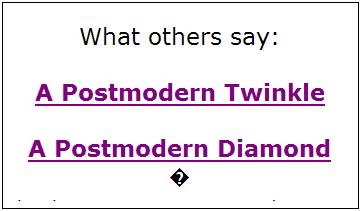
The above screenshot is only
an image of the links;
here are the links themselves:
A Postmodern Twinkle
A Postmodern Diamond
The question mark in the
diamond is the browser's
rendition of the server's
baffled response to
a character it cannot
recognize-- in this case,
the HTML code for
a blank space:
" "
Related material:
The God-Shaped Hole
Sunday, July 1, 2007 10:31 PM
Trinity Test
continued...
| "Three times the concentred self takes hold, three times The thrice concentred self, having possessed The object, grips it in savage scrutiny, Once to make captive, once to subjugate Or yield to subjugation, once to proclaim The meaning of the capture, this hard prize, Fully made, fully apparent, fully found." -- "Credences of Summer," VII, by Wallace Stevens, from Transport to Summer (1947) |
For a religious
interpretation
of 265, see
Sept. 30, 2004.
For a religious
interpretation
of 153, see
Fish Story.
A quotation from
the Eater of Souls:

Sunday, July 1, 2007 1:27 PM
Last to the Lost:
by the Numbers

2/21
A Superficial Beauty:

Structural Certainty:
| |
murphy plant, murphy grow, a maryamyria- | |
10 |
| |
meliamurphies, in the lazily eye of his lapis, | |
11 |
| |
|
|
12 |
| |
 |
|
13 |
| |
|
|
14 |
| Uteralterance or | Vieus Von DVbLIn, 'twas one of dozedeams | |
15 |
| the Interplay of | a darkies ding in dewood) the Turnpike under | |
16 |
| Bones in the | the Great Ulm (with Mearingstone in Fore | |
17 |
| Womb. | ground). 1 Given now ann linch you take enn | |
18 |
| |
all. Allow me! And, heaving alljawbreakical | |
19 |
| |
expressions out of old Sare Isaac's 2 universal | |
20 |
| The Vortex. | of specious aristmystic unsaid, A is for Anna | |
21 |
| Spring of Sprung | like L is for liv. Aha hahah, Ante Ann you're | |
22 |
| Verse. The Ver- | apt to ape aunty annalive! Dawn gives rise. | |
23 |
| tex. | Lo, lo, lives love! Eve takes fall. La, la, laugh | |
24 |
| |
leaves alass! Aiaiaiai, Antiann, we're last to | |
25 |
| |
the lost, Loulou! Tis perfect. Now (lens | |
26 |
-- Finnegans Wake, Book II,
Episode 2, page 293
1/27
Sunday, July 1, 2007 2:06 AM
Jewel in the Lotus, revised:
there the dance is.
-- T. S. Eliot
Humphrey Carpenter in The Inklings, his book on the Christian writers J. R. R. Tolkien, C. S. Lewis, and Charles Williams, says that
"Eliot by his own admission took the 'still point of the turning world' in Burnt Norton from the Fool in Williams's The Greater Trumps."— The Inklings, Ballantine Books, 1981, p. 106
Today's Birthdays: .... Actress-dancer Leslie Caron is 76.... Movie director Sydney Pollack is 73.... Dancer-choreographer Twyla Tharp is 66. --AP, "Today in History," July 1, 2007
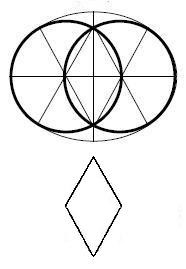
The Diamond
in the Mandorla