From the journal of Steven H. Cullinane...
2007 June 16-30
Saturday, June 30,
2007 10:04 PM
Annals of Theology:
November 2004--

Controversial
"Desperate Housewives"
ad on "Monday
Night Football"
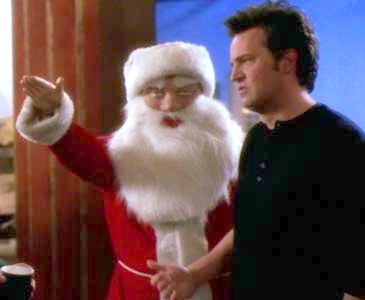
"Desperate Housewives"... ranks No. 5 among all prime-time shows for
ages 12-17. ("Monday Night Football" is No. 18.) This may explain in
part why its current advertisers include products like Fisher-Price
toys, the DVD of "Elf" and the forthcoming Tim Allen holiday vehicle,
"Christmas With the Kranks."
Those who cherish the First Amendment
can only hope that the Traditional Values Coalition,
OneMillionMoms.com, OneMillionDads.com and all the rest send every
e-mail they can to the F.C.C. demanding punitive action against the
stations that broadcast "Desperate Housewives." A "moral values"
crusade that stands between a TV show this popular and its audience
will quickly learn the limits of its power in a country where
entertainment is god.
-- "The Great Indecency Hoax," a New York Times column
by Frank Rich quoted in Log24 on Nov. 26, 2004
|
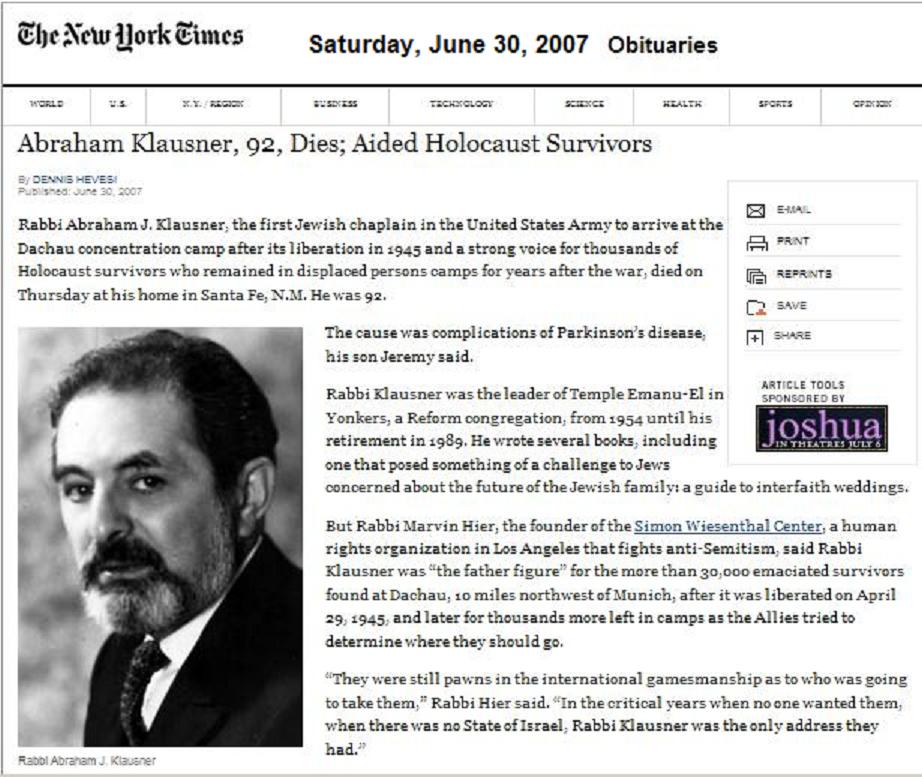
The entertainment continues. A rabbi's obituary in today's New
York Times (see previous entry) served as ad-bait for "Joshua,"
a Fox Searchlight film opening July 6.
A search for a less sacrilegious memorial to the rabbi yields the
following:

The "Project MUSE" link above
works only at
subscribing libraries.
It seems that here, too,
the rabbi is being
used as bait.
For a perhaps preferable
reference to bait, in the
context of St. Peter as
a "fisher of men," see
the Christian "mandorla"
or "vesica
piscis,"
a figure hidden within
the geometry of Rome's
St. Peter's Square--
which, despite its name,
is an oval:

For the geometric
construction of the
Roman oval, see
"ovato tondo" in
Rudolf Arnheim's
The
Power of the Center.
For a less theoretical account
of the religious significance
of the mandorla, see
the 2001 film
The Center of the World.
Saturday, June 30, 2007 1:00 PM
Father Figure
An Evening Star
for Rabbi Abraham Klausner,
a "father figure" according to
The New York Times.
The Times says Klausner
died at 92 on
|
Sunday, May 14, 2006
Today's birthday: George Lucas,
creator of the mother of all battle epics.
STAR WARS continued:
|
In the details:

Clicking on "Joshua" will take you
to a site on a film opening
July 6. That site describesthe title character as follows:
|
"Joshua is no ordinary boy....
He’s exceptionally intelligent and frighteningly precocious.
He has an angelic politeness and an easy cool that belie his young
age....
Is
it all a series of eerie coincidences or are they in the midst of an
unimaginably evil mind? And could it be Joshua who, like his Biblical
namesake, is bringing the house tumbling down around his family?"
|
The "Biblical namesake" is the
Joshua of the Old Testament--
source of the deeply flawed
"tumbling down" analogy.
In the New Testament,
Thursday, June 28, 2007 9:00 PM
Professor Eucalyptus again--
Real Numbers:
An Object Lesson
A Cornell professor discusses a poem by Wallace
Stevens:
"Professor Eucalyptus in 'Ordinary Evening' XIV, for example, 'seeks/
God in the object itself,' but this quest culminates in his own
choosing of 'the commodious adjective/ For what he sees... the
description that makes it divinity, still speech... not grim/ Reality
but reality grimly seen/ And spoken in paradisal parlance new'...."
"God in the object" seems
unlikely to be found in the
artifact pictured on the
cover of Mao's book:
I have more confidence
that God is to be found
in the Ping Pong balls
of the New York Lottery.

These objects may be
regarded as supplying
a parlance that is, if not
paradisal, at least
intelligible-- if only in
the context of my own
personal experience:
Journal entry dated 5/14:
Thursday, June 28, 2007 12:06 PM
Happy Birthday, Mel Brooks
Christianus
Cornelius Uhlenbeck
Oct. 18, 1866 - Aug. 12, 1951
"...
born at Voorburg near The Hague in Holland, and studied philology at
the University of Leiden.... Though he would actually have preferred to
graduate in Basque, Uhlenbeck in 1888, when only 22 years old, took his
doctor's degree in Dutch. It must be here noted that for this
degree
the requirements in comparative philology were very considerable...." --International Journal of American Linguistics,
Jan. 1953
From Uhlenbeck's A Manual of Sanskrit Phonetics (1898):
"The Indogermanic family of languages. The great family of
languages, in which Sanskrit belongs, is called the Indogermanic,
Indoceltic or Aryan.... The word Indogermanic
dates from a time, when it was not yet proved, that the Celtic dialects
also make part of our family of languages, and indicates by the
combined name of the utmost branches, Indian and Germanic, the whole
territory of speech, to which they belong. Now that it is certain, that
Celtic also is a member of our family, it would be accurate to replace
the word Indogermanic by Indoceltic, because not
Germanic, but Celtic is the utmost branch in the Occident. The name Indogermanic
however is generally adopted and it would be impossible to supplant it
by another. By the word Aryan
is generally understood a certain subdivision of the Indogermanic
family, viz. the Indo-Iranian, and therefore it would seem unsuitable
to use this name also for the whole Indogermanic family."
Wednesday, June 27, 2007 3:33 PM
Juneteenth Revisited--
A Long and Strange
Day
Time and chance
yesterday:
Pennsylvania Lottery
June 26, 2007--
Mid-day 040
Evening 810
040:
A discussion of the work of Ralph Ellison:
"... why do you think he did not finish these novels? He wrote on them
for many, many years-- 40 years, I think."
"Yes, he worked for 40 years."
See Ellison's novel Juneteenth (New
York Times review, 1999)
810:
August 10 (8/10), 2004 --
"But all things then were oracle and secret.
Remember the night when,
lost, returning, we turned back
Confused, and our headlights
singled out the fox?
Our thoughts went with it then,
turning and turning back
 With the
same terror,
With the
same terror,
into the deep thicket
Beside
the highway,
at home in the dark thicket.
I say the wood within is the dark wood...."
-- Donald Justice, "Sadness"
John Baez, Diary, entry of June 22, 2007:
"On Tuesday the 19th....
I hiked down the completely dark but perfectly familiar gravel road
with my suitcase in hand, listening to the forest creatures. But then,
I couldn't find my parents' driveway! It was embarrassing: I could see
their house perfectly well, off in the distance, but it was so darn
dark I couldn't spot the driveway. It felt like a dream: after a long
flight with many delays, one winds up walking to ones parents house,
lost in a spooky forest....
... I sort of enjoy this kind of
thing, as long as there's no real danger. It's also sort of scary. The
well-lit grid of civilization slowly falls away, and you're out there
alone in the night...
Anyway: I
considered hiking straight through the woods to my parents' house, but
I decided things were already interesting enough, so instead I called
my mom and ask her to drive down the driveway a bit, just so I could
see where it was. And so she did, and then it was obvious.
So, I got home shortly before midnight. A long and
strange day. My dad was already in bed, but I said hi to him anyway."
Related material:
Juneteenth through
Midsummer Night
Monday, June 25, 2007 3:00 PM
For Anti-Christmas:
Object Lesson
"... the best definition
I have for Satan
is that it is a real
spirit of unreality."
M. Scott Peck,
People of the Lie
"Far in the woods they sang
their unreal songs,
Secure. It was difficult
to sing in face
Of the object. The singers
had to avert themselves
Or else avert the object."
-- Wallace Stevens,
"Credences of Summer"
|
Today is June 25,
anniversary of the
birth in 1908 of
Willard Van Orman Quine.
Quine died on
Christmas Day, 2000.
Today, Quine's birthday, is,
as has been noted by
Quine's son, the point of the
calendar opposite Christmas--
i.e., "Anti-Christmas."
If the Anti-Christ is,
as M. Scott Peck claims,
a spirit of unreality, it seems
fitting today to invoke
Quine, a student of reality,
and to borrow the title of
Quine's Word and Object...
Word:
An excerpt from
"Credences of Summer"
by Wallace Stevens:
"Three times the concentred
self takes hold, three times
The thrice concentred self,
having possessed
The object, grips it
in savage scrutiny,
Once to make captive,
once to subjugate
Or yield to subjugation,
once to proclaim
The meaning of the capture,
this hard prize,
Fully made, fully apparent,
fully found."
-- "Credences of Summer," VII,
by Wallace Stevens, from
Transport to Summer (1947) |
Object:
From Friedrich
Froebel,
who invented kindergarten:

From Christmas 2005:
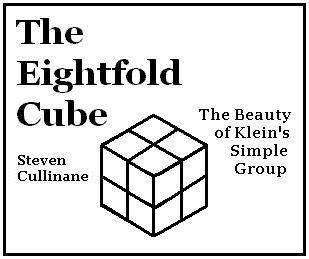
Click on the images
for further details.
For a larger and
more sophisticaled
relative of this object,
see yesterday's entry
At Midsummer Noon.
The object is real,
not as a particular
physical object, but
in the way that a
mathematical object
is real -- as a
pure Platonic form.
"It's all in Plato...."
-- C. S. Lewis
Sunday, June 24, 2007 12:00 PM
At Midsummer Noon:
Raiders of
the Lost Stone
(Continued from June 23)
Charles Williams:
"In Many Dimensions (1931)
Williams sets before his reader the
mysterious Stone of King Solomon,
an image he probably drew
from a brief description in Waite's
The Holy Kabbalah (1929)
of a supernatural cubic stone
on which was inscribed
Sunday, June 24, 2007 12:07 AM
Primitive Roots:
Midsummer Night
in the Garden
of Good and Evil

"I Put a Spell on You"
-- Nina Simone,
title of autobiograpy
"The
voodoo priestess looked across the table at her wealthy client, a man
on trial for murder: 'Now, you know how dead time works. Dead time
lasts for one hour-- from half an hour before midnight to half an hour
after midnight. The half-hour before midnight is for doin' good. The
half-hour after midnight is for doin' evil....'"
-- Glenna Whitley, "Voodoo Justice," The New York Times, March
20, 1994
Robert Pirsig, Zen and the Art of
Motorcycle Maintenance, 1974:
"But
what's happening is that each year our old flat earth of conventional
reason becomes less and less adequate to handle the experiences we have
and this is creating widespread feelings of topsy-turviness. As a
result we're getting more and more people in irrational areas of
thought... occultism, mysticism, drug changes and the like... because
they feel the inadequacy of classical reason to handle what they know
are real experiences."
"I'm not sure what you mean by classical reason."
"Analytic
reason, dialectic reason. Reason which at the University is sometimes
considered to be the whole of understanding. You've never had to
understand it really. It's always been completely bankrupt with regard
to abstract art. Nonrepresentative art is one of the root experiences
I'm talking about. Some people still condemn it because it doesn’t make
'sense.' But what's really wrong is not the art but the 'sense,' the
classical reason, which can't grasp it. People keep looking for branch
extensions of reason that will cover art's more recent occurrences, but
the answers aren't in the branches, they're at the roots."
"Let the midnight special
shine her light on me."

Saturday, June 23, 2007 6:00 PM
Tales from the Bully Pulpit:
Saturday, June 23, 2007 9:00 AM
In the Details, continued...
"As
though their knowledge of the quantum secrets came with the power of
prophecy, some three dozen of Europe's best physicists ended their 1932
meeting in Copenhagen with a parody of Goethe’s 'Faust.'....
It was only in retrospect that the silliness became profound. The
players were becoming possessors of 'a truth with implicit powers of
good and evil,' Gino Segrè writes in 'Faust in Copenhagen,' his
inventive new book about the era. And 'the devil... was in the
details.'" --George Johnson
Friday, June 22, 2007 2:22 PM
For Studio 60, a Bush Joke:
Thursday, June 21, 2007 9:57 PM
Time's whirligig spins, and...
Thursday, June 21, 2007 4:30 PM
Found in translation:
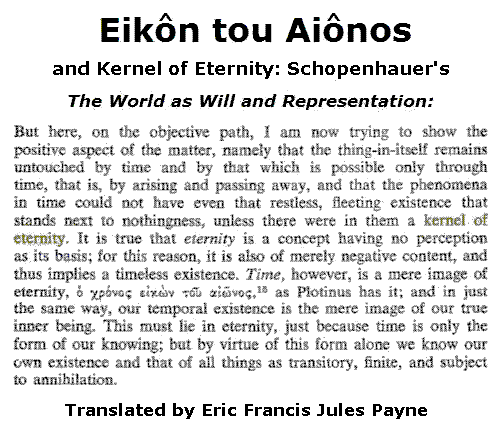
"Ich
aber, hier auf dem objektiven Wege, bin jetzt bemüht, das Positive
der
Sache nachzuweisen, daß nämlich das Ding an sich von der
Zeit und Dem,
was nur durch sie möglich ist, dem Entstehen und Vergehen,
unberührt
bleibt, und daß die Erscheinungen in der Zeit sogar jenes rastlos
flüchtige, dem Nichts zunächst stehende Dasein nicht haben
könnten,
wenn nicht in ihnen ein Kern aus der Ewigkeit*
wäre. Die Ewigkeit ist freilich ein Begriff, dem keine Anschauung
zum
Grunde liegt: er ist auch deshalb bloß negativen Inhalts, besagt
nämlich ein zeitloses Dasein. Die Zeit ist demnach ein
bloßes Bild der
Ewigkeit, ho chronos eikôn tou aiônos,**
wie es Plotinus***
hat: und ebenso ist unser zeitliches Dasein das bloße Bild unsers
Wesens an sich. Dieses muß in der Ewigkeit liegen, eben weil die
Zeit
nur die Form unsers Erkennens ist: vermöge dieser allein aber
erkennen
wir unser und aller Dinge Wesen als vergänglich, endlich und der
Vernichtung anheimgefallen."
* "a kernel of eternity"
** "Time is the image of eternity."
*** "wie es Plotinus hat"--
Actually, not Plotinus, but Plato,
according to Diogenes Laertius.
Related material:
Time
Fold,
J. N. Darby,
"On the Greek Words for
Eternity and Eternal
(aion and aionios),"
Carl Gustav Jung, Aion,
which contains the following
four-diamond figure,

and Jung
and the Imago Dei.
Thursday, June 21, 2007 12:07 PM
Structural Logic continued:
"His graceful accounts of the Bach Suites for Unaccompanied Cello
illuminated the works’ structural logic as well as their inner
spirituality."
--Allan Kozinn on Mstislav Rostropovich in The New York Times, quoted in Log24 on April 29, 2007
"At that instant he saw, in one blaze of light, an image
of unutterable
conviction.... the core of life, the essential pattern whence all other
things proceed, the kernel of eternity."
-- Thomas Wolfe, Of Time and the River, quoted in Log24 on June 9, 2005
"...
the stabiliser of an octad preserves the affine space structure on its
complement, and (from the construction) induces AGL(4,2) on it. (It
induces A8 on the octad, the kernel
of this action being the translation group of the affine space.)"
-- Peter J. Cameron, "The
Geometry of the Mathieu Groups" (pdf)
"... donc Dieu existe,
réponse!"
"Only gradually did I discover
what the mandala really is:
'Formation, Transformation,
Eternal Mind's eternal recreation'"
(Faust, Part Two, as
quoted by Jung in
Memories,
Dreams, Reflections)

"Pauli as Mephistopheles
in a 1932 parody of
Goethe's Faust at Niels Bohr's
institute in Copenhagen.
The drawing is one of
many by George Gamow
illustrating the script."
-- Physics Today
"Borja
dropped the mutilated book on the floor with the others. He was looking
at the nine engravings and at the circle, checking strange
correspondences between them.
'To meet someone' was his
enigmatic answer. 'To search for the stone that the Great Architect
rejected, the philosopher's stone, the basis of the philosophical work.
The stone of power. The devil likes metamorphoses, Corso.'"
-- The Club Dumas, basis for the Roman Polanski
film "The Ninth Gate" (See 12/24/05.)
"Pauli linked this symbolism
with the concept of automorphism."
-- The Innermost Kernel
(previous entry)
And from
"Symmetry in Mathematics
and Mathematics of Symmetry"
(pdf), by Peter J. Cameron,
a paper presented at the
International
Symmetry Conference,
Edinburgh, Jan. 14-17, 2007,
we have
The Epigraph--

(Here "whatever" should
of course be "whenever.")
Also from the
Cameron paper:
Local or global?
Among other (mostly more vague) definitions of symmetry, the
dictionary will typically list two, something like this:
• exact correspondence of parts;
• remaining unchanged by transformation.
Mathematicians
typically consider the second, global, notion, but what about the
first, local, notion, and what is the relationship between them?
A
structure M is homogeneous if every isomorphism between
finite substructures of M can be extended to an automorphism of
M; in other words, "any local symmetry is global."
|
Some Log24 entries
related to the above politically
(women in mathematics)--
Global and Local:
One Small Step
and mathematically--
Structural Logic continued:
Structure and Logic (4/30/07):
This entry cites
Alice
Devillers of Brussels--

"The aim of this thesis
is to classify certain structures
which are, from a certain
point of view, as homogeneous
as possible, that is which have
as many symmetries as possible."
"There is such a thing
as a tesseract."
-- Madeleine L'Engle
Wednesday, June 20, 2007 1:06 AM
ART WARS continued:
Kernel
Mathematical
Reviews citation:
MR2163497 (2006g:81002) 81-03
(81P05)
Gieser, Suzanne The innermost kernel. Depth psychology and
quantum physics. Wolfgang Pauli's dialogue with C. G. Jung. Springer-Verlag,
Berlin, 2005. xiv+378 pp. ISBN: 3-540-20856-9
A quote from MR at
Amazon.com:
"This revised translation of a Swedish Ph. D. thesis in philosophy
offers far more than a discussion of Wolfgang Pauli's encounters with
the psychoanalyst Carl Gustav Jung.... Here the book explains very well
how Pauli attempted to extend his understanding beyond superficial
esotericism and spiritism.... To understand Pauli one needs books like
this one, which... seems to open a path to a fuller understanding of
Pauli, who was seeking to solve a quest even deeper than quantum
physics." (Arne Schirrmacher, Mathematical Reviews, Issue 2006g)
An excerpt:
I
do not yet know what Gieser means by "the innermost kernel." The
following is my version of a "kernel" of sorts-- a diagram well-known
to students of anthropologist Claude Levi-Strauss and art theorist Rosalind
Krauss:
The four group is also known as the Vierergruppe
or Klein group. It appears, notably, as the translation subgroup
of A, the group of 24 automorphisms of the affine plane over
the 2-element field, and therefore as the kernel of the
homomorphism taking A to the group of 6 automorphisms of the
projective line over the 2-element field. (See Finite Geometry of
the Square and Cube.)
Tuesday, June 19, 2007 3:17 PM
Meta Physics continued:
Faustus
is gone:
regard his hellish fall
-- Marlowe
I have just read, in the New
York Times Book Review that arrived in yesterday's mail, a review
of Segre's Faust in Copenhagen. The review, on
news stands next Sunday, was titled by the Times "Meta
Physicists."
On Faust-- today's noon entry and yesterday's "Nightmare Lessons."
On "Meta Physicists"-- an entry of June 6, on Cullinane College, has a section
titled "Meta Physics."
On Copenhagen-- an entry of Bloomsday Eve, 2004 on a native of that city.
Another Dane:
"Words, words, words."
-- Hamlet
Another metaphysics:
"317 is a prime,
not because we think so,
or because our minds
are shaped in one way
rather than another,
but because it is so,
because mathematical
reality is built that way."
-- G. H. Hardy,
A Mathematician's Apology
Tuesday, June 19, 2007 1:00 PM
Timing, Part III:
Tuesday, June 19, 2007 12:00 PM
Timing, Part II:
Let Noon Be Fair
-- Title of a novel
by Willard Motley
A review of Helene Cixous's Three Steps on the Ladder of Writing:
"Cixous
explores three distinct 'schools' that produce what she envisions as
great writing-- the Schools of the Dead, of Dreams, and of Roots.
Cixous invests much weight in the purposefully ambiguous nature of the
word 'school'; she seems to refer to a motivation, conscious or
unconscious, that directs, influences, and shapes writing; at other
times she seems to want to speak of actual places from whence we get
instruction (again, consciously or unconsciously)."
From Under the Volcano, by Malcolm Lowry,
1947, Chapter I:
Faustus is gone: regard his hellish fall --
"Shaken, M. Laruelle replaced the book on the table...
he reached to
the floor for a folded sheet of paper that had fluttered out of it. He
picked the paper up between two fingers and unfolded it, turning it
over. Hotel Bella Vista, he read."
From The Shining, Chapter 18:
"In
1961 four writers, two of them Pulitzer Prize winners, had leased the
Overlook and reopened it as a writers' school. That had lasted one
year.... Every big hotel has got a ghost. Why? Hell, people come
and go.... (In the room the women come and go)" --Quoted in Shining Forth
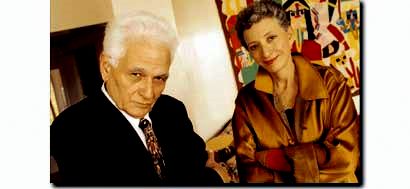
Photo: jewishbookweek.com
Jacques Derrida and Helene Cixous
Time of this entry:
Noon.
Tuesday, June 19, 2007 11:49 AM
Timing, Part I:
Let No Man Write
My Epitaph
-- Title of a novel
by Willard Motley
"Recall
the passage in the Odyssey when he [Ulysses] encounters the Cyclops
Polyphemos. Trying to disguise himself, to hide himself, Ulysses calls
himself Outis-- nobody, no man, personne. Here, in a strategy of simple
erasure, the Subject masks his singularity behind no one, das Man (here
in a sense that does not depend on the Heidggerian distinction between
the authentic Dasein and the inauthentic das Man). In French, Outis is
translated as personne, meaning no one, no particular subject."
-- Jacques Derrida, "Summary of Impromptu Remarks," pp. 39-45 in Anyone, ed. by Cynthia Davidson (New York:
Rizzoli International, 1991)
"In A
GOOD YEAR, more than one reference is made to the secret of comedy.
It's all in the timing, two characters explain." --Review
at epinions.com
Monday, June 18, 2007 1:00 PM
Annals of Education:
Nightmare
Lessons
"We are going to keep doing this
until we get it right."
--Log24 on June 15
Obituaries in the News
By THE ASSOCIATED PRESS
Published: Monday, June 18, 2007
in The New York Times
Filed at 6:13 a.m. ET
Norman Hackerman
"AUSTIN,
Texas (AP) -- Norman Hackerman, a chemist ... died Saturday [June 16]
.... He was 95. ... He taught chemistry ... before joining the
Manhattan Project to develop a nuclear weapon during World War II."
The date of Hackerman's death is celebrated in
Ireland as Bloomsday-- the day on which, in 1904, the events of
James Joyce's novel Ulysses came to pass.
From Log24 on Bloomsday 2007:
Scene from
"Behind the Lid" --

Photo by Richard Termine
"Behind the Lid" is an avant-garde
production featuring scenes from the author's life presented in the
form of dreams.
Those who like such scenes may consult past Log24 entries. They
will
find, for instance, the following, commemorating a death which, like
Hackerman's, occurred on a Bloomsday:
Click on the picture for details.
"History, Stephen said,
is a nightmare
from which I am
trying to awake."
-- Ulysses
Monday, June 18, 2007 2:00 AM
ART WARS: Mystic River Song

Yesterday, Father's Day, was also the
anniversary of the Battle of Bunker Hill.
Bunker Hill Community College
was the site yesterday of the
New
England Fine Arts Fair.
|

Folk are humpin'
And the chillun is high.
Oh yo' daddy's rich,
'Cos yo' ma is good lookin'...
|
"By
all means accept the invitation to hell, should it come. It will
not
take you far-- from Cambridge to hell is only a step; or at most a hop,
skip, and jump. But now you are evading-- you are dodging the
issue.... after all, Cambridge is hell enough."
-- Great Circle, a 1933 novel
by Conrad Aiken (father of Joan Aiken, who wrote The Shadow
Guests)
Sunday, June 17, 2007 7:00 PM
Father's Day Part III:
A selection from
the
Stephen King Hymnal
"... it's going to be
accomplished in steps,
this establishment
of the Talented in
the scheme of things."
-- Anne McCaffrey,
Radcliffe '47,
To
Ride Pegasus
See also
Part I and Part II.
Sunday, June 17, 2007 3:00 PM
Father's Day Part II:
No Place Like Home:
A Father's Day Special
for Stephen King

"... the poet's search
for the same exterior
made / Interior"
-- Wallace Stevens
"Imago. Imago. Imago."
-- Wallace Stevens
(See previous entry.)
Stevens's phrase was
the epigraph to
The Imago Sequence,
a novella published
in May 2005.
From a
review
(containing a spoiler)
of the novella:
"The
Imago Sequence are three notable photographs taken by an otherwise
unnotable photographer. They are photographs taken underground,
location a well kept secret, and show either a bizarre rock formation
carved out over millenia, or perhaps the imprint of a fossiled hominid
in an anguished pose.
The
photographs can have an impact on the viewer, and have had a history of
having a major impact on the owners. One has changed hands, and the new
owner shows off his new prized objet d'art, and sets one of his
employees the tasks [sic] of identifying the location of the
third in the sequence...."
Greensburg, Kansas
prior to
May 4, 2007:

This may be taken
as a reference to
today's previous entry.
That entry, like
the novella
The Imago Sequence,
contains a sequence
of three photographs.
The sequence was made
a month or so after the
novella was published,
but I was unaware
until this afternoon
that the novella existed.
Besides
"Imago Imago Imago,"
two other phrases
come to mind...
The real estate motto
"Location,
Location, Location"
and Stevens again--
"Adam in Eden was the
father of Descartes."
Happy Father's Day.
Sunday, June 17, 2007 2:02 PM
Father's Day Part I:
Saturday, June 16, 2007 12:00 PM
A Manhattan Project:
Obituaries in the
News
By THE ASSOCIATED PRESS
Published: June 16, 2007,
in The New York Times
Filed at 7:10 a.m. ET
Samuel Isaac Weissman
ST.
LOUIS (AP) -- Samuel Isaac Weissman, a professor and chemist who helped
develop the first atomic bomb as part of the Manhattan Project, has
died. He was 94.
Weissman died Tuesday [June 12]....
From Log24
on Tuesday,
June 12:
Sky Fish

Illustration from
LOGOS
(May 17, 2007)
From today's
New York Times:
Photo by Richard Termine
Scene from "Behind the Lid"
(See the Log24 entries from
June 12, the date of
Weissman's death.)
From Ben Brantley's
review of "Behind the Lid,"
a quote from the author:
"Her life, her voice says,
was devoted to discovering
'the inside on the outside,
the outside on the inside.'"
Related material:
Julie
Taymor--
"They did it from
the inside to the outside.
And from the outside to the in.
And that profoundly
moved me then. It was...
it was the most important thing
that I ever experienced."
Wallace Stevens--
Professor Eucalyptus said,
"The search/ For reality
is as momentous as/
The search for God."
It is the philosopher's search/
For an interior made exterior/
And the poet's search
for the same exterior
made/ Interior....
Saturday, June 16, 2007 12:00 AM
Thanks for the portrait, and