Friday, June 15, 2007 10:31 PM
Annals of Art Education:
(continued from Dec. 11, 2006):
J. G. Ballard on "the architecture of death":
"... a huge system of German fortifications that included the Siegfried line, submarine pens and huge flak towers that threatened the surrounding land like lines of Teutonic knights. Almost all had survived the war and seemed to be waiting for the next one, left behind by a race of warrior scientists obsessed with geometry and death."
-- The Guardian, March 20, 2006
From the previous entry, which provided a lesson in geometry related, if only by synchronicity, to the death of Jewish art theorist Rudolf Arnheim:
"We are going to keep doing this until we get it right."
Here is a lesson related, again by synchronicity, to the death of a Christian art scholar of "uncommon erudition, wit, and grace"-- Robert R. Wark of the Huntington Library. Wark died on June 8, a date I think of as the feast day of St. Gerard Manley Hopkins, a Jesuit priest-poet of the nineteenth century.
From a Log24 entry on the date of Wark's death--
Samuel Pepys on a musical performance (Diary, Feb. 27, 1668):
"When the Angel comes down""When the Angel Comes Down, and the Soul Departs," a webpage on dance in Bali:
"Dance is also a devotion to the Supreme Being.""I went to Bali to a remote village by a volcanic mountain...."
The above three quotations were intended to supply some background for a link
to an entry on Taymor, on what Taymor has called "skewed mirrors," and
on a related mathematical concept named, using a term Hopkins coined,
"inscapes."
They might form part of an introductory class in mathematics and art given, like the class of the previous entry, in Purgatory.
Wark, who is now, one imagines, in Paradise, needs no such class. He nevertheless might enjoy listening in.
A guest teacher in
the purgatorial class
on mathematics
and art:


"Is it safe?"
Friday, June 15, 2007 1:00 PM
ART WARS continued:
Art Education
Rudolf Arnheim, a student of Gestalt psychology (which, an obituary notes, emphasizes "the perception of forms as organized wholes") was the first Professor of the Psychology of Art at Harvard. He died at 102 on Saturday, June 9, 2007.
The conclusion of yesterday's New York Times obituary of Arnheim:
"... in The New York Times Book Review in 1986, Celia McGee called Professor Arnheim 'the best kind of romantic,' adding, 'His wisdom, his patient explanations and lyrical enthusiasm are those of a teacher.'"
A related quotation:
"And you are teaching them a thing or two about yourself. They are learning that you are the living embodiment of two timeless characterizations of a teacher: 'I say what I mean, and I mean what I say' and 'We are going to keep doing this until we get it right.'"
-- Tools for Teaching
Here, yet again, is an illustration that has often appeared in Log24-- notably, on the date of Arnheim's death:

"We have had a gutful of fast art and fast food. What we need more of is slow art: art that holds time as a vase holds water: art that grows out of modes of perception and whose skill and doggedness make you think and feel; art that isn't merely sensational, that doesn't get its message across in 10 seconds, that isn't falsely iconic, that hooks onto something deep-running in our natures. In a word, art that is the very opposite of mass media. For no spiritually authentic art can beat mass media at their own game."
-- Robert Hughes, speech of June 2, 2004
"Whether the 3x3 square grid is fast art or slow art, truly or falsely iconic, perhaps depends upon the eye of the beholder."
-- Log24, June 5, 2004
If the beholder is Rudolf Arnheim, whom we may now suppose to be viewing the above figure in the afterlife, the 3x3 square is apparently slow art. Consider the following review of his 1982 book The Power of the Center:
"Arnheim deals with the significance of two kinds of visual organization, the concentric arrangement (as exemplified in a bull's-eye target) and the grid (as exemplified in a Cartesian coordinate system)....
It is proposed that the two structures of grid and target are the symbolic vehicles par excellence for two metaphysical/psychological stances. The concentric configuration is the visual/structural equivalent of an egocentric view of the world. The self is the center, and all distances exist in relation to the focal spectator. The concentric arrangement is a hermetic, impregnable pattern suited to conveying the idea of unity and other-worldly completeness. By contrast, the grid structure has no clear center, and suggests an infinite, featureless extension.... Taking these two ideal types of structural scaffold and their symbolic potential (cosmic, egocentric vs. terrestrial, uncentered) as given, Arnheim reveals how their underlying presence organizes works of art."
-- Review of Rudolf Arnheim's The Power of the Center: A Study of Composition in the Visual Arts (Univ. of Calif. Press, 1982). Review by David A. Pariser, Studies in Art Education, Vol. 24, No. 3 (1983), pp. 210-213
We may imagine such a discussion in an afterlife art class-- in, perhaps, Purgatory rather than Heaven-- that now includes Arnheim as well as Ernst Gombrich and Kirk Varnedoe.
Such a class would be one prerequisite for a more advanced course-- Finite geometry of the square and cube.
Thursday, June 14, 2007 9:00 PM
Nine is a Vine:
for Remembering
June 9, the birthday of
Aaron Sorkin, a writer
mentioned in recent
Log24 entries, was also
the birthday of writer
Patricia Cornwell.
An illustration
from that date:
Cornwell's first book was
a biography of
Ruth Bell Graham,
A Time for Remembering.
"Seven is heaven,
Eight is a gate,
Nine is a vine."
Thursday, June 14, 2007 4:00 PM
A Death, A Life...
"Kurt Waldheim, the former United Nations Secretary General and President of Austria whose hidden ties to Nazi organizations and war crimes was [sic] exposed late in his career, died today at his home in Vienna. He was 88." --The New York Times this afternoon
From a story by
Leonard Michaels
linked to on
Aaron Sorkin's
birthday, June 9:
It has been said that the unexamined life isn't worth living. Nachman wasn't against examining his life, but then what was a life? ....
2. A quotation from an anonymous
Internet user signed
"George Polya"--
"Steven Cullinane is a Liar."
3. L'Affaire Dharwadker continues
(May 31, 2007)
4. Geometry for Jews

"One two three four,
who are we for?"
Thursday, June 14, 2007 10:35 AM
For a Bright Star:
Trifecta

Arts & Letters Daily (14 Jun 2007):
Every time an economic impact study comes out, you know the pigs are at the pastry cart. "Save your city by giving money to the arts!" Yeah, sure... more
Democracy can flourish in India only if every citizen resists the will to dominate and accepts the reality and equality of others... more
The
American left has turned into a skittish, hysterical old lady who lives
in the past, falls for pseudo-intellectual garbage, and runs from real
conflict or responsibility... more
Thursday, June 14, 2007 2:00 AM
Gestalt, Part II
Epiphany: A link in the Log24 entries for Epiphany 2007 leads to Damnation Morning, which in turn leads to Why Me?, a discussion of the mythology of Spiders vs. Snakes devised by Fritz Leiber. Spiders represent the conscious mind, snakes the unconscious.
On Hexagram 18: "The Chinese character ku represents a bowl in whose contents worms are breeding. This means decay." --Wilhelm's commentary
This brings us back to the previous entry with its mention of the date of Rudolf Arnheim's death: Saturday, June 9. In Log24 on that date there was a link, in honor of Aaron Sorkin's birthday, to a short story by Leonard Michaels. That link was suggested, in part, by a review in the Sunday New York Times Book Review (available online earlier, on Friday). Here is a quote from that review related to the Hexagram 18 worm bowl:
"... what grabbed attention for his early collections was Michaels's gruesome, swaggering depiction of the sexual rampage that was the swinging '60s in New York-- 'the worm bucket,' as Michaels described an orgy."
Related material for meditation on this, the anniversary (according to Encyclopaedia Britannica) of the birth of author Jerzy Kosinski-- his novel The Hermit of 69th Street.
Kosinski was not unfamiliar with Michaels's worm bucket. For related information, see Hermit (or at least a review).
In Leiber's stories the symbol of the Snakes is similar to the famed Yin-Yang symbol, also known as the T'ai-chi tu. For an analysis of this symbol by Arnheim, see the previous entry. See also "Sunday in the Park with Death" (Log24, Oct. 26, 2003):
Thursday, June 14, 2007 1:06 AM
Gestalt, Part I
In memory of
Rudolf Arnheim,
who died on
Saturday, June 9
From the Wikipedia article on Gestalt psychology prior to its modification on May 31, 2007:
"Emergence, reification, multistability, and invariance are not separable modules to be modeled individually, but they are different aspects of a single unified dynamic mechanism.
For a mathematical example of such a mechanism using the cubes of psychologists' block design tests, see Block Designs in Art and Mathematics and The Kaleidoscope Puzzle."
The second paragraph of the above passage refers to my own work.
Some Gestalt-related work of Arnheim:

"Perceptual Analysis of a
Symbol of Interaction,"
pp. 222-244 in
Toward a Psychology of Art:
Collected Essays,
Univ. of Calif. Press, 1966
Time of this entry:
1:06:18 AM ET.
Wednesday, June 13, 2007 6:29 PM
From Andrew Cusack:
for Spain

Click for details.
Related flaming crosses:
Nov. 19, 2004
and
Nov. 21, 2004.
(This entry was actually made
just before noon on June 14.
Its time, 6:29, was reserved
earlier in honor of
the date 6/29.)
Wednesday, June 13, 2007 12:00 PM
Endings

One Notch Above
Maureen Dowd in today's New York Times on "Sopranos" creator David Chase:
"Mr. Chase, an apocalyptic tease, gave us a gimmicky and unsatisfying film-school-style blackout for an end to his mob saga, a stunt one notch above 'It was all a dream.'"
Tuesday, June 12, 2007 11:07 PM
Because, because, because, because...
"... Packaging is unavoidable.
Facts rarely, if ever,
speak for themselves."
-- Matthew C. Nisbet,
American University
Assistant Professor
of "Communication,"
on June 6, 2007, in
Framing Science
Frame this.
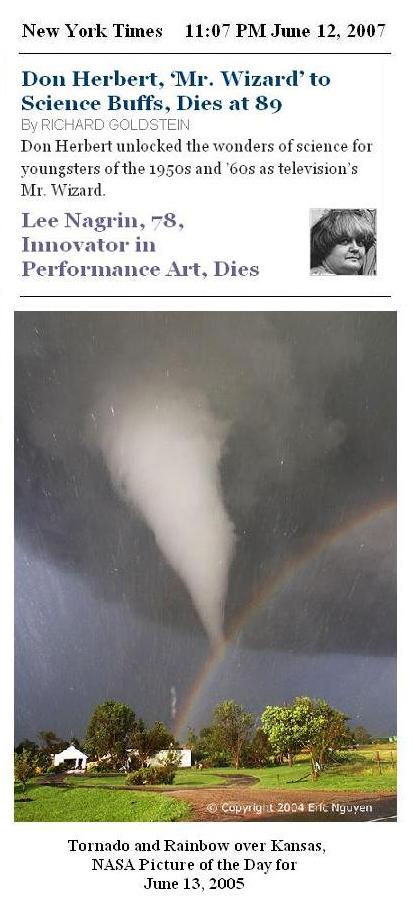
Related material:
previous Log24 entries
of June 10-12
Tuesday, June 12, 2007 2:00 PM
Stage Space
Sky Fish

Illustration from
LOGOS
(May 17, 2007)
From an obituary in today's New York Times:
"Lee Nagrin, a noted Off Broadway performance artist... died Thursday in Manhattan. She was 78....
She formed her own company, the Sky Fish Ensemble, in 1979 and presented performance-art pieces that tended to unspool like fairy tales, filled with mysterious, archetypal imagery. Her own presence was mysterious, too, both on and off the stage, often conjuring up the sense of a keen-eyed, all-seeing, benign witch.
She created some of those images midperformance, as when she traced a landscape along brown paper that ringed the stage space of Silver Whale Gallery, where much of her work was performed.
For
her last piece, 'Behind the Lid,' she collaborated with the puppeteer
Basil Twist on a story in which a woman looks back on her life through
a dream. Performances are this month at the Silver Whale."
LEE NAGRIN AND BASIL TWIST’S
BEHIND THE LID
Tuesday - Sunday @ 8PM
June 3rd - June 28th
Silver Whale Gallery
"Silver Whale Gallery (21 Bleecker Street) proudly announces the world
premiere of BEHIND THE LID, a new play by playwright/performer Lee
Nagrin and puppeteer/performer Basil Twist that chronicles a woman
looking back on her life through a dream;
her memories expand, open and reveal while an intimate audience of 18
will travel with her through this hand made world. Audience members are
guided by a young familiar through this older woman's life and dreams.
They experience layer upon layer of the life of an American artist -
Lee Nagrin. Basil Twist creates the puppetry and performs.
Tickets
for BEHIND THE LID are $40. To purchase tickets, please call
Smarttix.com at 212-868-4444 or for more information visit
www.leenagrin.com on the Internet."
on June 7, the date
of Nagrin's death:
"... Packaging is unavoidable.
Facts rarely, if ever,
speak for themselves."
-- Matthew C. Nisbet,
Assistant Professor
of "Communication,"
June 6, 2007
From the
New York Lottery
on June 7, the date
of Nagrin's death:
Mid-day: 603
Evening: 805
Another opening of
another show.
Monday, June 11, 2007 12:00 AM
Another Midnight Special
Second Billing, Part III:
Philosophy of
Communication

Pictures are more accessible
than words. See Logos
(May 17) and Torbellino
(June 10), as well as
the entries for June 8,
the date of Rorty's death.
Sunday, June 10, 2007 12:00 PM
Happy Birthday, Judy Garland

Iago states that he is not who he is. --Mark F. Frisch
La historia agrega que, antes o después de morir, se supo frente a Dios y le dijo: «Yo, que tantos hombres he sido en vano, quiero ser uno y yo». La voz de Dios le contestó desde un torbellino: «Yo tampoco soy; yo soñé el mundo como tú soñaste tu obra, mi Shakespeare, y entre las formas de mi sueño estabas tú, que como yo eres muchos y nadie». --Jorge Luis Borges
Sunday, June 10, 2007 2:00 AM
Garden of the Soul
The Miracle of the Bells
quoted in
A Mass for Lucero--
"'A pretty girl--
is like a melody---- !'
But that was always
Bill Dunnigan's
Song of Victory....
Thus thought the...
press agent for
'The Garden of the Soul.'"
"Ay que bonito es volar
A las dos de la mañana...."
-- "La Bruja"
For a rendition by
Salma Hayek, click
on the picture below.

Related material:
Log24 entries for
May 18, 2007.
Saturday, June 9, 2007 9:00 AM
Happy Birthday, Aaron Sorkin
Friday, June 8, 2007 4:00 PM
ART WARS continued:
Samuel Pepys on a musical performance (Diary, Feb. 27, 1668):
"When the Angel comes down"
"When the Angel Comes Down, and the Soul Departs," a webpage on dance in Bali:
"Dance is also a devotion to the Supreme Being."
"I went to Bali to a remote village by a volcanic mountain...."
"No se puede vivir sin amar."
Log24 on St. Peter's Day, 2004:
"And so to bed."
Friday, June 8, 2007 2:00 PM
Commencement week ends:
| "Beautiful indeed is the source of truth. To measure the changes of time and space the smartest are nothing." |

Thursday, June 7, 2007 4:15 PM
What is Truth, continued:
truth
On "framing" and "spin"
in journalism:
"... Packaging is unavoidable.
Facts rarely, if ever,
speak for themselves."
-- Matthew C. Nisbet,
Assistant Professor
of "Communication,"
June 6, 2007
If they could, they might
say "We was framed!"
Facts cannot, of course,
speak for themselves
to those who do not
understand their language.
Example:
A picture that appeared in
Log24 on June 7, 2005:

Click for details.
Attempt to
frame the picture:
Analogies
"A functor is an analogy."
-- Anonymous
The best mathematicians "see
analogies between analogies."
-- Banach, according to Ulam
For further details,
click on the link
"Analogies" above.
See also the analogies in
the previous entry.
Thursday, June 7, 2007 11:30 AM
Final Arrangements, continued:
From the May 6, 2007,
New York Times,
Charles McGrath on
Philip K. Dick:
His early novels, written in two weeks or less, were published in double-decker Ace paperbacks that included two books in one, with a lurid cover for each. "If the Holy Bible was printed as an Ace Double," an editor once remarked, "it would be cut down to two 20,000-word halves with the Old Testament retitled as 'Master of Chaos' and the New Testament as 'The Thing With Three Souls.'"

Click to enlarge.
As for "the thing with
three souls"--
Part I:
"Educate, Empower, Entertain"
-- Motto of Yolanda King
Part II:
Three universities
(but not those of
Martin Myerson)--
Princeton, Harvard, Cambridge
Wednesday, June 6, 2007 11:07 AM
A Mathematical Narrative
June 7 in New Zealand.
Today at Cullinane College:
Examination Day

(For the college curriculum,
see the New Zealand
Qualifications Authority.)
If Cullinane College were Hogwarts--
Last-minute exam info:
The Lapis Philosophorum
"The lapis was thought of as a unity and therefore often stands for the prima materia in general."
-- Aion, by C. G. Jung"Its discoverer was of the opinion that he had produced the equivalent of the primordial protomatter which exploded into the Universe."
-- The Stars My Destination, by Alfred Bester
And from Bester's The Deceivers:
Meta Physics
"'... Think of a match. You've got a chemical head of potash, antimony, and stuff, full of energy waiting to be released. Friction does it. But when Meta excites and releases energy, it's like a stick of dynamite compared to a match. It's the chess legend for real.'
'I don't know it.'
'Oh, the story goes that a philosopher invented chess for the amusement of an Indian rajah. The king was so delighted that he told the inventor to name his reward and he'd get it, no matter what. The philosopher asked that one grain of rice be placed on the first square of the chessboard, two on the second, four on the third, and so on to the sixty-fourth.'
'That doesn't sound like much.'
'So the rajah said. ...'"
Related material:
Geometry of the I Ching
Tuesday, June 5, 2007 6:01 PM
Mathematics and Narrative, continued:
and a Bridge
"... just as God defeats the
devil: this bridge exists ..."
-- Andre Weil
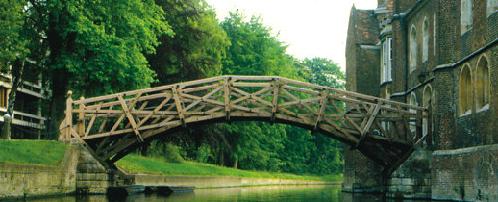
The "Mathematical"
Bridge at Queens' College,
Cambridge:
Some related material
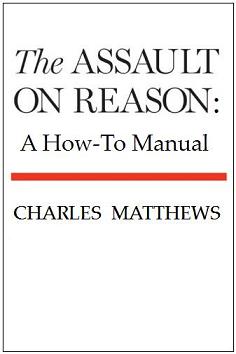
might well be titled,
as in
the previous entry's
parody of a new book,
For details, see
Connecting Ideas
and
Blitzes at Wikipedia.
(The reference in the parody
book cover above is to
Charles Matthews,
Wikipedia administrator
and former
Fellow of Queens' College.)
Tuesday, June 5, 2007 2:00 PM
Meanwhile, back at Harvard...
This morning was the
Princeton commencement.
Meanwhile...

courtesy of Kenneth L.
From the May 18 Harvard Crimson:
"Paul B. Davis ’07-’08, who contributed
to a collection of student essays
written in 2005 on the purpose
and structure of a Harvard education,
said that 'the devil is in the details'...."
For the details, see
Al Gore and the
Absence of Truth
(May 30, 2007).
Tuesday, June 5, 2007 11:08 AM
Whirligig continued...
A Whirligig Tour

website on
"Presbyterian
Creedal Standards"
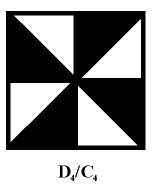
The above symbol
appeared here
on 11/8/02.
Related material:
1. The remarks of
Bradley Whitford
at Princeton's
Class Day yesterday:

2. An illustration from
Log 24 on 11/10/06:
|
|
Paul Robeson in |

3. The Whirligig of Time
(1/5/03):

4. Natalie Angier, priestess of Scientism
(5/26/07), and her new book
The Canon: A Whirligig Tour of
the Beautiful Basics of Science
(available as a special from
Amazon.com):
| Better Together Buy this book with God Is Not Great: How Religion Poisons Everything by Christopher Hitchens today!
Customers who bought this item also bought God Is Not Great: How Religion Poisons Everything by Christopher Hitchens |


Sunday, June 3, 2007 9:29 PM
For Princeton's Class of 2007:
Albert Einstein--
"God does not play dice
with the universe."
Reply by the
New Jersey Lottery on
Sunday, June 3, 2007--
Mid-day 220, evening 939.
Related material
Review of a 2004 production
of a 1972 Tom Stoppard
play, "Jumpers"--

Sunday, June 3, 2007 10:31 AM
Today's Sermon:
"Macquarrie remains one of the most
important commentators [on] ...
Heidegger's work. His co-translation
of Being and Time into English is
considered the canonical version."
-- Wikipedia

The Rev. Macquarrie died on
May 28. The Log24 entry
for that date contains the
following illustration:

The part of the illustration
relevant to the death of
Macquarrie is the color.
From my reply to
a comment on the
May 28 entry:
From McKenna's afterword:
any remarks of Whitehead
on the color "dove grey"
(or "gray") but Whitehead
did say that
McKenna on the color
"dove grey" may be
taken, in a schizophrenic
(or, similarly, a Christian) way,
as a reference to the Holy Spirit.
My own remarks on the hippie
scene seem appropriate as a
response to media celebration
of today's 40th anniversary of
the beginning of the 1967
"summer of love."
Saturday, June 2, 2007 8:00 AM
Connecting Ideas
"I don't think the 'diamond theorem' is anything serious, so I started with blitzing that."
-- Charles Matthews at Wikipedia, Oct. 2, 2006
"The 'seriousness' of a mathematical theorem lies, not in its practical consequences, which are usually negligible, but in the significance of the mathematical ideas which it connects. We may say, roughly, that a mathematical idea is 'significant' if it can be connected, in a natural and illuminating way, with a large complex of other mathematical ideas."
-- G. H. Hardy, A Mathematician's Apology