From the journal of Steven H. Cullinane...
2007 January 16-31
Wednesday, January 31, 2007
3:09 PM
Happy Birthday, Norman Mailer
Ontotheology "At times, bullshit can only be
countered with superior bullshit."
--
Norman Mailer "It may be that universal history is the
history of the different intonations
given a handful of metaphors."
-- Jorge Luis Borges (1951),
"The Fearful Sphere of Pascal,"
in
Labyrinths, New Directions, 1962
"Before
introducing algebraic semiotics and structural blending, it is good to
be clear about their philosophical orientation. The reason for taking
special care with this is that, in Western culture, mathematical
formalisms are often given a status beyond what they deserve. For
example, Euclid wrote, '
The laws of nature are but the mathematical thoughts of God.'"
-- Joseph A. Goguen, "Ontology, Society, and Ontotheology" (
pdf)
Goguen does not give a source for this alleged "thoughts of God" statement.
A Web search for the source leads only to
A Mathematical Journey, by
Stanley Gudder, who apparently also attributes the saying to Euclid.
Neither Goguen nor Gudder seems to have had any interest in the accuracy of the Euclid attribution.
Talk of "nature" and "God" seems unlikely from Euclid, a pre-Christian
Greek whose pure mathematics has (as G. H. Hardy might be happy to
point out) little to do with either.
Loose talk about God's thoughts has also been attributed to Kepler and Einstein... and we all know about Stephen Hawking.
Gudder may have been misquoting some other author's
blather about Kepler. Another possible source of the "thoughts of God" phrase is
Hans Christian Oersted. The following is from Oersted's
The Soul in Nature--
"Sophia. Nothing
of importance; though indeed I had one question on my lips when the
conversion took the last turn. When you alluded to the idea, that the
Reason manifested in Nature is infallible, while ours is fallible,
should you not rather have said, that our Reason accords with that of
Nature, as that in the voice of Nature with ours?
Alfred. Each
of these interpretations may be justified by the idea to which it
applies, whether we start from ourselves or external nature. There are
yet other ways of expressing it; for instance, the laws of Nature are
the thoughts of Nature.
Sophia. Then these thoughts of Nature are also thoughts of God.
Alfred.
Undoubtedly so, but however valuable the expression may be, I would
rather that we should not make use of it till we are convinced that our
investigation leads to a view of Nature, which is also the
contemplation of God. We shall then feel justified by a different and
more perfect knowledge to call the thoughts of Nature those of God; I
therefore beg you will not proceed to [sic] fast."
Oersted
also allegedly said that "The Universe is a manifestation of an
Infinite Reason and the laws of Nature are the thoughts of God." This
remark was found (via Google book search) in an obscure journal that does not give a precise source for the words it attributes to Oersted.

Monday, January 29, 2007
9:00 AM
Robot Wisdom continued:
By Indirections
(Hamlet, II, i)
"Michael Taylor (1971).... contends that the central conflict in Hamlet is between 'man as victim of fate and as controller of his own destiny.'"-- The Gale Group, Shakespearean Criticism, Vol. 71, at eNotes
Doonesbury today:
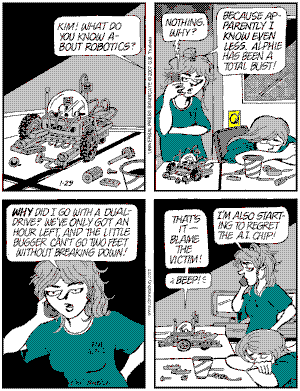
"Personality is a synthesis of possibility and necessity."-- Soren Kierkegaard
On Fate (Necessity),
Freedom (Possibility),
and Machine Personality--
Part I: Google as Skynet
George Dyson--
The Godel-to-Google Net [March 8, 2005]
A Cathedral for Turing [October 24, 2005]
Dyson: "The correspondence between Google and biology is not an analogy, it's a fact of life."
Part II: The Galois Connection
David Ellerman--
"A Theory of Adjoint Functors-- with some Thoughts about their Philosophical Significance" (pdf) [November 15, 2005]
Ellerman:
"Such a mechanism seems key to understanding how an organism can
perceive and learn from its environment without being under the direct
stimulus control of the environment-- thus resolving the ancient
conundrum of receiving an external determination while exercising
self-determination."
For a less technical version, see Ellerman's "Adjoints and Emergence: Applications of a New Theory of Adjoint Functors" (pdf).
Ellerman
was apparently a friend of, and a co-author with, Gian-Carlo Rota. His
"theory of adjoint functors" is related to the standard mathematical
concepts known as profunctors, distributors, and bimodules.
The applications of his theory, however, seem to be less to mathematics
itself than to a kind of philosophical poetry that seems rather
closely related to the above metaphors of George Dyson. For a less
poetic approach to related purely mathematical concepts, see, for
instance, the survey Practical Foundations of Mathematics by Paul Taylor (Cambridge University Press, 1999).
For less poetically appealing, but perhaps more perspicuous,
extramathematical applications of category theory, see the work of, for
instance, Joseph Goguen: Algebraic Semiotics and Information Integration, Databases, and Ontologies.
Saturday, January 27, 2007
9:00 AM
Art Wars continued...
Art and the
Holy Spirit
Madeleine L'Engle in The Irrational Season (1977), beginning of Chapter 9 (on Pentecost):
"The Holy Spirit, the third person of the Trinity, is the easiest of
this not-at-all-easy concept for me to understand. Any artist, great
or small, knows moments when something more than he takes over, and he
moves into a kind of 'overdrive,' where he works as ordinarily he
cannot work. When he is through, there is a sense of exhilaration,
exhaustion, and joy. All our best work comes in this fashion, and it
is humbling and exciting.
After A Wrinkle in Time was
finally published, it was pointed out to me that the villain, a naked
disembodied brain, was called 'It' because It stands for Intellectual
truth as opposed to a truth which involves the whole of us, heart as
well as mind. That acronym had never occurred to me. I chose the name
It intuitively, because an IT does not have a heart or soul. And I did
not understand consciously at the time of writing that the intellect,
when it is not informed by the heart, is evil."
Friday, January 26, 2007
2:48 PM
Philosophy Wars continued...
IT
"... at last she realized
what the Thing on the dais was.
IT was a brain.
A disembodied brain...."
"There could not be an objective test
that distinguished a clever robot
from a really conscious person."
-- Daniel Dennett in TIME magazine,
"If telepathy is admitted
it will be necessary
to tighten our test up."
Wednesday, January 24, 2007
1:00 AM
Eureka
The Dead Shepherd
starring E. Howard Hunt
and James Jesus Angleton
From this morning's
New York Times:

Tim Weiner in today's New York Times:
"Mr. Hunt was intelligent, erudite, suave and loyal to his friends....
Everette
Howard Hunt Jr. was born in Hamburg, N.Y., on Oct. 9, 1918, the son of
a lawyer and a classically trained pianist who played church organ. He
graduated from Brown University in June 1940 and entered the United
States Naval Academy as a midshipman in February 1941.
He
worked as a wartime intelligence officer in China, a postwar spokesman
for the Marshall Plan in Paris and a screenwriter in Hollywood. Warner
Brothers had just bought his fourth novel, 'Bimini Run,' a thriller set
in the Caribbean, when he joined the fledgling C.I.A. in April 1949.
Mr.
Hunt was immediately assigned to train C.I.A. recruits.... He moved to
Mexico City, where he became chief of station in 1950. He brought along
another rookie C.I.A. officer, William F. Buckley Jr., later a
prominent conservative author and publisher, who became godfather and
guardian to the four children of Mr. Hunt and his wife, the former
Dorothy L. Wetzel.
In 1954, Mr. Hunt helped plan the covert operation that overthrew the elected president of Guatemala....
By
the time of the coup, Mr. Hunt had been removed from responsibility. He
moved on to uneventful stints in Japan and Uruguay. Not until 1960 was
Mr. Hunt involved in an operation that changed history.
The
C.I.A. had received orders from both President Dwight D. Eisenhower and
his successor, President John F. Kennedy, to alter or abolish the
revolutionary government of Fidel in Cuba. Mr. Hunt's assignment was to
create a provisional Cuban government that would be ready to take power
once the C.I.A.'s cadre of Cuban shock troops invaded the island....
He
retired from the C.I.A. in 1970 and secured a job with an
agency-connected public relations firm in Washington. Then, a year
later, came a call from the White House....
Mr.
Hunt’s last book, 'American Spy: My Secret History in the C.I.A.,
Watergate and Beyond,' written with Greg Aunapu, is to be published on
March 16 with a foreword by his old friend William F. Buckley Jr.
Late in life, he said he had no regrets, beyond the Bay of Pigs."
Related Material:
Game Boy,
Philosophy Wars,
and the following:

"In his study of The Cantos,
Davenport defines the Poundian
ideogram as 'a grammar of images,
emblems, and symbols, rather than
a grammar of logical sequence....
An idea unifies, dominates, and
controls the particulars that make
the ideogram'."

Photo from Miami University site
Tuesday, January 23, 2007
12:00 PM
Philosophy Wars
Quine vs. Kierkegaard
"The most prominent critic
of the modal notions is Quine.
Throughout his career, he has
argued against the use of notions
like necessity and possibility."
-- Michael J. Loux,
Note 1 of Chapter 5,
"The Necessary and the Possible,"
in Metaphysics:
A Contemporary Introduction
(Routledge, second edition,
January 1, 2002)
"Personality is a synthesis of
possibility and necessity."
-- Soren Kierkegaard,
The Sickness Unto Death
Related material:
Plato, Pegasus,
and the Evening Star
Diamonds Are Forever
Dream a Little Dream
Update of 3:45 PM:
From Arts & Letters Daily
this afternoon--
"Existentialism is not all gloom,
even if Heidegger looks pretty sour
in those photos. It’s a philosophy
that America needs now, says
the late Robert Solomon...
more ... obit"
See also Jan. 2,
the date of
Solomon's death
in Switzerland,
and click on the
following symbol
from that date:

Monday, January 22, 2007
11:11 AM
Dream a Little Dream:
A Brief Alternate Version of
The Diamond Age:
Or, a Young Lady's
Illustrated Primer
Piper Laurie is 75.
For Piper Laurie
on her birthday
(again):
"He was part of my dream, of course--
but then I was part of his dream, too!"
-- Lewis Carroll,
Through the Looking Glass
Chapter XII ("Which Dreamed It?")

He
looked at her face. She was very drunk. Her eyes were swollen, pink
at the corners. "What's the book?" he said, trying to make his voice
conversational. But it sounded loud in the room, and hard.
She blinked up at him, smiled sleepily, and said nothing.
"What's the book?" His voice had an edge now.
"Oh," she said. "It's Kierkegaard. Soren Kierkegaard."
She pushed her legs out straight on the couch, stretching her feet.
Her skirt fell back a few inches from her knees. He looked away.
"What's that?" he said.
"Well, I don't exactly know, myself." Her voice was soft and thick.
He turned his face away from her again, not knowing what he was
angry with. "What does that mean, you don't know, yourself?"
She blinked at him. "It means, Eddie, that I don't exactly know what
the book is about. Somebody told me to read it, once, and that's what
I'm doing. Reading it."
-- Walter Tevis, The Hustler
Sunday, January 21, 2007
11:22 AM
California Dreamin', Part II
Saturday, January 20, 2007
2:14 PM
Storyboard
Saturday, January 20, 2007
1:00 PM
ART WARS continued
From today's online New York Times:
Friday, January 19, 2007
11:07 PM
Art Wars at The New Criterion:
Triple Kiss

| I bent to kiss the lovely Maid, | |
| And found a threefold kiss return’d. |
-- "The Crystal Cabinet"
The above illustration of a classic Blake verse is for Anthony Daniels,
a critic of Ezra Pound. The illustration may appeal to Daniels, since
it is, like the persona presented by Daniels himself, petit-bourgeois
and vulgar.
It was inspired by today's two previous entries and by Daniels's remarks, in this month's New Criterion magazine, on Ezra Pound:
"Of his poetry I shall say nothing: not being fluent in Greek, Chinese,
Italian, Farsi, and so forth, I do not feel much qualified to comment
on it.... I shall merely confess to a petit-bourgeois partiality for
comprehensibility and to what Pound himself called, in the nearest he
ever came to a mea culpa with regard to his own ferocious anti-Semitism
at a time of genocide, 'a vulgar suburban prejudice' against those who
suppose that their thoughts are so profound that they justify a
lifetime of exegesis if ever their meaning is to be even so much as
glimpsed through a glass darkly."
-- "Pound's Depreciation"
Daniels, here posing as
a vulgar suburban petit-bourgeois, is unwilling to examine Pound's
poetry even "through a glass darkly." This echoes the petit-bourgeois,
but not vulgar, "confession" of today's previous entry:
"I didn't expect much--didn't look out the window
At school more diligent than able--docile stable"
-- "A Life," by Zbigniew Herbert
Pound, editor of T. S. Eliot's "The Waste Land"-- published in the first issue of the original Criterion magazine in 1922-- might refer Daniels to the ghost of Guy Davenport:
"'The architectonics of a narrative,' Davenport says, 'are emphasized
and given a role to play in dramatic effect when novelists become
Cubists; that is, when they see the possibilities of making a
hieroglyph, a coherent symbol, an ideogram of the total work. A symbol
comes into being when an artist sees that it is the only way to get all
the meaning in.'....
In his study of The Cantos,
Davenport defines the Poundian ideogram as 'a grammar of images,
emblems, and symbols, rather than a grammar of logical sequence.... An
idea unifies, dominates, and controls the particulars that make the
ideogram'.... He insists on the intelligibility of this method: 'The
components of an ideogram cohere as particles in a magnetic field,
independent of each other but not of the pattern in which they figure.'"
-- Andre Furlani, "'When Novelists Become Cubists': The Prose Ideograms of Guy Davenport"
Friday, January 19, 2007
7:00 PM
The Painted Word, continued:
Semantic Transparency
"... semantic transparency ... would allow disparate systems to share some understanding of the actual concepts that are represented..."
-- IBM Developer Works on October 7, 2003
From Wikipedia's
"Upper Ontology"
and
Epiphany 2007:
"There is no neutral ground
that can serve as
a means of translating between
specialized (lower) ontologies."
There is, however,
"the field of reason"--
the 3x3 grid:

Click on grid
for details.
From a Log24 entry of January 7, 2007:
"One of the primary critiques of modernism that Learning from Las Vegas was engaged in, as Frederic [sic]
Jameson clearly noted, was the dialectic between inside and outside and
the assumption that the outside expressed the interior. Let's call this
the modernist drive for 'expressive transparency.'"
-- Aron Vinegar of Ohio State U., "Skepticism and the Ordinary: From Burnt Norton to Las Vegas"
From this week's New Yorker (issue dated Jan. 22, 2007)--
"A Life," by Zbigniew Herbert
(translated from the Polish by Alissa Vales):
I was a quiet boy a little sleepy and--amazingly--
unlike my peers--who were fond of adventures--
I didn't expect much--didn't look out the window
At school more diligent than able--docile stable
For the rest of the poem, click here.
From the Wikipedia article on Zbigniew Herbert:
"In modern poetry, Herbert advocated semantic transparence. In a talk given at a conference organized by the journal Odra
he said: 'So not having pretensions to infallibility, but stating only
my predilections, I would like to say that in contemporary poetry the
poems that appeal to me the most are those in which I discern something
I would call a quality of semantic transparency (a term borrowed from
Husserl's logic). This semantic transparency is the characteristic of a
sign consisting in this: that during the time when the sign is used,
attention is directed towards the object denoted, and the sign itself
does not hold the attention. The word is a window onto reality.'"
(Wikipedia cites as the source--
Herbert's talk at the meeting "Poet in face of the present day,"
organized by the "Odra" journal. Print version: Preface to: Zbigniew
Herbert "Poezje," Panstwowy Instytut Wydawniczy, Warszawa 1998, ISBN 83-06-02667-5.)
Fom Nabokov's Transparent Things (pdf):
"Its ultimate vision was the incandescence of a book or a box grown completely transparent and hollow. This is, I believe, it:
not the crude anguish of physical death but the incomparable pangs of
the mysterious mental maneuver needed to pass from one state of being
to another. Easy, you know, does it, son."
Related material:
Confession

Friday, January 19, 2007
11:11 AM
Bee Season, continued:
Twisted Honeycomb
From a review in today's New York Times by Janet Maslin of Norman Mailer's new novel, The Castle in the Forest:
"The
wise beekeeper does not wear dark clothing, lest it pick up
light-colored pollen. Italian bees are gentler and more chic than the
Austrian variety. The mating box, capping fork and spur-wheel embedder
are essential tools for apiculture. And all power in the beehive rests
with a treacherous but fragrant bitch.
All
this bee talk crops up in 'The Castle in the Forest,' Norman Mailer's
zzzzz-filled new novel about Adolf Hitler's tender, metaphor-fraught
and (in this book's view) literally bedeviled boyhood. So it is not a
stretch for the book's jacket copy to insist that 'now, on the eve of
his 84th birthday, Norman Mailer may well be saying more than he ever
has before.' More about beekeeping-- absolutely."


