From the journal of Steven H. Cullinane...
2006 December 01-15
Friday, December 15, 2006
2:02 AM
Hamlet Meets Young Frankenstein:
Putting the
X
in Xmas
"It's all in Plato, all in Plato;
bless me, what do they
teach them at these schools?"
-- C. S. Lewis
Apparently they teach them nihilism, empty rhetoric, and despair, as reflected in Borges, Baudrillard, and Benjamin, according to the art review below from today's New York Times. Let us hope that the late Peter Boyle,
who died on Tuesday, Dec. 12, has moved beyond these now-- singing
"Heaven, I'm in Heaven," rather than "Puttin' on the Ritz."
"In
one of Jorge Luis Borges's best-known short stories, 'Pierre Menard,
Author of the Quixote,' a 20th-century French writer sets out to
compose a verbatim copy of Cervantes's 17th-century masterpiece simply
because he thinks he can, originality perhaps not being all it's
cracked up to be. He
manages two chapters word for word, a spontaneous duplicate that
Borges's narrator finds to be 'infinitely richer' than the original
because it contains all manner of new meanings and inflections,
wrenched as it is from its proper time and context...."
[An artist's version of a newspaper is]....
"a
drawing of a copy of a version of what happened, holding a mirror up to
nature with a refraction or two in between. In a way that mixes Borges with a dollop of Jean Baudrillard and a heavy helping of Walter Benjamin, the work also upends ideas...." |
The Work:
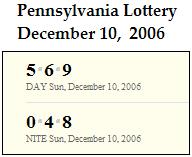
Pennsylvania Lottery
December 2006
Daily Number (Day):
Borges,
Menard's Quixote, and
The Harvard Crimson | Mon., Dec. 11:
133
|
Baudrillard
(via a white Matrix) | Sun., Dec. 10:
569 |
Benjamin and
a black view of life in
"The Garden of Allah" | Sat., Dec. 9:
602 |
Click on numbers
for commentary.
"There is nothing new under the sun. With the death of the real, or rather with its (re)surrection, hyperreality both emerges and is already always reproducing itself." --Jean Baudrillard
Related material:
Thursday, December 14, 2006
6:06 AM
Hamlet's Transformation,
continued from Sept. 6:

Click on picture
for details.
Wednesday, December 13, 2006
9:29 AM
Christmas in Heaven and Hell
Best Wishes for a
C. S. Lewis
Christmas
Update of 4:23 PM:
The
Lewis link above deals with the separation of Heaven from Hell. The
emphasis is on Heaven. A mysterious visitor to this website, "United
States," seems to be seeking equal time for Hell. And so...
Tuesday, December 12, 2006
11:22 AM
For Sinatra's Birthday

The "NITE" number 108 leads us
naturally to 1/08:
Sunday, January 08, 2006
| For Stephen Hawking's Birthday
Epigraphs to the classic novel Cosmic Banditos: God does not play dice with the universe. --Albert Einstein Not only does God play dice with the universe, but sometimes he throws them where they cannot be seen. --Stephen Hawking
Today's Pennsylvania Lottery numbers: | |
This (and yesterday's "DAY" number 133)
suggests we consult page 133 of
Bartlett's Familiar Quotations
of 1919. At the top of this
page we find...
"O day and night,
but this is wondrous strange!"
-- Hamlet, Act I, Scene 5
Another figure from 1/08,
St. Mary Magdalene, might,
adapting the words of Borges,
offer the following observation:
"Shakespeare's text and the lottery's
are verbally identical, but the second
is almost infinitely richer.
(More ambiguous, detractors will
say, but ambiguity is richness.)"
Related material: 11/22.
Monday, December 11, 2006
7:20 AM
Notes for Chile on...
Geometry and Death
J. G. Ballard on "the architecture of death":
"... a huge system of German fortifications that included the Siegfried
line, submarine pens and huge flak towers that threatened the
surrounding land like lines of Teutonic knights. Almost all had
survived the war and seemed to be waiting for the next one, left behind
by a race of warrior scientists obsessed with geometry and death."
-- The Guardian, March 20, 2006
Edward Hirsch on Lorca:
"For him, writing is a struggle both with geometry and death."
-- "The Duende," American Poetry Review, July/August 1999
"Rosenblum writes with
absolute intellectual honesty,
and the effect is sheer liberation....
The disposition of the material is
a model of logic and clarity."
-- Harper's Magazine review
quoted on back cover of
Cubism and Twentieth-Century Art,
by Robert Rosenblum
(Abrams paperback, 2001)
SINGER, ISAAC:
"Are Children the Ultimate Literary Critics?"
-- Top of the News 29 (Nov. 1972): 32-36.
"Sets forth his own aims in writing for children
and laments 'slice of life' and chaos in
children's literature. Maintains that children
like good plots, logic, and clarity,
and that they have a concern for
'so-called eternal questions.'"
-- An Annotated Listing of Criticism
by Linnea Hendrickson
"She returned the smile, then looked
across the room to her youngest brother,
Charles Wallace, and to their father,
who were deep in concentration, bent
over the model they were building
of a tesseract: the square squared,
and squared again: a construction
of the dimension of time."
-- A Swiftly Tilting Planet,
by Madeleine L'Engle
For "the dimension of time,"
see A Fold in Time,
Time Fold, and
Diamond Theory in 1937.
"... Philip of Austria... longing to discover the Muse and the Angel in theology, found himself imprisoned by the Duende of cold ardors in that masterwork of the Escorial, where geometry abuts with a dream and the Duende wears the mask of the Muse for the eternal chastisement of the great king."
Perhaps. Or perhaps Philip, "the lonely
hermit of the Escorial," is less lonely now.
Sunday, December 10, 2006
9:00 PM
Beyond Geometry, continued:
Sunday, December 10, 2006
12:00 PM
Nobel Prize Day, 2006
On This Date
"... in 1896 Alfred Nobel,
the inventor of dynamite and
founder of the Nobel prizes,
died in San Remo, Italy,
at age 63."
-- "Today in History,"
by The Associated Press
... And the Nobel Prize
for Bullshit goes to...
First Runner-up --
A Piece of Justice.
From
a summary of the novel:
The
story deals with "one Gideon Summerfield, deceased." Summerfield, a
former tutor at (the fictional) St. Agatha's College, Cambridge
University, "is about to become the recipient of the Waymark prize.
This prize is awarded in Mathematics and has the same prestige as the
Nobel...."
Sunday, December 10, 2006
9:00 AM
A First Class Degree
The Librarian "Like all men of the Library,
I have traveled in my youth."
-- Jorge Luis Borges,
The Library of Babel "
Papá me mandó un artículo
de J. G. Ballard en el que
se refiere a cómo el lugar
de la muerte es central en
nuestra cultura contemporánea."
-- Sonya Walger,
interview dated September 14
(
Feast of the Triumph of the Cross),
Anno Domini 2006
Walger's father is, like Borges,
from Argentina.
She "studied English Literature
at Christ Church College, Oxford,
where she received
a First Class degree.... "
--
Wikipedia "... un artículo de J. G. Ballard...."--
A Handful of Dust, by J. G. Ballard (
The Guardian, March 20, 2006):
"... The Atlantic wall was only part of a huge system of German
fortifications that included the Siegfried line, submarine pens and
huge flak towers that threatened the surrounding land like lines of
Teutonic knights. Almost all had survived the war and seemed to be
waiting for the next one, left behind by a race of warrior scientists
obsessed with geometry and death.
Death was what the Atlantic wall and Siegfried line were all about....
...
modernism of the heroic period, from 1920 to 1939, is dead, and it died
first in the blockhouses of Utah beach and the Siegfried line...
Modernism's attempt to build a better world with the aid of science and
technology now seems almost heroic. Bertolt Brecht, no fan of
modernism, remarked that the mud, blood and carnage of the first world
war trenches left its survivors longing for a future that resembled a
white-tiled bathroom. Architects were in the vanguard of the new
movement, led by Le Corbusier and the Bauhaus design school. The old
models were thrown out. Function defined form, expressed in
a pure geometry that the eye could easily grasp in its entirety."

"This is the garden of Apollo,
the field of Reason...."
--
John Outram, architect (Click on picture for details.)
Sunday, December 10, 2006
6:00 AM
In the Garden of Allah
The Lottery 12/9/06
| Mid-day
| Evening
|
New York
| 036
See
The Quest
for the 36
| 331
See 3/31--
"square crystal" and "the symbolism could not have been more perfect."
|
Pennsylvania
| 602
See 6/02--
Walter Benjamin
on
"Adamic language."
| 111
See 1/11--
"Related material:
Jung's Imago and Solomon's Cube."
|
Saturday, December 9, 2006
4:00 AM
ART WARS continued
Death on the Feast
of Saint Nicholas

Quotation from Log24 on
September 14, 2003-- Skewed Mirrors:
Readings on Aesthetics for the
Feast of the Triumph of the Cross:
"We're
not here to stick a mirror on you. Anybody can do that, We're here to
give you a more cubist or skewed mirror, where you get to see yourself
with fresh eyes. That's what an artist does. When you paint the
Crucifixion, you're not painting an exact reproduction."
— Julie Taymor on "Frida" (AP, 10/22/02)
" Saint Francis Borgia at the Deathbed of an Impenitent
[above], painted by Francisco Goya (1746-1828) in 1788, is one of the
most astonishing works in an oeuvre replete with remarkable images. In
the decade and a half since its inclusion in Robert Rosenblum's
survey* of nineteenth-century art, this canvas has become widely known
among scholars and their students. Rosenblum, following a line of
interpretation that dates back to the middle of the nineteenth century,
uses this painting to support a symptomatic reading of Goya's art,
which he describes as 'the most sharply accurate mirror of the collapse
of the great religious and monarchic traditions of the West.'" -- Andrew Schulz in The Art Bulletin, Dec. 1, 1998 * 19th-Century Art, by H. W. Janson and Robert Rosenblum, 1984
|
Rosenblum died at 79 on Wednesday,
the Feast of St. Nicholas.
For more on
St. Francis Borgia, see
In Lieu of Rosebud.
Friday, December 8, 2006
9:00 AM
At the Crossroads
An Instance
of the Fingerpost
"CRUCIAL (from Lat. crux, a cross),
that which has the form of a cross...
From Francis Bacon's expression
instantia crucis (taken, as he says, from
the finger-post or crux at cross-roads)"
"For every kind of vampire,
-- Gravity's Rainbow
There is such a thing
as a tesseract.
Related material:
The Gameplayers of Zan
"Appropriating the Button-molder's
words to Peer Gynt, he would say,
'We'll meet at the next crossroads…
and then we'll see--
I won't say more.'"
Thursday, December 7, 2006
3:30 AM
From Here to Eternity 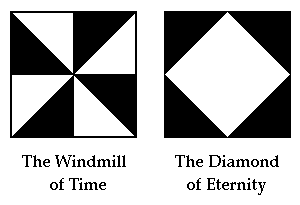
Wednesday, December 6, 2006
3:15 AM
ART WARS continued
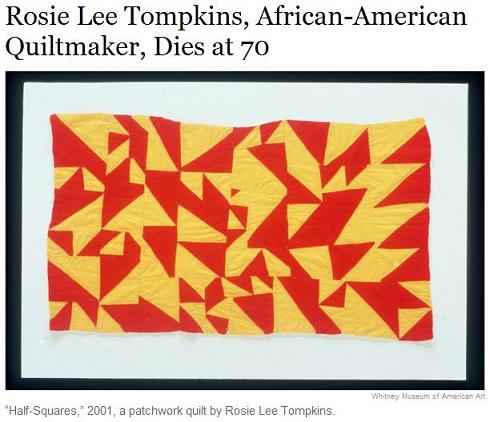
Tompkins was found dead
on December 1, 2006.
From Log24 on that date:
 That entry
 contained an excerpt from
Tom Wolfe's
The Painted Word--
"What I saw before me was the critic-in-chief of The New York Times saying: In looking at a painting today, 'to lack a persuasive theory is to lack something crucial.' I read it again. It didn’t say 'something helpful' or 'enriching' or even 'extremely valuable.' No, the word was crucial...."
The
story deals with "one Gideon Summerfield, deceased." Summerfield, a
former tutor at (the fictional) St. Agatha's College, Cambridge
University, "is about to become the recipient of the Waymark prize.
This prize is awarded in Mathematics and has the same prestige as the
Nobel. Summerfield had a rather lackluster career at St. Agatha's, with
the exception of one remarkable result that he obtained. It is for this
result that he is being awarded the prize, albeit posthumously."
Someone is apparently trying to prevent a biography of Summerfield from
being published.
The following page contains
a critical part of the solution
to the mystery:
Tuesday, December 5, 2006
5:01 AM
Anno Domini
Today in History
(via The Associated Press)
On this date (Dec. 5): In
1776, the first scholastic fraternity in America, Phi Beta Kappa, was
organized at the College of William and Mary in Williamsburg, Va.
In 1791, composer Wolfgang Amadeus Mozart died in Vienna, Austria, at age 35.
In 2006, author Joan Didion is 72. |
Joan Didion, The White Album:
"We tell ourselves stories in order to live....
We
interpret what we see, select the most workable of multiple choices. We
live entirely, especially if we are writers, by the imposition of a
narrative line upon disparate images, by the 'ideas' with which we have
learned to freeze the shifting phantasmagoria which is our actual
experience.
Or at least we do for a while. I am talking here
about a time when I began to doubt the premises of all the stories I
had ever told myself, a common condition but one I found troubling."
An Alternate History
(based on entries of
the past three days):
"A FAMOUS HISTORIAN:
England, 932 A.D. --
A kingdom divided...."
-- Introduction to "Spamalot"
Monday, December 4, 2006
11:01 AM
A Christmas Carol:
Descent of the God  Related material:
 All Hallows' Eve,
2005:
Multispeech 
as well as
C. S. Lewis,
That Hideous Strength,
Chapter 15,
"The Descent of the Gods,"
and
Charles Williams,
"
The Carol of Amen House":
Beauty arose of old
And dreamed of a perfect thing,
Where none shall be angry or cold
Or armed with an evil sting;
Where the world shall be made anew,
For the gods shall breathe its air,
And Phoebus Apollo there-through
Shall move on a golden stair.
(For the musical score, see
The Masques of Amen House.)
See also
A Mass for Lucero.
Monday, December 4, 2006
2:45 AM
Umkehrung (Spin)
180, 932 -
The Musical!
"You gotta be
true to your code."
-- Sinatra
NY Lottery, 2006:
Dec. 3 Mid-day - 180
Dec. 3 Evening - 932
Yesterday's entry suggested that
the date, December 3, might be
appropriate for some sort of
Broadway production.
Yesterday evening's NY lottery
number, 932, suggests
* (via Google) that a visit to
the castle Wildeck is in order.
This castle is now the home
of the
Buchdruck-Museum honoring
Johannes Gutenberg.
For an appropriate Broadway
production, see today's
New York Times:
Gutenberg! The Musical! Yesterday's mid-day NY lottery
number, 180, suggests, in the
above context, the German term
Umkehrung. A casual web search
on this term (+ "reversal,"
then, refining the search,
+ "Theocritus") leads
to the following material,
which I personally find of
much greater interest than
the above Broadway production.
(Such web searches are made
possible by a technological
revolution comparable to that
of Gutenberg... Broadway may
perhaps look forward to...
"
Google! The Musical!")
| Google Search 12/4/06 |
Results 1 - 2 of about 14
for umkehrung theocritus. (0.07 seconds) |
I12: on 'transference' by Theocritus of refined motifs to uncouth peasants, ... is in reality a parody, a devastating 'Umkehrung' of the real thing, ...
|
| A THEOPHANY IN THEOCRITUS IN a masterly study of the language and motifs of ... epithet I The completeness and precision of the Umkehrung (for this term cf. ... |
* "
ZSCHOPAU,
a town in the kingdom of Saxony, on the left bank of the Zschopau....
It contains... a castle (Wildeck), built by the Emperor Henry I in
932." --
From the classic 11th edition of the Encyclopaedia Britannica (1911)
(The date 932 may or may not be accurate, but still serves nicely as what has been called elsewhere "
an instance of the fingerpost.")
Sunday, December 3, 2006
2:22 AM
Kennedy Center
By Joel Rothstein
Reuters
Sunday, December 3, 2006; 12:12 AM
WASHINGTON (Reuters) - "Washington's elite mingled with artistic icons at the Kennedy Center Honors on Saturday....
The
Kennedy Center Honors weekend was to conclude on Sunday with Bush
hosting an afternoon reception at the White House followed by an
evening performance at the John F. Kennedy Center for the Performing
Arts.
The show will be broadcast on the CBS television network on December 26."
From "Today in History,"
by The Associated Press:
On this date (Dec. 3):
In 1925,
"Concerto in F,"
by George Gershwin,
had its world premiere
at New York's Carnegie Hall,
with Gershwin himself
at the piano.
In 1947,
the Tennessee Williams play
"A Streetcar Named Desire"
opened on Broadway.
In 1953,
the musical "Kismet"
opened on Broadway.
In 1960,
the musical "Camelot"
opened on Broadway.
Related material:
Yesterday's entries--
Monroe and the Kennedys
and

Monroe and the Kennedys,
Part II.
Click on the picture
for further details.
Saturday, December 2, 2006
12:00 PM
Monroe and the Kennedys, Part II
Brothers:
Divine Intervention
Puts the "X" in Sex
Steven Rosen in The Boston Globe, Sunday, Nov. 26, 2006:
"Emilio
Estevez still doesn't know why, but one day in 2000 he and his brother
Charlie Sheen found themselves doing a photo shoot at this city's
long-closed but still infamous Ambassador Hotel. It was where Senator
Robert F. Kennedy was fatally shot the night he won California's
crucial Democratic presidential primary in 1968.
The site made
little sense for the film they were promoting, 'Rated X,' a feature
about the real-life San Francisco pornographers Jim and Artie
Mitchell.... he [Estevez] and Sheen co-starred as the Mitchell
brothers.
'It wasn't something I had requested,' Estevez says
today of the photo shoot's location. 'It was perhaps the photographer.
I never got to the bottom of it, but there I was.'
To him, it
was one in a series of 'divine interventions' that gave him the
inspiration to write and direct the new film 'Bobby,' which opened
Thursday [Nov. 23, Thanksgiving Day 2006]."

Brothers
Bobby Kennedy and
John F. Kennedy

Brothers
Charlie Sheen and
Emilio Estevez
"We keep coming back
and coming back to the real:
To the hotel instead of
the hymns...."
-- Wallace Stevens
(
See previous entry.)
For an account of the
Kennedy film in the
style of the
"West Wing" liberals,
see Larry King tonight.
For some deeper political
background from a more
authentic voice of the left, see
The Myth of the Kennedys.
Saturday, December 2, 2006
1:29 AM
Monroe and the Kennedys
In honor of
the film "Bobby,"
now playing.
("Venus at St. Anne's"
is the title of the final
chapter of
the C. S. Lewis classic
That Hideous Strength.)

Symbol of Venus
and
Symbol of Plato
Related symbols:


Click on pictures
for details related tp
the Feast of St. Anne
(
July 26).
"The best theology today,
in its repudiation of a
rhetorical religious idealism,
finds itself in agreement
with a recurrent note
in contemporary poetry....
We keep coming back
and coming back/
To the real: to the hotel
instead of the hymns/
That fall upon it
out of the wind. We seek/
... Nothing beyond reality.
Within it/
Everything,
the spirit’s alchemicana....
(From 'An Ordinary Evening
in New Haven,'
in The Collected Poems
of Wallace Stevens....)
... Not grim/
Reality, but reality grimly seen....
(Ibid.)"
-- "The Church's
New Concern with the Arts,"
by Amos N. Wilder,
Hollis Professor
of Divinity, Emeritus,
at Harvard Divinity School,
in Christianity and Crisis,
February 18, 1957.
"All the truth in the world
adds up to one big lie."
Friday, December 1, 2006
4:07 AM
ART WARS continued
Day Without Art
From the Online Etymology Dictionary:
crucial - 1706, from Fr. crucial... from L. crux (gen. crucis) "cross." The meaning "decisive, critical" is extended from a logical term, Instantias Crucis, adopted by Francis Bacon (1620); the notion is of cross fingerboard signposts* at forking roads, thus a requirement to choose.
"... given the nature of our intellectual commerce with works of art, to lack a persuasive theory is to lack something crucial-- the means by which our experience of individual works is joined to our understanding of the values they signify."
-- Hilton Kramer in The New York Times, April 28, 1974
"I realized that without making the slightest effort I had come upon
one of those utterances in search of which psychoanalysts and State
Department monitors of the Moscow or Belgrade press are willing to
endure a lifetime of tedium: namely, the seemingly innocuous obiter dicta, the words in passing, that give the game away.
What I saw before me was the critic-in-chief of The New York Times saying: In looking at a painting today, 'to lack a persuasive theory is to lack something crucial.' I read it again. It didn’t say 'something helpful' or 'enriching' or even 'extremely valuable.' No, the word was crucial....
The
more industrious scholars will derive considerable pleasure from
describing how the art-history professors and journalists of the period
1945-75, along with so many students, intellectuals, and art tourists
of every sort, actually struggled to see the paintings
directly, in the old pre-World War II way, like Plato's cave dwellers
watching the shadows, without knowing what had projected them, which
was the Word."
-- Tom Wolfe, The Painted Word
For some related material from the next 30 years, 1976-2006, see Art Wars.
* "Note that in the original Latin, the term is not by any means 'fingerpost' but simply 'cross' (Latin Crux, crucis)
- a root term giving deeper meaning to the 'crucial' decision as to
which if any of the narratives are 'true,' and echoing the decisive
'crucifixion' revealed in the story."
-- Wikipedia on An Instance of the Fingerpost.