From the journal of Steven H. Cullinane...
2006 June 16-30
Friday, June 30, 2006 6:23 PM
"Wind over Water" in the I Ching,
the Classic of Transformations,
signifies huan, "dissolving."
Dissolving:
Our revels now are ended.
These our actors,
as I foretold you,
were all spirits...
Friday, June 30, 2006 2:20 PM
Independence
Day Cover
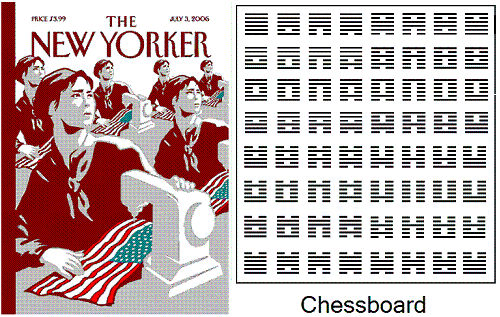
Click on picture for further details.
Thursday, June 29, 2006 11:11 AM
Wednesday, June 28, 2006 12:00 PM
Tuesday, June 27, 2006 10:31 AM
Kaplansky received his doctorate in mathematics at Harvard in 1941 as
the first Ph.D. student of Saunders Mac Lane.
From the April 25, 2005, Harvard Crimson:
Ex-Math
Prof Mac Lane, 95, Dies
Gade University
Professor of Mathematics Barry Mazur, a friend of the late Mac Lane,
recalled that [a Mac Lane paper of 1945] had at first been rejected
from a lower-caliber
mathematical journal because the editor thought that it was "more
devoid of content" than any other he had read.
"Saunders wrote
back and said, 'That's the point,'" Mazur said. "And in some ways
that's the genius of it. It's the barest, most Beckett-like
vocabulary
that incorporates the theory and nothing else."
He likened it
to a sparse grammar of nouns and verbs and a limited vocabulary that is
presented "in such a deft way that it will help you understand any
language you wish to understand and any language will fit into it."
A sparse grammar of lines from Charles Sanders Peirce
(Harvard College, class of 1859):
It is true of this set of
binary connectives,
as it is true of logic generally, that (as alleged above of Mac Lane's
category theory) "it
will help you understand any
language you wish to understand and any language will fit into it." Of
course, a great deal of questionable material has been written about
these connectives. (See, for instance, Piaget and
De Giacomo.)
For remarks on the connectives that are not questionable, see
Wittgenstein's Tractatus Logico-Philosophicus (English version,
1922), section 5.101,
and Knuth's "Boolean
Basics" (draft, 2006).
Related entry: Binary Geometry.
Monday, June 26, 2006 11:07 AM
D-Day Notes
continued:
Lyle Stuart,
publisher of The Anarchist Cookbook and The Turner
Diaries, died at 83 on Saturday, June 24, 2006.
"Mr. Stuart was named Lionel Simon when he was born in
Manhattan, the
son of a salesman and a secretary. His father committed suicide
when
the boy was 6."
Monday, June 26, 2006 9:29 AM
A Little Extra Reading
In memory of
Mary Martin McLaughlin,
a
scholar of Heloise and Abelard.
McLaughlin died on June 8, 2006.
"Following the parade, a speech is given by Charles Williams, based on
his book The Place of the Lion.
Williams explains the true meaning of the word 'realism' in both
philosophy and theology. His guard of honor, bayonets gleaming, is led
by William of Ockham."
-- Midsummer
Eve's Dream
A
review by John D. Burlinson of Charles Williams's novel The
Place of the Lion:
"... a little extra reading regarding Abelard's take on 'universals'
might
add a little extra spice-- since Abelard is the subject of the
heroine's ... doctoral dissertation. I'd suggest the
article 'The
Medieval Problem of Universals' in the online Stanford
Encyclopedia of Philosophy."
Michael L.
Czapkay, a student of philosophical theology at Oxford:
"The development of logic in the schools
and universities of western Europe between the eleventh and fifteenth
centuries constituted a significant contribution to the history of
philosophy. But no less significant was the influence of this
development of logic on medieval theology. It provided the necessary
conceptual apparatus for the systematization of theology. Abelard,
Ockham, and Thomas Aquinas are paradigm cases of the extent to which
logic played an active role in the systematic formulation of Christian
theology. In fact, at certain points, for instance in modal logic,
logical concepts were intimately related to theological problems, such
as God's knowledge of future contingent truths."
The
Medieval Problem of Universals, by Fordham's Gyula
Klima, 2004:
"... for Abelard, a status is an object of the divine
mind,
whereby God preconceives the state of his creation from eternity."
Status Symbol
(based on Weyl's Symmetry):
"... for then we would know
Sunday, June 25, 2006 7:00 PM
Language
Games:
Chess and Bingo
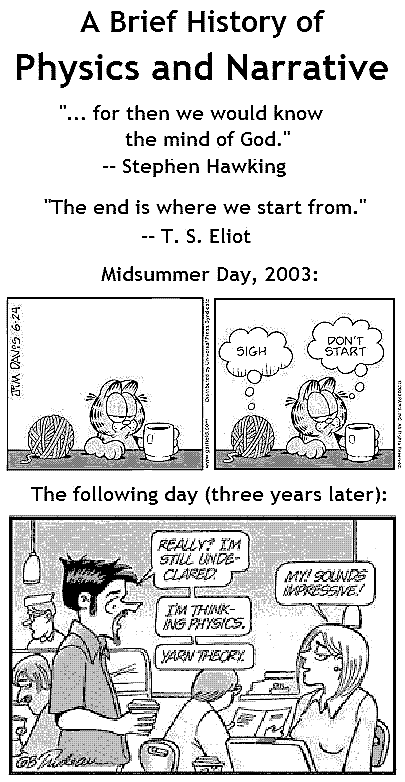
Chess: See Log24, Midsummer Day, 2003. Happy mate change,
Nicole.
Bingo: See a journal entry from seven years ago, On Linguistic Creation. Happy birthday, Willard
Van Orman Quine.
Sunday, June 25, 2006 11:00 AM
Sunday, June 25, 2006 7:59 AM
Saturday, June 24, 2006 4:17 PM
In memory of
Hunter
S. Thompson
On Midsummer Day:
Big
Time
Parts I, II, III
Part I:
April 17, 2003: Holiday Affair
Saturday, June 24, 2006 4:16 PM
Big Time, Part II:
April 16, 2003: Keeping Time
Saturday, June 24, 2006 4:15 PM
Big Time, Part III:
April 15, 2003: Green and Burning
Saturday, June 24, 2006 7:59 AM
Zen and the Art
"Man stands in his own shadow and wonders why it is dark."
-- "Ancient Zen saying," according to "Today in History," June 24, by
the Associated Press
"A man may be free to travel where he likes, but there is no place on
earth where he can escape from his own Karma, and whether he lives on a
mountain or in a city he may still be the victim of an uncontrolled
mind. For man's Karma travels with him, like his shadow. Indeed, it is
his shadow, for it has been said, 'Man stands in his own
shadow and wonders why it is dark.'"
-- Alan W. Watts, The Spirit of Zen, third edition, Grove
Press, 1958, page 97
Robert Pirsig, Zen and the Art of Motorcycle Maintenance, 1974:
"But what's happening is that each year our old flat earth of
conventional reason becomes less and less adequate to handle the
experiences we have and this is creating widespread feelings of
topsy-turviness. As a result we're getting more and more people in
irrational areas of thought... occultism, mysticism, drug changes and
the like... because they feel the inadequacy of classical reason to
handle what they know are real experiences."
"I'm not sure what you mean by classical reason."
"Analytic reason, dialectic reason. Reason which at
the University is sometimes considered to be the whole of
understanding. You've never had to understand it really. It's always
been completely bankrupt with regard to abstract art. Nonrepresentative
art is one of the root experiences I'm talking about. Some people still
condemn it because it doesn't make 'sense.' But what's really wrong is
not the art but the 'sense,' the classical reason, which can't grasp
it. People keep looking for branch extensions of reason that will cover
art's more recent occurrences, but the answers aren't in the branches,
they're at the roots."
Saturday, June 24, 2006 12:00 AM
Friday, June 23, 2006 9:00 PM
Friday, June 23, 2006 2:56 PM
Binary Geometry
There is currently no area of mathematics named "binary
geometry." This is, therefore, a possible name for the geometry
of sets with 2n elements (i.e., a sub-topic of Galois
geometry and of algebraic geometry over finite fields-- part of
Weil's "Rosetta stone" (pdf)).
Examples:
- Charles Sanders Peirce, "The
Simplest Mathematics."
- Donald E. Knuth's discussion of binary hypercubes
in "Boolean
Basics," a draft of section 7.1.1 in The
Art of Computer Programming, Volume 4: Combinatorial
Algorithms
- My own discussion of a binary hypercube in Geometry
of the 4x4x4 Cube
- A more sophisticated example: the geometry of
elliptic curves
over a binary Galois field. For an excellent introduction,
see the Certicom online elliptic
curve tutorial. This has an applet
illustrating elliptic curves in a space of 256 points (256=16x16, with
the x and y variables of a curve each having 16
possible values).
- In summary, apart from the fact that the native
language of computers has
characteristic 2, "binary" mathematics, i.e. mathematics in characteristic
2, is of special interest both in the study of finite geometry (Finite
Geometry of the Square and Cube) and in algebraic geometry (see,
for instance, the work of Brian
Conrad).
Wednesday, June 21, 2006 9:00 AM
Beijing String
continued...
A comment left at Peter
Woit's weblog:
Xinhua
has a story
from June 20 on Yau showing a video in Beijing of a talk by Hamilton on
the Poincare conjecture. This Xinhua story is rather Sinocentric, but
it is balanced nicely by a document from China's Morningside
Center of Mathematics that gives a more
complete record of Hamilton's talk.
Tuesday, June 20, 2006 1:23 PM
Cat's Yarn
"The history of topology
dates back at least to the middle of the 18th century. One of its first
major boosts came at the end of the 19th century, when Poincare was
trying to understand the set of solutions to a general algebraic
equation...."
Tuesday, June 20, 2006 7:59 AM
| Oh, do not ask, "What is it?" |
Let us go and make our visit.
|
On
Tuesday evening, the schedule says "Prof. Yau present his new research
result," which presumably will be about the proof of the Poincare
conjecture.
|
| Would it have been worth while, |
To have bitten off the matter
with a smile, |
To have squeezed the universe
into a ball |
To roll it toward some
overwhelming question....
|
|
Yau rated the conjecture as one of the major
mathematical puzzles of the 20th Century.
"The conjecture is that if in a closed three-dimensional space,
any
closed curves can shrink to a point continuously, this space can
be
deformed to a sphere," he said.
|
Monday, June 19, 2006 4:00 PM
Snippets:
A Reply to John Updike
See Updike on digitized snippets.
The following four snippets were pirated from the end of MathPages
Quotations, compiled by Kevin Brown.
They are of synchronistic interest in view of the
previous two Log24
entries, which referred (implicitly) to a Poe story and (explicitly) to
Pascal.
"That is another of your odd notions,"
said the Prefect, who had the fashion
of calling everything 'odd' that was
beyond his comprehension, and thus
lived amid an absolute legion of 'oddities.'
                             Edgar Allan Poe

I knew when seven justices could not
take up a quarrel, but when the parties
were met themselves, one of them
thought but of an If,  as, 'If you said so,
then I said so'; and they shook hands
and swore brothers. Your If is the only
peacemaker; much virtue in If.
                             Shakespeare

I have made this letter longer than usual
because I lack the  time to make it shorter.
                             Blaise Pascal

S'io credessi che mia risposta fosse
a persona che mai tornasse al mondo,
questa fiamma staria senza piu scosse.
Ma per cio che giammai di questo fondo
non torno vivo alcun, s'i'odo il vero,
senza tema d'infamia ti rispondo.
                             Dante, 1302
For translations of the Dante (including one by Dorothy
Sayers), see everything2.com.
An anonymous author there notes that Dante
describes a flame in
which is encased a damned soul. The flame vibrates as the soul speaks:
If I thought that I were making
Answer to one that might return to view
The world, this flame should evermore
    cease shaking.

But since from this abyss, if I hear true,
None ever came alive, I have no fear
Of infamy, but give thee answer due.

-- Dante, Inferno, Canto 27, lines 61-66,
    translated by Dorothy Sayers
Updike says,
"Yes, there is a ton of information on the web but
much of it is grievously inaccurate, unedited, unattributed and
juvenile. The electronic marvels that abound around us serve, I have
the impression, to inflame what is most informally and non-critically
human about us. Our computer screens stare back at us with a kind of
giant, instant aw-shucks, disarming in its modesty."
Note Updike's use of "inflame."
For an aw-shucks version of "what is most
informally and
non-critically human about us," as well as a theological flame, see
both the previous entry and the above report from Hell.
Note that the web serves also to correct material that is
inaccurate, unedited, unattributed, and juvenile. For examples, see Mathematics
and Narrative. The combination of today's entry
for Pascal's birthday with that web page serves both to
light one candle and to curse the darkness.
Monday, June 19, 2006 7:59 AM
The Pascal Candle
"A
Pascal Candle can be found
in most churches,
and it is easy
to identify. It
could well be taller
and fatter
than any other candle
in the church...."
Sunday, June 18, 2006 7:00 PM
Gold Bug
Variations
The personae of summer
play the characters
Of an inhuman author,
who meditates
With the gold bugs,
in blue meadows,
late at night.
-- Wallace Stevens,
"Credences of Summer,"
Canto X, Collected Poetry
and Prose, 322-326
Sunday, June 18, 2006 7:59 AM
For Mel Gibson,
who may or may not
see a parallel here.
- After the movie was released, screenwriter Joe Eszterhas's
own father Istvan Eszterhas was accused of war crimes in Hungary by
printing anti-Semitic
editorials and even organizing a book burning.
- Both Kirk Douglas and Walter Matthau wanted to
play the father....
Once a son,
now a father:
"He spent his earliest years in post WWII--refugee camps. He came to
America and grew up in Cleveland--stealing cars, rolling drunks,
battling priests, nearly going to jail. He became the screenwriter of
the worldwide hits Basic Instinct, Jagged Edge, and Flashdance. He also
wrote the legendary disasters Showgirls and Jade. The rebellion never
ended, even as his films went on to gross more than a billion dollars
at the box office and he became the most famous--or
infamous--screenwriter in Hollywood. Joe Eszterhas is a complex and
paradoxical figure: part outlaw and outsider combined with equal parts
romantic and moralist. More than one person has called him 'the devil.'
He has been referred to as 'the most reviled man in America.' But Time
asked, 'If Shakespeare were alive today, would his name be Joe
Eszterhas?'"
-- Random
House promotional material
And
eventually to become
a holy ghost...
"Yea, though I walk
through the valley of death
I will fear no evil,
for I am the meanest
son of a bitch
in the valley."
— Karl Cullinane
in The Silver Crown,
by Joel Rosenberg
Saturday, June 17, 2006 7:59 AM
"Breaking the spell of religion is
a
game that many people can play."
-- Freeman Dyson in the current
New York Review of Books
Part I:
The Game

Part II:
Many People

For further details,
see Solomon's
Cube
and myspace.com/affine.
"The rock cannot be broken.
It is the truth."
-- Wallace Stevens
Friday, June 16, 2006 9:00 AM
For Bloomsday 2006:
Hero of His Own Story
"The philosophic college should spare a detective for me."
-- Stephen Hero. Epigraph to Chapter 2, "Dedalus and the
Beauty Maze," in Joyce and Aquinas, by William T. Noon, S. J.,
Yale University Press, 1957 (in the Yale paperback edition of 1963,
page 18)
"Dorothy Sayers makes a great deal of sense when she points out in her
highly instructive and readable book The Mind of the Maker
that 'to complain that man measures God by his own measure is a waste
of time; man measures everything by his own experience; he has no other
yardstick.'"
-- William T. Noon, S. J., Joyce and Aquinas (in the Yale
paperback edition of 1963, page 106)
Related material:
- Dorothy Sayers and Jill Paton Walsh
- Jill
Paton Walsh's detective novel A
Piece of Justice (1995):
"The
mathematics of tilings and quilting play background roles in this
mystery in which a graduate student attempts to write a biography of
the (fictitious) mathematician Gideon Summerfield. Summerfield is about
to posthumously receive the prestigious (and, I should point out, also
fictitious) Waymark Prize in mathematics...but it soon becomes clear
that someone with evil intentions does not want the student's book to
be published!
By all accounts this is a well written
mystery...the second by the author with college nurse Imogen Quy
playing the role of the detective."
-- Mathematical Fiction by Alex Kasman, College of
Charleston
- Quilt Geometry, by Steven H. Cullinane
AD PULCHRITUDINEM TRIA REQUIRUNTUR:
INTEGRITAS, CONSONANTIA, CLARITAS.
-- St. Thomas Aquinas