From the journal of Steven H. Cullinane...
2006 February 16-28
Tuesday, February 28, 2006 4:23 PM
Monday, February 27, 2006 1:14 PM
Rosebud
(continued from Feb.
22)
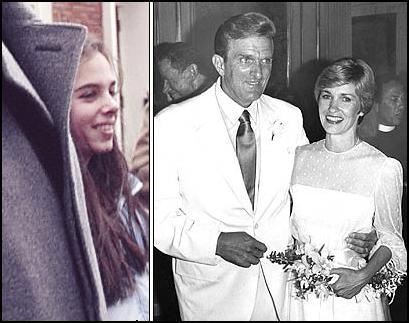
Click on the picture for details.
|
"Otis Chandler will go down as
one of the most important figures
in newspaper history," said
Dean Baquet, editor of The Times.
|
"Yet Chandler was also
an enigma...."
Monday, February 27, 2006 10:30 AM
Point Counter Point
From the Encyclopaedia Britannica, 11th Edition, 1911:
COUNTERPOINT (Lat. contrapunctus, "point
counter point," "note against note")
"In music, the art happily defined by Sir Frederick Gore Ouseley as that 'of combining'
melodies....
Double
Counterpoint is a combination of melodies so designed that either can
be taken above or below the other. When this change of position is
effected by merely altering the OCTAVE (from Lat. octavus, eighth, octo,
eight) of either or both melodies (with or without transposition of the
whole combination to another KEY),
the artistic value of the device is simply that of the raising of the
lower melody to the surface. The harmonic scheme remains the same,
except in so far as some of the chords are not in their fundamental
position, while others, not originally fundamental, have become so. But
double counterpoint may be in other intervals than the octave; that is
to say, while one of the parts remains stationary, the other may be
transposed above or below it by some interval other than an octave,
thus producing an entirely different set of harmonies."
See also Sybille Bedford's
biography of Aldous Huxley

and the entry below.
Related material:
A Contrapuntal Theme.
Monday, February 27, 2006 9:26 AM
Sudden View
From John O'Hara's Birthday:
"We
stopped at the Trocadero and there was hardly anyone there. We
had
Lanson 1926. 'Drink up, sweet. You gotta go some. How
I love music.
Frère Jacques, Cuernavaca, ach du lieber August. All
languages. A
walking Berlitz. Berlitz sounds like you with that champagne, my
sweet, or how you're gonna sound.'"
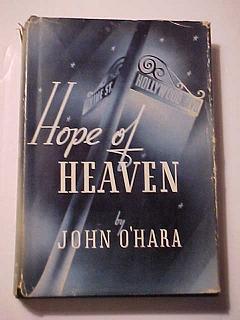
— John O'Hara, Hope of Heaven, Chapter 11, 1938
"And they were all filled with the Holy Ghost, and began to speak
with other tongues, as the Spirit gave them utterance."
— Acts, Chapter 2, Verse 4
"Lps. The keys to. Given! A way a lone a last a loved a long the
PARIS,
1922-1939."
— James Joyce, conclusion of Finnegans
Wake
"Using
illustrative material from religion, myth, and culture, he starts with
the descent of the dove on Jesus and ends with the poetic ramblings of
James Joyce."
— Review of a
biography of the Holy Spirit
Monica Potts in today's New York Times on Sybille
Bedford:
"Though her works were not always widely popular, they inspired a
deeply fervent following of committed admirers, starting with her first
published work, A Sudden View, in 1953. Later retitled A
Visit to Don Otavio, it was an account of her journey through
Mexico."
... "I addressed him. 'Is Cuernavaca not below Mexico City?'
'It is low.'
'Then what is this?' Another summit had sprung
up above a curve.
'At your orders, the Three Marias.'
'What are the Three Marias?'
'These.'
Later, I learned from Terry
that they were the three peaks by the La Cima Pass which is indeed one
of the highest passes in the Republic; and still later from experience,
that before running down to anywhere in this country one must first run
up some six or seven thousand feet. The descents are more
alarming
than the climbs. We hurtled towards Cuernavaca down unparapeted
slopes
with the speed and angle, if not the precision, of a scenic railway--
cacti flashed past like telegraph poles, the sun was brilliant, the air
like laughing gas, below an enchanting valley, and the lack of brakes
became part of a general allegro accelerando."
-- Sybille Bedford, A
Sudden View, Counterpoint Press, Counterpoint edition (April
2003), page 77
"How continually, how startlingly, the landscape changed! Now the
fields were full of stones: there was a row of dead trees. An
abandoned plough, silhouetted against the sky, raised its arms to
heaven in mute supplication; another planet, he reflected again, a
strange planet where, if you looked a little further, beyond the Tres
Marias, you would find every sort of landscape at once, the Cotswolds,
Windermere, New Hampshire, the meadows of the Eure-et-Loire, even the
grey dunes of Cheshire, even the Sahara, a planet upon which, in the
twinkling of an eye, you could change climates, and, if you cared to
think so, in the crossing of a highway, three civilizations; but
beautiful, there was no denying its beauty, fatal or cleansing as it
happened to be, the beauty of the Earthly Paradise itself."
-- Malcolm Lowry, Under
the Volcano, Harper Perennial Modern Classics, 1st Perennial
Classics edition (May 1, 2000), page 10
Friday, February 24, 2006 10:31 PM
Final Club
For the feast of St. Matthias
(traditional calendar)--
from Amazon.com, a quoted Library Journal review of Geoffrey Wolff's novel The
Final Club:
"'What other colleges call fraternities, Princeton
calls Eating
Clubs. The Final Club is a group of 12 Princeton seniors in 1958 who
make their own, distinctive club....
Young adults may find this interesting, but older
readers need not join The Final Club.'
-- Previewed in Prepub Alert, Library Journal 5/1/90.
Paul E. Hutchison, Fisherman's Paradise, Bellefonte, Pa. Copyright 1990
Reed Business Information, Inc."
From The Archivist, by Martha Cooley:
"Although I've always been called Matt, my first name isn't Matthew but
Matthias: after the disciple who replaced Judas Iscariot. By the
time
I was four, I knew a great deal about my namesake. More than once
my
mother read to me, from the New Testament, the story of how Matthias
had been chosen by lot to take the place of dreadful Judas.
Listening,
I felt a large and frightened sympathy for my predecessor. No
doubt a
dark aura hung over Judas's chair-- something like the pervasive,
bitter odor of Pall Malls in my father's corner of the sofa.
As
far as my mother was concerned, the lot of Matthias was the
unquestionable outcome of an activity that seemed capricious to me: a
stone-toss by the disciples. I tried with difficulty to picture a
dozen men dressed in dust-colored robes and sandals, playing a child's
game. One of the Twelve had to carry on, my mother explained,
after
Judas had perpetrated his evil. The seat couldn't be left
empty.
Hence Matthias: the Lord's servants had pitched their stones, and his
had traveled the farthest."
Friday, February 24, 2006 1:00 PM
For St.
Matthias's Day
(traditional calendar):
Log24, April 25, 2003 and
The Matthias Defense.
Thursday, February 23, 2006 2:09 PM
Headline in today's Harvard Crimson:
Thursday, February 23, 2006 1:06 PM
Cubist Epiphany
"In The Painted Word, a rumination on the state of American painting in the 1970s, Tom Wolfe described
an epiphany...."
-- Peter
Berkowitz, "Literature in Theory"
"I had an epiphany."
-- Apostolos Doxiadis, organizer of last summer's conference on mathematics
and narrative. See the Log24 entry of 1:06 PM last August 23 and the four entries that
preceded it.
"... das Durchleuchten des ewigen Glanzes des 'Einen' durch die
materielle Erscheinung"
-- A definition of beauty from Plotinus, via Werner
Heisenberg
"By groping toward the light we are made to realize how deep the
darkness is around us."
-- Arthur Koestler, The Call Girls: A Tragi-Comedy, Random
House, 1973, page 118, quoted in The
Shining of May 29
"Perhaps we are meant to see the story as a cubist retelling of the
crucifixion...."
-- Adam White Scoville, quoted in Cubist Crucifixion,
on Iain Pears's novel, An
Instance of the Fingerpost
Related material:
Log24 entries of
Feb.
20,
21, and
22.
Wednesday, February 22, 2006 9:00 PM
Wednesday, February 22, 2006 10:00 AM
In the Details
"The groom wears
his boutonniere
on the left lapel,
nearest to his heart.
Buttonieres are generally
single blossoms
such as rosebuds."
-- allweddingideas.com
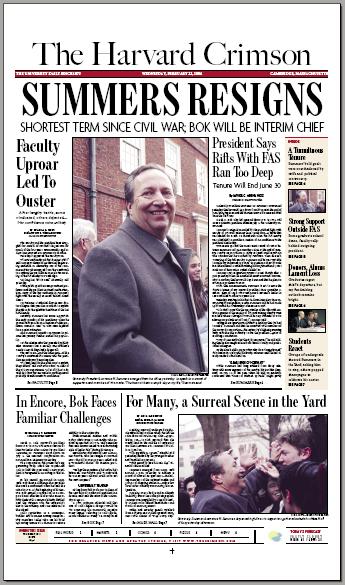 Rosebud
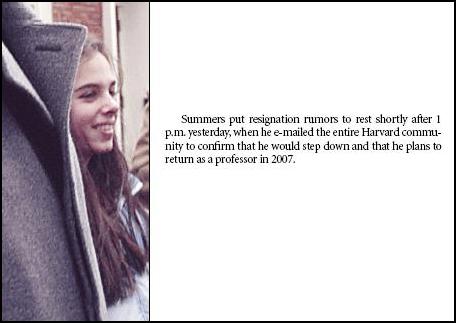 Crimson photo by Vilsa E. Curto
Tuesday, February 21, 2006 1:00 PM
"Contemporary literary
theory did not emerge in an intellectual and cultural vacuum. The
subordination of art to argument and ideas has been a long time in the
works. In The Painted Word, a rumination on the state of American painting in the 1970s, Tom Wolfe described
an epiphany he had one Sunday morning while reading an article in the New York Times
on an exhibit at Yale University. To appreciate contemporary art-- the
paintings of Jackson Pollock and still more so his followers-- which to
the naked eye appeared indistinguishable from kindergarten splatterings
and which provided little immediate pleasure or illumination, it was
'crucial,' Wolfe realized, to have a 'persuasive theory,' a
prefabricated conceptual
lens
to make sense of the work and bring into focus the artist's point. From
there it was just a short step to the belief that the critic who
supplies the theories is the equal, if not the superior, of the artist
who creates the painting."
-- Peter
Berkowitz, "Literature in Theory"
 Cover art by Rea Irvin
On this date in 1925,
The New Yorker
first appeared.
Related material:
Aldous Huxley on
The Perennial Philosophy
(ART WARS, March 13, 2003)
and William
James on religion:
"James
points out that... a mystical experience displays the world through a
different lens than is present in ordinary experience. The experience,
in his words, is 'ineffable'...."
For an experience that is
perhaps more effable,
see the oeuvre of
Jill St. John.

Related material:
A drama for
Mardi Gras,
The Crimson Passion,
and (postscript of 2:56 PM)
today's
Harvard Crimson
(
pdf, 843k)
Tuesday, February 21, 2006 11:32 AM
|
murphy plant, murphy grow, a maryamyria- |
|
10 |
|
meliamurphies, in the lazily eye of his lapis, |
|
11 |
|
|
|
12 |
|
 |
|
13 |
|
|
|
14 |
|
Uteralterance or |
Vieus Von DVbLIn, 'twas one of dozedeams |
|
15 |
|
the Interplay of |
a darkies ding in dewood) the Turnpike under |
|
16 |
|
Bones in the |
the Great Ulm (with Mearingstone in Fore |
|
17 |
|
Womb. |
ground). 1 Given now ann linch you
take enn |
|
18 |
|
all. Allow me! And, heaving alljawbreakical |
|
19 |
|
expressions out of old Sare Isaac's 2
universal |
|
20 |
|
The Vortex. |
of specious aristmystic unsaid, A is for Anna |
|
21 |
|
Spring of Sprung |
like L is for liv. Aha hahah, Ante Ann you're |
|
22 |
|
Verse. The Ver- |
apt to ape aunty annalive! Dawn gives rise. |
|
23 |
|
tex. |
Lo, lo, lives love! Eve takes fall. La, la,
laugh |
|
24 |
|
leaves alass! Aiaiaiai, Antiann, we're last to |
|
25 |
|
the lost, Loulou! Tis perfect. Now (lens |
|
26 |
Monday, February 20, 2006 2:20 PM
New Site
(revised on May 21, 2006)
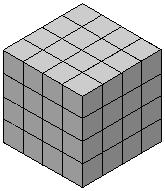
The new site for my math files is
finitegeometry.org/sc/index.html:
| | Finite Geometry
of the Square
and Cube
by Steven H. Cullinane
|
| This site is about the
Geometry of the 4x4x4 Cube
(the mathematical structure,
not the mechanical puzzle)
and related simpler structures.
|
As time goes on, I'll be changing links on the Web to my math pages, which are now scattered at various Web addresses, to refer to this new site.
Incidentally, this is the 20th anniversary of my note, "The relativity problem in finite geometry."
Monday, February 20, 2006 12:00 AM
The Past Revisited
From Log24 a year ago on this date, a quote from Many Dimensions (1931),
by Charles Williams:
"Lord
Arglay had a suspicion that the Stone would be purely logical.
Yes, he
thought, but what, in that sense, were the rules of its pure logic?"
For the rest of the story, see the downloadable version at Project
Gutenberg of Australia.
Sunday, February 19, 2006 2:04 PM
But seriously...
Sunday, February 19, 2006 11:30 AM
The Dirty Thirty
Today's birthdays:
- Amy Tan, born Feb. 19, 1952, in Oakland, California,
and
- the late Lee
Marvin, born Feb. 19, 1924, in New York City.
For Amy Tan:
"Tan has a strong distaste for 'hodge-podge collections' that have no
unifying theme. But as fate would have it, she had just recently
recognized the common thread running through her own work.
'It has
to do with my upbringing with a father who very strongly believed in
faith as a Baptist minister, and my mother, who very strongly believed
in fate, and I'm trying to find things that work for me.'
She
proposed a collection based upon her lifelong search for a
philosophical middle ground between faith and fate, to be called The
Opposite of Fate. When her puzzled editor asked her what the
opposite of fate might be, Tan cryptically replied, 'Exactly!'"
-- Jay MacDonald, "Book Page"
For Lee Marvin:
"On
Feb. 19, 1945,
during World War II, some thirty thousand U.S. Marines landed on Iwo
Jima, where they began a monthlong battle to seize control of the
island from Japanese forces."
-- Adapted from "Today's Highlight in History," by the Associated Press
Friday, February 17, 2006 1:09 PM
Raiders of the Lost...
(continued)
"'Tony
Rome' is flavored with enough in-jokes to make any Sinatra fan smile--
Frank sleeping in his office underneath a copy of the
Jewish Daily
Forward; confronting a lady who needs help finding her 'lost
pussy'...."
-- Tony Rome
Friday, February 17, 2006 11:07 AM
Role Model
The adventures of Harvard president Larry Summers
continue
in today's Crimson:
At
the most vulnerable juncture of his half-decade at Harvard's helm,
Summers now faces a fuming Faculty with few vocal supporters by his
side.
And many of his longtime allies are expressing disaffection with what
they see as the president's ineffective leadership.
"If
he's going to be like every other college president-- just a caretaker,
fundraiser, and a mouther of platitudes-- then why do we need someone
who's also going to offend people?" said psychologist Steven
Pinker, who was one of Summers' most prominent supporters last
year....
Pinker,
while saying he wasn't sure if the Corporation should take any public
steps, said he hoped the board would, at least, intervene privately
with the president.
"I would like them to give some
guidance to Summers and to say, 'Things aren�t going well. You've got
to either bring back some leadership and
make sure that trains run on time and start new
initiatives that you originally wanted to bring-- or else get out of
the way,'" Pinker said.
-- Anton S. Troianovski
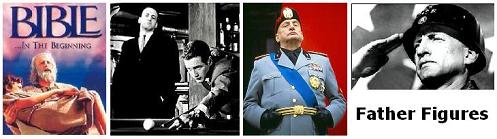
Who'll be my role model
Now that my role model is
Gone, gone?
-- Paul Simon
Friday, February 17, 2006 1:00 AM
Thursday, February 16, 2006 1:00 PM
From James A. Michener's The Source:
"Trouble started in a quarter that neither Uriel nor Zadok could have
foreseen. For many generations the wiser men of Zadok's clan had
worshipped El-Shaddai with the understanding that whereas Canaanites
and Egyptians could see their gods directly, El-Shaddai was invisible
and inhabited no specific place. Unequivocally the Hebrew
patriarchs
had preached this concept and the sager men of the clans accepted it,
but to the average Hebrew who was not a philosopher the theory of a god
who lived nowhere, who did not even exist in corporeal form, was not
easy to comprehend. Such people were willing to agree with Zadok
that
their god did not live on this mountain-- the one directly ahead-- but
they suspected that he did live on some mountain nearby, and when they
said this they pictured an elderly man with a white beard who lived in
a proper tent and whom they might one day see and touch. If
questioned, they would have said that they expected El-Shaddai to look
much like their father Zadok, but with a longer beard, a stronger
voice, and more penetrating eyes.
Now, as these simpler-minded
Hebrews settled down outside the walls of Makor, they began to see
Canaanite processions leave the main gate and climb the mountain to the
north, seeking the high place where Baal lived, and they witnessed the
joy which men experienced when visiting their god, and the Hebrews
began in subtle ways and easy steps to evolve the idea that Baal, who
obviously lived in a mountain, and El-Shaddai, who was reported to do
so, must have much in common. Furtively at first, and then
openly,
they began to climb the footpath to the place of Baal, where they found
a monolith rising from the highest point of rock. Here was a
tangible
thing they could comprehend, and after much searching along the face of
the mountain, a group of Hebrew men found a straight rock of size equal
to the one accorded Baal, and with much effort they dragged it one
starless night to the mountain top, where they installed it not far
from the home of Baal...."
Rabbi Chitrik died on
Valentine's Day, 2006,
having had a heart attack
on Feb. 8, 2006--
 Grammy
Night
Grammy
Night.

The above monolith is perhaps more
closely related to El-Shaddai than to
Madonna, Grammy Night, and Baal.
It reflects my own interests
(
Mathematics
and Narrative)
and those of Martin Buber
"Among Buber's early philosophical influences were Kant's Prolegomena,
which he read at the age of fourteen, and Nietzsche's Zarathustra.
Whereas Kant had a calming influence on the young mind troubled by the aporia
of infinite versus finite time, Nietzsche's doctrine of 'the eternal
recurrence of the same' constituted a powerful negative
seduction. By
the time Buber graduated from Gymnasium he felt he had overcome this
seduction, but Nietzsche's prophetic tone and aphoristic style are
evident in Buber's subsequent writings."