From the journal of Steven H. Cullinane...
2005 August 16-31
Tuesday, August 30, 2005
5:20 PM
Monday, August 29, 2005
4:00 PM
Date: Sun, 28 Aug 2005
12:30:40 -0400
From: Alf van der Poorten AM
Subject: Vale George Szekeres and
Esther Klein Szekeres
Members
of the Number Theory List will be sad to learn that George and Esther
Szekeres both died this morning. George, 94, had been quite ill
for the last 2-3 days, barely conscious, and died first at 06:30.
Esther, 95, died a half hour later.
Both George Szekeres and
Esther Klein will be recalled by number theorists as members of the
group of young Hungarian mathematicians of the 1930s including Turan
and Erdos. George and Esther's coming to Australia in the late
40s played an important role in the invigoration of Australian
Mathematics. George was also an expert in group theory and
relativity; he was my PhD supervisor.
Emeritus Professor
Alf van der Poorten AM
Centre for Number Theory Research
1 Bimbil Place, Killara NSW |
| "Hello! Kinch here. Put me on to Edenville. Aleph, alpha: nought, nought, one." "A very short space of time through very short times of space....
Am I walking into eternity along Sandymount strand?" -- James Joyce, Ulysses, Proteus chapter
A very short space of time through very short times of space....
"It is demonstrated that space-time should possess a discrete structure on Planck scales."
-- Peter Szekeres, abstract of Discrete Space-Time |
Peter Szekeres is the son of George and Esther Szekeres.
ATQUE
"At present, such relationships can at best be heuristically described
in terms that invoke some notion of an 'intelligent user standing
outside the system.'"
-- Gian-Carlo Rota in Indiscrete Thoughts, p. 152
Saturday, August 27, 2005
10:00 PM
Diamond Theorem Revisited
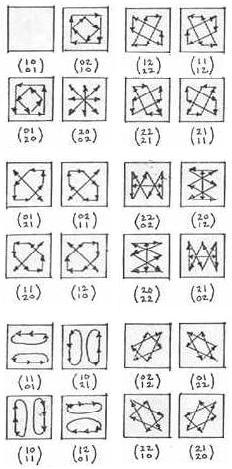
This evening I wrote a revised version of my 1979 "diamond theorem" abstract.
Thursday, August 25, 2005
3:09 PM
Analogical
Train of Thought
Part I: The 24-Cell
From S. H. Cullinane,
Visualizing GL(2,p),
March 26, 1985--
From John Baez,
"This Week's Finds in
Mathematical Physics (Week 198),"
September 6, 2003: Noam Elkies writes to John Baez: Hello again,You write: [...]
"I'd
like to wrap up with a few small comments about last Week. There
I said a bit about a 24-element group called the 'binary tetrahedral
group', a 24-element group called SL(2,Z/3), and the vertices of a
regular polytope in 4 dimensions called the '24-cell'. The most
important fact is that these are all the same thing! And I've learned a
bit more about this thing from here:"
[...]
Here's yet another way to see this: the 24-cell is the subgroup of the
unit quaternions (a.k.a. SU(2)) consisting of the elements of norm 1 in
the Hurwitz quaternions - the ring of quaternions obtained from the
Z-span of {1,i,j,k} by plugging up the holes at (1+i+j+k)/2 and its
<1,i,j,k> translates. Call this ring A. Then this group maps
injectively to A/3A, because for any g,g' in the group |g-g'| is at
most 2 so g-g' is not in 3A unless g=g'. But for any odd prime p the
(Z/pZ)-algebra A/pA is isomorphic with the algebra of 2*2 matrices with
entries in Z/pZ, with the quaternion norm identified with the
determinant. So our 24-element group injects into SL2(Z/3Z) - which is barely large enough to accommodate it. So the injection must be an isomorphism. Continuing a bit longer in this vein: this 24-element group then injects into SL2(Z/pZ)
for any odd prime p, but this injection is not an isomorphism once
p>3. For instance, when p=5 the image has index 5 - which, however,
does give us a map from SL2(Z/5Z) to the symmetric group of order 5, using the action of SL2(Z/5Z) by conjugation on the 5 conjugates of the 24-element group. This turns out to be one way to see the isomorphism of PSL2(Z/5Z) with the alternating group A5. Likewise the octahedral and icosahedral groups S4 and A5 can be found in PSL2(Z/7Z) and PSL2(Z/11Z), which gives the permutation representations of those two groups on 7 and 11 letters respectively; and A5 is also an index-6 subgroup of PSL2(F9), which yields the identification of that group with A6. NDE
The
enrapturing discoveries of our field systematically conceal, like
footprints erased in the sand, the analogical train of thought that is
the authentic life of mathematics - Gian-Carlo Rota
|
Like footprints erased in the sand....
Part II: Discrete Space
Log24, May 27, 2004 --
"Hello! Kinch here. Put me on to Edenville. Aleph, alpha: nought, nought, one."
"A very short space of time through very short times of space....
Am I walking into eternity along Sandymount strand?"
-- James Joyce, Ulysses, Proteus chapter
A very short space of time through very short times of space....
"It is demonstrated that space-time should possess a discrete structure on Planck scales."
-- Peter Szekeres, abstract of Discrete Space-Time
"A theory.... predicts that space and time are indeed made of discrete pieces."
-- Lee Smolin in Atoms of Space and Time (pdf), Scientific American, Jan. 2004
"... a fundamental discreteness of spacetime seems to be a prediction of the theory...."
-- Thomas Thiemann, abstract of Introduction to Modern Canonical Quantum General Relativity
"Theories of discrete space-time structure are being studied from a variety of perspectives."
-- Quantum Gravity and the Foundations of Quantum Mechanics at Imperial College, London
Disclaimer:
The above speculations by physicists
are offered as curiosities.
I have no idea whether
any of them are correct.
Related material:
Stephen Wolfram offers a brief
History of Discrete Space.
For a discussion of space as discrete
by a non-physicist, see
John Bigelow's
Space and Timaeus.
Part III: Quaternions
in a Discrete Space
Wednesday, August 24, 2005
12:00 AM
High Concept, continued:
"In the beginning there was nothing.
And God said, 'Let there be light!'
And there was still nothing,
but now you could see it."
-- Jim Holt, Big-Bang Theology,
Slate's "High Concept" department
Related material:
- On the phrase "verbum mentis"
- From Satan's Rhetoric, by Armando Maggi
(University of Chicago Press, 2001):
Page 110:
"In chapter I
I explained that devils first and foremost exist as semioticians of the
world's signs. Devils solely live in their interpretations, in
their destructive syllogisms. As Visconti puts it, devils speak
the idiom of the mind.37 .... The exorcist's healing
voice states that Satan has always been absent from the world, that his
disturbing and unclear manifestations in the possessed person's
physicality are really nonexistent occurrences, nothing but
disturbances of the mind, since evil itself is a lack of being."
Footnote 37, page 110:
"It is necessary to distinguish the devils' 'language of the mind' and Augustine's verbum mentis (word of the mind), as he theorizes it first of all in On the Trinity (book 15). The devils' language of the mind disturbs the subject's internal and preverbal discourse." |
Tuesday, August 23, 2005
1:06 PM
Tuesday, August 23, 2005
12:00 PM
High Concept*
"Concept (scholastics' verbum mentis)--
theological analogy of Son's procession
as Verbum Patris, 111-12"
-- index to Joyce and Aquinas,
by William T. Noon, S.J.,
Yale University Press 1957,
second printing 1963, page 162
"So did God cause the big bang? Overcome by metaphysical lassitude, I finally reach over to my bookshelf for The Devil's Bible.
Turning to Genesis I read: 'In the beginning there was nothing. And God
said, 'Let there be light!' And there was still nothing, but now you
could see it.'"
-- Jim Holt,
Big-Bang Theology,
Slate's "High Concept" department
Related material:
Nothing Ventured,
The God-Shaped Hole, and
Is Nothing Sacred? * See also John O'Callaghan,
Thomistic Realism and the Linguistic Turn: Toward a More Perfect Form of Existence,
(University of Notre Dame Press, 2003) and Joshua P. Hochschild, "Does
Mental Language Imply Mental Representationalism? The Case of Aquinas’s
Verbum Mentis,"
Proceedings of the Society for Medieval Logic and Metaphysics, Volume 4, 2004 (pdf), pp. 12-17.
Tuesday, August 23, 2005
2:45 AM
Monday, August 22, 2005
4:07 PM
The Hole
Part I: Mathematics and Narrative

Apostolos Doxiadis on last month's conference on "mathematics and narrative"--
Doxiadis is describing how talks by two noted mathematicians were related to
"... a sense of a 'general theory bubbling up' at
the meeting... a general theory of the deeper relationship of
mathematics to narrative.... "
Doxiadis says both talks had "a big hole in the middle."
"Both began by saying something like: 'I believe
there is an important connection between story and mathematical
thinking. So, my talk has two parts. [In one part] I’ll tell you
a few things about proofs. [And in the other part] I’ll tell you
about stories.' .... And in both talks it was in fact implied by a
variation of the post hoc propter hoc, the principle of consecutiveness
implying causality, that the two parts of the lectures were intimately
related, the one somehow led directly to the other."
"And the hole?"
"This was exactly at the point of the link...
[connecting math and narrative]... There is this very well-known Sidney
Harris cartoon... where two huge arrays of formulas on a blackboard are
connected by the sentence 'THEN A MIRACLE OCCURS.' And one of the two
mathematicians standing before it points at this and tells the other:
'I think you should be more explicit here at step two.' Both... talks
were one half fascinating expositions of lay narratology-- in fact, I
was exhilarated to hear the two most purely narratological talks at the
meeting coming from number theorists!-- and one half a discussion of a
purely mathematical kind, the two parts separated by a conjunction
roughly synonymous to 'this is very similar to this.' But the
similarity was not clearly explained: the hole, you see, the
'miracle.' Of course, both [speakers]... are brilliant men, and
honest too, and so they were very clear about the location of the hole,
they did not try to fool us by saying that there was no hole where
there was one."
Part II: Possible Worlds
"At times, bullshit can only be countered with superior bullshit."
-- Norman Mailer
Many Worlds and Possible Worlds in Literature and Art, in Wikipedia:
"The concept of possible worlds dates back to a least Leibniz who in his Théodicée
tries to justify the apparent imperfections of the world by claiming
that it is optimal among all possible worlds. Voltaire satirized
this view in his picaresque novel Candide....
Borges' seminal short story El jardín de senderos que se bifurcan ("The Garden of Forking Paths") is an early example of many worlds in fiction."
Background:
Modal Logic in Wikipedia
Possible Worlds in Wikipedia
Possible-Worlds Theory, by Marie-Laure Ryan
(entry for The Routledge Encyclopedia of Narrative Theory)
The God-Shaped Hole
Part III: Modal Theology "'What is this Stone?' Chloe asked....
'...It is told that, when the Merciful One made the worlds,
first of all He created that Stone and gave it to the Divine One whom
the Jews call Shekinah, and as she gazed upon it the universes arose
and had being.'"
-- Many Dimensions, by Charles Williams, 1931 (Eerdmans paperback, April 1979, pp. 43-44)
"The lapis was thought of as a unity and therefore often stands for the prima materia in general."
--
Aion, by C. G. Jung, 1951 (Princeton paperback, 1979, p. 236)
"Its
discoverer was of the opinion that he had produced the equivalent of
the primordial protomatter which exploded into the Universe."
"We symbolize logical necessity with the box ( ) ) and logical possibility with the diamond ( ). )." -- Keith Allen Korcz 
"The possibilia that exist, and out of which the Universe arose, are located in a necessary being...." -- Michael Sudduth, Notes on
God, Chance, and Necessity
by Keith Ward, Regius Professor of Divinity at Christ Church College, Oxford (the home of Lewis Carroll) |
Saturday, August 20, 2005
2:07 PM
Truth vs. Bullshit
Background:
For an essay on the above topic
from this week's New Yorker,
click on the box below.
| Representing truth: 
Rebecca Goldstein | Representing bullshit: 
Apostolos Doxiadis |
Goldstein's truth:
Gödel was a Platonist who believed in objective truth.
See Rothstein's review of Goldstein's new book Incompleteness.
| Doxiadis's bullshit:
Gödel, along with Darwin, Marx, Nietzsche, Freud, Einstein, and
Heisenberg, destroyed a tradition of certainty that began with Plato
and Euclid. |
"Examples are the stained-glass
windows of knowledge." -- Nabokov
Friday, August 19, 2005
2:00 PM
Mathematics and Narrative
continued
"There is a pleasantly discursive treatment of Pontius Pilate's unanswered question 'What is truth?'"
-- H. S. M. Coxeter,
1987, introduction to Richard J. Trudeau's remarks on the "Story
Theory" of truth as opposed to the "Diamond Theory" of truth " in
The Non-Euclidean Revolution
"I had an epiphany: I thought 'Oh my God, this is it! People are talking about elliptic curves and of course they think they are talking mathematics. But are they really? Or are they talking about stories?'"
-- An organizer of last month's "Mathematics and Narrative" conference
"A new epistemology is emerging to replace the Diamond Theory of truth.
I will call it the 'Story Theory' of truth: There are no diamonds.
People make up stories about what they experience. Stories that catch
on are called 'true.' The Story Theory of truth is itself a story that
is catching on. It is being told and retold, with increasing frequency,
by thinkers of many stripes*...."
-- Richard J. Trudeau in The Non-Euclidean Revolution
"'Deniers' of truth... insist that each of us is trapped in his own
point of view; we make up stories about the world and, in an exercise
of power, try to impose them on others."
-- Jim Holt in this week's New Yorker magazine. Click on the box below.
* Many stripes --
"What disciplines were represented at the meeting?"
"Apart from historians, you mean? Oh, many: writers, artists,
philosophers, semioticians, cognitive psychologists – you name it."
-- An organizer of last month's "Mathematics and Narrative" conference
Thursday, August 18, 2005
1:09 PM

"Mr.
Deutsch, a jaunty, elegant figure, was known as Ardie to his friends.
Those friends included the composer Frank Loesser, who was his roommate
for a time, and Frank Sinatra, with whom he spent many a marathon
weekend of whiskey, pasta and golf in Palm Springs."
--
Todd S. Purdum in today's New York Times
Thursday, August 18, 2005
12:48 AM
Wednesday, August 17, 2005
12:00 PM
At Cologne 
"The Game was at first nothing more than a witty
method for developing memory and ingenuity among students and musicians.
The inventor, Bastian Perrot of Calw...
found that the pupils at the Cologne Seminary had a rather elaborate
game they used to play. One would call out, in the standardized
abbreviations of their science, motifs or initial bars of classical
compositions, whereupon the other had to respond with the continuation
of the piece, or better still with a higher or lower voice, a
contrasting theme, and so forth. It was an exercise in memory and
improvisation quite similar to the sort of thing probably in vogue
among the ardent pupils of counterpoint in the days of Schütz,
Pachelbel, and Bach....
Bastian Perrot... constructed a frame,
modeled on a child's abacus, a frame with several dozen wires on which
could be strung glass beads of various sizes, shapes, and colors...."
-- Hermann Hesse at The Glass Bead Game Defined
Tuesday, August 16, 2005
12:07 PM
Narrative and Latin Squares
From The Independent, 15 August 2005:
"Millions of people now enjoy Sudoku puzzles. Forget the pseudo-Japanese baloney: sudoku grids are a version of the Latin Square created by the great Swiss mathematician Leonhard Euler in the late 18th century."
The Independent was discussing the conference on "Mathematics and Narrative" at Mykonos in July.
From the Wikipedia article on Latin squares:
"The popular Sudoku puzzles are a special case of Latin squares; any solution to a Sudoku puzzle is a Latin square. Sudoku imposes the additional restriction that 3×3 subgroups must also contain the digits 1–9 (in the standard version).
The Diamond 16 Puzzle illustrates a generalized concept of Latin-square orthogonality: that of "orthogonal squares" (Diamond Theory, 1976) or "orthogonal matrices"-- orthogonal, that is, in a combinatorial, not a linear-algebra sense (A. E. Brouwer, 1991)."
This last paragraph, added to Wikipedia on Aug. 14, may or may not survive the critics there.
Saturday, August 13, 2005
2:00 PM
Kaleidoscope, continued:
Austere Geometry
From Noel Gray, The Kaleidoscope: Shake, Rattle, and Roll:
"... what we will be considering is how the ongoing production of
meaning can generate a tremor in the stability of the initial
theoretical frame of this instrument; a frame informed by geometry's
long tradition of privileging the conceptual ground over and above its
visual manifestation. And to consider also how the possibility of
a seemingly unproblematic correspondence between the ground and its
extrapolation, between geometric theory and its applied images, is
intimately dependent upon the control of the truth status ascribed to
the image by the generative theory. This status in traditional
geometry has been consistently understood as that of the graphic
ancilla-- a maieutic force, in the Socratic sense of that term-- an
ancilla to lawful principles; principles that have, traditionally
speaking, their primary expression in the purity of geometric
idealities.* It follows that the possibility of installing a
tremor in this tradition by understanding the kaleidoscope's images as
announcing more than the mere subordination to geometry's theory-- yet
an announcement that is still in a sense able to leave in place this
self-same tradition-- such a possibility must duly excite our attention
and interest.
* I refer here to Plato's utilisation in the Meno of graphic austerity
as the tool to bring to the surface, literally and figuratively, the
inherent presence of geometry in the mind of the slave."
See also
Noel Gray, Ph.D. thesis, U. of Sydney, Dept. of Art History and Theory, 1994:
"The Image of Geometry: Persistence qua Austerity-- Cacography and The Truth to Space."
Saturday, August 13, 2005
12:04 PM
Kaleidoscope, continued:
In Derrida's Defense
The previous entry quoted an attack on Jacques Derrida for ignoring the
"kaleidoscope" metaphor of Claude Levi-Strauss. Here is a quote
by Derrida himself:
"The time for
reflection is also the chance for turning back on the very conditions
of reflection, in all the senses of that word, as if with the help of
an optical device one could finally see sight, could not only view the
natural landscape, the city, the bridge and the abyss, but could view
viewing. (1983:19)
-- Derrida, J. (1983) ‘The Principle of Reason: The University in the Eyes of its Pupils’, Diacritics 13.3: 3-20."
The above quotation comes from Simon Wortham, who thinks the "optical device" of Derrida is a mirror. The same quotation appears in Desiring Dualisms at thispublicaddress.com, where the "optical device" is interpreted as a kaleidoscope.
Derrida's "optical device" may (for university pupils desperately seeking an essay topic) be compared with Joyce's "collideorscape." For a different connection with Derrida, see The 'Collideorscape' as Différance.