From the journal of Steven H. Cullinane... 2004 July 1-15
Thursday, July 15, 2004 3:04 PM
"Ready for more international
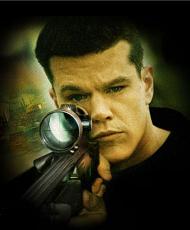
espionage and intrigue? On July 23, Matt Damon returns as amnesiac spy Jason Bourne in the
sequel to 2002's surprise hit, 'The Bourne Identity.' ....
At the end of
'Identity,' Bourne promised retaliation to Treadstone (the super-secret agency
that created him) if it came after him."
And now...
Bad
Will Hunting

Super-secret?
You can't make this
stuff up.
Thursday, July 15, 2004 2:29 AM
In memory of
 Frances Hansen,
cruciverbalist extraordinaire:
The
first crossword puzzle --

For related
commentary on
telepathic interplay, see an
entry for Aug.
29, 2002.
For related material on
intersecting word
patterns
and telepathic interplay,
see
The Demolished Man,
by Alfred Bester, and
We Are The Key,
a Log24 entry for
St. Lucia's Day, 2003.
Here is an illustration of what might
be called, as in the above
puzzle, a
"ten miles pit," from
Forbidden
Planet,
a classic film, based on
Shakespeare's
The Tempest,
discussed in the
8/29/02 entry.

A quotation that
somehow
seems relevant:
|
O the mind, mind has mountains,
cliffs of
fall
Frightful, sheer, no-man fathomed.
Hold them cheap
May who
ne'er hung there.
-- Gerard Manley Hopkins
|
Frances Hansen died on Friday, July 9. For more on words and The Roots of Coincidence (the subject of the
previous entry), see the entries of July 8-10.
Thursday, July 15, 2004 1:11 AM
Yesterday's first entry contained a
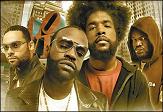
picture of the Philadelphia group The Roots:
Yesterday's last entry, "Welcome to Mr. Motley's
Neighborhood," dealt with properties of social networks. Trying to learn more
about such properties, I just came across this in the Wikipedia:
Small World Phenomenon --
"
The
Tipping Point by Malcolm Gladwell, based on articles originally published
in The New Yorker, elaborates the 'funneling' concept. In it Gladwell argues
that the six-degrees phenomenon is dependent on a few extraordinary people
('connectors') with large networks of contacts and friends: these hubs then
mediate the connections between the vast majority of otherwise weakly-connected
individuals."
From USA Today
--
Posted 7/12/2004 10:51 PM
Updated 7/13/2004 4:32
AMThe Roots tap
urgent beat
in 'Tipping Point' "The Tipping Point refers to Malcolm Gladwell's book
about critical moments that touch off social phenomena, and the album certainly
conveys a sense of urgency.
Between the riveting beats and frontman Tariq
'Black Thought' Trotter's razor-sharp lyrics about a range of social ills, it's
almost impossible to turn away." -- Steve Jones
For more on black
thought, click on the picture of Willard Motley's book in the previous
entry.
Wednesday, July 14, 2004 9:00 PM
Welcome
to...Mr.
Motley'sNeighborhood
"Perhaps people will revert to private social networks--ones
they manage locally....
Perhaps the law of networks--the strength of a tie degrades by the square of
the number of links--would become more apparent, and perhaps that would be a
good thing.
I'm not sure how good that is as a business model, but it works as a social
model."
The beautiful, brilliant, and charming Esther Dyson seems to have
suffered a temporary lapse in brilliance with the above remark on the strength
of ties in social networks....
"the law of networks--the strength of a
tie degrades by the square of the number of links...."
Here are some
useful references encountered while fact-checking Ms. Dyson's assertion about
the "law of networks" --
Links on
Graph Theory and Network Analysis
The
Navigability of Strong Ties:
Small Worlds, Tie Strength and Network
Topology (pdf)
Modeling Coleman's Friendly Association Networks (pdf)
The Strength of Weak Ties:
A Network Theory Revisited
(pdf)
Scientific Collaboration Networks, II (pdf)
(Deals
specifically with tie-strength computation.)
Dynamic Visualization of
Social Networks
and, finally, a diagram of social networks in
Shakespeare that conclusively demonstrates that there is no simple relationship
between strength of ties and number of ties:
Cleopatra's Social Ties (png)
Perhaps what Ms. Dyson
had in mind was the following (courtesy of The
Motley Fool):
"Metcalfe's Law of Networks states that the value of a network
grows by the square of the size of the network. Translated, this means
that a network that is twice as large as another network will actually be at
least four times as valuable. Why? Because four times as many interconnections
are possible between participants in the larger network.
When you add a fourth
person to a group of three, you don't add just one more networked relationship.
You add several. The new individual can network with all three of the existing
persons, and vice versa. The Internet is no different. It became more and more
valuable as the numbers of computers using it grew."
For another perspective on this alleged law, from science fiction author
Orson Scott Card, see The Group, a Log24 entry of Sept. 24, 2002.
Elsewhere, in a
discussion of social-networking software:
"Esther Dyson starts with a
request that people turn to their left and ask the person next to them, 'Will
you be my friend?' The room erupts in chatter, but, of course, the problem is we
don't have enough information about one another to make a snap decision about
that question."
Obviously, ties resulting from such a request will be weak, rather than
strong. However, as study of the above network-theory links will reveal, weak
ties can sometimes be more useful than strong ties. An example:
Passing the Peace at Mass.
Compare and contrast with
Ms. Dyson's request
to turn and
ask the Mr. Rogers question,
"Will you be my friend?"
The best response to this question
that I know
of was contained in
a good-bye letter from a girl named
Lucero in Cuernavaca
in the early 1960's:
"Si me deveras
quieres,
deja me en paz."
(See Shining
Forth.)
Wednesday, July 14, 2004 4:25 PM
Bright
Star
From Robert A. Heinlein's
classic novel, Glory
Road:
|
"I have many names. What would you like to call me?"
"Is one of them
'Helen'?"
She smiled like
sunshine and I learned that she had dimples. She looked sixteen and in her first
party dress. "You are very gracious. No, she's not even a relative. That was
many, many years ago." Her face turned thoughtful. "Would you like to call me
'Ettarre'?"
"Is that one of your
names?"
"It is much like one
of them, allowing for different spelling and accent. Or it could be 'Esther'
just as closely. Or 'Aster.' Or even 'Estrellita.' "
" 'Aster,' " I
repeated. "Star. Lucky Star!" |
Today's birthday:

Esther Dyson
Wednesday, July 14, 2004 1:20 PM
ValueAmerican Heritage
Dictionary --
val·ue NOUN:
6. Mathematics An
assigned
or calculated numerical quantity.

Commentary
--
See
Boyz N the Hood:
Kerry, Edwards Emphasize Values
(Log24 7/11,
2004).
Time Magazine,
issue
dated July 19, 2004 --
"Second-Helping Summer:
Movie sequels are getting
raves..."
Boyz N the Hood,
Part II -- First Family Visits
Hood
First Family Visits
Hood:
After the service, Bush spoke with the press
outside the chapel.
"These incidents were basically thrust upon the
innocent Iraqi people by gangs, violent gangs...."
"I know this, that we're plenty tough, and we'll
remain tough...."
"Happy Easter to everybody. Thank you."
Happy Bastille Day, Fort Hood.
Monday, July 12, 2004 10:31 PM
Character and Values
In
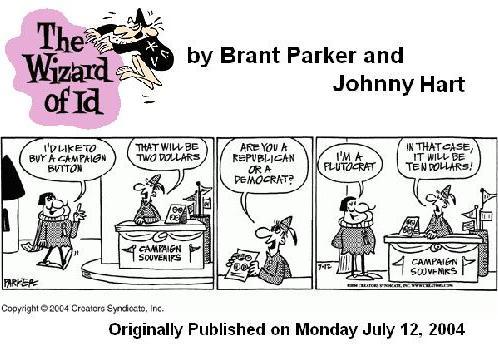
response to this morning's Wizard-of-Id example (see 1:22 PM entry) of a
political Bob-Hope-style Christian wisecrack (a style more apt to make me gag
than laugh), some further quotations:
I need a
photo-opportunity,
I want a
shot at redemption.
Don't want to end up a cartoon
In a cartoon
graveyard.
— Paul Simon
|
|
The Washington Post on the gigolo candidate in Boston
Monday:
"In a lunch speech to more than 1,000 women who had donated $500
to $2,000 to his campaign or the Democratic Party, Kerry was joined on stage by
his wife, Teresa Heinz Kerry.... He focused his comments on improving health
care and creating more jobs -- notions that he said 'are not Democratic values.
They're not Republican values. They are American values.' "
Let us pass
over Kerry's ignorance of the difference between desiderata
(things considered desirable) and values (principles, standards, or qualities considered desirable).
A
definition of "values" in a different sense, one that might appeal to the late
St. Laurance Rockefeller, dead on 7/11, who majored
in philosophy at Princeton:
"In an artistical composition, the
character of any one part in its relation to other parts and to the whole —
often used in the plural: as, the values are well given, or well
maintained."
-- Webster's Unabridged Dictionary, 1913
Rockefeller is, I hope,
now in a place where he can discuss this definition with Bach as it applies to,
say, that composer's "Goldberg Variations."
Here below, another sort of
Goldberg Variations seems appropriate to the times we live in ...
The
following composition was inspired by Whoopi Goldberg's remarks at last Thursday's Radio City Music
Hall Democratic Party fund-raiser.
Democratic
Political Art:
Motherhood
and Apple Pie

Sources:
Ike Turner,
Bad Dreams album,
Mom's Apple Pie album (X-rated),
and
Log24 entries of
July 9-10 and July 12.
Update of 3:17 AM July 13,
2004:
A place in Heaven next to St. Laurance
seems to have been
reserved:

Monday, July 12, 2004 1:29 PM
Sequel
| This world is not conclusion; |
|
| A sequel stands beyond, |
|
| Invisible, as music, |
|
| But positive, as sound. |
|
| It beckons and it baffles; |
5 |
| Philosophies don't know, |
|
| And through a riddle, at the last, |
|
| Sagacity must go. |
|
| To guess it puzzles scholars; |
|
| To gain it, men have shown |
10 |
| Contempt of generations, |
|
And crucifixion known.
|
Monday, July 12, 2004 1:22 PM
Sequel to the Previous Entry:
Monday, July 12, 2004 4:16 AM
"J. S. Bach's 'Goldberg Variations' is a self-contained world,
immersion in which is transformative....
At the end of Variation 30, Bach
writes simply 'Aria da capo.' I have written it out for the convenience of the
players. This recurrence of the Aria, after its long journey through thirty
variations and especially coming immediately after the exuberant Quodlibet
(Variation 30), is magical. It is the same Aria, yet subtly different:
transformed."
Monday, July 12, 2004 1:44 AM
Campaign Song
"All things return to the One.
What does the
One return to?"
-- Zen koan, epigraph to
The Footprints of
God,
by Greg Iles of
Natchez, Mississippi
"Literature
begins with geography."
-- attributed to Robert Frost
Sunday, July 11, 2004 3:57 PM
Los Angeles Times
2:38 PM PDT, July 9, 2004 --
Boyz N the Hood:
Kerry, Edwards Emphasize
Values
By Matea
Gold, Times Staff Writer
BEAVER, W.
Va. -- Anticipating a full-frontal attack by President Bush, Sens. John
Edwards and John Kerry offered a vigorous defense of their character today,
arguing they are more aligned with the concerns of the middle class as they
accused the administration of having hollow values.
For further details, see Ann Coulter
on the Shyster and the Gigolo.
For a more philosophical approach to
culture
and politics, see a Log24 entry
from October 29, 2002:
|
Our Judeo-Christian
Heritage:
Two Sides of the Same
Coin
|
Saturday, July 10, 2004 3:17 PM
Oxford Word
From today's obituary in The New York Times of R. W. Burchfield, editor of
A Supplement to the Oxford English
Dictionary:
"Robert William Burchfield was born Jan. 27, 1923, in Wanganui, New Zealand.
In 1949, after earning an undergraduate degree at Victoria University College in
Wellington, he accepted a Rhodes scholarship to Oxford.
There, he read
Medieval English literature with C.S. Lewis and J.R.R. Tolkien."
For more
on literature and Wanganui, see my entry of Jan. 19. 2003, from which the following is taken.
|
"Cullinane College is a Catholic co-educational college, set to
open in Wanganui (New Zealand) on the 29th of January, 2003."
The 29th of January will be the 40th anniversary
of the death of Saint Robert Frost.
New Zealand, perhaps the most beautiful country on
the planet, is noted for being the setting of the film version of Lord of
the Rings, which was written by a devout Catholic, J. R. R.
Tolkien.
For other New Zealand themes,
see Alfred Bester's novels The Stars My Destination and The Deceivers.
The original title of The Stars My
Destination was Tyger! Tyger! after Blake's poem.
For more on fearful symmetry, see the
work
of Marston
Conder, professor of mathematics at the University of Auckland, New Zealand.
|
Saturday, July 10, 2004 1:36 PM
Wrestling with
Words
"Philosophers ponder the idea of identity: what it is
to give something a name on Monday and have it respond to that name on
Friday...."
-- Bernard Holland, The New York Times of Monday, May 20,
1996
From today's New York Times obituaries:
R. W. Burchfield
died Monday. He was "an internationally renowned lexicographer who wrestled the
Oxford English Dictionary into the era of 'sexploitation.' "
In other news....
"Although Mr.
Kerry had told the crowd at the New York fund-raiser that 'every single
performer' on the bill had 'conveyed to you the heart and soul of our country,'
his campaign on Friday sought to distance Mr. Kerry and his running mate,
Senator John Edwards, from the anti-Bush jokes, lyrics and statements of some of
the entertainers.
But it declined to release a videotape of the performance at which Ms.
Goldberg, a bottle of wine in hand, made an extended sexual pun out of the
president's surname.
[Also on Friday...]
At an afternoon airport rally in Beaver, W. Va., a town of 1,378 people, Mr. Kerry attached the
word 'value' to virtually every line of his standard stump speech...."
Somehow, a different word comes to
mind.
Friday, July 9, 2004 7:11 PM
Scoop
This afternoon I came
across, in a briefcase I seldom use, two books I had not looked at since I
bought them last month:
- The Footprints of God, a recently
published paperback by Greg Iles, a writer who graduated from Trinity High
School, Natchez, Mississippi, in 1979, and from the University of Mississippi in
Oxford in 1983.
- Sanctuary, by the better-known
Mississippi writer William Faulkner.
At the time I purchased the
books, indeed until I looked up Iles on the Web today, I was not aware of the
Mississippi connection. Their physical connection, lying together today in my
briefcase, is, of course, purely coincidental. My view of coincidence is close
to that of Arthur Koestler, who wrote The
Challenge of Chance and The Roots of
Coincidence, and to that of Loren Eiseley, who wrote of a dice game and
of "the Other Player" in his autobiography, All the Strange
Hours.
A Log24 entry yesterday referred to a comedic novel on the role of
chance in physics, Cosmic Banditos.
Today's New York Times quotes an entertainer who referred to President Bush
yesterday, at a political fund-raiser, as a bandito. Another coincidence...
this one related directly to the philosophy of coincidences expounded jokingly
in Cosmic Banditos.
I draw no
conclusions from such coincidences, but they do inspire me to look a little
deeper into life's details -- where, some say, God is. Free association on
these details, together with a passage in Sanctuary, inspired the following
collage:
 Related
Texts
Related
TextsFaulkner on a trinity of women
in
Sanctuary (Ch. 25):
"Miss Reba emerged from behind the screen with
three glasses of gin. 'This'll put some heart into us,' she said. 'We're setting
here like three old sick cats.' They bowed formally and drank, patting their
lips. Then they began to talk. They were all talking at once,
* again in half-completed
sentences, but without pauses for agreement or affirmation."
"
In
Defense of the Brand":
"When I was helping Frito corn chips expand its
core user group in the mid-'90s, we didn't ask Frito-Lay to just wave the Fritos
banner. The brand was elevated to a place where it could address its core users
in a way that was relevant to their lifestyle. We took the profile of the
audience and created a campaign starring Reba McEntire. It captured the brand's
essence, and set Frito eaters amidst good music, good people, and good
fun."
Song lyric, Reba McEntire:
"I might have been born
just plain white
trash,
but Fancy was my name."
Loren Eiseley,
Notes of an
Alchemist:
I never found
the hole in the wall;
I never
found
Pancho Villa country
where you see the enemy first.
-- "The
Invisible Horseman"
* A significant
phrase. See
Thursday, July 8, 2004 12:25 PM
Bandito
12:25 PM July 8:
|
"Willst Du
lieber
einen gelben Stern
haben?" she asked.
"Oder einen roten?"
-- Martin Cruz
Smith,
Stallion Gate,
Ballantine
paperback,
1987, page 101
|

Personally, I
prefer
a blue-green star:
 Follow-up of
2 PM July 9, 2004
--
From today's New York Times:
"Texas Bandito, how much
money
did you put in your pocket today?"
John Mellencamp crooned
in a
country ballad.
In a two-and-a-half hour gala
that raised $7.5
million,
a record for a single event,
Chevy Chase poked fun at
the
president's pronunciation
of "nuclear"...

The concert
brought 6,200 people,
paying $250 to $25,000 each...
beating the $6.8
million haul
from a parallel gala last month
in Los Angeles
featuring
Barbra Streisand,
Willie Nelson,
and Billy Crystal.
The
take will be split....
Here, Chevy, is
another
way to pronounce "nuclear"-- The Source:
Click on
picture for details.
Wednesday, July 7, 2004 7:00 PM
Beyond Geometry
(Title of current L. A. art exhibit)
|
John Baez:
What is the difference between topology and
geometry?
Geometry you learn in high school; topology in college. So,
topology costs more.
A bit more
seriously.... |
"The greatest obstacle to discovery
is not
ignorance --
it is the illusion of knowledge."
-- Daniel J. Boorstin,
American historian,
educator, writer.
Source:
The Washington Post,
"The Six O'Clock
Scholar,"
by Carol Krucoff (29 Jan. 1984)
For the illusion of
knowledge,
see (for instance)
The Importance of Being Nothingness,by Craig J.
Hogan
(American Scientist, Sept.-Oct. 2001).
A bit more
seriously...
"These cases are
neither harmless nor amusing."
--
Craig J. Hogan,
op. cit.For
example:"Thanks to Dr. Matrix
for honouring
this websitewith
the Award for Science Excellence
on May 14, 2002 and selecting it
for
prominent display in the categories
of
Mathematics and
Creative Minds."
See also my notes
On Dharwadker's
Attempted Proof,
November 28, 2000, and
The
God-Shaped Hole,
February 21, 2001.
Wednesday, July 7, 2004 4:07 PM
Not-So-Solemn Requiem
Funeral song for Marlon Brando to sing, at long last, to the immortal Grace
Kelly...
"Everybody's just dying to be heard..."
-- KHYI radio, Plano, Texas, 4:00 PM EDT
(... followed at 4:04 PM by ...
"I guess
I just woke up
from my American dream.")
Relevant theology...
"Death is not earnest in the same way the eternal is. To the
earnestness of death belongs precisely that capacity for awakening, that
resonance of a profound mockery which, detached from the thought of the eternal,
is an empty and often brash jest, but together with the thought of the eternal
is just what it should be...."
-- Søren Kierkegaard, Works of
Love,
Harper Torchbooks, 1964, p. 324
Wednesday, July 7, 2004 2:00 PM
Elegance
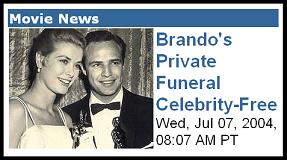
Except, of course, for
Amazing Grace.
Friday, July 2, 2004 2:25 PM
Contender
"Jack Nicholson
has said he believes, as do many actors, that when Brando's gone, everyone moves
up a place."
-- Claudia Luther and Elaine Dutka,
Los Angeles Times staff writers
Marlon
Brando in On the
Waterfront:
Terry Malloy: "It wasn't him, Charley, it was you.
Remember that night in the Garden you came down to my dressing room and you
said, 'Kid, this ain't your night. We're going for the price on Wilson.' You
remember that? 'This ain't your night'! My night! I coulda taken Wilson apart!
So what happens? He gets the title shot outdoors on the ballpark and what do I
get? A one-way ticket to Palookaville! You was my brother, Charley, you shoulda
looked out for me a little bit. You shoulda taken care of me just a little bit
so I wouldn't have to take them dives for the short-end money."
Charley Malloy: "Oh, I had some bets down for
you. You saw some money."
Terry
Malloy: "You don't understand. I coulda had class. I coulda been a
contender. I coulda been somebody, instead of a bum, which is what I am, let's
face it. It was you, Charley."
Sylvester Stallone in Rocky:
"I can't beat him. But
that don't bother me. The only thing I want to do is to go the distance, that's
all. Because if that bell rings and I'm still standing, then I'm gonna know for
the first time in my life, see, that I wasn't just another bum from the
neighborhood."
Friday, July 2, 2004 2:00 AM
Is
Nothing Sacred?
...continued...
|
From a
review in today's
New York
Times
of an
L.A. art exhibit,
"Beyond Geometry"
By Michael
Kimmelman
in Los Angeles
The roots of this work go back to Duchamp, the
abiding spirit of "Beyond Geometry." When he acquired his porcelain urinal in
1917 from a plumbing equipment manufacturer on lower Fifth Avenue in Manhattan,
signed it R. Mutt and submitted the now infamous "Fountain" to the Society of
Independent Artists exhibition, he set the stage for nearly every subsequent
attempt to blur the difference between art and everyday life.
This was the great breakthrough of modernism or the
end of culture as we know it, depending on your perspective. Either way, after
Duchamp, as the artist Joseph Kosuth has put it, all art became conceptual.
Duchamp predicted that even a breath might end up
being called a work of art, and he was right. Gilbert and George started calling
their performances sculptures in the 70's. Chris Burden, James Lee Byars and
others said that their actions were sculptures. Smithson declared derelict
factories and suburbs to be sculptures. Artists even made light, the ultimate
intangible, into sculpture.
The show includes sculptures by Richard Serra and
Barnett Newman. I recall Mr. Serra once talking about how Barnett Newman's
paintings invite you to walk past them, to experience them not in a single
glance but over time, physically. He said the paintings, with their vertical
stripes, or "zips," are "about dividing and placing spaces next to one another,
not about illusionism."
"They're great when you have to walk by them and
immerse yourself in the divisions of their spaces," he added. Meaning, they're
like sculptures.
Nomenclature is not the point. What matters is the
ethos of countercultural disruption, looking at the world and art through the
other end of the telescope, which is the heart of "Beyond Geometry" and the
appeal of its best works to young artists.
Now is the time to put this period of postwar tumult
into global perspective. The show here is a useful step in that direction.
|
Meanwhile, in Philadelphia,
other art events:

(Click on logo for details.)
The reader may determine whether the Philadelphia
nothing is the sort of nothing deemed, by some, sacred in my note of
March 9, 2000.
I personally have a very low opinion of Kimmelman
and his "ethos of countercultural disruption." The sort of light sculpture his
words evoke is not that of the Pantheon (illustrated in an entry for St. Peter's Day) but that of the current
Philadelphia "Big Nothing" show, which in turn reminds me of that classic 1973
Hollywood art exhibit, The
Exorcist:

Thursday, July 1, 2004 7:59 PM