Saturday, February 14, 2004 1:11 PM
Export Janet.
"... on behalf of the
Entertainment Industry Coalition
for
Free Trade (EIC),
we appreciate the opportunity
to appear before
you...."
-- Testimony before the
U. S. International
Trade
Commission
at mpaa.org
From the CNN transcript of Lou Dobbs Tonight, Friday the 13th of February, 2004...
DOBBS: Joining us tonight... Steve Forbes, the editor and chief of "Forbes".... Mark Morrison, managing editor of "Businessweek"........
MORRISON: We'd all like to see more job creation and less exporting of jobs.
But coming to the right answer as to achieving that, what policy changes, can we
make? We don't want to go down a protectionist road.
DOBBS: Why not?
MORRISON: What would you suggest?
DOBBS: Why not?
You
want to know what I would suggest? You go first.
FORBES: I don't want
another depression.
DOBBS: You don't want a Great Depression. Do you
think Smoot-Hawley caused the depression?
FORBES: It certainly
contributed to it.
DOBBS: Oh, for crying out loud. The fact of the matter
is, that...
FORBES: Do you want to go to North Carolina and say to the
BMW workers send the jobs back to Germany?
DOBBS: I haven't made a
proposal yet and Forbes is all over me here.
FORBES: You want to have a
lively show, keep your ratings up.
(LAUGHTER)
DOBBS: Yes, we'll
do that talking about Smoot-Hawley.
The fact of the matter
is...
FORBES: Culture...
Janet Jackson Act.
DOBBS: The fact of the matter is,
we're exporting our wealth at an alarming rate. We simply cannot continue this.
And we've got 3 trillion dollars in IOUs. You tell me, at some point you are
going to have to make a decision, either you are going to have free trade that
has mindlessly led us to this point, or you are going to have fair, managed,
mutual trade and build the economy back up.
FORBES: The trouble with
managed trade it's managed by politicians.
DOBBS: Well, I'd rather it be
managed by politicians...
FORBES: Managing anything is something to be
avoided and deplored. There -- our economy today.
DOBBS: There are
politicians who care about working men and women in this country. Who care about
long-term wealth of this economy [more] than heads of multinationals who are
indifferent.
FADE OUT; BACKGROUND SOUND:
Thursday, February 12, 2004 10:02 PM
Profile in Courage:
Bush Distances Himself from Aide
on Exporting
Jobs
Thursday, February 12, 2004 1:23 PM ET
|
|
By Adam Entous HARRISBURG, Pa. (Reuters) - Under pressure from fellow Republicans, President Bush distanced himself on Thursday from one of his top economic advisers who said the outsourcing of U.S. jobs to workers overseas may benefit the economy. |
"The (economic) numbers are good. But I don't worry about numbers, I worry about people," Bush told students and teachers at a high school in Pennsylvania -- a pivotal state in this year's election and one of the hardest hit by factory job losses during his presidency.
Without mentioning by name the chairman of his Council of Economic Advisers, Gregory Mankiw, Bush said he was concerned "there are people looking for work because jobs have gone overseas" and vowed to "act to make sure there are more jobs at home" by keeping taxes low and by retraining displaced workers. Bush offered no new initiatives to curb outsourcing and aides said he opposed restrictions on free trade.
"You can fool all of the people
all of the
time."

-- Art Buchwald
Thursday, February 12, 2004 12:00 PM
The Smoking Stovepipe
"What appears to have happened is this. Sometime soon after 9-11, the neocons persuaded the president that invading Iraq was the next crucial step in winning the war on terror and evil in which Divine Providence had chosen him to be the Churchill of his generation. And if the country and Congress were unconvinced of the need for war, it was his job to convince them.
And here is where the administration began to cross the line. To persuade us that Saddam was a mortal threat to which the only recourse was war, they needed evidence. But, apparently, there was little or no hard evidence to be had. No smoking guns....
First, they decided on war. Then they sent everyone out on a global scavenger hunt to find the evidence to prove we had no alternative but war. And though the information that came back was suspicious and the sources suspect, at least it pointed, as desired, in the right direction.
And, so, the hawks fed it to their propagandists in the press and 'stovepiped' it to the White House, where it soon began to appear in the statements and speeches of the president and his War Cabinet."
-- Patrick J. Buchanan, Feb. 11, 2004

Happy birthday, Abie baby.
"Every totalitarian leader claims that, in himself, he is nothing at all: His strength is only the strength of the people who stand behind him, whose deepest strivings only he expresses. The catch is, those who oppose the leader by definition not only oppose him, but they also oppose the deepest and noblest strivings of the people."
-- a column opposing the president at foreignpolicy.com.
Wednesday, February 11, 2004 10:15 AM
On Exporting Jobs
The liberal view:
"Outsourcing raises American productivity, gives our economy a boost, increases foreign demand for U.S. products and leaves us better off."
-- Nicholas D. Kristof
in today's New York
Times
The Perot view:
"Perot Systems, the computer services company founded by former presidential candidate Ross Perot, is all set to add about 3,500 jobs in India and move into two new facilities there this year."
-- Times of India, Feb. 7, 2004
The conservative view:
As noted by Pat Buchanan in yesterday's entry, the conservative view is strongly anti-free-trade. This view currently seems best defended, not by Buchanan and Perot's largely defunct Reform Party, but instead by the Communist Party... in, for instance, its incarnation as the International Committee of the Fourth International (ICFI). See the Committee's World Socialist Web Site for details.
See particularly the World Socialist account of demonstrations against the Free Trade Area of the Americas (FTAA) in Miami last year:
Legal observer details police violence
against FTAA protesters in
Miami.
Supporters of free-trader John Kerry might consider taking the Communists a
bit more seriously this year. There is no credible challenge to Bush from
the right, but a challenge to Kerry from the disgruntled left -- in the form of
write-ins, stay-at-homes, and votes for obscure leftist candidates -- could tip
a close election in Bush's favor... as Nader did in 2000.
Tuesday, February 10, 2004 12:07 PM
George W.
Bush,
Liberal!

Part I:
|
President's Economic
Report
WASHINGTON — The movement of American factory jobs and white-collar work to other countries is part of a positive transformation that will enrich the U.S. economy over time, even if it causes short-term pain and dislocation, the Bush administration said today. The embrace of foreign "outsourcing," an accelerating trend that has contributed to U.S. job losses in recent years and has become an issue in the 2004 elections, is contained in the president's annual report to Congress on the health of the U.S. economy.... Although trade expansion inevitably hurts some workers, it says, the
benefits will eventually outweigh the costs as Americans are able to buy
goods and services at lower costs and as jobs are created in growing
sectors of the economy. |
Part II:
A search on liberal "free trade" leads to the following quote:
"One of the central concepts of classical liberal economic thought is the superiority of free trade over protectionism."
Therefore George W. Bush, by courageously advocating free trade despite its political unpopularity, is a classic liberal.
Part III:
Context for the above quote:
The Liberal Agenda for the 21st Century
George W. Bush's free-trade policy
fits right in.
Part IV:
The Conservative Alternative...
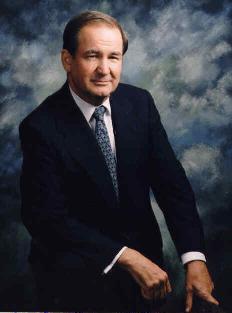
Patrick J. Buchanan,
author of "The Death of Manufacturing"
and A Republic, Not an Empire.
"Let it be said: George Bush is beatable. He has no explanation and no cure for the hemorrhaging of manufacturing jobs at Depression rates, no plan to stop the outsourcing of white-collar jobs to Asia, no desire or will to stop the invasion from Mexico.
Yet, he remains a favorite against Kerry, because Kerry has no answers, either. Both are globalists. Both are free-traders. Both favor open borders. Again, it needs to be said: There is no conservative party in America."
-- Patrick J. Buchanan, Feb. 2, 2004
Not yet, there isn't.
Monday, February 9, 2004 6:36 PM
Hermes and Folded Time
Yesterday's entry on painter Ward Jackson and the philosopher Gadamer involved what is called hermeneutics, or the art of interpretation. Gadamer was a leader in this field. The following passage perhaps belabors the obvious, but it puts hermeneutics clearly in context.
From Daniel Chandler's Semiotics for Beginners:
"The 'tightness' of semiotic codes themselves varies from the rule-bound closure of logical codes (such as computer codes) to the interpretative looseness of poetic codes. Pierre Guiraud notes that 'signification is more or less codified,' and that some systems are so 'open' that they 'scarcely merit the designation 'code' but are merely systems of "hermeneutic" interpretation' (*Guiraud 1975, 24). Guiraud makes the distinction that a code is 'a system of explicit social conventions' whilst 'a hermeneutics' is 'a system of implicit, latent and purely contingent signs,' adding that 'it is not that the latter are neither conventional nor social, but they are so in a looser, more obscure and often unconscious way' (*ibid., 41). His claim that (formal) codes are 'explicit' seems untenable since few codes would be likely to be widely regarded as wholly explicit. He refers to two 'levels of signification,' but it may be more productive to refer to a descriptive spectrum based on relative explicitness, with technical codes veering towards one pole and interpretative practices veering towards the other. At one end of the spectrum are what Guiraud refers to as 'explicit, socialized codes in which the meaning is a datum of the message as a result of a formal convention between participants' (*ibid., 43-4). In such cases, he argues, 'the code of a message is explicitly given by the sender' (*ibid., 65). At the other end of the spectrum are 'the individual and more or less implicit hermeneutics in which meaning is the result of an interpretation on the part of the receiver' (*ibid., 43-4). Guiraud refers to interpretative practices as more 'poetic,' being 'engendered by the receiver using a system or systems of implicit interpretation which, by virtue of usage, are more or less socialized and conventionalized' (*ibid., 41). Later he adds that 'a hermeneutics is a grid supplied by the receiver; a philosophical, aesthetic, or cultural grid which he applies to the text' (*ibid., 65)."
* Pierre Guiraud, Semiology (trans. George Gross), London: Routledge & Kegan Paul, 1975
Related material:
From Michalinos Zembylas on Michel Serres:
"Serres' use of Hermes is reminiscent of hermeneutics. The word derives from Hermes and implies that the idea of hermeneutics as a theory of interpretation (and consequently of communication) is necessary when there is a possibility for misunderstanding. Hermes translated the 'word of Gods'; an interpreter translates the written text, and a teacher 'translates' the literature.... Understanding then is aided by the mediation of a hermeneut.... According to Gadamer (1975), the pleasure such understanding elicits is the joy of knowledge (which does not operate as an enchantment but as a kind of transformation). It is worth exploring this idea a bit more since there are interesting connections with Serres' work."
There is also an interesting connection with Guiraud's work. As quoted above, Guiraud wrote that
"...a hermeneutics is a grid supplied by the receiver; a philosophical, aesthetic, or cultural grid which he applies to the text."
Serres describes Hermes as passing through "folded time." Precisely how time can be folded into a grid is the subject of my note The Grid of Time, which gives the context for the Serres phrase "folded time."
For more on hermeneutics and Gadamer's "joy of knowledge," see Ian
Lee in The Third Word War on "understanding the J.O.K.E." (the Joy of Knowledge Encyclopedia).
Sunday, February 8, 2004 2:00 PM
The Quality of Diamond
On February 3, 2004, archivist and abstract painter Ward Jackson died at 75. From today's New York Times:
"Inspired by painters like Piet Mondrian and Josef Albers, Mr. Jackson made austere, hard-edged geometric compositions, typically on diamond-shaped canvases."
|
On a 2003 exhibit by Pablo Helguera that included Mr. Jackson: Parallel Lives recounts and recontextualizes real episodes
from the lives of five disparate individuals including Florence Foster
Jenkins, arguably the world's worst opera singer; Giulio Camillo, a
Renaissance mystic who aimed to build a memory container for all things;
Friedrich Froebel, the inventor of the kindergarten education system, the
members of the last existing Shaker community, and Ward Jackson, the
lifelong archivist of the Solomon R. Guggenheim Museum.
|
On February 3, the day that Jackson died, there were five different log24.net entries:
Parallels with the Helguera exhibit:
Florence Foster Jenkins: Janet Jackson in (2) above.
Giulio Camillo: Myself as compiler of the synchronistic excerpts in (5).
Friedrich Froebel: David Wade in (4).
The last Shakers: Christopher Alexander and his acolytes in (1).
Ward Jackson: On Feb. 3, Jackson became a permanent part of
Some thoughts of Hans-Georg
Gadamer
relevant to Jackson's death:
|
by G.T. Karnezis The pleasure it [art] elicits "is the joy of knowledge." It does not operate as an enchantment but "a transformation into the true." Art, then, would seem to be an essentializing agent insofar as it reveals what is essential. Gadamer asks us to see reality as a horizon of "still undecided possibilities," of unfulfilled expectations, of contingency. If, in a particular case, however, "a meaningful whole completes and fulfills itself in reality," it is like a drama. If someone sees the whole of reality as a closed circle of meaning" he will be able to speak "of the comedy and tragedy of life" (genres becoming ways of conceiving reality). In such cases where reality "is understood as a play, there emerges the reality of what play is, which we call the play of art." As such, art is a realization: "By means of it everyone recognizes that that is how things are." Reality, in this viewpoint, is what has not been transformed. Art is defined as "the raising up of this reality to its truth." |
As noted in entry (3) above
on the day that Jackson
died,
"All the world's a stage."
Saturday, February 7, 2004 2:00 PM
Saturday, February 7, 2004 1:00 PM
Scholarship vs. Bullshit
"Examples are the stained-glass windows of knowledge." -- Vladimir Nabokov
An example of scholarship:
An example of bullshit:
Further background:
Noble lies and perpetual war: Leo Strauss, the neo-cons, and
Iraq.
Friday, February 6, 2004 7:35 AM
Government by Crackpots
Morning briefing:
Paul Krugman on Laurie Mylroie in today's New York Times...
Peter Bergen in the Washington Monthly...
Laurie Mylroie: The Neocons'
Favorite
Conspiracy Theorist,
and Cecil Adams in the Chicago Reader on...
Leo Strauss and
the Neocon
Crackpots.
Strauss lectured on Plato at the
University of Chicago. For more on Plato and philosophy at the University
of Chicago, see the classic Zen and the Art of Motorcycle
Maintenance.
Thursday, February 5, 2004 2:56 PM
Quantum Logic:
A memorial to the late Alan Bullock,
founding master of St.
Catherine's College,
Oxford, and historian of the Third Reich.
Bullock died on Groundhog Day.
From an obituary:
"Hitler: a Study in Tyranny was published in 1952 with the aphorism from Aristotle: ‘Men do not become tyrants in order to keep out the cold.’ In the same year Alan Bullock took up his appointment to the oddly-named office of ‘Censor’ of St. Catherine’s Society – a male society, constitutionally part of the University, with a handful of tutors and no residential accommodation. Ten years later it became a College...."
|
Emblem of |
Quantum Oscillator |
Explaining what these Catherine wheels symbolize seems an appropriate task for Oxford philosophers. From the St. Catherine's College site: "The College's motto - Nova et Vetera (the new and the old) - sums up its unique quality among Oxford colleges."
See also today's previous entry, prompted by a recent MIT Press book on
philosophy and quantum theory.
Thursday, February 5, 2004 12:00 PM
Affirmation of Place and Time:
East
Coker and Grand Rapids
This morning's meditation:
"Let us talk together with the courage, humor, and ardor of Socrates.
In that long conversation, we may find ourselves considering something Plato's follower Plotinus said long ago about 'a principle which transcends being,' in whose domain one can 'assert identity without the affirmation of being.' There, 'everything has taken its stand forever, an identity well pleased, we might say, to be as it is.... Its entire content is simultaneously present in that identity: this is pure being in eternal actuality; nowhere is there any future, for every then is a now; nor is there any past, for nothing there has ever ceased to be.' Individuality and existence in space and time may be masks that our sensibilities impose on the far different face of quantum reality."
-- Peter Pesic, Seeing Double: Shared Identities in Physics, Philosophy, and Literature, MIT Press paperback, 2003, p. 145
A search for more on Plotinus led to sites on the Trinity, which in turn led to the excellent archives at Calvin College in Grand Rapids.
A search for the theological underpinnings of Calvin College led to the Christian Reformed church:

"Our emblem is
the cross in a triangle."
The triangle, as a symbol of "the delta factor," also plays an important role in the semiotic theory of Walker Percy. A search for current material on Percy led back to one of my favorite websites, that of Percy expert Karey Perkins, and thus to the following paper:
The "East Coker" Dance
in T. S. Eliot's Four
Quartets:
An Affirmation of Place and Time
by
Karey Perkins
For a rather different, but excellent, literary affirmation of place and time -- in Grand Rapids, rather than East Coker -- see, for instance, Michigan Roll, a novel by Tom Kakonis.
We may, for the purposes of this trinitarian meditation, regard Percy and Kakonis as speaking for the Son and Karey Perkins as a spokesperson for the Holy Spirit. As often in my meditations, I choose to regard the poet Wallace Stevens as speaking perceptively about (if not for, or as) the Father. A search for related material leads to a 1948 comment by Thomas McGreevy, who
"... wrote of Stevens' 'Credences of Summer' (Collected Poems 376),
On every page I find things that content me, as 'The trumpet of the morning blows in the clouds and through / The sky.'
A devout Roman Catholic, he added, 'And I think my delight in it is of the Holy Spirit.' (26 May 1948)."
An ensuing search for material on "Credences of Summer" led back, surprisingly, to an essay -- not very scholarly, but interesting --on Stevens, Plotinus, and neoplatonism.
Thus the circle closed.
As previous entries have indicated, I have little respect for Christianity as
a religion, since Christians are, in my experience, for the most part, damned
liars. The Trinity as philosophical poetry, is, however, another
matter. I respect Pesic's speculations on identity, but wish he had a
firmer grasp of his subject's roots in trinitarian thought. For Stevens,
Percy, and Perkins, I have more than respect.
Tuesday, February 3, 2004 7:11 PM
Retiring Faculty
The following is related to
today's
previous four log24 entries.
From my paper journal, a Xeroxed note, composed entirely of cut
copies
of various documents,
from July 11, 1990....
|
Harvard Alumni Gazette June
1990
Thought for today: "He who tells the truth must have one foot in the stirrup." -- Armenian Proverb Preserve me from the enemy -- T. S. Eliot, Choruses from the Rock -- 1934 Pattern in Islamic Art is the most thorough study yet published of the structure of the art.
|
Sources: Harvard Alumni Gazette, local newspaper, a volume of
the poems of T. S. Eliot, David Wade's Pattern in Islamic Art, and a
paperback novelization of Pale Rider
Tuesday, February 3, 2004 6:16 PM
Theory of Design
For an introduction, see
Pattern in Islamic Art, by David Wade.
For a deeper look that is related to the previous three log24 entries, see Goppold's
Tuesday, February 3, 2004 1:44 PM
Lila
Robert M. Pirsig, Lila, 1991 Bantam hardcover, p. 111:
"... Quality 'is' morality. Make no mistake about it. They're 'identical.' And if Quality is the primary reality of the world then that means morality is also the primary reality of the world."
-- Quoted at
The
Alexander-Pirsig Connection.
"This creative activity of the Divine is called lila, the play of God, and the world is seen as the stage of the divine play."
-- Fritjof Capra, The Tao of Physics, Third Edition, Updated, 1991, Shambhala paperback, pp. 87-88, quoted here
"All the world's a stage."
Tuesday, February 3, 2004 1:35 PM
Speaking Globally
On Janet Jackson at the Super Bowl:
"I don’t expect much but I am hoping that the whole episode rekindles a discussion in the country about the incredible double standard there is in the popular culture. Adults complain about the prevalence of teen sex, teen pregnancy, drug abuse, and lack of respect for appropriate authority but then place those very behaviors in front of children in the form of talented, attractive and highly paid role models. This is not a sensible approach. Speaking globally, this culture is asking for its own demise."
-- Warren Throckmorton, 2/3/04
Tuesday, February 3, 2004 11:11 AM
The Quality with No Name
|
|
|
And what is good, Phædrus,
and what is not good...
Need we ask anyone
to tell us these things?
-- Epigraph to
Zen and the
Art of Motorcyle Maintenance
Brad Appleton discusses a phrase of Christopher Alexander:
"The 'Quality Without A Name' (abbreviated as the acronym QWAN) is the quality that imparts incommunicable beauty and immeasurable value to a structure....
Alexander proposes the existence of an objective quality of aesthetic beauty that is universally recognizable. He claims there are certain timeless attributes and properties which are considered beautiful and aesthetically pleasing to all people in all cultures (not just 'in the eye of the beholder'). It is these fundamental properties which combine to generate the QWAN...."
See, too, The
Alexander-Pirsig Connection.
Monday, February 2, 2004 11:30 AM
From Re Joyce,
by Anthony Burgess:

Sunday, February 1, 2004 8:37 PM
New web page:
Sunday, February 1, 2004 11:07 AM
Note for St. Brigid's Day