From the journal of Steven H. Cullinane...
2003 Nov. 1-15
Saturday, November 15, 2003
1:26 PM
From the
Empty Center:
|
From Friday's 2:56 AM entry --
Philip K. Dick,
The Man in the High Castle:
"Sun at the top.
Tui at the bottom.
Empty in the center."

"Do you know
what hexagram that is?"
she said.
"Without using the chart?"
"Yes," Hawthorne said.
"It's Chung Fu," Juliana said.
"Inner Truth. I know
without using the chart, too.
And I know what it means."
Margo Jefferson in
today's NY Times:
"When a classical text is modernized,
what matters is imaginative logic.
Is the transformation coherent?
Does it enhance the power
of the past and present?
I say yes to both questions." |
Yesterday's entry "Aes Triplex" deals with image and reality.
Its final link, to the heart of Rome, leads to Julius Caesar.
A related review in today's New York Times:
The opening paragraph:
"We live in a media maelstrom, and the Moonwork theater company's 'Julius Caesar' comes hurtling toward us right from its center. This production, at the Connelly Theater in the East Village through Nov. 23, is set in the here and now.
Shakespeare's
'Julius Caesar' is about politics, rhetoric and power; about manipulation of a nation's image and its people; about conspiracy, murder and the war that leads to a new regime. What play is better suited for our times?"
-- Margo Jefferson
Friday, November 14, 2003
1:48 PM
Aes Triplex
The title, from a Robert
Louis Stevenson essay, means "triple brass" (or triple bronze):
From the admirable site
of J. Nathan Matias:
"Aes Triplex means Triple Bronze, from a line in Horace's
Odes that reads 'Oak and triple bronze encompassed the breast of him
who first entrusted his frail craft to the wild sea.' ''
From Philip K. Dick's The Man in the High Castle:
Juliana said, "Oracle, why did you write The Grasshopper Lies Heavy?
What are we supposed to learn?"
"You have a disconcertingly superstitious way of phrasing your question,"
Hawthorne said. But he had squatted down to witness the coin throwing. "Go
ahead," he said; he handed her three Chinese brass coins with holes
in the center. "I generally use these."
This passage, included in my
earlier entry today, combined with today's opening of yet another major motion
picture starring Russell Crowe, suggests three readings for that young man,
who is perhaps the true successor to Marlon Brando.
Oracle, for Crowe as John Nash (A Beautiful
Mind):
Understanding
the I Ching
Mutiny, for Crowe as Jack Aubrey (Master and
Commander):
Bartleby, the
Scrivener
Storm, for Crowe as Maximus
(Gladiator):
Pharsalia, Book
V:
The Oracle, the Mutiny, the Storm
As background listening, one possibility is Sinatra's
classic "Three Coins":
"Three hearts in the
fountain,
Each heart longing for its home.
There they lie in the
fountain
Somewhere in the heart of Rome.*"
Personally, though, I prefer, as a tribute to author Joan Didion (who
also wrote of coins and the Book of Transformations), the even more
classic Sinatra ballad
"Angel
Eyes."
* Horace leads to "Acroceraunian
shoals," which leads to Palaeste,
which leads to Pharsalia and to the heart of
Rome. (With a nod to my high school Latin teacher, the late great John
Stachowiak.)
Friday, November 14, 2003
2:56 AM
Philip K. Dick Meets Joan Didion
From the ending of
The Man in the High Castle:
Juliana said, "I wonder why the oracle would write a novel. Did you ever think of asking it that?" ....
"You may say the question aloud," Hawthorne said. "We have no secrets here."
Juliana said, "Oracle, why did you write The Grasshopper Lies Heavy? What are we supposed to learn?"
"You have a disconcertingly superstitious way of phrasing your question," Hawthorne said. But he had squatted down to witness the coin throwing. "Go ahead," he said; he handed her three Chinese brass coins with holes in the center. "I generally use these."
She began throwing the coins; she felt calm and very much herself. Hawthorne wrote down her lines for her. When she had thrown the coins six times, he gazed down and said:
"Sun at the top. Tui at the bottom. Empty in the center."
"Do you know what hexagram that is?" she said. "Without using the chart?"
"Yes," Hawthorne said.
"It's Chung Fu," Juliana said. "Inner Truth. I know without using the chart, too. And I know what it means."
From the ending of
Play It As It Lays:
I lie here in the sunlight, watch the hummingbird. This morning I threw the coins in the swimming pool, and they gleamed and turned in the water in such a way that I was almost moved to read them. I refrained.
One thing in my defense, not that it matters. I know something Carter never knew, or Helene, or maybe you. I know what "nothing" means, and keep on playing.
Why, BZ would say.
Why not, I say.
Thursday, November 13, 2003
7:30 PM
The Tables of Time
Implied by previous two entries:

See, too, Art Wars and Time Fold.
Thursday, November 13, 2003
2:48 PM
Change and Permanence:
A Philosophical Quartet
|

Heraclitus
|
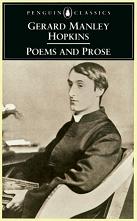
Hopkins
|
|

H. Wilhelm
|

Paul B. Yale
|
Thursday, November 13, 2003
11:00 AM
Dream of the Unified Field
Quartet:
Shanavasa, Ananda,
Jorie Graham, Robert Louis Stevenson
"Shanavasa asked Ananda,
'What is the fundamental uncreated essence of all things?' "
-- Jorie Graham,
"Relativity: A Quartet"
in The Dream of the Unified Field:
Selected Poems 1974-1994,
Ecco Press, 1995
"Ananda to Shanavasa:
'Buddha is Alive! Buddha is Alive!'
Shanavasa to Upagupta:
'Space is Consumed by Flaming Space.' "
-- Table of Contents, Living Buddha Zen

Cover illustration
by Stephen Savage,
NY Times Book Review,
Feb. 2 (Candlemas), 2003
"We live the time that a match flickers."
-- Robert Louis Stevenson, Aes Triplex
Robert Louis Stevenson was born in Edinburgh on this date in 1850.
Wednesday, November 12, 2003
9:58 AM
The Silver Table
"And suddenly all was changed. I saw a great assembly of gigantic forms all motionless, all in deepest silence, standing forever about a little silver table and looking upon it. And on the table there were little figures like chessmen who went to and fro doing this and that. And I knew that each chessman was the idolum or puppet representative of some one of the great presences that stood by. And the acts and motions of each chessman were a moving portrait, a mimicry or pantomine, which delineated the inmost nature of his giant master. And these chessmen are men and women as they appear to themselves and to one another in this world. And the silver table is Time. And those who stand and watch are the immortal souls of those same men and women. Then vertigo and terror seized me and, clutching at my Teacher, I said, 'Is that the truth?....' "
-- C.S. Lewis, The Great Divorce, final chapter
Follow-up to the previous four entries:
St. Art Carney, whom we may imagine to be a passenger on the heavenly bus in The Great Divorce, died on Sunday, Nov. 9, 2003.
The entry for that date (Weyl's birthday) asks for the order of the automorphism group of a 4x4 array. For a generalization to an 8x8 array -- i.e., a chessboard -- see
Geometry of the I Ching.
Audrey Meadows, said to have been the youngest daughter of her family, was born in Wuchang, China.
"Tui means to 'give joy.' Tui leads the common folk and with joy they forget their toil and even their fear of death. She is sometimes also called a sorceress because of her association with the gathering yin energy of approaching winter. She is a symbol of the West and autumn, the place and time of death."
-- Paraphrase of Book III, Commentaries of Wilhelm/Baynes.
Tuesday, November 11, 2003
7:25 PM
Divine Comedy
Michael Joseph Gross:
"The Great Divorce is C.S. Lewis's Divine Comedy: the narrator bears strong resemblance to Lewis (by way of Dante); his Virgil is the fantasy writer George MacDonald; and upon boarding a bus in a nondescript neighborhood, the narrator is taken to Heaven...."

Tuesday, November 11, 2003
11:11 AM
11:11
"Why do we remember the past
but not the future?"
-- Stephen Hawking,
A Brief History of Time,
Ch. 9, "The Arrow of Time"
For another look at
the arrow of time, see
Time Fold.
 "Imaginary time is a relatively simple concept that is rather difficult to visualize or conceptualize. In essence, it is another direction of time moving at right angles to ordinary time. In the image at right, the light gray lines represent ordinary time flowing from left to right - past to future. The dark gray lines depict imaginary time, moving at right angles to ordinary time."
Is Time Quantized?
Yes.
Maybe.
We don't really know.
Let us suppose, for the sake of argument, that time is in fact quantized and two-dimensional. Then the following picture,

from Time Fold, of "four quartets" time, of use in the study of poetry and myth, might, in fact, be of use also in theoretical physics.
In this event, last Sunday's entry, on the symmetry group of a generic 4x4 array, might also have some physical significance.
At any rate, the Hawking quotation above suggests the following remarks from T. S. Eliot's own brief history of time, Four Quartets:
"It seems, as one becomes older,
That the past has another pattern,
and ceases to be a mere sequence....
I sometimes wonder if that is
what Krishna meant—
Among other things—or one way
of putting the same thing:
That the future is a faded song,
a Royal Rose or a lavender spray
Of wistful regret for those who are
not yet here to regret,
Pressed between yellow leaves
of a book that has never been opened.
And the way up is the way down,
the way forward is the way back."
Related reading:
The Wisdom of Old Age and
Poetry, Language, Thought.
Tuesday, November 11, 2003
11:00 AM
Eleven.
Sunday, November 9, 2003
5:00 PM
For Hermann Weyl's Birthday:
A Structure-Endowed Entity
"A guiding principle in modern mathematics is this lesson: Whenever you have to do with a structure-endowed entity S, try to determine its group of automorphisms, the group of those element-wise transformations which leave all structural relations undisturbed. You can expect to gain a deep insight into the constitution of S in this way."
-- Hermann Weyl in Symmetry
Exercise: Apply Weyl's lesson to the following "structure-endowed entity."

What is the order of the resulting group of automorphisms? (The answer will, of course, depend on which aspects of the array's structure you choose to examine. It could be in the hundreds, or in the hundreds of thousands.)
Friday, November 7, 2003
7:00 PM
A Beautiful Fantasy:
The Secret life of
John Nash

"Dr. Blind (pronounced 'Blend') was about ninety years old and had taught, for the past fifty years, a course called 'Invariant Subspaces' which was noted for its monotony and virtually absolute unintelligibility, as well as for the fact that the final exam, as long as anyone could remember, had consisted of the same single yes-or-no question. The question was three pages long but the answer was always 'Yes'. That was all you needed to pass Invariant Subspaces."
-- The Secret History, by Donna Tartt

"...I put my arms around him yes and drew him down to me so he could feel my breasts all perfume yes and his heart was going like mad and yes I said yes I will Yes.
Trieste-Zurich-Paris
1914-1921"
-- Ulysses, by James Joyce
Friday, November 7, 2003
1:28 PM
Today in History:
The Comeback Kid
(Courtesy of Dr. Mac's Cultural Calendar)
On this date:
In 1962, having lost the California governor’s race, Richard Nixon said to the press, “You won’t have Nixon to kick around any more.”
In 1972, Republican incumbent President Richard Nixon was re-elected, defeating Democratic candidate George McGovern, 520 electoral votes to 17.
From the archives of singer/songwriter Shannon Campbell ("voice of an angel, mouth of a truckdriver") --
Feb. 6, 2002: The Essential Matrix
NEO: (whines) Who am I?
TRINITY: You are The One.
EVERYONE ELSE: Eh, he might be The One.
TRINITY: He is The One.
NEO: I am not The One.
TRINITY: You are The One.
THE ORACLE: You are not The One, but you can't tell anybody.
NEO: (whines) But I wanted to be The One. I want to go home....
TRINITY: Fuck. He's not The One.
EVERYONE ELSE: Told you so.
MORPHEUS: Sure wish someone was The One. I'm in deep shit.

Thursday, November 6, 2003
2:00 PM
Legacy Codes:
The Most Violent Poem
Lore of the Manhattan Project:
From The Trinity Site —
"I imagined Oppenheimer saying aloud, 'Batter my heart, three person'd God," unexpectedly recalling John Donne's 'Holy Sonnet [14],' and then he knew, ' "Trinity" will do.' Memory has its reasons.
'Batter my heart' — I remember these words. I first heard them on a fall day at Duke University in 1963. Inside a classroom twelve of us were seated around a long seminar table listening to Reynolds Price recite this holy sonnet....
I remember Reynolds saying, slowly, carefully, 'This is the most violent poem in the English language.' "
Related Entertainment

Today's birthday:
director Mike Nichols
From a dead Righteous Brother:
"If you believe in forever
Then life is just a one-night stand."
-- Bobby Hatfield, found dead
in his hotel room at
7 PM EST Wednesday, Nov. 5, 2003,
before a concert scheduled at
Western Michigan University, Kalamazoo.
From a review of The Matrix Revolutions:
"You'd have to be totally blind at the end to miss the Christian symbolism.... Trinity gets a glimpse of heaven.... And in the end... God Put A Rainbow In The Clouds."
Moral of the
Entertainment:
According to Chu Hsi [Zhu Xi],

"Li" is
"the principle or coherence
or order or pattern
underlying the cosmos."
-- Smith, Bol, Adler, and Wyatt,
Sung Dynasty Uses of the I Ching,
Princeton University Press, 1990
Related Non-Entertainment
Symmetry and a Trinity
(for the dotting-the-eye symbol above)
Introduction to Harmonic Analysis
(for musical and historical background)
Mathematical Proofs
(for the spirit of Western Michigan
University, Kalamazoo)
Moral of the
Non-Entertainment:
"Many kinds of entity
become easier to handle
by decomposing them into
components belonging to spaces
invariant under specified symmetries."
-- The importance of
mathematical conceptualisation
by David Corfield,
Department of History and
Philosophy of Science,
University of Cambridge
See, too,
Symmetry of Walsh Functions and
Geometry of the I Ching.
Wednesday, November 5, 2003
5:32 PM
Legacy Codes
"In writing The Legacy Codes, the term itself became the play's central metaphor. In newspaper accounts of the Wen Ho Lee case, the classified legacy codes which caused the uproar were described as computer simulations of plutonium explosions. The term is also used by computer experts for any archaic codes which are still necessary to run complex computer programs. For me the term can also be interpreted as the DNA genetic code, it can be interpreted as what is passed on in families regarding culture, family secrets, genetic traits. It also can relate to how people and institutions want to be remembered in the future."
-- Playwright Cherylene Lee
The Legacy Codes opens at 7 tonight in Manhattan.
Wednesday, November 5, 2003
2:23 PM
Game Over
"Everything that has a beginning
has an end."
-- The Matrix Revolutions

Matrix, by Knots, Inc., 1979.
"Easy to master — A lifetime to enjoy!"
The object for 2 players (8-adult)
is to be the first to form a line
consisting of 4 different
colored chips.
Imagist Poem

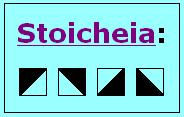


(Recall the Go-chip
in Wild Palms.)
Wednesday, November 5, 2003
10:10 AM
Endings and Beginnings
Today's birthday: author Sam Shepard.
From pbs.org:
"Shepard has a noted aversion to pat endings: 'I hate endings. Just detest them. . . . The temptation toward resolution, towards wrapping up the package, seems to me a terrible trap. Why not be more honest with the moment? The most authentic endings are the ones which are already evolving towards another beginning. That's genius.' "
Chinese Poem


Translation:
End
Chu
(See previous entry.
Click on characters
above for details.)
Tuesday, November 4, 2003
11:55 AM
Library of Paradise

Click to enlarge.
In memory of architect Philip Chu, who designed the above library at Amherst College:
"Chu was best known for his designs of college libraries, which his family said blended 'modern influences from such innovators as Frank Lloyd Wright, the Oriental use of space and exterior design together with the traditional materials.' Critics characterized his designs as 'warm and inviting,' his family said in a written statement.
Among his designs were the Robert Frost Library at Amherst College, which was dedicated by President John Kennedy..."
-- Honolulu Advertiser, Nov. 3, 2003
And now I was beginning to surmise:
Here was the library of Paradise.
-- Hermann Hesse, Magister Ludi
Chu died at 83 in Honolulu on
October 27, 2003.
See Dream of Heaven, Oct. 27, 2003.
See, too, ART WARS for Oct. 26, 2003...
Forty years to the day after Kennedy's remarks at Amherst.

Monday, November 3, 2003
4:16 PM
Chronotope
The polytope at left in the illustration below might, to use the term of Bakhtin, be called a "chronotope."
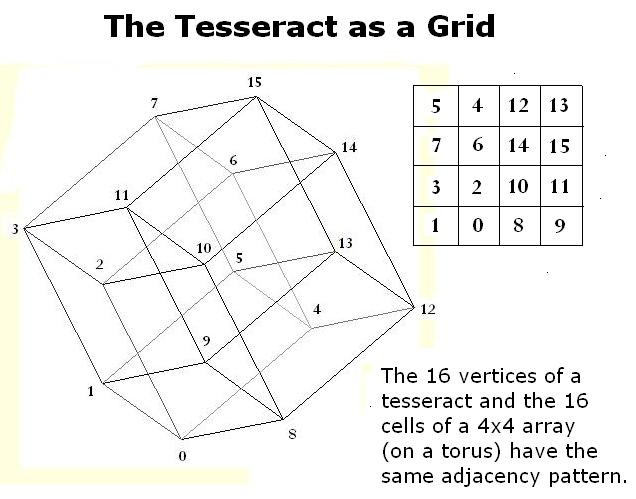
See Time Fold for a literary context.
Sunday, November 2, 2003
11:11 AM
All Souls' Day
at the Still Point
From remarks on Denis Donoghue's Speaking of Beauty in the New York Review of Books, issue dated Nov. 20, 2003, page 48:
"The Russian theorist Bakhtin lends his august authority to what Donoghue's lively conversation has been saying, or implying, all along. 'Beauty does not know itself; it cannot found and validate itself — it simply is.' "
From The Bakhtin Circle:
"Goethe's imagination was fundamentally chronotopic, he visualised time in space:
Time and space merge ... into an inseparable unity ... a definite and absolutely concrete locality serves at the starting point for the creative imagination... this is a piece of human history, historical time condensed into space....
Dostoevskii... sought to present the voices of his era in a 'pure simultaneity' unrivalled since Dante. In contradistinction to that of Goethe this chronotope was one of visualising relations in terms of space not time and this leads to a philosophical bent that is distinctly messianic:
Only such things as can conceivably be linked at a single point in time are essential and are incorporated into Dostoevskii's world; such things can be carried over into eternity, for in eternity, according to Dostoevskii, all is simultaneous, everything coexists.... "
Bakhtin's notion of a "chronotope" was rather poorly defined. For a geometric structure that might well be called by this name, see Poetry's Bones and Time Fold. For a similar, but somewhat simpler, structure, see Balanchine's Birthday.
From Four Quartets:
"At the still point, there the dance is."
From an essay by William H. Gass on Malcolm Lowry's classic novel Under the Volcano:
"There is no o'clock in a cantina."
Saturday, November 1, 2003
1:05 PM
Symmetry in Diamond Theory:
Robbing Peter to Pay Paul
"Groups arise in most areas of pure and applied mathematics, usually as a set of operators or transformations of some structure. The appearance of a group generally reflects some kind of symmetry in the object under study, and such symmetry may be considered one of the fundamental notions of mathematics."
-- Peter Webb
"Counter-change is sometimes known as Robbing Peter to Pay Paul."
-- Helen Kelley Patchwork
For a look at the Soviet approach
to counterchange symmetry, see
The Kishinev School of Discrete Geometry.
The larger cultural context:
See War of Ideas (Oct. 24),
The Hunt for Red October (Oct. 25),
On the Left (Oct. 25), and
ART WARS for Trotsky's Birthday (Oct. 26).
Saturday, November 1, 2003
8:48 AM
All Saints' Day:
The Song of Saint Ezra
Ezra Pound, imagist poet and fascist saint, died on this date in 1972.
"But you, newest song of the lot,
You are not old enough
to have done much mischief.
I will get you a green coat out of China
With dragons worked upon it."
-- "Further Instructions," 1913
For more on China and Christian Fascism, see the memorial to the wife of Generalissimo Chiang Kai-shek in TIME magazine, issue dated Nov. 3, 2003.
From Image in Poetry:
"Ezra Pound made perhaps the most widely used definition of image in the 20th century:
An ‘Image’ is that which presents an intellectual and emotional complex in an instant of time. "
-- Ezra Pound, "A Few Don’ts by an Imagiste," Poetry, March 1913
For an excellent essay by Jungian James Hillman on the political implications of imagism, see
Egalitarian Typologies versus
the Perception of the Unique.
A specific image that is a personal favorite of mine is found in the I Ching:

Note that in the West,
this Chinese character
is known as the "Pound sign."
"The Perception of the Unique," indeed.