
Saturday, August 30, 2003 12:00 AM
Happy Birthday,
Mary Shelley
"Frank and Stein quickly realized
they needed the big three things
that every programming language has:
a father;
a name;
and something cool."
Sounds to me more like a religion.
Premodern Religion...

See Union of American Hebrew Congregations.
Modern (A.D.) religion...
See my note
Catholic Tastes
of July 27, 2003.
Postmodern religion...

See my note
The Transcendent Signified
of July 26, 2003.
Friday, August 29, 2003 3:07 PM
The Shining of Park Place
Today is the birthday of Oliver Wendell Holmes, Sr., writer, dean of Harvard Medical School, father of Supreme Court Justice Oliver Wendell Holmes, Jr., and author of at least seven hymns.
It is also the feast day of Saint Lewis Henry Redner, author of the tune now known as "O Little Town of Bethlehem." Redner was church organist for Phillips Brooks, who wrote the "Bethlehem" lyrics but then published the hymn under the facetious name "St. Louis," a deliberate misspelling of Redner's name.
Redner died on August 29, 1908, at the Marlborough Hotel in Atlantic City.
Since Holmes Sr. was both a poet and the father of a famous lawyer, a reference to poet-lawyer Wallace Stevens seems in order.
"We keep coming back and coming back
To the real: to the hotel
instead of the hymns...."
-- Wallace Stevens,
"An Ordinary Evening in New Haven"
From Best Atlantic City Hotels:
Bally's Park Place, located at Park Place and Boardwalk, partially stands on the site of the former Marlborough Hotel.
For some background on the theology of hotels, see Stephen King's classic The Shining and my own note, Shining Forth.
Let us pray that any haunting at the current Park Place and Boardwalk location is done by the blessed spirit of Saint Lewis Redner.
|
Atlantic City |
|
|
Postscript of 7:11 PM --
From an old Dave Barry column:
"Beth thinks the casinos should offer more of what she described as 'fun' games, the type of entertainment-for-the-whole-family activities that people engage in to happily while away the hours. If Beth ran a casino, there would be a brightly lit table surrounded by high rollers in tuxedos and evening gowns, and the air would be charged with excitement as a player rolled the dice, and the crowd would lean forward, and the shout would ring out...
'He landed on Park Place!' "

Charles Lindbergh seems to have done
just that. See yesterday's entry
and today's New York Times story
Thursday, August 28, 2003 11:35 PM
ach du lieber August." — John O'Hara, Hope of Heaven |
| "anticipate the happiness of heaven" |
= | "himmlisches Glück vorweg empfinden" |
See also today's previous entries.
Thursday, August 28, 2003 9:26 PM
Elegance

Louise Glück, the
U.S. poet laureate.
Pulitzer winner Glück
named poet laureate
By CARL HARTMAN
The Associated Press
8/28/2003, 6:26 PM ET
WASHINGTON (AP) — Louise Glück, winner of a Pulitzer Prize and a dozen other poetry awards, will be the next U.S. poet laureate....
Asked for a sample of her work, she suggested five lines from "The Seven Ages," published in 2001:
"Immunity to time, to change. Sensation
Of perfect safety, the sense of being
Protected from what we loved
And our intense need was absorbed by the night
And returned as sustenance."
Thursday, August 28, 2003 6:35 PM
Spirit
In memory of
Walter J. Ong, S. J.,
professor emeritus
at St. Louis University,
St. Louis, Missouri
"The Garden of Eden is behind us
and there is no road back to innocence;
we can only go forward."
— Anne Morrow Lindbergh,
Earth Shine, p. xii
Earth Shine, p. xiii:
We shall not cease from exploration
And the end of all our exploring
Will be to arrive where we started
And know the place for the first time.
— T. S. Eliot, Four Quartets.
Eliot was a native of St. Louis.
"Every city has its gates, which need not be of stone. Nor need soldiers be upon them or watchers before them. At first, when cities were jewels in a dark and mysterious world, they tended to be round and they had protective walls. To enter, one had to pass through gates, the reward for which was shelter from the overwhelming forests and seas, the merciless and taxing expanse of greens, whites, and blues--wild and free--that stopped at the city walls.
In time the ramparts became higher and the gates more massive, until they simply disappeared and were replaced by barriers, subtler than stone, that girded every city like a crown and held in its spirit."
— Mark Helprin, Winter's Tale
Book Cover,
1954:

"The pattern of the heavens
and high, night air"
— Wallace Stevens,
An Ordinary Evening in New Haven
See also my notes of
Monday, August 25, 2003
(the feast day of Saint Louis,
for whom the city is named).
For a more Eden-like city,
see my note of
October 23, 2002,
on Cuernavaca, Mexico,
where Charles Lindbergh
courted Anne Morrow.
Wednesday, August 27, 2003 3:40 AM
Crystal and Dragon
David Wade published a book called Crystal and Dragon in 1993 about the apparent opposites of structure and fluidity, order and chaos, law and freedom, and so on.
Here is a page on these concepts as they relate to my mathematical work.
Monday, August 25, 2003 4:24 AM
Words Are Events
August 12 was the date of death of Joseph Patrick Kennedy, Jr., and the date I entered some theological remarks in a new Harvard weblog. It turns out that August 12 was also the feast day of a new saint... Walter Jackson Ong, of St. Louis University, St. Louis, Missouri, a Jesuit institution.
Today, August 25, is the feast day of St. Louis himself, for whom the aforementioned city and university are named.
The New York Times states that Ong was "considered an outstanding postmodern theorist, whose ideas spawned college courses...."
There is, of course, no such thing as a postmodern Jesuit, although James Joyce came close.
From The Walter J. Ong Project:
"Ong's work is often presented alongside the postmodern and deconstruction theories of Claude Levi-Strauss, Jacques Derrida, Michel Foucault, Hélène Cixous, and others. His own work in orality and literacy shows deconstruction to be unnecessary: if you consider language to be fundamentally spoken, as language originally is, it does not consist of signs, but of events. Sound, including the spoken word, is an event. It takes time. The concept of 'sign,' by contrast, derives primarily not from the world of events, but from the world of vision. A sign can be physically carried around, an event cannot: it simply happens. Words are events."
|
From a commonplace book "We keep coming back and coming back |
The web page where I found the Stevens quote also has the following:
|
Case 9 of Hekiganroku: A monk asked Joshu, Joshu said, Setcho's Verse: Its intention concealed, Setcho (980-1052), |
See also my previous entry for today,
"Gates to the City."
Monday, August 25, 2003 3:31 AM
Gates to the City
Today's birthday:
On August 25, 1918, composer Leonard Bernstein was born.
From Winter's Tale, Harcourt Brace (1983):
Four Gates to the CityBy MARK HELPRIN Every city has its gates, which need not be of stone. Nor need soldiers be upon them or watchers before them. At first, when cities were jewels in a dark and mysterious world, they tended to be round and they had protective walls. To enter, one had to pass through gates, the reward for which was shelter from the overwhelming forests and seas, the merciless and taxing expanse of greens, whites, and blues--wild and free--that stopped at the city walls. In time the ramparts became higher and the gates more massive, until they simply disappeared and were replaced by barriers, subtler than stone, that girded every city like a crown and held in its spirit. Some claim that the barriers do not exist, and disparage them. Although they themselves can penetrate the new walls with no effort, their spirits (which, also, they claim do not exist) cannot, and are left like orphans around the periphery. To enter a city intact it is necessary to pass through one of the new gates. They are far more difficult to find than their solid predecessors, for they are tests, mechanisms, devices, and implementations of justice. There once was a map, now long gone, one of the ancient charts upon which colorful animals sleep or rage. Those who saw it said that in its illuminations were figures and symbols of the gates. The east gate was that of acceptance of responsibility, the south gate that of the desire to explore, the west gate that of devotion to beauty, and the north gate that of selfless love. But they were not believed. It was said that a city with entryways like these could not exist, because it would be too wonderful. Those who decide such things decided that whoever had seen the map had only imagined it, and the entire matter was forgotten, treated as if it were a dream, and ignored. This, of course, freed it to live forever. |
See also
Lenny's Gate:

Fred Stein,
Central Park,
1945
Thanks to Sonja Klein Fine Art
for pointing out the Stein photo.
Sunday, August 24, 2003 2:56 PM
Passing the Crown
Today's New York Times Book Review vilifies author John O'Hara as a "jerk." Earlier this week, the Times called him a "lout." These attacks amount to a virtual crown of thorns. For commentary on these attacks by the Times (a publication generally more sympathetic to Jews than to Catholics), see
The Crucifixion of John O'Hara.
But there is, to use a term of Harvard philosopher Ralph Waldo Emerson, "compensation."
Today's New York Times Magazine paints an excellent portrait of Harvard President Larry Summers. This portrait, by author James Traub, is less than flattering. Traub notes that Summers is "a blunt and overbearing figure," and quotes an anonymous faculty friend of Summers as saying that many on campus "just despise him. The level of the intensity of their dislike for him is just shocking."
Traub notes that at Harvard, "Despite the protections of tenure, virtually all of Summers's critics were too afraid of him to be willing to be quoted by name."
At Yale, however, at least one professor has dared to criticize Summers openly.
In the Boston Globe on August 14, Alex Beam, Globe columnist, quoted Yale music professor John Halle as saying that Summers, an economist, "knows the price of everything and the value of nothing. By all accounts, he is a deeply vulgar individual...."
These remarks suggest the following illustrations, based on today's Times Book Review and Times Magazine, of a thorny crown being thoughtfully passed to a new generation.
|
Author O'Hara |
President Summers |
Saturday, August 23, 2003 3:07 AM
Pictures of Nothing
'"The artist delights to go back to the first chaos of the world... All is without forms and void. Some one said of his landscapes that they were pictures of nothing, and very like."
-- William Hazlitt, 1816, on J. M. W. Turner
"William Hazlett [sic] once described Turner's painting as 'pictures of the elements of air, earth, and water. The artist delights to go back to the first chaos of the world...All is without form and void. Some one said of his landscapes that they were pictures of nothing and very like.' This description could equally well be applied to a Pollock, Newman, or Rothko."
-- Sonja J. Klein, thesis, The Nature of the Sublime, September 2000
The fifty-second A. W. Mellon series of Lectures in the Fine Arts was given last spring at the National Gallery in Washington, D.C., by Kirk Varnedoe, art historian at the Institute for Advanced Study, Princeton, New Jersey.
|
The lecture series was titled Pictures of Nothing: The lectures, 2003: Why Abstract Art? ... March 30 Survivals and Fresh Starts ... April 6 |
Varnedoe died on Thursday, August 14, 2003,
the day of the Great Blackout.
Pictures of Nothing:
"Record-breaking crowds turned up at the National Gallery for Kirk's Mellon Lectures....
Dour works like
Frank Stella's early
gray-on-black canvases ...

"Die Fahne Hoch,"
Frank Stella,
1959

"Gray on Black,"
or "Date of Death"
seemed to open up under Kirk's touch to reveal a delicacy and complexity lost in less textured explanations."
-- Blake Gopnik in the Washington Post,
Aug. 15, 2003
For another memorial to Varnedoe, see
A May 18 Washington Post article skillfully summarized Varnedoe's Mellon Lectures at the National Gallery:
Closing the Circle on Abstract Art.
For more on art and nihilism, see
Friday, August 22, 2003 4:04 PM
Mr. Holland's Week
On Monday, August 18, 2003,
a New York Times editor wrote
the following headline
for a book review:
Bending Over Backward
for a Well-Known Lout.
The word "lout" here refers to
author John O'Hara, who often
wrote about his native Pennsylvania.

On Thursday, August 21, 2003,
the Pennsylvania Lottery
midday number was
162.
For some other occurrences of this number,
see my entries of August 19, written
in honor of the birthday of
Jill St. John.
The "three days" remark referred to above
is from another St. John (2:19), allegedly
the author of an account of the last days
of one Jesus of Nazareth.
Those who share Mel Gibson's
taste for religious drama may
savor the following dialogue:
|
Dramatis Personae:
Narrator: Those who had been healed did not join in with the throng at Jesus' crucifixion who cried, "Crucify Him, crucify Him." .... Voice of Doom: It was a different story for the guilty ones who had fled from the presence of Jesus. Group 1: The priests and rulers never forgot the feeling of guilt they felt that moment in the temple. Group 2: The Holy Spirit flashed into their minds the prophets' writings concerning Christ. Would they yield to this conviction? Voice of Doom: Nope! They would have to repent first! They would not admit that they were wrong! They knew that they were dead wrong. But they would not repent of it! And because Jesus had discerned their thoughts, they hated Him. With hate in their hearts they slowly returned to the temple. Voice of Hope: They could not believe their eyes when they saw the people being healed and praising God! These guilty ones were convicted that in Jesus the prophecies of the Messiah were fulfilled. As much as they hated Jesus, they could not free themselves from the thought that He might be a prophet sent by God to restore the sacredness of the temple. Voice of Doom: So they asked Him a stupid question! "What miracle can you perform to show us that you have the right to do what you did?" Voice of Jesus: "Destroy this temple and in three days I will build it again." Voice of Doom: Those guys couldn't believe it! |
Philosophers ponder the idea of identity:
what it is to give something a name
on Monday
and have it respond to that name
on Friday....
-- Bernard Holland, The New York Times,
Monday, May 20, 1996
"Ask a stupid question..."
For further details, see
The Crucifixion of John O'Hara
Friday, August 22, 2003 12:12 AM
Birthday Tablet
"Of the world's countless customs and traditions, perhaps none is as elegant, nor as beautiful, as the tradition of sangaku, Japanese temple geometry."
Sangaku means "mathematical tablet."
Here is a sangaku for
Dr. Mary McClintock Dusenbury
on her birthday.
|
|
For an explanation,
click here.
Tuesday, August 19, 2003 10:23 PM
O'Hara's Fingerpost
In The New York Times Book Review of next Sunday (August 24, 2003), Book Review editor Charles McGrath writes that author John O'Hara
"... discovered a kind of story... in which a line of dialogue or even a single observed detail indicates that something crucial has changed."
From the Online Etymology Dictionary:
crucial - 1706, from Fr. crucial... from L. crux (gen. crucis) "cross." The meaning "decisive, critical" is extended from a logical term, Instantias Crucis, adopted by Francis Bacon (1620); the notion is of cross fingerboard signposts at forking roads, thus a requirement to choose.
The remainder of this note deals with the "single observed detail" 162.
|
|
Instantias Crucis
Francis Bacon says
"Among Prerogative Instances I will put in the fourteenth place Instances of the Fingerpost, borrowing the term from the fingerposts which are set up where roads part, to indicate the several directions. These I also call Decisive and Judicial, and in some cases, Oracular and Commanding Instances. I explain them thus. When in the investigation of any nature the understanding is so balanced as to be uncertain to which of two or more natures the cause of the nature in question should be assigned on account of the frequent and ordinary concurrence of many natures, instances of the fingerpost show the union of one of the natures with the nature in question to be sure and indissoluble, of the other to be varied and separable; and thus the question is decided, and the former nature is admitted as the cause, while the latter is dismissed and rejected. Such instances afford very great light and are of high authority, the course of interpretation sometimes ending in them and being completed. Sometimes these instances of the fingerpost meet us accidentally among those already noticed, but for the most part they are new, and are expressly and designedly sought for and applied, and discovered only by earnest and active diligence."
Inter praerogativas instantiarum, ponemus loco decimo quarto Instantias Crucis; translato vocabulo a Crucibus, quae erectae in biviis indicant et signant viarum separationes. Has etiam Instantias Decisorias et Judiciales, et in casibus nonnullis Instantias Oraculi et Mandati, appellare consuevimus. Earum ratio talis est. Cum in inquisitione naturae alicujus intellectus ponitur tanquam in aequilibrio, ut incertus sit utri naturarum e duabus, vel quandoque pluribus, causa naturae inquisitae attribui aut assignari debeat, propter complurium naturarum concursum frequentem et ordinarium, instantiae crucis ostendunt consortium unius ex naturis (quoad naturam inquisitam) fidum et indissolubile, alterius autem varium et separabile ; unde terminatur quaestio, et recipitur natura illa prior pro causa, missa altera et repudiata. Itaque hujusmodi instantiae sunt maximae lucis, et quasi magnae authoritatis; ita ut curriculum interpretationis quandoque in illas desinat, et per illas perficiatur. Interdum autem Instantiae Crucis illae occurrunt et inveniuntur inter jampridem notatas; at ut plurimum novae sunt, et de industria atque ex composito quaesitae et applicatae, et diligentia sedula et acri tandem erutae.
-- Francis Bacon, Novum Organum, Book Two, "Aphorisms," Section XXXVI
A Cubist Crucifixion
An alternate translation:
"When in a Search of any Nature the Understanding stands suspended, the Instances of the Fingerpost shew the true and inviolable Way in which the Question is to be decided. These Instances afford great Light..."
From a review by Adam White Scoville of Iain Pears's novel titled An Instance of the Fingerpost:
"The picture, viewed as a whole, is a cubist description, where each portrait looks strikingly different; the failings of each character's vision are obvious. However, in a cubist painting the viewer often can envision the subject in reality. Here, even after turning the last page, we still have a fuzzy view of what actually transpired. Perhaps we are meant to see the story as a cubist retelling of the crucifixion, as Pilate, Barabbas, Caiaphas, and Mary Magdalene might have told it. If so, it is sublimely done so that the realization gradually and unexpectedly dawns upon the reader. The title, taken from Sir Francis Bacon, suggests that at certain times, 'understanding stands suspended' and in that moment of clarity (somewhat like Wordsworth's 'spots of time,' I think), the answer will become apparent as if a fingerpost were pointing at the way. The final narrative is also titled An Instance of the Fingerpost, perhaps implying that we are to see truth and clarity in this version. But the biggest mystery of this book is that we have actually have no reason to credit the final narrative more than the previous three and so the story remains an enigma, its truth still uncertain."
For the "162" enigma, see
The Matthias Defense, and
The Still Point and the Wheel.
See also the December 2001 Esquire and

the conclusion of my previous entry.
Tuesday, August 19, 2003 5:23 PM
Intelligence Test
From my August 31, 2002, entry quoting Dr. Maria Montessori on conciseness, simplicity, and objectivity:
 |
 |
Above: Dr. Harrison Pope, Harvard professor of psychiatry, demonstrates the use of the Wechsler Adult Intelligence Scale "block design" subtest.
Another Harvard psychiatrist, Armand Nicholi, is in the news lately with his book The Question of God: C.S. Lewis and Sigmund Freud Debate God, Love, Sex, and the Meaning of Life.
|
Pope |
Nicholi |
|
Old |
New |
For the meaning of the Old-Testament logos above, see the remarks of Plato on the immortality of the soul at
For the meaning of the New-Testament logos above, see the remarks of R. P. Langlands at
The Institute for Advanced Study.
For the meaning of life, see
The Gospel According to Jill St. John,

whose birthday is today.
"Some sources credit her with an I.Q. of 162."
Sunday, August 17, 2003 2:00 PM
A Thorny Crown of...

From the first episode of
the television series
"The West Wing":
|
Original airdate: Sept. 22, 1999 MARY MARSH |
Going There, Part I
|
Crown of Ideas Kirk Varnedoe, 57, art historian and former curator of the Museum of Modern Art, died Thursday, August 14, 2003. From his New York Times obituary: " 'He loved life in its most tangible forms, and so for him art was as physical and pleasurable as being knocked down by a wave,' said Adam Gopnik, the writer and a former student of his who collaborated on Mr. Varnedoe's first big show at the Modern, 'High & Low.' 'Art was always material first — it was never, ever bound by a thorny crown of ideas.' " For a mini-exhibit of ideas in honor of Varnedoe, see Verlyn Klinkenborg on Varnedoe: "I was always struck by the tangibility of the words he used.... It was as if he were laying words down on the table one by one as he used them, like brushes in an artist's studio. That was why students crowded into his classes and why the National Gallery of Art had overflow audiences for his Mellon Lectures earlier this year. Something synaptic happened when you listened to Kirk Varnedoe, and, remarkably, something synaptic happened when he listened to you. You never knew what you might discover together." Perhaps even a "thorny crown of ideas"?
Varnedoe's death coincided with "To what extent does this idea of a civic life produced by sense of adversity correspond to actual life in Brasília? I wonder if it is something which the city actually cultivates. Consider, for example the cathedral, on the monumental axis, a circular, concrete framed building whose sixteen ribs are both structural and symbolic, making a structure that reads unambiguously as a crown of thorns; other symbolic elements include the subterranean entrance, the visitor passing through a subterranean passage before emerging in the light of the body of the cathedral. And it is light, shockingly so...." -- Modernist Civic Space: The Case of Brasilia, by Richard J. Williams, Department of History of Art, University of Edinburgh, Scotland |
Going There, Part II
|
Simple, Bold, Clear Art historian Kirk Varnedoe was, of course, not the only one to die on the day of the Great Blackout. Claude Martel, 34, a senior art director of The New York Times Magazine, also died on Thursday, August 14, 2003. Janet Froelich, the magazine's art director, describes below a sample of work that she and Martel did together: "A new world of ideas"
Froelich notes that "the elements are simple, bold, and clear." For another example of elements with these qualities, see my journal entry The flag design in that entry
Note that the elements of the flag design have the qualities described so aptly by Froelich-- simplicity, boldness, clarity:
They share these qualities with the Elements of Euclid, a treatise on geometrical ideas. For the manner in which such concepts might serve as, in Gopnik's memorable phrase, a "thorny crown of ideas," see "Geometry for Jews" in ART WARS: Geometry as Conceptual Art. See also the discussion of ideas in my journal entry on theology and art titled Understanding: On Death and Truth and the discussion of the word "idea" (as well as the word, and the concept, "Aryan") in the following classic (introduced by poet W. H. Auden):
|
Saturday, August 16, 2003 6:00 AM
Varnedoe's Crown
Kirk Varnedoe, 57, art historian and former curator of the Museum of Modern Art, died Thursday, August 14, 2003.
From his New York Times obituary:
" 'He loved life in its most tangible forms, and so for him art was as physical and pleasurable as being knocked down by a wave,' said Adam Gopnik, the writer and a former student of his who collaborated on Mr. Varnedoe's first big show at the Modern, 'High & Low.' 'Art was always material first — it was never, ever bound by a thorny crown of ideas.' "
For a mini-exhibit of ideas in honor of Varnedoe, see
Verlyn Klinkenborg on Varnedoe:
"I was always struck by the tangibility of the words he used.... It was as if he were laying words down on the table one by one as he used them, like brushes in an artist's studio. That was why students crowded into his classes and why the National Gallery of Art had overflow audiences for his Mellon Lectures earlier this year. Something synaptic happened when you listened to Kirk Varnedoe, and, remarkably, something synaptic happened when he listened to you. You never knew what you might discover together."
Perhaps even a "thorny crown of ideas"?
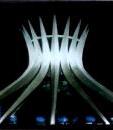
"Crown of Thorns"
Cathedral, Brasilia
Varnedoe's death coincided with
the Great Blackout of 2003.
"To what extent does this idea of a civic life produced by sense of adversity correspond to actual life in Brasília? I wonder if it is something which the city actually cultivates. Consider, for example the cathedral, on the monumental axis, a circular, concrete framed building whose sixteen ribs are both structural and symbolic, making a structure that reads unambiguously as a crown of thorns; other symbolic elements include the subterranean entrance, the visitor passing through a subterranean passage before emerging in the light of the body of the cathedral. And it is light, shockingly so...."
-- Modernist Civic Space: The Case of Brasilia, by Richard J. Williams, Department of History of Art, University of Edinburgh, Scotland


