Killer Radio "See the girl with the diamond ring? -- Jerry Lee "Killer" Lewis on "And on this point I pass the same judgment as those who say that
geometricians give them nothing new by these rules, because they possessed
them in reality, but confounded with a multitude of others, either useless
or false, from which they could not discriminate them, as those who,
seeking a diamond of great price
amidst a number of false ones, but from which they know not how to
distinguish it, should boast, in holding them all together, of possessing
the true one equally with him who without pausing at this mass of rubbish
lays his hand upon the costly stone which they are seeking and for which
they do not throw away the rest." -- Blaise Pascal, De l'Esprit Géométrique "When the light came she was sitting on the bed beside an open
suitcase, toying with her diamond rings. She saw the light first in
the depths of the largest stone." -- Paul Preuss, Broken Symmetries, Now playing (6:41 PM EDT) on Killer Radio: "Jack of Diamonds, that's "This Jack,
joke, poor potsherd, patch, matchwood, immortal diamond...." -- Gerard Manley Hopkins, Society of Jesus
The Big Time "The place outside the cosmos where I and my
pals do our nursing job I simply call the Place. A lot of my nursing consists of amusing and
humanizing Soldiers fresh back from raids into time. In fact,
my formal title is Entertainer...." -- The Big Time, A Story That
Works -- Fritz Leiber in "The Button Molder"
She knows how to shake
that thing."
KHYI 95.3 FM,
Plano, Texas,
at about 5:12 PM EDT
7/31/03,
introduced by DJ Allen Peck Sr.
scene at
Diamond Head, Oahu, Hawaii
a hard card to
find."
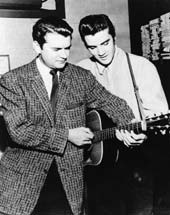
Perhaps Sam Phillips
was twanged by a Hawaiian guitar. (See previous two entries.)

by
Fritz Leiber
See also "Top Ten Most Overheard Comments by new KHYI listeners" at Miss Lana's Anything Page, entry for
Pearl Harbor Day, December 7,
2002.
|
Thursday, July 31, 2003 |
Twanged! The Father of Rock and Roll, See also my entry Wednesday morning Meditation for this, the feast day of the founder of the Society of Jesus: "If there's a rock and roll heaven, |
|
Wednesday, July 30, 2003 |
Toronto Day Today is said to be the day Toronto was founded, and is the day, they say, of what will be the largest concert in the history of Canada.... The Rolling Stones at Comparisons to Woodstock have been made, with attendance expected to be about half a million strong. Thoughts of Woodstock reminded me of Joni Mitchell, and so I sought Joni's advice for an alternative to the spirit of this event, recalling her words Oh honey you turn me on A search for the promised The redneck alternative.... TWANG 'EM! Today's culture wars quote: "God help me, I do love it so."
|


|
Wednesday, July 30, 2003 |
Dial in the Number Today is the anniversary of the founding of Toronto and the day scheduled for the biggest concert in Canadian history. |
|
Wednesday, July 30, 2003 |
Dial in the Number 7:59 am |
|
Wednesday, July 30, 2003 |
Into the Day "...no-one sang the night into the day" -- Carly Simon, "Embrace Me, You Child," quoted in yesterday's entry Trick of the Light. I have no song to bring night into day; the best I can do for this morning, the birthday of director/author Peter Bogdanovich, is supply a Frank Russo RealAudio rendition of "Long Ago and Far Away," from his CD "Quiet Now." The song's connection with Bogdanovich, who turns 64 today, is through Rita Hayworth and Orson Welles. |
|
Wednesday, July 30, 2003 |
Transcendental Meditation The bicentennial of Ralph Waldo Emerson was on May 25, 2003. For a commemoration of Emerson on that date, click on the picture below of Harvard University's Room 305, Emerson Hall. This will lead you to a discussion of the properties of a 5x5 array, or matrix, with a symbol of mystical unity at its center. Although this symbol of mystical unity, the number "1," is not, pace the Shema, a transcendental number, the matrix is, as perhaps a sort of Emersonian compensation, what postmodernists would call phallologocentric. It is possible that Emerson is a saint; if so, his feast day (i.e., date of death), April 27, might reveal to us the sort of miraculous fact hoped for by Fritz Leiber "It's quarter to three..." -- St. Frank Sinatra |


 in my previous entry. A check of
 |
Tuesday, July 29, 2003 |
The Big Time "The place outside the cosmos where I and my pals do our nursing job I simply call the Place. A lot of my nursing consists of amusing and humanizing Soldiers fresh back from raids into time. In fact, my formal title is Entertainer...." -- The Big Time, A Story That Works -- Fritz Leiber in "The Button Molder" |
|
Tuesday, July 29, 2003 |
Trick of the Light For Carly Simon "... on the dance floor she seemed to be the only one completely alive. It was a trick of the light that followed one person around. Joe had seen the quality before; it was rare, but not unknown. Every time we say good-bye.... Porter had written an intimate ballad.... " -- Martin Cruz Smith, Stallion Gate, Ch. 2 "At night I heard God Then one night Daddy died -- Carly Simon, |
|
Monday, July 28, 2003 |
11:11 At the eleventh hour of the eleventh day of the eleventh month, 1918, the Great War ended. See Plato, Pegasus, and the Evening Star. Concluding Unscientific Postscript: Maggio See also
|

|
Monday, July 28, 2003 |
With a Smile On parent knees, Reuters, July 28, 2003 5:56 PM ET: Bob Hope Dies With a Smile "... surrounded by family, including his wife of 69 years, the former Dolores Reade, and their children, as well as his personal physician, several nurses and a priest who celebrated mass in Hope's bedroom." |
|
Monday, July 28, 2003 |
City of God Today's site music is The central aim of Western religion -- The central aim of Western philosophy -- "Of these dualities, the first is the most important; all the others may be seen as different aspects of this fundamental dichotomy. To establish a rational and consistent relationship between the limited [man, etc.] and the unlimited [the cosmos, etc.] is... the central aim of all Western philosophy." "In the garden of Adding Today is the feast of St. Johann Sebastian Bach. |
|
Monday, July 28, 2003 |
The Transcendent A sequel to my recent entries From a July 28 New York Times story on a controversy over the Latin Mass: "Granted, most of the people don't understand Latin," he said, "yet they understand its evocation of the transcendent." -- Father John A. Perricone From the excellent site Quotations on Sound, Joseph Campbell, The Power of Myth Campbell: "We want to think about God. God is a thought. God is a name. God is an idea, but its reference is to something that transcends all thinking. The ultimate mystery of being is beyond all categories of thought. My friend Heinrich Zimmer of years ago used to say, 'The best things can't be told,' because they transcend thought. 'The second best are misunderstood,' because those are the thoughts that are supposed to refer to that which can't be thought about, and one gets stuck in the thoughts. 'The third best are what we talk about.' And myth is that field of reference, metaphors referring to what is absolutely transcendent." Moyers: "What can't be known or can't be named except in our own feeble attempt to clothe it in language." Campbell: "And the ultimate word in our language for that which is transcendent is God." |
|
Monday, July 28, 2003 |
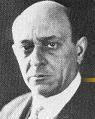
Midnight Cowboy A Last Hurrah for Harold C. Schonberg, New York Times music critic (not to be confused with Arnold Schoenberg, composer): "His criticism of music he disliked could be harsh, and in a valedictory essay published at the time of his retirement as senior critic, he explained himself unrepentantly. 'I thought the serial-dominated music after the war was a hideously misbegotten creature sired by Caliban out of Hecate, and I had no hesitation in saying so,' he wrote. 'Nor has it been proved that I was all wrong. Certain it is that the decades of serialism did nothing but alienate the public, creating a chasm between composer and audience.'" The serialist composer Arnold Schoenberg, on the other hand, wrote: "I believe what I do and do only what I believe; and woe to anybody who lays hands on my faith. Such a man I regard as an enemy, and no quarter given!" To which the appropriate reply is:
"Here's a quarter, call someone who cares."
-- Travis Tritt, CowboyLyrics.com |

|
Sunday, July 27, 2003 |
Catholic Tastes In memory of New York Times music critic Harold C. Schonberg, who died Saturday, July 26, 2003: Nous Voici Dans La Ville - A Christmas song from 15th century France (midi by John Philip Dimick). In memory of my own youth:
In memory of love: Volverán del amor en tus oídos Las palabras ardientes a sonor; Tu corazón de su profundo sueño Tal vez despertará; Pero mudo y absorto y de rodillas, Como se adora a Dios ante su altar, Como yo te he querido…desengáñate, ¡Así no te querrán!
Translation by Young Allison, 1924: Burning words of love will come The Robert Lowell version of Will Not Come Back Dark swallows will doubtless come back killing
See, too, my entry for the feast day of | |||||||


|
Saturday, July 26, 2003 |
The Transcendent "God is both the transcendent signifier — Caryn Broitman, "Central to deconstructive theory is the notion that there is no 'transcendent signified,' or 'logos,' that ultimately grounds 'meaning' in language...." — Henry P. Mills, "It is said that the students of medieval Paris came to blows in the streets over the question of universals. The stakes are high, for at issue is our whole conception of our ability to describe the world truly or falsely, and the objectivity of any opinions we frame to ourselves. It is arguable that this is always the deepest, most profound problem of philosophy. It structures Plato's (realist) reaction to the sophists (nominalists). What is often called 'postmodernism' is really just nominalism, colourfully presented as the doctrine that there is nothing except texts. It is the variety of nominalism represented in many modern humanities, paralysing appeals to reason and truth." -- Simon Blackburn, Think, The question of universals is still being debated in Paris. See my July 25 entry, That entry discusses an essay on A different essay by Harris has a discussion that gets to the heart of this matter: whether pi exists as a platonic idea apart from any human definitions. Harris notes that "one might recall that the theorem that pi is transcendental can be stated as follows: the homomorphism Harris illustrates this with For the complete passage, click here. If we rotate the Harris X by 90 degrees, we get a representation of the Christian Logos that seems closely related to the God-symbol of Arthur C. Clarke and Stanley Kubrick in 2001: A Space Odyssey. On the left below, we have a (1x)4x9 black monolith, representing God, and on the right below, we have the Harris slab, with X representing (as in "Xmas," or the Chi-rho page of the Book of Kells) Christ... who is, in theological terms, also "the variable par excellence."
Kubrick's Harris's |


|
Saturday, July 26, 2003 |
Funeral March John Schlesinger dead at 77; LOS ANGELES - Oscar-winning director John Schlesinger, who daringly brought gay characters into mainstream cinema with Midnight Cowboy and tapped into nightmares with the teeth-drilling torture of Marathon Man, died Friday at 77. The British-born filmmaker.... died about 5:30 a.m.... Schlesinger also directed The Day of the Locust, based on a novel by Nathanael West. See Heaven, Hell, and Hollywood and From the latter: "Then you know your body's sent, — The Day of the Locust, This song may be downloaded at That same site begins with a traditional Mexican song... "La cucaracha, la cucaracha, ("The cockroach, the cockroach, This suggests an appropriate funeral march for John Schlesinger: "Ya murió la cucaracha, ya la llevan a enterrar..." - La Cucaracha Those attending Schlesinger's wake, as opposed to his funeral, may wish to perform other numbers from the Pot Culture page, which offers a variety of "viper" songs. Bright Star and Dark Lady "Mexico is a solar country -- but it is also a black country, a dark country. This duality of Mexico has preoccupied me since I was a child." -- Octavio Paz, Bright Star Amen. Dark Lady For the meaning of the above symbols, see Concluding Unscientific Postscript: Oh, yes... the question of Recall that he also directed the delightful
| ||||||||||||


|
Friday, July 25, 2003 |
Realism in Literature:
Filed at 11:13 p.m. EDT Friday, July 25, 2003 PUEBLA, Mexico (AP) -- Mexico's Popocatepetl volcano shot glowing rock and ash high into the air Friday night, triggering a thunderous explosion that panicked some residents in nearby communities. Here are 3 webcam views of the volcano. Nothing to see at the moment. Literary background: Malcolm Lowry's Under the Volcano, Plato, Pegasus, and the Evening Star, and, as background for today's earlier entry on Platonism and Derrida,
In the above two-step vignette, the part of Gollum is played by the author of "Further Into the Depths of Satan," who called C. S. Lewis a fool† "that was and is extremely useful to his father the devil." † See Matthew 5:22: "...whosoever shall say, Thou fool, shall be in danger of hell fire." |
|
Friday, July 25, 2003 |
For Jung's 7/26 Birthday: Leftist academics are trying to pull a fast one again. An essay in the most prominent American mathematical publication tries to disguise a leftist attack on Christian theology as harmless philosophical woolgathering. In a review of Vladimir Tasic's Mathematics and the Roots of Postmodern Thought, the reviewer, Michael Harris, is being less than candid when he discusses Derrida's use of "logocentrism": "Derrida uses the term 'logocentrism'... as 'the metaphysics of phonetic writing'...." — Notices of the American Mathematical Society, August 2003, page 792 We find a rather different version of logocentrism in Tasic's own Sept. 24, 2001, lecture "Poststructuralism and Deconstruction: A Mathematical History," which is "an abridged version of some arguments" in Tasic's book on mathematics and postmodernism: "Derrida apparently also employs certain ideas of formalist mathematics in his critique of idealist metaphysics: for example, he is on record saying that 'the effective progress of mathematical notation goes along with the deconstruction of metaphysics.' Derrida's position is rather subtle. I think it can be interpreted as a valiant sublation of two completely opposed schools in mathematical philosophy. For this reason it is not possible to reduce it to a readily available philosophy of mathematics. One could perhaps say that Derrida continues and critically reworks Heidegger's attempt to 'deconstruct' traditional metaphysics, and that his method is more 'mathematical' than Heidegger's because he has at his disposal the entire pseudo-mathematical tradition of structuralist thought. He has himself implied in an interview given to Julia Kristeva that mathematics could be used to challenge 'logocentric theology,' and hence it does not seem unreasonable to try looking for the mathematical roots of his philosophy." The unsuspecting reader would not know from Harris's review that Derrida's main concern is not mathematics, but theology. His 'deconstruction of metaphysics' is actually an attack on Christian theology. From "Derrida and Deconstruction," by David Arneson, a University of Manitoba professor and writer on literary theory: "Logocentrism: 'In the beginning was the word.' Logocentrism is the belief that knowledge is rooted in a primeval language (now lost) given by God to humans. God (or some other transcendental signifier: the Idea, the Great Spirit, the Self, etc.) acts a foundation for all our thought, language and action. He is the truth whose manifestation is the world." Some further background, putting my July 23 entry on Lévi-Strauss and structuralism in the proper context: Part I. The Roots of Structuralism "Literary science had to have a firm theoretical basis..." Part II. Structuralism/Poststructuralism "Most [structuralists] insist, as Levi-Strauss does, that structures are universal, therefore timeless." Part III. Structuralism and Jung's "theories, like those of Cassirer and Lévi-Strauss, command for myth a central cultural position, unassailable by reductive intellectual methods or procedures." And so we are back to logocentrism, with the Logos — God in the form of story, myth, or archetype — in the "central cultural position." What does all this have to do with mathematics? See "the Klein group (much beloved of Structuralists)" Another Michael Harris Essay, Note 47 - "From Krauss's article I learned that the Klein group is also called the Piaget group." and Jung on Quaternity: "...there is no denying the fact that [analytical] psychology, like an illegitimate child of the spirit, What attitude should mathematicians have towards all this? Towards postmodern French Mathematicians should adopt the attitude toward "the demimonde of chic academic theorizing" expressed in Roger Kimball's essay, Feeling Sorry for Rosalind Krauss. Towards logocentric German Mathematicians should, of course, adopt a posture of humble respect, tugging their forelocks and admitting their ignorance of Christian theology. They should then, if sincere in their desire to honestly learn something about logocentric philosophy, begin by consulting the website The Quest for the Fiction of an Absolute. |
 leads an esoteric, special existence beyond the fringe of what is generally acknowledged to be the academic world."
|
Friday, July 25, 2003 |
Democracy in America Jay Leno's man-in-the-street "Duh" interviews are no longer funny. See
|
|
Thursday, July 24, 2003 |
Intelligence Test On July 17, my entry "British Intelligence" linked to a Guardian story about a bumbling amateur spy organization set up by the Bush administration. The headline of that entry, together with Tony Blair's remark quoted there, implied that The Guardian was a much better example of real British intelligence than Blair's minions. On July 21, my entry "Meet D. B. Norton" attacked Blair as a puppet of media tycoon Rupert Murdoch. Now The Guardian has come through with a story confirming the picture of puppetmaster Murdoch. See This BBC row is not about Jackie Ashley For background on Rupert Murdoch, see Murdoch's Mean Machine in the Columbia Journalism Review Edward Arnold portrays Rupert Murdoch For more details, see Congress Vote May Stymie Murdoch and Scramble to Overturn House Media Bill. |

